
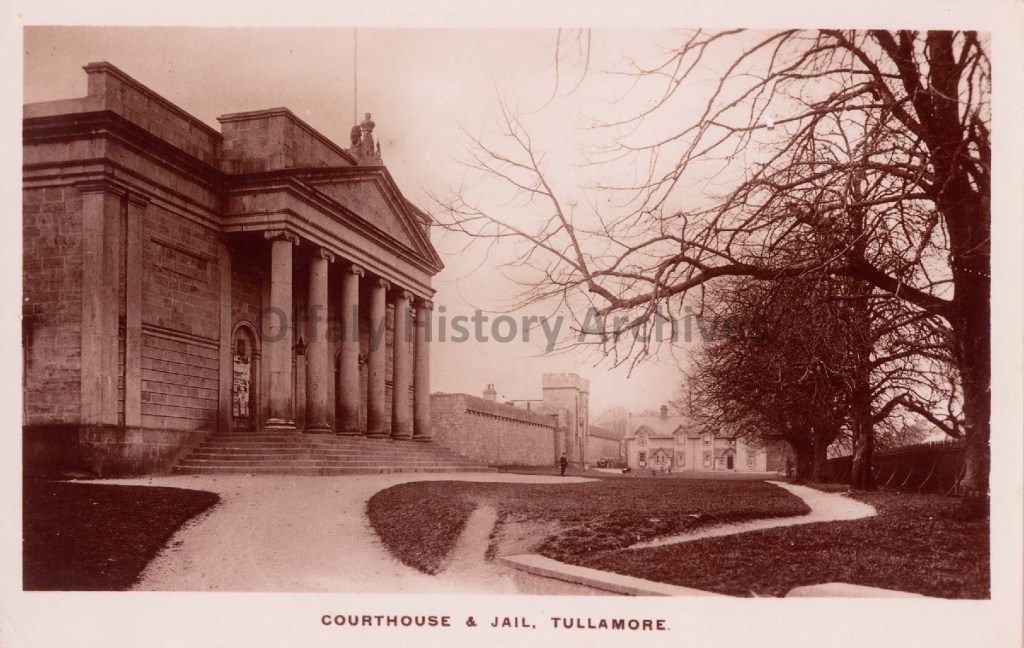
T.D. Sullivan was one of the most high-profile political figures to be targeted by the London administration under the Crimes Act for publishing what they considered dangerous material that could incite opposition and violence against the police from carrying out their duties of evicting tenants who were unable to pay their rents. The Irish National League was established with the aims of bringing about the end of rack-rents (extortionate rents) and ownership of the soil by the occupier and a nationwide fund was in place for several years to prevent as many evictions as possible. However, publicising this opposition and encouraging the people to come together in the newspapers now placed a target on the backs of editors who began to be arrested and imprisoned for encouraging the ‘Plan of Campaign’ and Sullivan was the latest editor to be arrested and conveyed to the notorious Tullamore Jail. He arrived in Tullamore on December 7 1887 and upon his arrival met the Governor of the Prison, Captain Fetherstonhaugh, who was extremely frosty in his reception to such an illustrious new inmate and Sullivan was astonished to learn that despite his being regarded as a first class misdemeanant, he would be sharing a cell with other inmates. The Tullamore Town Commissioners were immediately on the ball to try and make contact with the political prisoners now incarcerated and to assess their wellbeing in this institution that gained notoriety for its deplorable unsanitary conditions and the treatment of the prisoners subjected to hard labour.
Dr. George Moorhead as the Chief Medical Officer insisted on examining the prisoners and his assessment of Sullivan appears on the visitors book of December 7 – ‘ I found the Lord Mayor who is committed as a ‘first class misdemeanant’, occupying an ordinary cell, which was so crowded with a few necessary pieces of furniture as to leave scarcely sufficient room for breathing space. He had no complaints but expressed a wish that he might shortly be removed to a better apartment, which he is entitled to as a first-class misdemeanant’.[1]’The Lady Mayoress left for Dublin this evening. It was originally her intention to remain in Tullamore during the Lord Mayor’s confinement but the flagrant violation of the law regulating his prison treatment induced her to adopt the course which she has taken’.[2]

Sullivan still shared a cell with several inmates in cramped and difficult conditions that were a contradiction to what he was entitled to and the visiting town commissioners that had managed to gain access to the prisoners, albeit, extremely limited and under supervision from the observant warders, decided that this situation needed to be remedied immediately.
‘The Lord Mayor still occupies the cell into which he was locked on Tuesday morning. Mr. James Hayes, T.C. proprietor of the Charleville Arms Hotel, has offered to furnish the Lord Mayor’s apartment with his (Mr. Hayes) own furniture’ as ‘The Very Rev. Dr. McAlroy, the chaplain, speaks of the Lord Mayor as being well and cheerful under the circumstances’.[3]
To assess Sullivan’s state of mind in the early days of his confinement is difficult to gauge with any certainty but his constant referral in his subsequent poems to ‘ Bang the bolts and clatter the tins’ indicates his discomfort in Tullamore Jail as the Crimes Act attempted to break the national resistance against the enforcement of evictions and the removal of tenants from the lands they occupied.
The MP Mr. Stanhope visited Sullivan on Friday December 9 1887 and commented on the Lord Mayor’s cell as ‘close and stuffy and the atmosphere is not good’ and he registered his displeasure with these conditions with the prison governor. ‘Mr. Stanhope feels indignant at the treatment of the Lord Mayor and says first class misdemeanants would not at all be treated in such a manner in England’ as the next person to visit the Lord Mayor was his chaplain, Rev. R. Conlon, and ‘states that his lordship was in excellent spirits, but looked pale’ as ‘He is still occupying a cell so small that he is obliged to rise at night to open a window for the sake of fresh air, he is allowed only one visit a day though two persons will be allowed to see him if they come together’.[4]
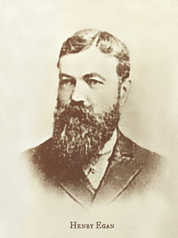
Henry Egan and William Adams, both prominent Tullamore men and town commissioners, took the opportunity to visit the prison together on Monday December 12 1887 and they spent some time with the Lord Mayor who commented that ‘he would be glad to receive visits from the people of Tullamore and other places, which would not clash with the visits of his friends as ‘Arrangements have therefore been made by which visits may be paid to the Lord Mayor by persons anxious to see him, without interference with the visits of his friends, and for this purpose a secretary has been appointed’.[5]
The Lady Mayoress made another visit to Tullamore on Tuesday December 13 and ‘At first the governor exhibited some hesitancy in allowing the visit to extend beyond the limit of half an hour’ as ‘The Lord Mayor remonstrated with the governor and said he should have not have asked the Lady Mayoress to visit him today, if he had not been given to understand that the interview would be of two hours duration and he would consider himself very much deceived if the interview were limited to half an hour’.[6] The governor relented and the interview lasted about two hours as ‘The Lord Mayor…considers his position as being too happy when he comes to think of the outrageous treatment which Mr. Mandeville and Mr. O’Brien are subjected to’[7] and he captures his mood vividly in his poem, Tullamore Jail, ‘Fed or famishing, well or ill, Their hearts are warm for Ireland still, With love no tyrant’s power can kill’.[8]
The restrictions on Sullivan began to be gradually eased and he was able to resume his journalistic work by the end of the week, and he was said to be quite content despite his incarceration. The next recorded visitor to Tullamore to see Sullivan was on Monday 19 December was T.J. Canty, J.P., from Clonakilty, Co. Cork, as Canty commented ‘and a better man than the Lord Mayor I never knew. He is, as Mr. Labouchere described him, a thorough gentleman, an eminent scholar, and he ranks amongst the very best of our Irish poets’.[9]
The following day saw the Lady Mayoress journeyed to Tullamore again and she commented on the condition of her husband, ‘He was always bright and cheerful…and the rigours of prison life have not yet soured his genial nature, nor is the worst that Balfour can do likely to have this effect’.[10] However, despite Sullivan resuming his journalistic work, some restrictions remained as ‘He mentioned that while he was permitted to receive all the London daily papers, the Irish journals, including his own papers, were scrupulously denied to him. This he considered very unfair and absurd treatment’.[11]The situation did not get any better as on Saturday December 24, Christmas Eve, ‘Last night the Governor informed the Lord Mayor that his lordship would not be permitted to receive this week’s copy of the Nation on the pretext that it contained “certain matter held to be illegal” that provoked a comment in the Midland Tribune, ‘The Lord Mayor has been allowed to do his journalistic work in connection with the Nation and it is certainly a cruel wrong that has been perpetrated on him in depriving him of the right of seeing the paper’.[12]A visit from two of his sons on Tuesday 27 December had the Lord Mayor in a positive mood as he approached his third week in the prison despite him still not receiving the latest copies of his newspaper, The Nation.
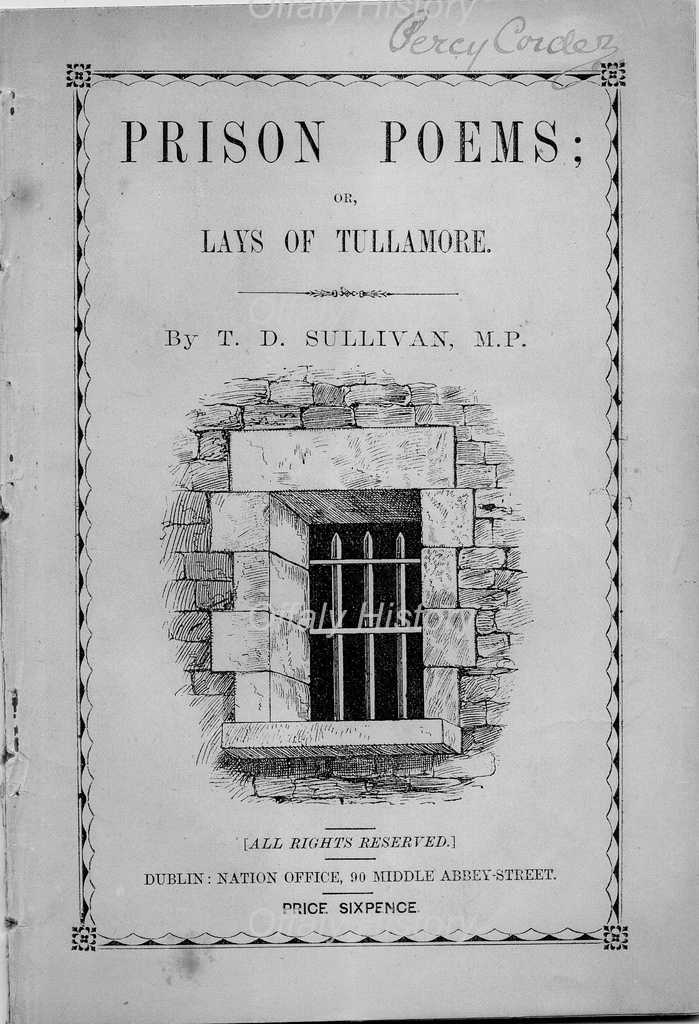
Sullivan’s poem entitled ‘Tullamore Jail’ attempts to grapple with the mundane existence that was imposed upon him from his involvement in the Plan of Campaign as he was the ‘guest of a person ‘As tender and sweet as a circular saw’ and ‘at six am, the trouble begins’ and reveals his disillusionment from the curtailment of his activities. Sullivan took over the editorship of the Nation in 1876 from his brother Alexander Martin Sullivan, and his devotion to Ireland can never be questioned from his involvement in ‘God Save Ireland’ – inspired by the Manchester Martyrs of O’Brien, Larkin, and Allen – but to be deprived of his liberty was a massive shock to the system and showed that Balfour was relentless in his pursuit to break the spirit of the Nationalist leaders that included Sullivan as part of the ‘Bantry Gang’
The year 1888 started for Sullivan with a visit by J.F. McCarthy, as he also visited the other political prisoners in Tullamore and had a lengthy discussion with Sullivan. Sullivan ‘informed McCarthy that he had not received the Nation or Weekly News, although copies of these papers, addressed to him, had matter stated by the prison authorities to be objectionable expunged from them’[1] as McCarthy stated ‘ that the Lord Mayor had rights to receive these papers, as long as reports of suppressed branches of the League are out of them’.[2]But Fetherstonhaugh still continued to intercept the papers addressed to Sullivan and refused to deliver what was addressed to his prisoner citing that he was only following the advice from the Prisons Board that these publications contained illegal matter as Sullivan protested that he was entitled to receive these papers.[3]
Sullivan received a visit from ‘The Mayor of Waterford, Thomas O’Toole, and Alderman Redmond, Waterford News…the visit to the Lord Mayor on behalf of the Corporation as the reported that His Lordship is in good health and spirits’ and they thanked him for his continuing commitment to Ireland despite his incarceration and expressed the desire that his ordeal would soon be over.[4]
The Midland Tribune of Thursday 26 January 1888 quoted the chairman of the Tullamore branch of the Irish National League, Constantine Quirke, ‘he understood the Right Hon. the Lord Mayor would be released from prison in eight or ten days’ and that a demonstration would be organised to celebrate the release from prison of William O’Brien and ‘it was the prevailing opinion that the Lord Mayor would address the people’.[5] O’Brien was unexpectedly released 2 days early to avoid a large crowd turning up at the prison and before leaving he called into the Lord Mayor and expressed his wish to see him released soon and return to Dublin.[6]
[1] Midland Tribune, Jan. 5 1888.
[2] Ibid.
[3] ‘Some day I’ll be Uncaged and free And moving all my friends among’, ‘The Holborn Restaurant’, in Prison Poems, p.20.
[4] Midland Tribune, Jan. 12 1888.
[5] Midland Tribune, Jan. 26 1888.
[6] Ibid.
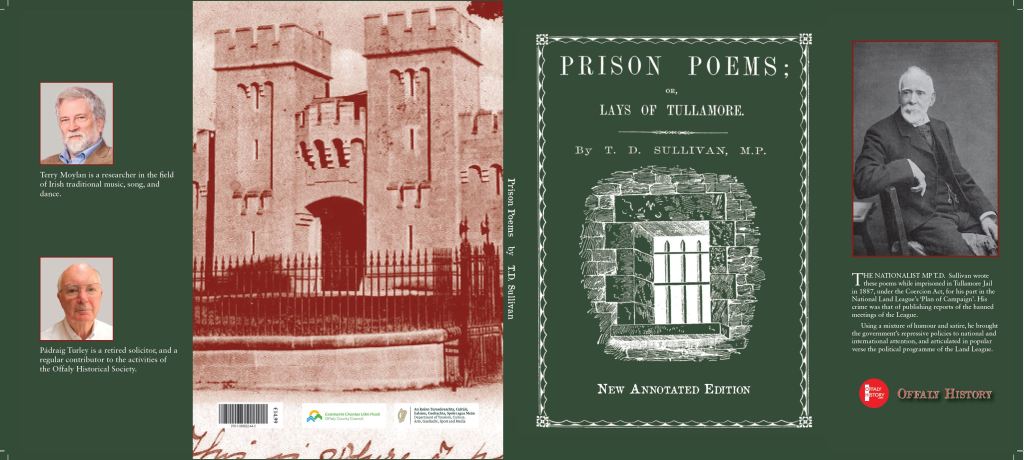
T D Sullivan is a patriot I never heard of until my research duties with Offaly History. Sullivan’s poetry in his time spent in this vile institution demonstrates the dichotomy of emotions that he experienced from his despair at the treatment of O’Brien and Mandeville to the materials ‘Some sent by friends to whom I’ve never spoken, Whose kindly faces I have never seen’. He despaired. as clear from his works in Tullamore that he wished to escape ‘his little study while the firelight gleaming ruddy’ and the limitation of his visits and inability to scrutinise his own papers provoked him to declare ‘I thank you friends, but if me being stricken, Prisoned, and bound, for breach of shameful laws’ and followed by ‘A noble love for Ireland and her cause’ as despite numerous appeals for his release and the conditions he endured despite his sympathies for those less well positioned, Sullivan upon his eventual release resumed his activities towards obtaining Home Rule for Ireland. His appraisal of subsequent events are questionable despite his visits to America to raise funds for C. S. Parnell and his opposition to him once his divorce case was publicised allowed opponents to be ostracised.
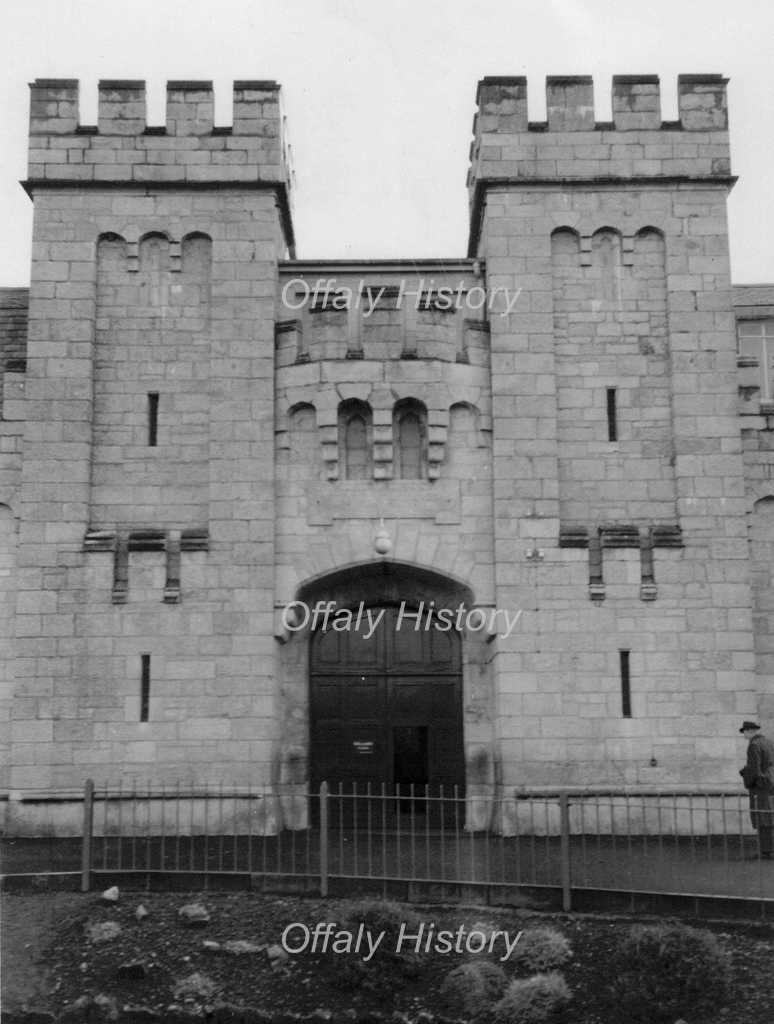
My appraisal of his poetry shows a highly efficient and honest person with no hidden agenda bar what he advocated from and his use of metaphors is outstanding to simplify once he realised where he was and the abysmal treatment of Home Rule prisoners whether they were MPs, editors, doctors or those considered a threat to Dublin Castle. Poetry is the most simplified form of written and oral expression to convey how an individual views situations in their own words and how we as an audience try to resonate their experiences once the door closes as a prisoner and they face the darkness, Sullivan and his poems convey his loneliness, defiance, and his aspirations that Home Rule will solve Ireland’s Issues. I invite all here to read his many words written in Tullamore Jail and to consider how his ability to use the written word leaves us with so many unanswered questions.
[1] Midland Tribune, Dec.8 1887.
[2] Ibid.
[3] Ibid.
[4] Ibid.
[5] Ibid.
[6] Midland Tribune, Dec. 15 1887.
[7] Ibid.
[8] ‘Tullamore Jail’ in ‘Prison Poems; or Lays of Tullamore’, Terry Moylan & Padraig Turley, eds. (Tullamore, 2025), p.3.
[9] Ibid.
[10] Midland Tribune, Dec. 22 1887.
[11] Midland Tribune, Dec. 29 1887.
[12] Ibid.
 offalyhistoryblog