
[This is part four and the final part of a blog article on the 1835 Poor Law Inquiry into the baronies of Philipstown Upper and Lower and is based on the transcripts from the original reports into social conditions in Ireland before the Famine. It provides a fascinating picture of farming in the area before the Famine, Ed.
Enjoy the weekend and sitback. We have the Book Fair on Saturday 4 April from 10 to 4 at Offaly History Centre, Bury Quay, beside the new Aldi.]
Tillage
The general produce of this barony is about equal proportions of tillage and grazing and the average size of the tillage farms is from 10 to 20 Irish acres; the Irish acre [1.62 statute acres] is used throughout the district. The largest farmer in this part of the country is Mr. Rait, who holds 700 Irish acres. In this barony there are no mountain dairy farms. The nature of the soil partakes of all kinds, from rich loam to the poorest clay, and was considered to be deteriorating in quality from the want of means among the farmers, caused by the low price of agricultural produce. It was, however, stated that the entire produce was greater now than formerly, owing to the far greater exertions now made. The farmers who occupy the district are of two classes; some few large farmers very respectable, but the small farmers poor and distressed. Some of the wheat is of the first quality, but in general it is not good in the district.
There is some wheat grown on naked fallow; but lime is not used in such cases, as it is considered too forcing for the land, which is weak; but other manures are applied. The crops are weeded about. June; but there is very little rolling, as the small farmers say they cannot afford to buy a roller. The seed is prepared with salt and water, and afterwards dried in lime. It never happens here with the small farmers that their crops suffer from not being cut down in time, while the owners are at work elsewhere, which work they would be so anxious to retain as to neglect their own crops; nor do they defer sowing their grain in time for the same reason, or from an obligation to give duty-days to their landlords; the great number of labourers precludes the necessity of any such proceeding. The corn is often threshed immediately after harvest to make the rent; and the seed is in many cases obliged to be purchased afterwards, at a higher price; and also the small farmers complain that a glut is caused in the market in consequence of so many being forced to sell their grain at the same period. It is not the case, however, that landlords buy corn from their tenants in harvest with a view to sell it to them again at a higher price in spring. The large farmers send their corn and cattle to Dublin by the canal, winch passes through this district; the small farmers sell in the neighbourhood, and are obliged to sell all the grain, not being able to retain anything for their own food but lumpers, a kind of cattle-potato.[1]
Artificial Grasses and Roots
Clover, vetches, rye-grass, and turnips, are grown by the large farmers, but very little by the small farmers, wheat, oats, and potatoes, being the crops usually cultivated. The advantages of green-feeding are unknown to the small farmers; nor do any, except the large farmers and those immediately in their neighbourhood, practise a useful alternation of crops. There have not been any deficiencies in the potato crops in this district, except what arose from the wetness of the seasons, as the people are careful in the selection of the seed, and exchange it from the bog to the upland, and vice versa. The lumpers are the description of potato cultivated by the poor farmers and peasantry, because they produce more abundantly on inferior land, and require less manure. There are no artificial manures in use, nor any house-feeding of cattle, except with a few of the large farmers.[2]
Effect of Tillage on the Demand for Labour
It was considered that one man would be sufficient for every ten acres of tillage, and that upon a farm of 100 acres, of which 50 were usually tilled, seven or eight men would get continued employment. Two horses were judged sufficient for 40 acres of tillage.
In this barony there is a good deal of first-quality grazing land, and much too that is bad; and the large farmers have lately been converting their tillage into grazing land. With regard to the relative advantages of green crops and of grazing, it was considered that some land would be more productive in green crops, and other land more suitable for permanent grass. Old grassland is sometimes let out for con acre at £8 an acre; this under-grass might be worth from £2 to £2. 10s. Two crops of potatoes are usually taken out of it, the second crop being manured; then two crops of oats, or more, perhaps. The same land, under proper tillage, would certainly produce wheat.[3]
Effect of Grazing on the Employment of Labour
When grass land is converted into tillage more labourers by far are employed on it; for on grazing land one man to every 50 acres is considered sufficient, while the same quantity in tillage would require five or six men constantly.
There is less employment for labourers in a grazing than in a tillage district; but the few who are employed are better off, and better treated, the expense of labour not being so much felt by the grazier. The cabins of labourers are placed wherever is most convenient for the farmer.
Comparative Advantage of Grazing and Tillage, ‘150 labourers had been deprived of work last year’
A great deal of land formerly in tillage has, of late years, been converted into grass land, and the effect has been to throw many labourers out of employment; and it was stated by Mr. Malone that 150 labourers had been deprived of work last year by this change. The low prices of agricultural produce, and the opinion of the farmers that they find it more profitable to feed cattle, have induced them to give up tillage, so that the labouring classes are much injured by it, and the injury seems likely to increase. Very few of the small farmers in this district have orchards, but almost all have cabbage gardens.
Dairy Farming Butter.
The farmers stated that their butter was of the first quality, though the buyers, in many instances, only allowed them the price of second quality. Mr. Odlum has seen butter sold for 10s. a-cask dearer in Dublin than it was purchased for the previous day at Philipstown. The butter is packed after successive churnings, but this was not considered to injure the quality; and the mode of saving butter was stated to be greatly improved. The large farmers of this part of the country sell their butter in Dublin, but the small farmers at Edenderry, Tullamore, and Philipstown.
Cheese.
There is no cheese made in this barony.
Sheep.
There are many sheep kept in this part of the country, but not as many as formerly; as a proof, it was stated by Mr. Odlum that at the fairs little more than half the sheep were now to be found which used to be exposed for sale formerly: the breed of sheep is mixed, being compounded of the Irish and Leicester.
Improvement in Breeding.
The breed of sheep has undergone considerable improvement in the quantity of flesh as compared to bone, and the propensity to fatten, but there is still great room for further improvement; there has been improvement also in the age at which sheep become fit for market, as they are now usually sold at from one year and a half to three years old. Some gentlemen and large farmers have introduced new breeds, ‘but many of the old still remain. Small farmers in this barony have, in general, two or three sheep, which they consider very valuable, as sheep always must be where the land is at all suitable.
Impediments to Rearing.
The sheep in this barony are subject to die of the rot, and the small farmers are unable to drain their land.
Wool.
The price of wool at present is from £1 to £1. 3s. for hoggets’ wool, and the weight of the clip from five to six pounds.
Cattle; Feeding; Price; Dairy Cows; Rents.
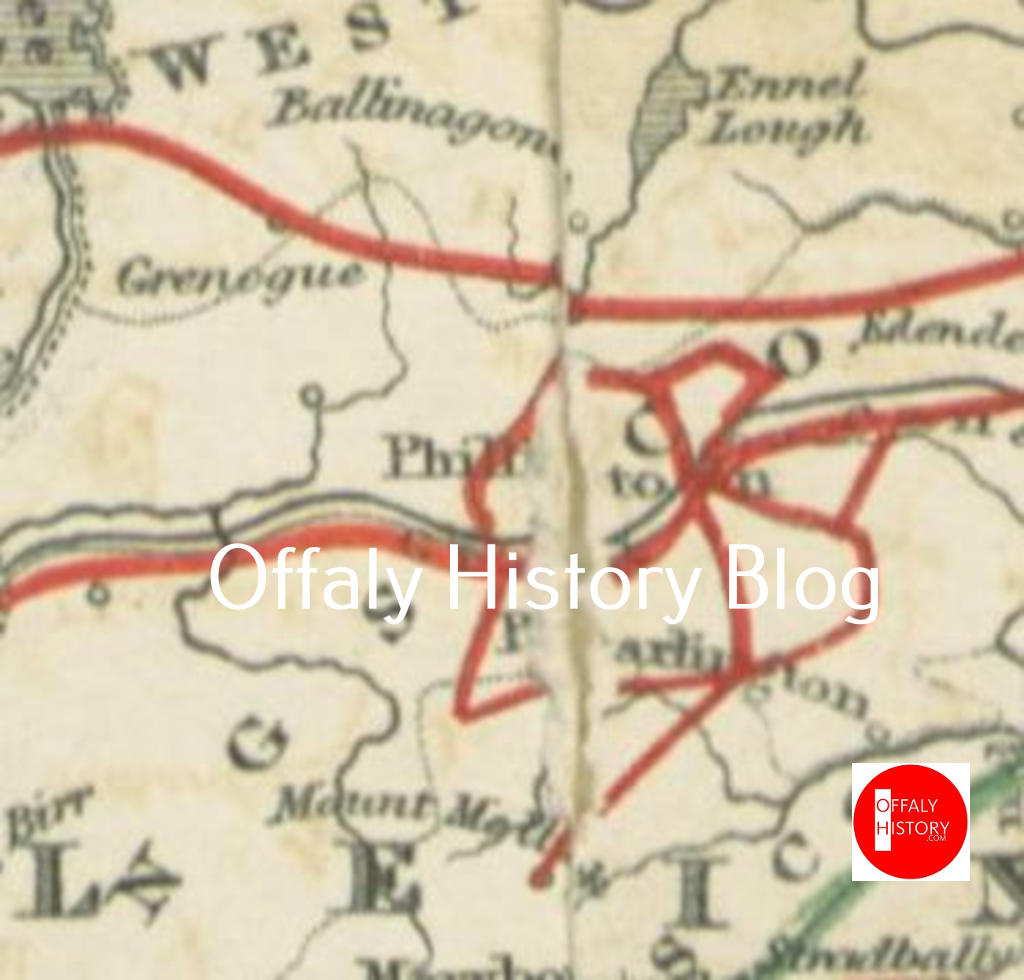
Some improvement has taken place in the cattle of this neighbourhood, and the Durham are most in request. Mr. Odlum, mentioned that he had paid £25 for a Durham bull. Irish bulls sell for about £6. Farmers’ cows vary in price from £5 to £12. Oxen are very seldom used for agricultural purposes. The cattle brought into this district for feeding are mostly from Carlow and Connaught.
Artificial feeding is common with large graziers only, and the cattle are all housed in winter.
Mr. Odlum states that the price of cattle has diminished of late years.
The Durham cows are most approved of’; but some persons have a mixture of the Lancashire long-horns with the Irish and short-horn. The Irish is considered a good milker, and the breed has been improved. Some daily cows are bred in the district, and some are brought from other places. There are no Kerry cows in this part of the country, but there are a few Ayrshire. The best cows in the district will give 20 quarts of milk in the day, but the ordinary quantity is from 10 to 12 quarts for a few months in summer. The average quantity of butter made by cows well kept throughout the year is 100 lbs., and there is no cheese made.
It was stated that there was no alteration in rents for the last four or five years in this part of the country, nor any reductions worth mentioning ; the extraordinary competition keeps up the rent : the competition was considered to arise from the great scarcity of employment which induced the people to seek after land at any price, as a defence against starvation The productions to which the tenant looks for the payment of his rents are wheat, barley, oats butter, and potatoes ; and for the payment of labour, and wearing out of his capital, he is obliged to depend on a portion of the same produce, but nearly all goes for rent. The small farmer employs only his own family, and reserves very little of the produce for implements building, or stock. There is no considerable waste in ditches or headlands, but all is” measured on the farmer, roads and old racks, & c., & c. Land in this barony is let by the Irish acre.[4]
Manures.
The usual manures are clay, bog earth, and’ dung. Lime is not much used, though convenient and reasonably cheap.
Lime.
Whatever lime is used in the barony is burned with turf; both are easily obtained. There is no restriction made by landlords to interfere with tenants opening lime-quarries, and there is every facility for transmitting lime from one end of the barony to the other.
Burning Land.
Some burning takes place on the bog lands for potatoes and other crops, and it is considered useful in some cases. The tenants are not restricted by covenant or penalty from burning.
Animal Manure.
Manure-is brought from Dublin to this barony by the canal boats, and is laid down at 4s. 6d. per ton, including all expenses. The small farmers in the neighbourhood pay considerable attention to the collection of manure. Bog stuff, earth, and other materials, are to be observed in their yards, and the cattle are bedded with straw, and litter of various kinds.
Other Manures.
Bones, salt, soot, rape, &c., are very little used as manures; but the composts used are made of earth, bog soil, and very little lime.
Enclosures and Fences
The usual fences are thorn fences and banks of earth and clay, and some open ditches, serving both as fences and drains. The meerings are made by the tenants, but there is not much expended on them, nor is there much trespass or litigation from the state of the fences.
Drainage.
A large proportion of the low grounds is subject to floods, which, if free from water, would be profitable for grazing, but the hay produced on it is of a coarse description. There is a great deal of wet land in the district, and it was thought that, if drainage and improvement of the rivers took place, the expense would be amply repaid.
Taxation
The grand jury cess averages from 2s. to 2s. 8d. per acre, and is laid according to an old applotment without reference to quality, and is therefore very unequally distributed; numbers of acres pay nothing. The uncertainty of the amount, the mode of assessment, and the period of collection, are all causes of distress. Tithe varies from 1s. 3d. to 2s. 6d. per acre, and is also a source of complaint among the people.[5]
Means of Conveyance to Market.
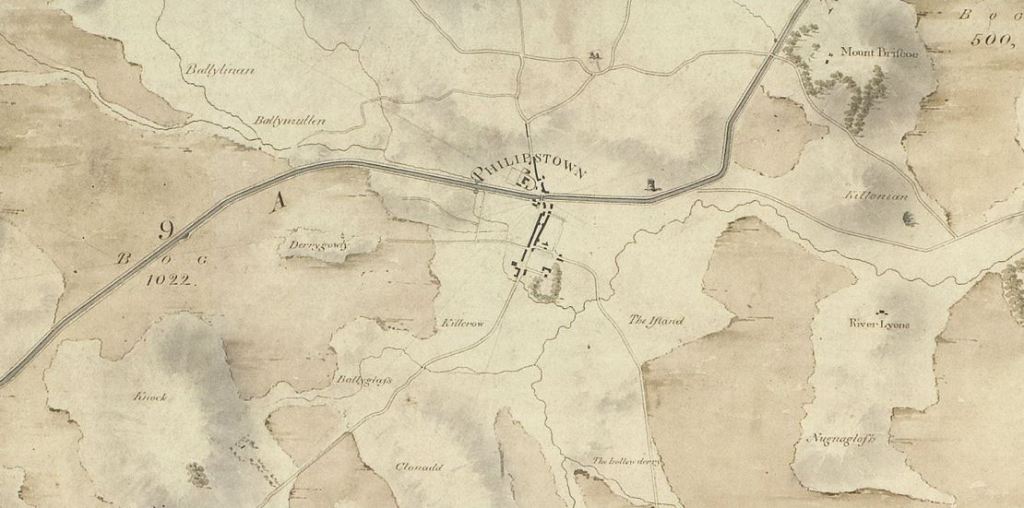
Some of the roads are in very bad repair, particularly part of that from Philipstown to Mountmellick, which is in a most disgraceful and dangerous state. However, the roads generally are in such a state now, that a horse can convey much more to market than formerly. It was not considered that tillage on mountain farms, or the conveyance of any commodities, was prevented by the badness of the roads. The opening of this part of the country to water carriage, by means of the canal, has undoubtedly been productive of great benefit. Vast quantities of turf are conveyed from this district to Dublin, and manure brought down in return. It was considered that a railroad through the bog of Allen would be of more advantage than any further increase of water carriage. There has not been any public work of late years that could produce any effect on employment or wages in these baronies.[6]
Observations on the Nature and State of Agriculture
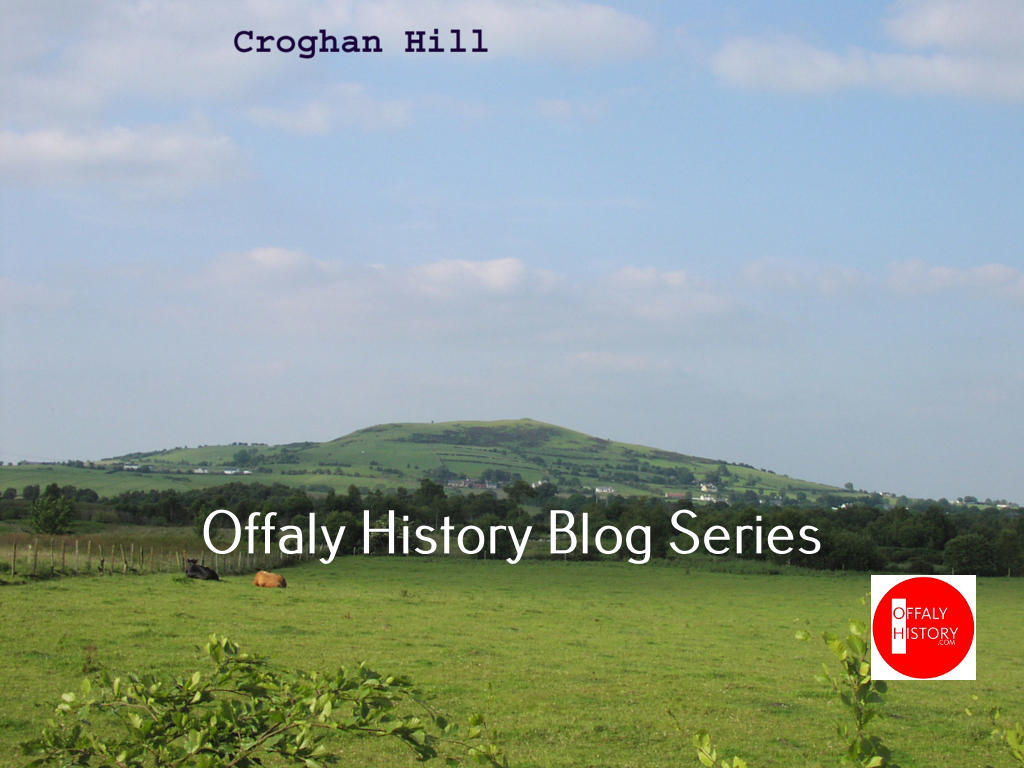
These baronies exhibit great varieties of soil, from a very thin stratum of peat or bog upon a sterile clay, to a most fertile dry loam, covering the rising grounds called islands, which are surrounded by bog — part of the immense bog of Allen. The baronies and the county are rich in limestone. The farms average 15 Irish or 24 English acres, the rent 15s. to £2. 2s. per Irish acre. The produce of wheat varies according to the land, from 7 to 12 barrels of 20 stones per Irish acre; the good lands averaging the latter quantity: 17 barrels have been produced. The agriculture, except on a very few large farms, is wretched, but the excellent crops on the islands under this bad management are sufficient proofs of their fertility: the rotation is, first, potatoes from lay or grass without manure; second, potatoes slightly manured; then follow three crops of oats in succession; after which the land is left for a few years, with sometimes a trifling seeding of grass, when it regains its former condition and undergoes the like course of treatment. The whole of Crogan Hill to the summit, which is much elevated, (a distance of from 30 to 40 miles being seen from it,) is covered with a rich loamy soil, worth £2 per Irish acre. The lowlands and their soils are equally mismanaged, and their produce is generally of trifling value. It will of course be concluded, and correctly, that there is no agricultural society nor resident landlords who take an interest in promoting the welfare and improvement of the country. High rents, low prices, the want of knowledge and skill, and consequently bad crops and impoverished farms, have reduced most of the small farmers to a miserable condition, who, being several years in arrear for rent, are fast sinking into ruin and despondency, and, as Mr. Odlum expressed it, “have a chain round their necks.” Yet such is the competition for a shelter and a potato that if it were known that a farm was to be vacated there would be 40 or 50 eager applicants for it at a high rent. Several of those farmers who have any capital left have laid their farms to grass and employ as few hands as possible, which aggravates the distress of the labourers who can obtain no employ in winter, and during summer their chance of work is precarious, and even in the finest day in harvest all cannot be employed. Many of them barely exist on a short supply of a coarse potato called lumpers, which are in England scarcely considered fit for cattle. They lie in miserable damp hovels, or cabins, and, as the Rev. Mr. Hamilton observed, “six or seven of them had only a blanket and a half to cover them;” and it is no uncommon thing for them to go a “spuddling” for a few small potatoes after the farmer had cleared his potato ground as carefully as he could. Malone, the serjeant of police at Philipstown, an intelligent and humane man, observed, “that the labourers could obtain no employment in the day-time ; they were therefore not fatigued and inclined for rest at night, but on the contrary restless and discontented, with a starving family, ready for any midnight outrage, and easily made tools of; that they were reduced to the necessity of either stealing or starvation, and that after death, in some cases, the relations were obliged to bury them without coffins.” Rinkins observed that “poverty and idleness make mischief.” A labourer said, in one of the baronies previously visited, that “he had nothing to do, and ‘he got leave to walk about and drag sorrow after his heels.” Some of the labourers who have regular work with the large farmers are better off, for instance those employed under Mr. George Rait, who occupies a farm of 700 Irish or upwards of 1,100 English acres. He allows his labourers a certain weight or measure of meal and milk per day, a room to eat their victuals in, and a fire to cook them by; the cost of the food allowed at present prices amounts to £10 per head per annum, and he pays them £7 each in money, which amounts in all to £17 per man in the year; the cost of an English labourer is about £30 per annum. Mr. George Rait and his brother are Scotchmen, and came to the farms they severally hold near Philipstown 20 years ago. They both have a number of agricultural pupils at handsome premiums. Mr. George Rait’s rent is £2. 2s. per Irish acre. The soil is a good firm dry loam, which he cultivates in the well-known alternate Scotch method, but does not stall-feed his cattle in summer. He sows Pacey’s perennial ryegrass, which is allowed to go to seed, and he finds the seed more valuable than the hay; the latter is useful for the horses and feeding bullocks along with turnips. The hay is thrashed before stacking, and the seed enclosed in a covering of straw and thatched like a corn stack for the winter; in spring it is winnowed and prepared for the English market. The clover and grass seeds are sown by a machine instead of the hand, the only one I have observed in Ireland. This manner of sowing cannot be too much recommended; the most careless observer would at once recognise the effect of the machine on a field of clover, from its remarkable regularity in the distribution of the plants; it also possesses the advantage of enabling the farmer to sow his clover and other light seeds in windy weather. Its simplicity and cheapness also recommend it. It consists of a long box of small diameter, in which revolves a roller studded with small spoons, the size of which is adapted to the kind of seed to be sown; from the box descends a board nearly touching the ground in which the seed is disseminated; it is preserved from the wind in front; the seed is protected from behind by a piece of canvass. A man wheels this light machine before him; its length is mostly adapted[7] to the size of the ridges so as to sow one at a time. By the machine the seed is deposited more evenly, therefore less seed would produce a better crop than in the random way of sowing in general use. But the saving of seed is a trifling object compared to a full crop; and in almost all cases far too little seed is sown, and the vacant ground becomes occupied with weeds; it should be remembered that the fuller and heavier the crop of clover the better is the succeeding crop. Mr. George Rait uses the Scotch wooden plough with cast-iron mouldhoard, but intends to substitute for it the iron plough. He generally fattens a large number of sheep and cattle on turnips and seeds; he is also a considerable breeder, and though the stock is very superior to most in the neighbourhood, he is not very particular about having them well bred; his cattle partake more of the Durham and his sheep of the Leicester than other breeds.
There are several farmers in the immediate vicinity of Mr. George Rait who have benefited by his example; but considering the time he has been practising this improved agriculture within five miles of Philipstown, it is a lamentable proof of the difficulty of disseminating agricultural improvements, and the slow pace at which they travel, to find so few adopting them. The small farmers are quite ignorant of any means of improvement; many of them never heard the name of many useful plants commonly cultivated by good farmers. Their implements are of the rudest description, and they never saw better. They have heavy wooden ploughs with long beams and wooden mould-boards patched with thick boards that impede their progress. The potatoes are planted in the lazy-bed manner, or, as they term it, on the ridge, and the wheat covered by the spade from soil dug from the furrows ; few sow any clover, rape, or turnips, and none practice the summer stall-feeding, the grand recipe for producing a never-failing supply of manure, and for enabling to keep three cows where one was kept Wore ; by this plan, which of course must be accompanied by alternate green and grain crops, the farmers would be able (paying moderate rents) to live in comfort, and realize a profit even at the present low price of produce : but they cannot learn this, or any other improved system, without the friendly aid of their landlords; they have neither the knowledge nor the means. Mr. Odlum observes that “landlord and tenant ought to be like father and son; the tenant ought to be hung that would not take his landlord on his back and carry him through any difficulty.” The small farmers keep from one to six sheep; the women spin the wool into yarn and pay Is. per yard for the manufacturing it into frieze; it forms a very desirable anil comfortable coat, which they call a hand-my-down, or outside shade, for many of them have scarcely anything else. This plan of keeping a sheep or two is worthy of being adopted in other parts of Ireland, and one which I ventured to advise in those baronies we inspected in Ulster.
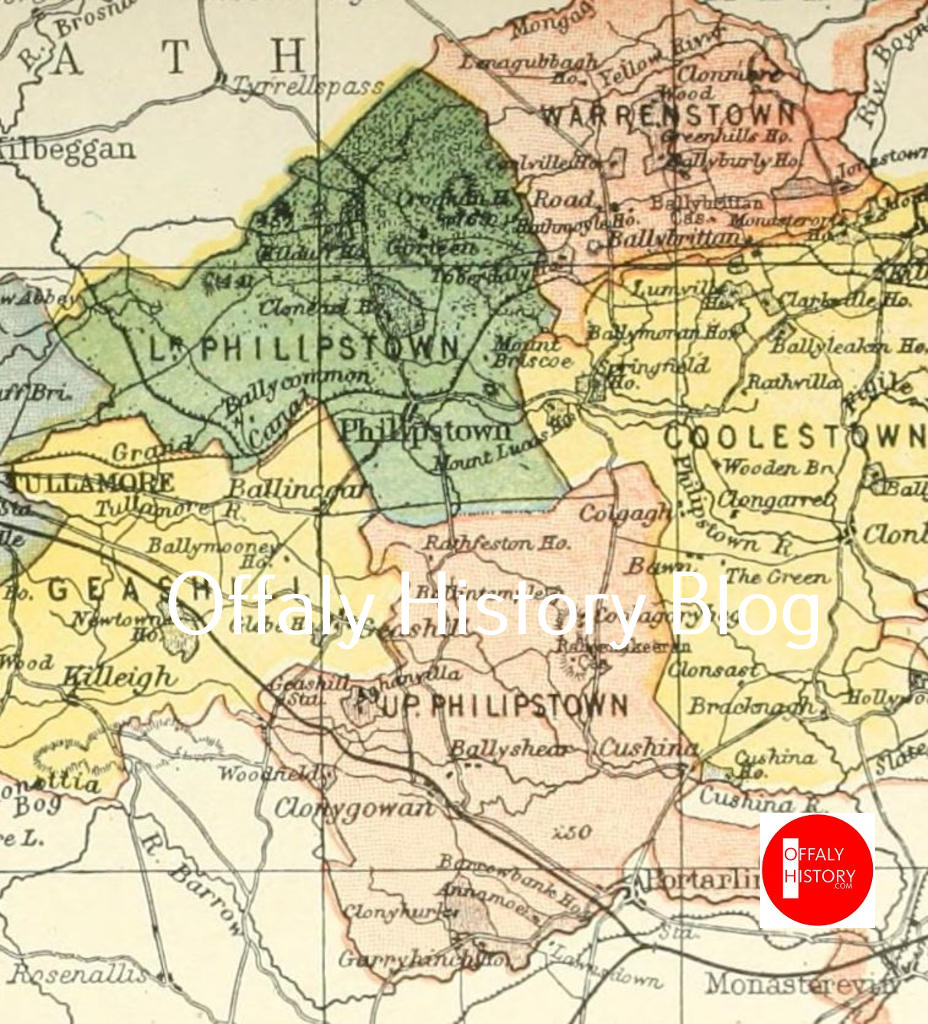
From the evidence received, as well as from observation, it is evident that the labourers, instead of being naturally idle, as many insinuate, are most anxious to obtain work, and travel many miles for it, though their hopes are so often disappointed, and exert themselves for that purpose, beyond what the English labourer would do, when there is any probability of trifling remuneration ; but there is generally so little stimulus to exertion, and their being able forget nothing to do but the liberty of “walking about and dragging sorrow after their heels,” it would be extraordinary if habitual idleness and inactivity did not fix upon them, in spite of their national quickness and activity. Admitting the scarcity of food and labour, it must appear an extraordinary anomaly that so many thousand acres of bog, inviting cultivation and well adapted for it, should remain within view of Philipstown untouched, or more correctly, not permitted to be touched, for many would gladly cultivate it if they were allowed to do so : the proprietors of the bog in the neighbourhood of Philipstown are the Earl of Charleville, Lord and Lady Belvidere, Lord Digbv, and Lord Ponsonby, to whom, in my opinion, it would have been by this time a source of great profit if they had permitted and encouraged its cultivation in a proper manner. The Ballycommon and Mount Lucas bogs, part of the immense bog of Allen, contain nearly 10,000 English acres, no part of which exceeds four miles from Philipstown; they consist of a fine black peat, dry in places, and admitting of complete drainage, being at an elevation of from 200 to 300 feet above the level of the sea, with abundance of clay and limestone gravel at a convenient depth, and an even surface; the Grand Canal also passing through the bog and communicating with the metropolis and other parts of Ireland. The cultivation of these bogs would give employment to all who want it, and would produce food and distribute comfort and happiness to thousands who are on the verge of starvation. If a company were to embark in these improvements, I have no doubt of the profit answering their expectation, and remunerating them for judicious outlay under a long lease. Draining would be the first step, claying would follow, which would be best done by a light moveable railroad, similar to those used on Chat Moss near Manchester, under the superintendence of William Reed, Esq.; but instead of using horses, I should recommend the waggons to be less and to be packed by men, as was the case on a bog in Lancashire, in which I was concerned. Two men moved nearly a ton of clay or sand; one mile of railway and 1 waggons cost, when prepared for laying down, nearly £400. The bog is as favourably situated as Chat Moss. Manure can be had by the canal. Good cow manure is now laid c on n on the banks at 4s. 6d. per ton, which is cheaper than it can be had at Chat Moss, on which I have seen as fine crops of potatoes, wheat, and clover, as I ever saw on the finest land, and valuable timber might also be raised on the bog, and in a very few years trees useful for rooting cottages and fencing would be produced, which the farmers often cart 15 or 20 miles. Scotch fir, birch, and alder would thrive on the upper moss, and where that has been dug off for fuel to a proper depth, the oak, ash, elm, sycamore, and Spanish chesnut, might be successfully planted, and would yield employment, ornament, shelter, and profit.[8]

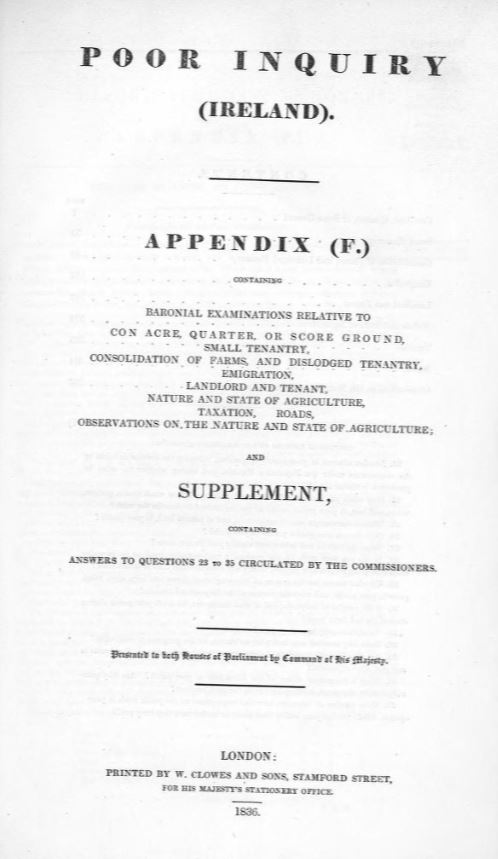
[1] Royal commission for inquiring into the condition of the poorer classes in Ireland, first report, appendix F (HC, 1836), p. 244–5.
[2] Ibid., p. 245.
[3] Ibid.
[4] Ibid., p. 246.
[5] Ibid., p. 330
[6] Ibid., p. 347
[7] Ibid., p. 379.
[8] Ibid., p. 380.
 offalyhistoryblog