
In the lead up to the feast day of Saint Colm Cille on 9 June we are glad to have this article thanks to Rachel Moss, Professor in the History of Art and Architecture, Trinity College, Dublin and author of The Book of Durrow, London, Thames and Hudson (2018), Blog Editor.
The long and eventful life of the Book of Durrow. By Rachel Moss. Blog no. 799, http://www.offalyhistoryblog. The Book of Durrow, a 1,300-year-old manuscript of the four gospels associated with the ancient monastic site at Durrow Co. Offaly, is special for many reasons. It is the earliest surviving complete gospel book in northwest Europe; it contains exquisite full-pages of ornament that demonstrate knowledge of current art styles in Ireland, Britain, Roman Europe and Coptic Egypt; it is one of the earliest examples of perfectly executed ‘Insular’ script that was to become the hallmark of Irish art for the following centuries and it is thought to be the work of a single scribe. Most significant of all, is the fact that it has survived, in near perfect condition, for such a long time
.(fig 1)
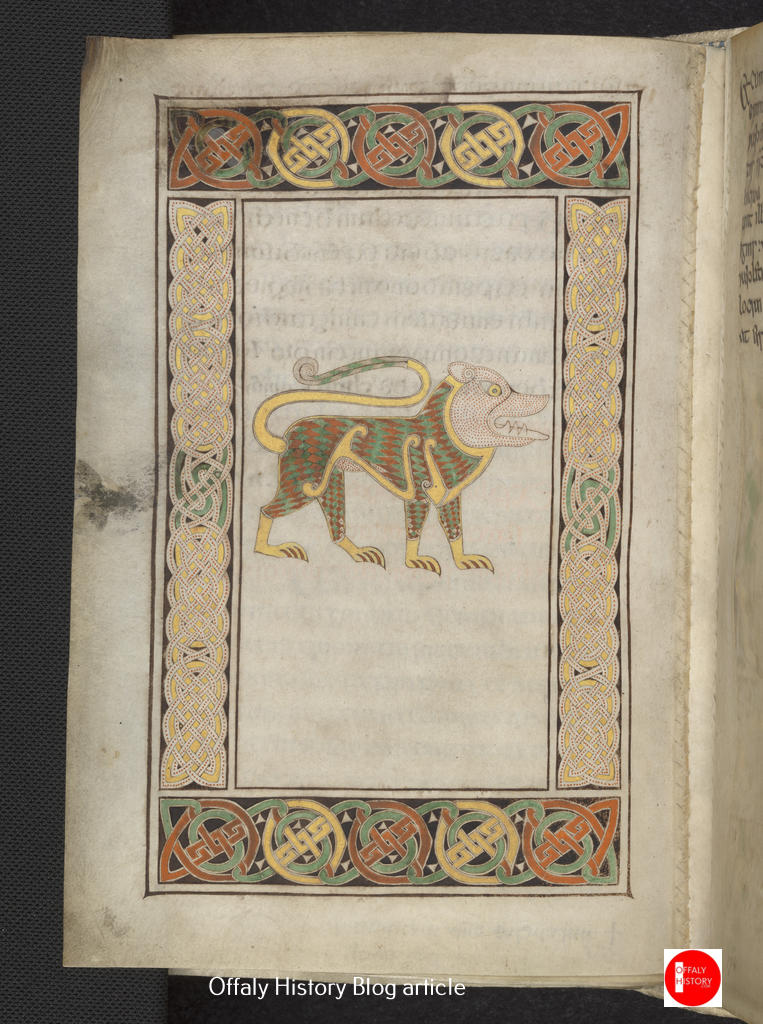
There is much about the manuscript we will never know, however, using evidence of the manuscript itself and a wide array of other historical sources, it is possible to build a narrative of the manuscript’s long and eventful life.
There has been much debate around whether the manuscript was made at Durrow, with some (mainly Scottish and English scholars) suggesting alternative origins in Western Scotland, at the Columban foundation of Iona, or Northumbria. Scribes and their books were constantly on the move at this time, so it impossible to be certain, but as Durrow was a well-established place of learning by the late 7th century, it is a strong contender.
Books were made for different purposes, and there is good evidence to suggest that during its early life, the Book of Durrow was used as an exemplar from which other gospel books were copied. Some of the opening pages of the Book of Kells, dated to about 100 years later than the Book of Durrow, are so close to the Durrow text (including minor errors), as to suggest that the later served as a model for part of the former. Incidental markings on some of the Book of Durrow’s pages, including pen trials, a small ‘doodle’ of a 9th century style animal head and random compass marks also suggest its presence in a scriptorium rather than a Library in the early centuries of its life (fig. 1). This makes it comparable to another Offaly manuscript, the Fadden More psalter, which was kept in a ‘loose-leaf’, folder-type binding so that individual sections could be distributed for copying.

Having survived for at least 300 years, the by then ‘ancient’ manuscript came to be regarded as something sufficiently old to have been the product of the hand of Colum Cille himself. Possession of the relics of a founder saint was important for any Irish monastery. As Colum Cille’s burial place was at Iona, it was even more important for the monastery at Durrow to at least have some of his possessions to strengthen their links with the founder and attract pilgrims to the site. Accordingly, the colophon (original note about the making of the manuscript) was altered to indicate its manufacture by the saint, and local king, Flann Sinna mac Máelsechnaill (r. 879-916) commissioned a precious book shrine to honour and protect the relic.

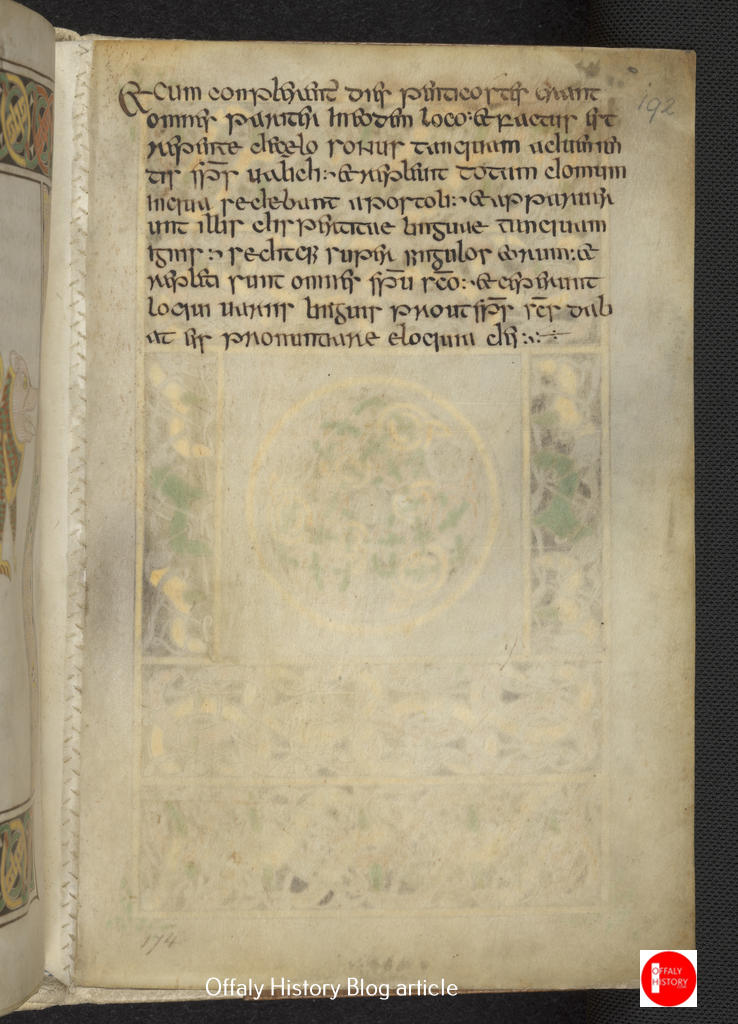
Unlike many contemporary book shrines, that of the Book of Durrow was clearly not sealed shut. Late in the eleventh century the monastery used the Book to record a gift of land from the Church at Killeshin (now Co. Laois). While marking a venerable gospel book with such a seemingly mundane transaction may seem like vandalism today, it was not uncommon, and similar notes can be found in the Book of Kells and the Book of Armagh. The Book also continued to be used for liturgical purposes, albeit only on special feast days. The inscription of a passage from Acts 2:1-4 was made on a blank page in the manuscript sometime in the 12th century. This passage formed part of the liturgy at Pentecost, the feast that comes 50 days after Easter. This was a significant holy day in the medieval calendar, but even more so at Durrow because it coincided with St Colum Cille’s death in 563. (fig. 3)
Following 12th century Church reform, the Augustinian canons took over the administration of the church at Durrow and likely became keepers of the Book of Durrow in its shrine and another relic of the saint, the so-called Durrow crosier. They clearly cared well for the manuscript as there are no signs of wear and tear from this period, so it may be that it remained closed in its precious shrine.
With the closure of the Augustinian priory the crosier passed to the McGeoghan family as hereditary keepers and it seems likely that they would have taken the manuscript too. It was at this time that historians began to hear of its existence. It was visited in the 1620s by James Ussher, Bishop of Meath, who distinguished between two ‘gospels of St Colum Cille’ by naming them the Books of Kells and Durrow. It was also studied by historian Conall McGeoghan, who signed his name in the manuscript at Christmas in 1633, and commented on the continued use of the manuscript as a relic. For a fee, the keeper was renting out a section of the manuscript (part of the gospel of St John) to local farmers, who dipped in the cattle trough to ward off illness.
During the 1660s, it was perhaps knowledge of this use, and the historical importance of the manuscript, that led a later Bishop of Meath, Henry Jones, to take ownership of the manuscript and deposit it in the only Library at the time in Ireland, at Trinity College Dublin. It remained relatively safe there until 1689, when Jacobite troops occupied the College over winter, and when they left the silver case had disappeared. To keep the manuscript safe, it was bound between simple leather covers roughly in the same order as it has come down to us today.
Since that time the manuscript has been periodically put on display in the College’s Library, often together with its more famous cousin, the Book of Kells. A digitized version of the manuscript is also now available. In contrast with its medieval life, whether in a scriptorium, in a shrine or a private residence the manuscript can now be viewed by anyone, anywhere in the world, where they can inspect its wonders at close range.
https://digitalcollections.tcd.ie/concern/works/wm117t53k?locale=en
All images © The Board of Trinity College, University of Dublin.

