The now online full census of 1926 is a great boon for family and local history. Already, most of us have looked up the manuscript returns for 1901 and 1911, now available online. Birr is fortunate in having the original returns for the barony of Ballybritt including the towns of Birr and Kinnitty for 1821. Nothing like this survives for the rest of Offaly – that is the other eleven baronies. However, the return of the number of people living in the lanes and streets of Tullamore was published in 1821 and provides an interesting insight into population and housing over 200 years ago. In a few weeks we take a closer look at the streets of Tullamore in new publications on the street names and its Bridge Street and High Street.
In 1852 Birr in King’s County decided to have a town commission/council in an attempt to improve facilities in the town that had aspirations to be the county town in the 1640s and perhaps up to the 1780s. The earl of Charleville ensured that Tullamore was named as the capital of King’s County after legislation was passed in the House of Commons in 1832 before becoming the capital town in 1835. This was by way of becoming the chief assize town with the full apparatus of county courthouse and jail.
How people travelled in the country towns in the midlands during these years is a mystery as the state of the roads were an absolute disgrace from mud and horse droppings that made travel impossible and unhealthy as the threat of cholera and typhoid fever was prevalent in the country and killed more people than the years of the Great Famine. Indeed, King’s County despite a low death rate from 1847 experienced emigration to an unprecedented level and Birr was no exception as the town suffered a serious decline in the population in the post-famine period.
The Commission of Enquiry into the Poorer Classes in Ireland was the result of the United Kingdom government’s investigation of rapid increases in population living in extreme poverty. From their official reports in the post-Napoleonic period Ireland’s growth-rate had remained high. In the 1831 census Ireland returned a population of 7.8 million up from 6.8 million in 1821. In the year 1831 the population baronies of the Upper and Lower Philipstown was 17,311. The town of Daingean had a population of 1,454.[i] For King’s County in general please see our previous blog.[ii]
In the baronies of Philipstown Upper and Lower two commissioners were appointed: Jonathan Binns and James O’Hea. It should be noted, previous to the dissolution of the Parliament of Ireland in 1800, Philipstown returned two members to that legislature.[iii] In 1835 Tullamore became the county town and with that the assizes were moved there from Philipstown.[iv] As the Poor Law Commissioner Jonathan Binns reflected:
‘Its trade has disappeared – many of its houses are in ruins – its shops are falling into decay – and its population, as these signs sufficiently indicate, are poor and wretched.’[v]
Offaly Heritage 13. This the 13th issue of the Offaly History Journal is now available and will be launched on 10 December at the Brewery Tap at 5 p.m. It’s another bumper issue with over 330 pages and well-illustrated, €19 soft and €25 hardback. The issue is dedicated to the late Christy Maye – a great friend to Offaly History. The new book is now available from Offaly History Centre. Midland Books and online at http://www.offalyhistory.com. The new book on The making of O’Connor Square will also be launched at this event. Signed copies will be available on the evening.
Offaly Heritage 13 (2025)
Editors: Michael Byrne, Dr Mary Jane Fox. Obits editor Kevin Corrigan
Introduction by Helen Bracken, President Offaly History
It was 2003 when the first issue of Offaly Heritage was published. Now 22 years on we are publishing our thirteenth volume. With so many other demands it has proved difficult to produce a volume every year. Instead, we prefer to produce a large volume every two years.
Offaly Heritage 13 is another bumper issue and very much on a par in quality with the issues since no. 9 was published in 2016. It is a tremendous achievement and benefits from the pro bono work of the editors and contributors.
Did you have old friends or family in Church Street 125 years ago? Probably not. It was a busier trading street 125 ago than it is today. That could be said even sixty years. As to its trade it probably suffered from the introduction of one-way systems and restricted parking in the 1960s. Yet another factor may well have been the closing of the markets in Market Square, and also the decline of the Methodist community in the street. Back in 1901 and further back to the first printed valuation of the mid-1850s it had about 57 rateable units – almost all private houses and shops, but also including Hayes’ Hotel, the Methodist church, the Costello private second-level school, the county infirmary (from 1942 the County Library), Charleville School (until 2006) and the Foresters Hall and Shambles (the meat and veg market).
Church Street is an interesting street to study with a good mix of mostly middle-class housing, good shops and trades, institutions, and good terraces with lots of boarders and lodgers to add novelty.
What? The course will give an overview of the sources and methods for the study of the archaeology, community and family history of County Offaly, and how to do research on areas that may interest you in local and family history. Thematic sessions will be delivered by experienced local scholars, who will introduce participants both to physical sources and to online resources. Offaly is taken as the example, but most of the records will have application for the entire country.
When? All talks will be held on Wednesday nights, from 7.30 to 9.30 pm.
Where? Offaly History Centre, Bury Quay, Tullamore, Co. Offaly, R35 Y5V0
Fees? The course fee for all ten sessions is €50, payable to the Offaly Heritage Centre at the time of booking. Please provide your credit or debit card details when booking, or visit the shop Monday–Friday, 9:30 am–4:30 pm.
Alternatively, payment can be made by bank transfer: Best contact us first as only a few places are left.
This course is supported by the Heritage Council and Offaly County Council. Places are limited to 25 participants, so early booking is strongly advised.
Please call or email us to check availability and make your booking
In the early days of the Irish Free State two ambitious projects stood out as justifying the struggle for national independence.
In 1925, out of a total national budget of £25 million, the fledgling government bravely invested £5.2 in the Shannon Hydro Electric Scheme. Finished within four years, it ensured a degree of energy autonomy and dramatically improved living conditions, particularly in towns and later in rural areas.
In a second progressive advance the State embarked on a programme to build a modern hospital in every county.
When I was eleven I spent a long Easter weekend in the County Hospital in Tullamore. I don’t know what was wrong with me but it can’t have been anything serious and I remember it as a most enjoyable and stimulating experience.
The nurses and the nuns were kind and caring, the ward was spacious and sunlit with a lovely view across O’Connor Park to the Slieve Blooms, while the food was a lot more varied than I was accustomed to at home. My friends and neighbours visited with gifts of Easter eggs and sweets. I particularly remember getting little furry yellow chicks in one egg and kept them as a souvenir for many years after.
I think that my stay in that icon of Irish Modernist architecture, must have instilled my future love of good buildings but it was the glimpses of the large colourful painting in the entrance hall that really stuck in my mind. In the years to come, when visiting my mother or sick friends, I always stopped for a while to look at it again.
Its installation in the entrance of the new County Hospital, which opened in 1942 and of which the town was so proud, was the inspiration of the architect Michael Scott.
The Scott building Midlands Regional Hospital, Tullamore, erected 1938-42(more…)
The Murals Bar Cultural life in 1950s Tullamore centred around ‘The Murals’ bar. This was where us local artists, actors, historians and writers drank, clutching our copies of ‘Ulysses’ in its concealing brown paper cover while engaging in fevered and sparkling debates on cubism, existentialism, atonality and Marxism.
I may be exaggerating somewhat, but ‘The Murals’ really was our Deux Magots, our Cafe de Flore. The bar was the meeting place of what passed for an intelligentsia in Tullamore at a time, which, though it is now regarded as restrictive and obscurantist, I remember as stimulating and progressive. Maybe I was lucky.
The attraction of ‘The Murals’ was its design which was quite unlike any of the more traditional pubs of the town which were usually small, dark and poky. With its high ceiling, stripped down design, timber veneering, bright red stools, it was cool and elegant and above all- modern.
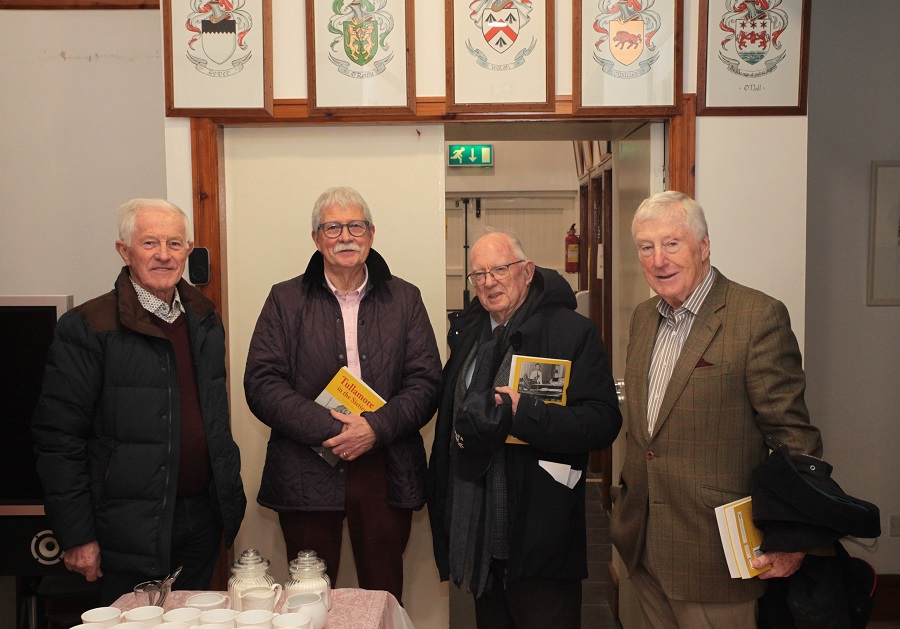
Tullamore in the Sixties was launched to great acclaim on 6 December. Most of the contributors living in Ireland participated in the proceedings with three to five minute talks. The book was launched by architect, town planner and artist Fergal MacCabe. A few of his own watercolours grace the contents of this 450 page book with extensive essays (from 18 writers) and 350 pictures. The book is available from Offaly History Centre, Bury Quay, Tullamore and Midland Books and the pop up at Bridge Centre. It can also be ordered on line.
Some of the contributors to Tullamore in the Sixties