
The Cottage in O’Moore Street, Tullamore is one of the few examples in Offaly of cottage ornée architecture. This was an architectural style that may have begun with Walpole’s Strawberry Hill, built over the period from 1749 to the 1770s. One of the best-known examples in Ireland is the Swiss Cottage in Cahir. These cottages were built by the well-off to play at rusticity and, as with this house, have carefully hidden its actual size and its impressive garden. The Cottage was built about 1809 and is one of three or four fine houses in the street, the best being Moore Hall and Tullamore House at the junction with Cormac Street.
(more…)Category: Architecture
-
Overview of Earl St/ Windmill St/ O’Moore Street, Tullamore in the early 1840s-1850s with up to 46 houses. No 2 in a 2024 Living in Towns series supported by the Heritage Council. By Michael Byrne and Offaly History. Blog No 625, 26th June 2024
The first overview of the street is available from the 1838 six-inch map and the 1843–54 valuations. By the early 1800s only one windmill survived and that was marked as in ruins on the 1838 five-ft manuscript map. Interestingly the 1838 six-inch map refers to windmills in ruins. Looking closer at both maps it does appear as if the second mill ruin was in the garden of no. 9 Cormac Street (see six-inch map). Moore Hall and ‘The Cottage’ were a hankering after rural life and as good quality houses were isolated from the town centre, but they made possible the attractive Willis-built Victoria Terrace of 1837–8.
(more…)
-
The houses and families of O’Moore Street, Tullamore, formerly known as Earl Street and Windmill Street. No. 1 in a new Offaly towns Built Heritage series supported by the Heritage Council. Part One: Developers and sub-tenants in O’Moore Street, Tullamore. By Michael Byrne and Offaly History. Blog No 624, 22nd June 2024
Once on the edge of the town O’Moore Street, Tullamore was, in the 1800s, known as Windmill Street because of the two windmills erected by the 1720s on the hill south of O’Moore Street The hill (probably the Tulach Mhór giving Tullamore its name) is now obscured by the houses from the courthouse to Spollanstown Road erected after the 1790s. Today O’Moore Street still exhibits some of the mixed residential development that was commonplace before the 1900s and the building of class demarcated suburban housing. Yet O’Moore Street was itself comparatively rural in the early 1800s, but now serves as an artery for traffic to Cloncollog, Clonminch, Killeigh (Mountmellick) and Geashill – with their extensive housing and shopping facilities. In the once undeveloped field opening to Clonminch and Spollanstown the substantial Tullamore Court Hotel was built in 1997. The street has more than a 300-year history it its physical development. The lack of decisions on good planning neglected to be taken in the 1750s continue to impact almost 300 years later and contribute the configuration the street has today.
(more…)
-
59 ‘The month of September in Banagher, and all along the Shannon banks, is visually a glorious one, with golden autumn mornings, the low sun making long shadows of the houses in the street’, Pope Hennessy, Bence Jones, Trollope, Banagher and the Shannon/Grand Canal landscape. No. 59 in the Grand Canal Offaly series. Blog No 619, 5th June 2024

Banagher, County Offaly has associations with two well-known writers of the nineteenth century – Anthony Trollope and Charlotte Bronte. Up to recent years nothing by way of notice of this was to be found in Banagher, but that has all changed as Banagher, now hard pressed along its main street, looks again to embrace tourism in a way that it did so well in the late nineteenth century and in the 1960s. The plans for the former hotel at Banagher will do much for the promotion of the architectural heritage of the town as did the voluntary work by the co-operative at Crank House. Pope Hennessey’s description in 1971 of Banagher in September would be music to Failte Ireland anxious as they are to extend the holiday season. He wrote:
‘The month of September in Banagher, and all along the Shannon banks, is visually a glorious one, with golden autumn mornings, the low sun making long shadows of the houses in the street. At dusk the whole river reflects the varied sunsets as the days draw in – effects of palest pink, for instance, striped by cloudy lines of green, or an horizon aflame with scarlet and orange light.’ And
The bridge at Banagher affords a splendid view over the level reaches of the river, which here flows glassily between a countryside as flat as that in some Dutch picture. In winter-time the flooded river spreads across these meadows to create an inland sea. In spring and early summer kingcups bloom amongst the sedge and reeds along the Shannon’s bank, wild yellow irises abound and cowslips also. In early summer, too, plumes of mauve and purple lilacs hang over the white walls of the yards of Banagher, and the whole countryside beyond the town displays brilliant variations of the “forty shades of green”.
Many have tackled Trollope’s life, but none immersed himself so much in Banagher as the late James Pope Hennessy.
John McCourt in his 2015 study of Trollope Writing the Frontier: Anthony Trollope between Britain and Ireland ‘offers an in-depth exploration of Trollope’s time in Ireland as a rising Post Office official, contextualising his considerable output of Irish novels and short stories and his ongoing interest in the country, its people, and its always complicated relationship with Britain’.
(more…)
-
Tullamore and the £1 million housing scheme of 1922. The new houses at John Dillon Street. By Peter Connell. Blog No 616, 25th May 2024
This is the story of eight new houses built by Tullamore Urban District Council in 1923 in what is now John Dillon Street. Turning into the street from Charleville Road, the first eight houses on the right were built as part of the Provisional Government’s £1 million scheme launch in 1922 in the midst of the Civil War. Opposite them are houses built by the Irish Soldiers and Sailors Land Trust for veterans of World War I. The eight houses may only have made a small dent in Tullamore’s chronically bad housing conditions in the early 20th century, but the circumstances surrounding when and how they were built provide some valuable insights into the history of the town and the country in these turbulent years.
(more…)
-
Remembering John Flanagan, the Tullamore builder and developer, who died on 9 May 2024. An obituary from Offaly History. Blog No 612, 11th May 2024
John Flanagan the well-known builder and advocate for Tullamore and County Offaly died on 9 May 2024. He was the modest man from the Meelaghans, Puttaghan and Bachelors Walk, Tullamore who invested his whole life in making Tullamore a better place for people to live, work, bank and even pray in. In 2018 he was awarded the Offaly Person of the Year Award. John Flanagan was a realist in the Lemass mode. His focus was on getting things done. At the time Lemass came to be Taoiseach in 1959 John Flanagan was just 28 years old. It was ten more years, in 1968-9, before he got his first major break with the purchase of the Tanyard Lane property in Tullamore from the P.&H. Egan liquidator. The Bridge House, also owned by the Egan firm, was bought soon after by Christy Maye, and thirty years on Tullamore had two fine hotels, developed by the new entrepreneurs of the 1960s and 1970s, on lands that had been part of Egan’s extensive portfolio.
(more…)
-
‘Altogether, Tullamore was voted an excellent destination’. A visit to Tullamore and district in September 2023 by Michael Fewer. Blog No 605, 26th April 2024
In April 2023 our little history group had a successful trip to the town of Wexford, where it was decided that our next outing would be Tullamore. So, on 28 September, we came together for lunch in the bar of the Bridge House, of which I have fond memories of getting warm and dry after a trek in driving rain from Daingean during my walk across Ireland in 2001, before checking in to our bed and breakfast accommodation at the Sea Dew guesthouse.
After lunch we took a walk up the town to have a look at the Offaly History Centre owned by the Offaly Historical and Archaeological Society. It is a very impressive facility indeed, an extensive premises just chock-a-block with books old and new, collections of records of all kinds, bound newspapers, photographs, family papers, school records – the list goes on and on. Michael Byrne had been introduced to me by Fergal McCabe: Fergal’s watercolour works are everywhere there.
(more…)
-
The Boarding School in Ferbane and the impact of the sisters of Saint Joseph of Cluny on the Midlands of Ireland. By Mary Delaney. Blog No 601, 19th April 2024
The sisters of Saint Joseph of Cluny first arrived in Ferbane on the 12th of May 1896. Their arrival and the arrival of those who followed in their footsteps were to have a significant impact on the community of Ferbane and to the education of young women in the midlands of Ireland.
The order of Saint Joseph of Cluny was founded in France in 1807 by Blessed Anne-Marie Javouhey. Having grown up in the aftermath of the French Revolution, her dictum was “to love the children” and make a great effort to improve their education to as high a degree as possible”.
“We have been asked to go to Ireland, to teach the poor and the well to do. I have been assured that we could do much good there. If such be the will of God, I agree to this foundation with all my heart”.[1]
Blessed Anne Marie wrote the above in 1850. However, it was ten years before four sisters, led by Mother Callixte Pichet, arrived in Dublin, and set up residence in a former Carmelite monastery in Blanchardstown. The congregation grew and within a year, twenty-three Irish girls had joined the order. The community continued to expand and in 1864 the sisters established their first secondary school for girls at Mount Sackville, situated in the idyllic location above the valley of the river Liffey adjoining Dublin’s Phoenix Park.
Mount Sackville would take its place among the leading secondary schools in Ireland and continues to be synonymous with the education of young women 160 years later.
(more…)
-
AN AWKWARD SITE- The Building and Rebuilding of the Church of the Assumption of Our Blessed Lady, Tullamore. By Fergal MacCabe. Blog No 599, 13th April 2024
A New Church
Towards the end of the 19th century the 1840 Mercy Convent with its frontage to the landscaped banks of the Grand Canal, was the most prominent symbol of the increasing importance of the Catholic Church in the spiritual life of the people of Tullamore. In contrast, the almost one hundred year old St Mary’s Parish Church, which had a capacity for 500 worshippers at most, was of a modest character. Located on a backland site behind Harbour Street on lands gifted by Lord Charleville it shared its cramped accommodation with the Parochial House.
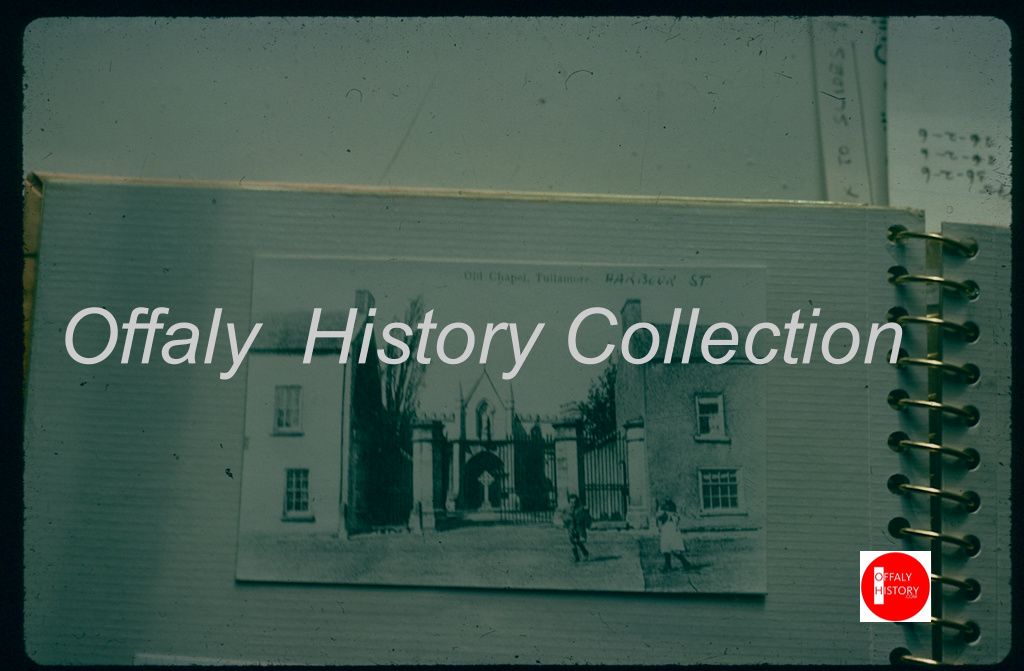
The old church of 1802 to 1903-4 As Michael Byrne records in his comprehensive historical survey of Tullamore Catholic Parish, the question of repairing the old church arose in 1897 but on the advice of the influential businessman and local politician Henry Egan, it was felt that building an entirely new church would be a better option.
No time was lost and on the 16th January 1898 a preliminary meeting of a Parish Council to plan for the new Church was assembled and six days later appointed the Cavan based architect William Hague whose brief was to provide a 1,600 seat structure with additional space for 500 more on special occasions.
(more…)
-
Launch of new book ‘The River Brosna – An Environmental History’ by John Feehan, Friday 22 March 8 p.m. Blog No 590, 21st March 2024
There is an open invitation to all those interested in the River Brosna to come to the book launch on Friday 22 March at 7.30pm in The Star (GAA hall) River Street, Clara hosted by Clara Heritage Society.
John Feehan has dedicated much of his life to studying and communicating the evolution of the landscape and how we have lived in and changed it – his previous Offaly publications have included books on the Slieve Blooms, Croghan Hill, the Landscape of Clonmacnoise, An Atlas of Birr and more recently Killaun Bog and the Camcor River. This new publication focuses on the River Brosna and its catchment.
The River Brosna is one of Ireland’s hidden rivers, glimpsed over bridges and for short stretches as it travels through Mullingar, Ballinagore, Kilbeggan, Clara, Ballycumber and Ferbane on its journey from Lough Owel to ShannonHarbour. Until now very little has been written about it yet few rivers have a more fascinating and varied story to tell. In this beautifully illustrated book John Feehan brings his long experience as an environmental scientist and historian to bear on all aspects of the natural, cultural and industrial heritage of the river and its catchment. Successive chapters review geological origins, the biodiversity of the river and its tributaries as well as the great area of bogland it drains. The history of the mills along the course of the river, and of the two great arterial schemes that so altered the river are reviewed and particular attention is devoted to the extraordinary stories of Mesolithic Lough Boora and the Bronze Age Dowris hoard.
(more…)
 offalyhistoryblog