Ted Barrett, one of the pioneers of cruising on the canal, was well aware of its environmental and leisure value. By the late 1960s he was advocating linking the canals with the lakes that might be made from the disused bogs to form a type of Norfolk Broads in Ireland.[1] In this letter of October 1964 he was to show his diplomatic and marketing skills in the course of advocating canal cruising. Barrett was the author of a guide to cruising on the canals.[2] At about the same time as Barrett Harry Egan and Frank Egan of Tullamore had developed a cruiser hire business based at Tullamore Harbour under the name Gay Line Cruisers. Later this was followed by Celtic Canal Cruisers (Mike and Heather Thomas). In fact by mid-1964 things were looking up for the Grand Canal after several years of uncertainty due to the Dublin Corporation proposal to cover over parts of the canal line in Dublin to facilitate sewerage disposal. The IWAI had been formed in 1954 to promote all the waterways but by the 1960s was in the van in protecting the Grand Canal waterway. A branch had been formed in Tullamore with the support of Frank Egan and PV Egan. These men went on to establish Gay Line Cruisers, based in Tullamore, and got involved in boat building. 1964 was also the year in which Brendan Smyth (d. 2021) of Banagher started his Silver Line Cruisers business – now one of the most successful on the Shannon and led by his children Barbara and Morgan. By 1991 up to nine hire cruise firms were offering almost 400 cruisers for self-drive, mostly on the River Shannon.
Banagher, County Offaly has associations with two well-known writers of the nineteenth century – Anthony Trollope and Charlotte Bronte. Up to recent years nothing by way of notice of this was to be found in Banagher, but that has all changed as Banagher, now hard pressed along its main street, looks again to embrace tourism in a way that it did so well in the late nineteenth century and in the 1960s. The plans for the former hotel at Banagher will do much for the promotion of the architectural heritage of the town as did the voluntary work by the co-operative at Crank House. Pope Hennessey’s description in 1971 of Banagher in September would be music to Failte Ireland anxious as they are to extend the holiday season. He wrote:
‘The month of September in Banagher, and all along the Shannon banks, is visually a glorious one, with golden autumn mornings, the low sun making long shadows of the houses in the street. At dusk the whole river reflects the varied sunsets as the days draw in – effects of palest pink, for instance, striped by cloudy lines of green, or an horizon aflame with scarlet and orange light.’ And
The bridge at Banagher affords a splendid view over the level reaches of the river, which here flows glassily between a countryside as flat as that in some Dutch picture. In winter-time the flooded river spreads across these meadows to create an inland sea. In spring and early summer kingcups bloom amongst the sedge and reeds along the Shannon’s bank, wild yellow irises abound and cowslips also. In early summer, too, plumes of mauve and purple lilacs hang over the white walls of the yards of Banagher, and the whole countryside beyond the town displays brilliant variations of the “forty shades of green”.
Many have tackled Trollope’s life, but none immersed himself so much in Banagher as the late James Pope Hennessy.
John McCourt in his 2015 study of Trollope Writing the Frontier: Anthony Trollope between Britain and Ireland ‘offers an in-depth exploration of Trollope’s time in Ireland as a rising Post Office official, contextualising his considerable output of Irish novels and short stories and his ongoing interest in the country, its people, and its always complicated relationship with Britain’.
Last week we looked at the history of steamers on the Shannon. Today we take the account of Henry D. Inglis published in 1835. Inglis was a professional travel writer and author of Spain in 1830, A Journey through Norway etc, published his A Journey throughout Ireland during the Spring, Summer and Autumn of 1834 in London in 1835. His account is well thought of and in his concluding remarks he says why jest or narrate the curious and witty eccentricities of Irish character when ‘God knows there is little real cause for jocularity, in treating of the condition of a starving people.’ So there was a degree of sympathy rather than of superiority.
Inglis was born in Edinburgh and was the only son of a Scottish lawyer. His Irish travels volume was published the year of his death, (first edition, 1835, fourth edition 1836). While considered a ‘fairly benevolent interpreter’ he could find no explanation for the Irish situation other than defects of character.
Inglis spent a week there and also visited Killaloe, Portumna and Banagher. He went from Banagher to Athlone by road and thought the latter was a remarkably ugly town – but not withstanding an interesting and excellent business town. He spent a week in Athlone and used it as a base for touring in the county of Longford to see Goldsmith’s Country.
The town councils of Tullamore, Birr and that of Edenderry were abolished ten years ago in what some consider was a mistake and a hasty reaction to the calls for pruning in that recessionary period. Here we provides some headlines for significan events since the first council body – the Tullamore Town Commission – was established in 1860. This was followed by the urban council in 1900. We post this blog on the anniversary of the great balloon fire of 10 May 1785.
Pollagh also spelt as Pullough, is located in a small village in County Offaly, it is in the Civil Parish of Lemanaghan. A small parish, it extends from Ballycumber to Ferbane. Pollagh village can be found on the north side of the canal. The Parish lies in the territory of Dealbhna Eathra of the MacCoghlans – an ancient people. It has a rich heritage in its archaeology including the important monastic site, churches, and ringforts and the famous castles.
One of The townlands that we come along as we work our way down the line is Pollagh, the name in Irish is Pollach, meaning Place full of Holes.
Townland
Area
Pop in 1841
Pop in 1851
No. of Houses in 1841
No. of Houses in 1851
Pop in 1871
Pop in 1911
No. of Houses in 1871
No. of Houses in 1911
Pollagh
907
267
168
43
33
282
223
42
50
An interesting profile in the fall and rise of the population due one assumes to the successful brick industry.
Rahan, Civil Parish is situated in the ancient O’Molloy territory of Fear Ceall meaning Men of the Woods or Men of the Churches. It is bounded on its north west side by the Brosna River. Its bedrock is Limestone and it has deposits of brick and clay along the Grand Canal.
The townlands from Ballydrohid, Tullamore to CornalaurBallindrinan Townland/ Image Source Townlands.ie
Its best know archaeological site is the Rahan Monastic Centre which was an area of great importance in the early Christian Period.
Townland: Ballindrinan is in the Electoral Division of Rahan, in Civil Parish of Rahan, in the Barony of Ballycowan, in the County of Offaly.
The Irish name for Ballindrinan is Baile an Draighneáin meaning land of the blackthorns.
Coming into Carton West, a small townland east of Tullamore that can be found in the Kilbride civil parish, this parish following the division of the original parish, is distinct from a second civil parish of the same name (Clara). The landscape in this area is mainly woodland, with a bedrock of dark Limestone, as in in the Ballyduff Quarries, this was used in the 19th century Tullamore buildings.
Ballycowan castle in view, about 1958.
This parish lies in the ancient O’Molloy territory of Fir Ceall or Men of the Churches or Men of the Woods. Here you will find many archaeological sites, which some have been destroyed or taken back by nature.
Carton West is in the Electoral Division of Silverbrook, in Civil Parish of Kilbride, in the Barony of Ballycowan, in the County of Offaly The Irish name for Carton West is An Cartrún Thiar meaning the West Carton (land Measure). This is an old measure of land.
Tullamore is the county town of Co Offaly, it lies on the Grand Canal. It is a large and thriving place that has seen great development over the years. In this article, have a look back with a picturesque timeline through from 1798 when the canal reached Tullamore. We will return to Tullamore stories of the canal when the east west tour is completed.
Kilbride Parish: Seven Miles from East to West. The Parish lies in the ancient O’Molloy territory of Fir Ceall, or Men of the Church. It contains main archaeological sites some of which have sadly been destroyed or taken back by nature.
Tullamore is in the Electoral Division of Tullamore Urban, in Civil Parish of Kilbride, in the Barony ofBallycowan, in the County of Offaly. The Irish name for Tullamore is Tulach Mhór meaning Great Hill. The rising ground in Tullamore leads to the hill at High Street – Cormac Street.
The Civil Parish of Geashill is the largest Parish in Offaly, and contains 74 townlands. As well as fine fields and bog land – dark, shale and lime mudstone, are just some of the materials you will find in its bedrocks.
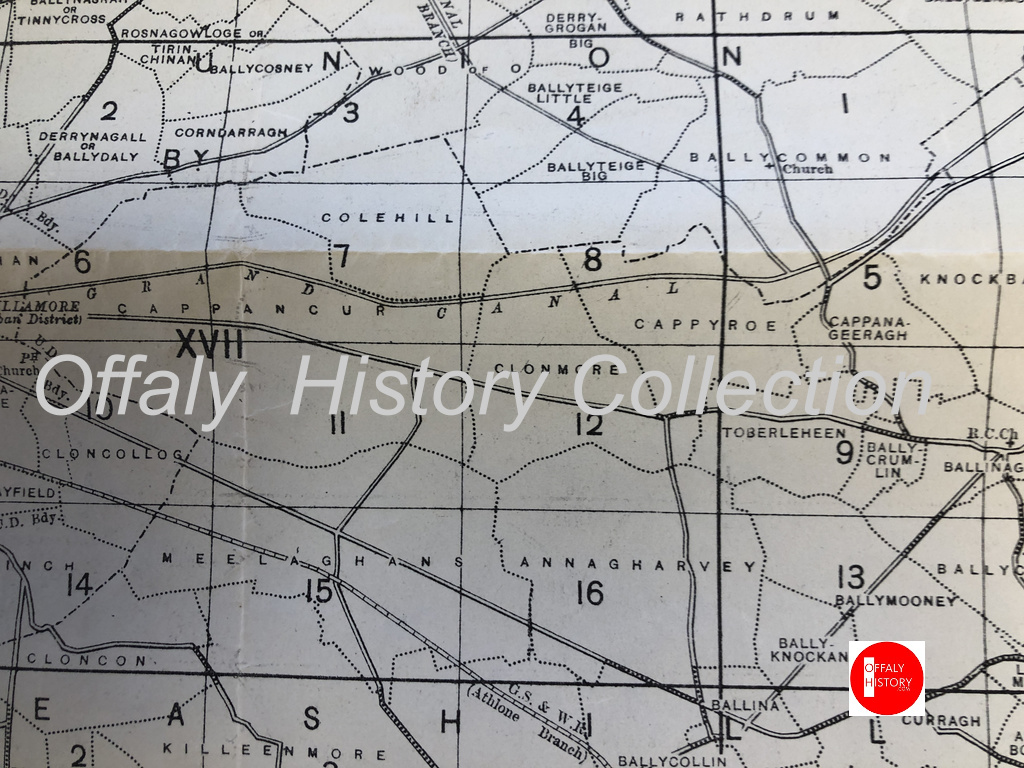
The Parish is part of the ancient territory of “Ui Failghe of the O’Connor chiefs”. It contains some of the oldest remains of castles and is rich in history. From ancient sites such as Enclosures and Ringforts. Sadly many of them have been lost due to nature elements and neglect. It contains the town land of Cappyroe which borders the Grand Canal line, it is the 293rd largest townland in Co. Offaly and in Irish is Ceapach Aodha Rua, translation meaning Plot of Land[2].
Map of the townlands from Ballycommon to Tullamore. There are over 1,000 townlands in Offaly. See townlands.ie for more.Your walk along the canal from Ballycommon will see you visit Cappyroe, Clonmore and Cappancur
In 1911 Cappyroe had one of the lowest concentration of houses in the area, during this period the household returns and ancillary, shows us that the population decreased from 106 in 1841 to 21 in 1911. There were 6 houses on record, all of all of Private Dwelling, with all inhabited, with classes of houses between 1st and 2nd . Age of occupiers ranging from 1-80. Here are the families that occupied these buildings during this time:
As we make our way along the line, we come to lock 22nd, which was previously mentioned in the last series of “East to West”. The 23rd Lock is followed close behind. A smooth and clear pathway can be found, making it easy to walk or cycle along the way. Coming up we see the 24th Lock. This lock is located near the former Celtic Canal Cruisers. We are preparing an article on this canal attraction, 1974-2004.
(08. Celtic Canal Cruisers / Image Source/ Offaly History). We are preparing a blog on this important cruise line. Can you help with material?
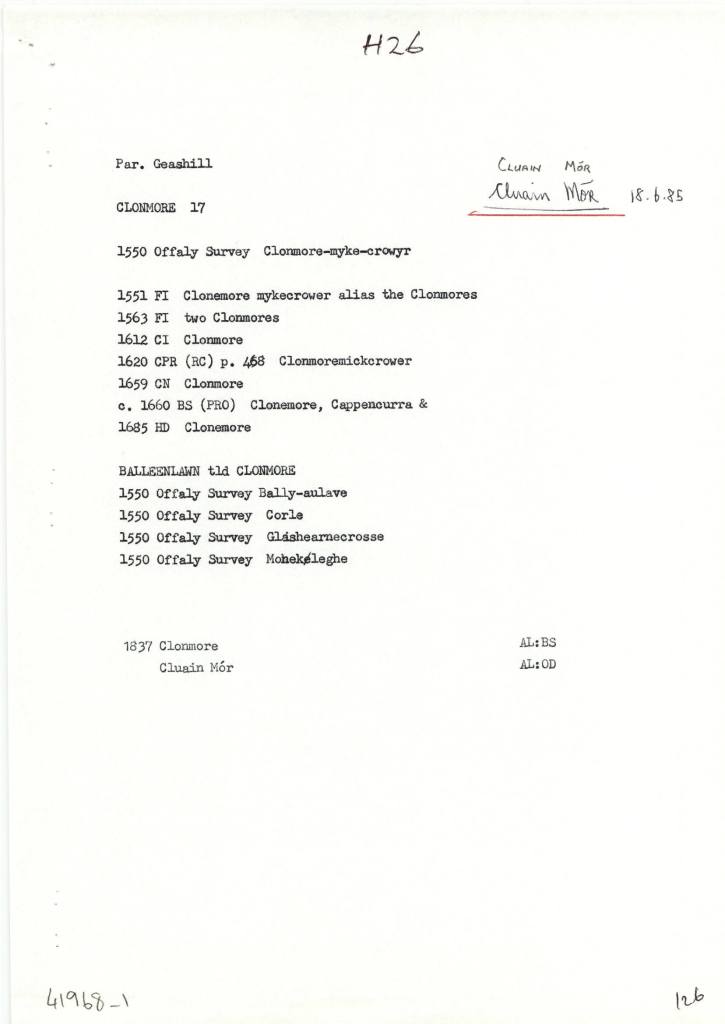
Clonmore (Cappancur), in the Civil Parish of Geashill, in the Barony of Geashill, in the County of Offaly. The Irish name for Clonmore is Cluain Mór meaning Great Field.
Clonmore is the site of a few known churches the Balleenlawn Church that stood until the early 19th century. Its Foundation, was discovered in 1942. It also contained an old graveyard that is still intact today[3].
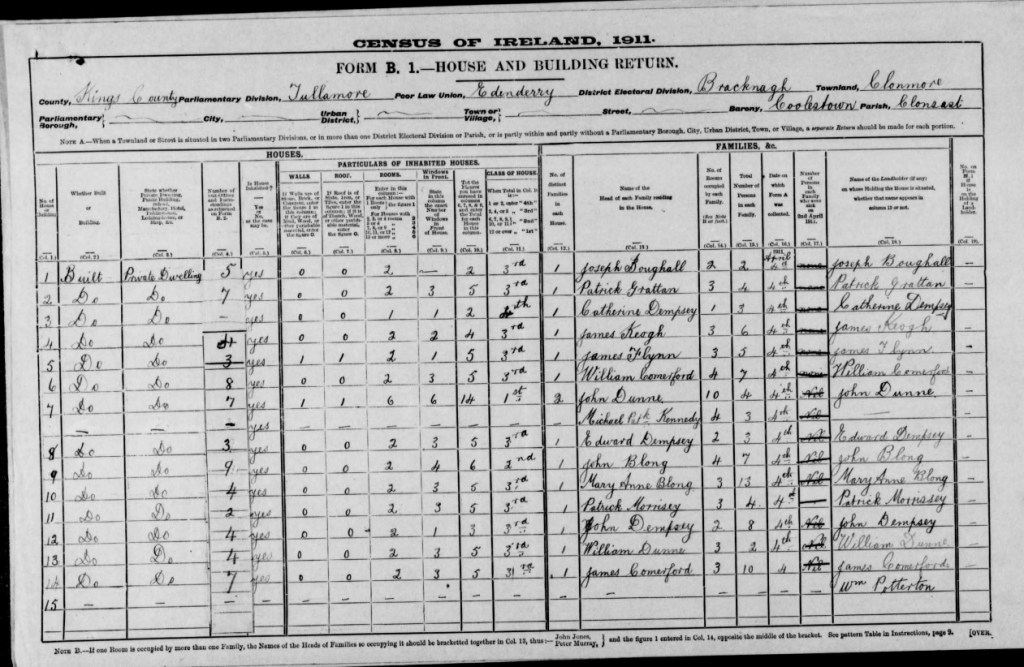
In 1911 Clonmore had 26 houses in the area, during this period the household returns and ancillary, shows us that the population decreased from 220 in 1841 to 101 in 1911. There was 26 houses show on record all of all of Private Dwelling, with all inhabited, with classes of houses between 1st, 2nd and 3rd. Age ranging from 1-80. Here are some of the families that occupied these buildings during this time:
(15.Coachman, source Travel and Transport in Ireland, Edited by Kevin B.Nowlan)
With the construction of the Grand Canal it provided a better connection to reach different townlands around the country. With many place still not connected by waterway, the coach services provided that connect for passengers to reach their final destinations.
As we make our way out of the Geashill Civil Parish, we reach the 25th Lock and Just at Digby Bridge, here we can see just the spire of Tullamore’s Catholic church. Close by is the 26th lock, the barony bridge with its passage under the canal and on to Tullamore. More on Wednesday.
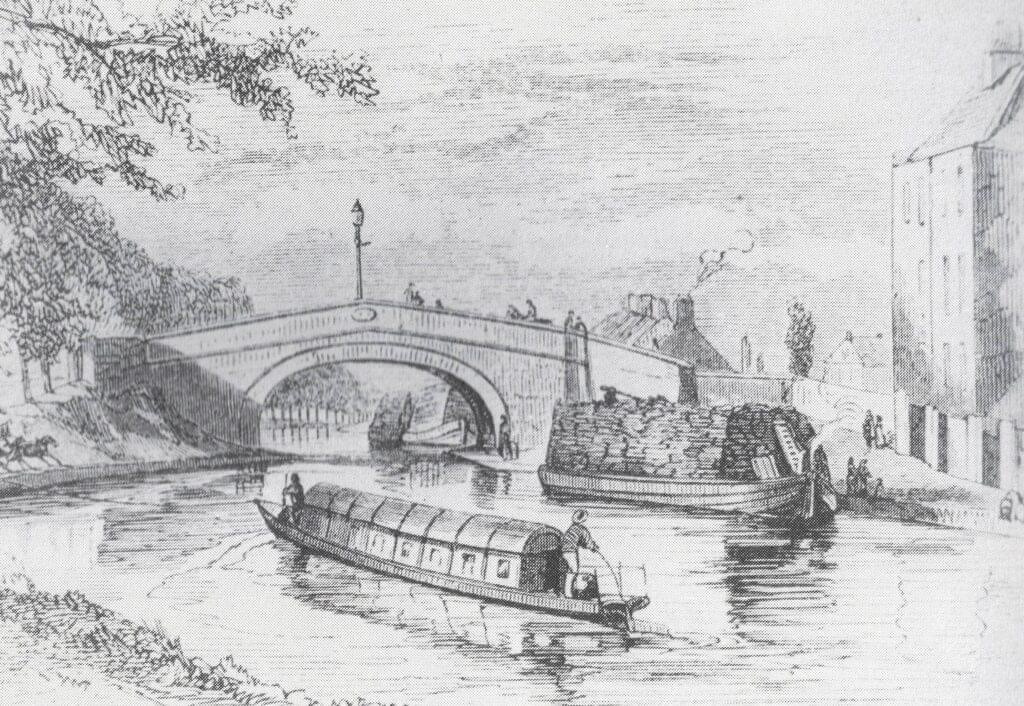
Flyboats on the canal in the 1830s, similar to the later design of the Celtic Cruisers fleet of the 1970s
[1] See “Safe Harbour, The Grand Canal at Edenderry” Mairead Evans & Therese Abbott” Topic Newsppapers Ltd, P22-23
[2] Offaly thought Time & Its Townlands. Thomas Lee. Pub: Ottait Publishing p173
[3] Offaly thought Time & Its Townlands. Thomas Lee. Pub: Ottait Publishing p173
There is an open invitation to all those interested in the River Brosna to come to the book launch on Friday 22 March at 7.30pm in The Star (GAA hall) River Street, Clara hosted by Clara Heritage Society.
John Feehan has dedicated much of his life to studying and communicating the evolution of the landscape and how we have lived in and changed it – his previous Offaly publications have included books on the Slieve Blooms, Croghan Hill, the Landscape of Clonmacnoise, An Atlas of Birr and more recently Killaun Bog and the Camcor River. This new publication focuses on the River Brosna and its catchment.
The River Brosna is one of Ireland’s hidden rivers, glimpsed over bridges and for short stretches as it travels through Mullingar, Ballinagore, Kilbeggan, Clara, Ballycumber and Ferbane on its journey from Lough Owel to ShannonHarbour. Until now very little has been written about it yet few rivers have a more fascinating and varied story to tell. In this beautifully illustrated book John Feehan brings his long experience as an environmental scientist and historian to bear on all aspects of the natural, cultural and industrial heritage of the river and its catchment. Successive chapters review geological origins, the biodiversity of the river and its tributaries as well as the great area of bogland it drains. The history of the mills along the course of the river, and of the two great arterial schemes that so altered the river are reviewed and particular attention is devoted to the extraordinary stories of Mesolithic Lough Boora and the Bronze Age Dowris hoard.









 offalyhistoryblog