Wellington’s victories in the battles in the Peninsular War were celebrated by Thomas Acres by the erection of the folly or tower in the garden of his private house at Acres Hall. This is now the Tullamore Municipal Council building and the garden is in part used for parking. The entire Acres development in Cormac Street west was based on the 1790 Kilcruttin Hill lease. The folly has been largely restored in 2020-22, but the part of the hill that was removed to facilitate more council parking ought to be replaced. In time perhaps the entire garden and folly could be incorporated into the town park.
There are 20 houses in all from south of the town hall and as far as the junction with the road to Kilcruttin beside the railway station. Following the numbering of these houses in the first valuation of 1843 and the second published in 1854 can be confusing. The numbers in the 1843 survey inclusive of Acres Hall are 505 to 520, with the count commencing at the single-storey over basement cottage at the junction of Cormac Street with the later road to Kilcruttin and finishing at Acres Hall (no. 520). That in the printed valuation of 1854 was Charleville Street nos 1 to 11. No. 1 was the home of Dr Pierce, son-in-law of Thomas Acres, and his wife Ellen and their ten children. The story of the house and the family we have looked at in blogs 2, 3 and 4 on Cormac Street, once called Charleville Street because it was the road to Charleville Demesne, the home of the Moore family from 1740 to 1764 and the Burys from 1764 to the present day (albeit now Hutton Bury since 1963).
Last week we set out reasons why Cormac Street can be considered so good. Anybody getting off the train, visiting the town park or the courthouse cannot but be impressed. The street is very largely intact since it was built and has been enhanced by the town park. The restoration of the full Kilcruttin Hill beside the folly should be undertaken by the municipal council given its historic importance. Charleville/Cormac Street was the outer extremity of the town when building started here in the 1780s. Probably the Elmfield house (now the location of the Aras an Chontae) dates to 1795. Both Norris of that house and Acres of Acres Hall (dated to 1786) were functionaries of the young landlord’s family and both built on the road to the demesne. Bury came of age in June 1786 and so could regulate matters himself. While there were some cabins on Charleville Road these were temporary structures and aside from Elmfield no building leases were granted here until that to Daniel E. Williams in 1898. He completed Dew Park by 1900 and it was then regarded as the best house in Tullamore having taken that honour from Acres Hall. It reflected changing times with the demise and relative impoverishment of the Acres family and the growing importance of the new Catholic merchant class of Egan’s and Williams. While Williams had a virtual freehold in Dew Park lands the Egan family took a long lease from the Acres Pierce family of Acres Hall in 1891. The third big house that of Elmfield may well have earned the first-place honour but the Goodbodys sold this house in the 1880s and moved to Dublin. Richard Bull, the sub-sheriff moved in and departed after 1904 when the house was taken by Dr Kennedy who had moved from The Cottage in O’Moore Street.
My paternal great-great grandfather was James Corcoran (c. 1801 to c. 1848), a tenant farmer/freeholder who, in the mid-1820s, had dominion over approximately 44 acres (current measurement) in the townland of Crissard in County Laois. At that time Crissard was often referred to as “Cropard,” with numerous variations on the name since. “Crissard” appears to be the official townland name, although local residents today favour “Crossard.”
In 1823 James married Elizabeth Conlon. Elizabeth was almost certainly from either Crissard or perhaps from one of two adjacent townlands; Wolfhill or Kellystown. Below is a cut-and-paste record from the Ballyadams R.C. Parish marriage records identifying their February 5, 1823 marriage. Note “Cropard” as the place name.
James and Elizabeth would go on to have six children between 1824 and 1846; Margaret, Mary, Frances, William, Honora and Patrick. A long gap between the birth of fifth child Honora in 1833 and sixth and final child Patrick in 1846 initially had me wondering if I had the “right” Patrick but all was quickly confirmed upon locating the baptism records for the children, all confirming the parents as James Corcoran and Elizabeth Conlon.
Aside from the Tithe record and baptism records for James and Elizabeth’s first five children, the next credible record(s) that I find of James are at least six newspaper entries in the Leinster Express between 1839 and 1842 where James, along with numerous other County Laois (Queens at that time) residents were seeking the right to vote. I never determined if James secured voting rights.
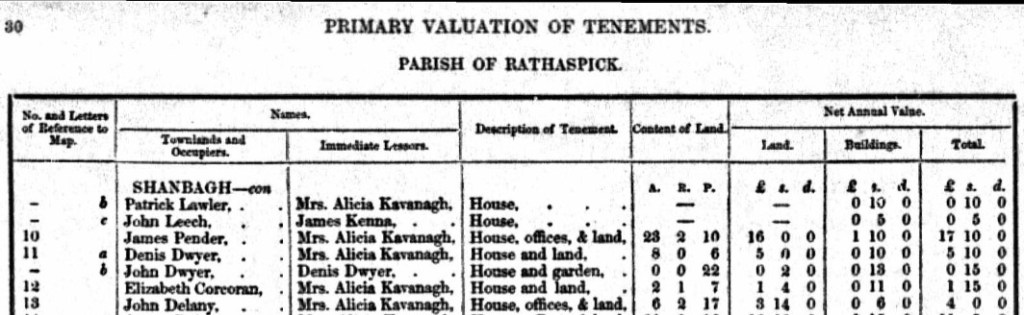
Following the early 1840s newspaper references, James appears in the record of son Patrick’s March, 1846 baptism. This is the final written reference to James. Then, in 1850, we find Elizabeth Corcoran in the Griffith’s Valuation records living as head-of-household in the townland of Shanbagh (Shanrath today), two miles to the east of Crissard (see below). The 11-shilling valuation of her residence suggests fourth class housing, an indication that she may have been living in mud hut poverty, as were seemingly most of her immediate neighbours.
I have little doubt that this is the correct Elizabeth Corcoran, owing in large part to the landowner listed for Elizabeth’s residence; one Alicia Kavanagh, a resident of nearby Wolfhill. The connection between these two women was likely tied to Alicia owning the land in Wolfhill on which the Roman Catholic Chapel of that time was located, which was almost certainly the church where my Corcoran ancestors would have worshipped.
Remains of the original Wolfhill R.C. Chapel, the ruins ofwhich are found in present day St. Mary’s Church Graveyard
James disappearance from the records after 1846 and Elizabeth’s subsequent appearance as a head-of-household in 1850 strongly hints that James died during this four-year period, which not coincidentally was the time of the Famine.
The Famine, and likely the death of James, triggered emigration of three and quite possibly four of the Corcoran children, including my great-grandfather William Corcoran who departed for New York in 1850, one year after his sister Frances Corcoran left for New York in 1849 and one year prior to sister Margaret (Corcoran) Knowles emigrated to New York in 1851; classic Irish “chain immigration” on display! There is strong circumstantial evidence that sister Honora Corcoran followed suit in 1852, although definitive proof is teasingly lacking.
I was able to trace the lives of William, Frances and Margaret until their deaths in New York. Frances, the first to emigrate, arrived in New York City, married another Irish immigrant named Patrick O’Brien, and remained in Manhattan until passing in 1895. More interestingly, William Corcoran and Margaret (Corcoran) Knowles relocated to Clinton County in the northeastern corner of New York State, both eventually landing in the rural Crissard-like town of Beekmantown, on the same road, just two houses/farms apart. Another Knowles, Patrick Knowles, the older brother of Margaret’s husband Dennis Knowles, lived on and farmed the property between William and Margaret’s; a little cluster of Crissard emigrants living in an environment in which they likely would have taken some comfort. Other Irish immigrant families surrounded the Corcoran/Knowles clan; families with surnames such as Conroy, Kearney, Mullen and Golden.
Margaret’s life in New York was sadly marred by two events. The first was the death of her and Dennis’ two young Irish-born children, Mary and Michael Knowles, both of whom died in New York City during the six months that the family lived there before relocating to Beekmantown. The second tragedy was the passing away of Margaret herself in 1861, at age 37. Brother William did not purchase his land in Beekmantown until 1863, so he was never reunited as a neighbor to his sister, although they did live in the same County for 10+ years, which no doubt allowed for close interaction.
William would marry another Knowles, Catherine Knowles, in 1869 (see St. James Church record below – “Knowles” is misspelled as “Noles”). Catherine was the Beekmantown-born daughter of Patrick Knowles and a niece of Dennis Knowles, further tightening the Corcoran/Knowles bond in Beekmantown. But in another grim twist, Catherine would die in 1871, only 10 days after giving birth to her and William’s second child and daughter, Anna Corcoran.
William quickly remarried in 1872 to Julia Kilroy (later “Gilroy”), Clinton County-born daughter of another Irish immigrant couple from County Cavan; Patrick Kilroy and Alice Keenan.
William and Julia would have one child, my grandfather, John Corcoran, in 1877. Upon William’s death at his Beekmantown home/farm in 1904, John inherited the farm where he would follow in William’s footsteps for over two decades, before losing his 300+ acres of land to the economic scourge of the Great Depression.
John Corcoran (c. 1900)
John would marry Margaret Dowd, with the couple going on to have four children of their own; my father Francis Corcoran, Mary Corcoran, Ruth (Corcoran) Martin and Florence (Corcoran) Tusa. The direct line Corcorans, including my brother, sister and I would remain in Beekmantown until 1975, at which point my father was transferred to Albany, New York for work, resulting in my siblings and I all dispersing after marriage, but all still making our homes in upstate New York.
My brother and I each have a son and daughter, with both of our sons living in upstate New York, ensuring at least one more generation of Crissard-origin Corcorans leaving their footprints, however small, in the same geographic area as our Irish immigrant William Corcoran.
Cormac Street is somewhat unique in the story of Tullamore Street development with its forty houses, two major institutional buildings, a folly and a town park. Rarely is a street preserved without blemish with so many elements over a two-hundred-year period. Cormac Street was also the home of the town’s major property developer and rentier Thomas Acres (d. 1836) who built his Acres Hall in 1786 (now the home of Tullamore Municipal Council). To the earl of Charleville and Thomas Acres is due most of the credit for the transformation of a green field site with Kilcruttin Hill and cemetery to the western side and the Windmill Hill to the east with the terraces in Cormac Street and O’Moore Street. Acres could thank the war with France, 1793–1815, for the boost to the local economy that provided him with tenants for the terrace of houses on the east side. The expansion of Tullamore after 1798 due to the Grand Canal connection with Dublin and the Shannon provided the impetus to secure a new county jail (1826–30), county town status in 1832 and to take effect in 1835 with the completion of the county courthouse. War, politics and pride of place all contributed to the mix. The Bury contribution was rounded off when Alfred (later the fifth earl) got a new railway station at Kilcruttin in place of that at Clonminch in about 1865. Alfred died in 1875 soon after he succeeded his nephew to the earldom.
Once on the edge of the town O’Moore Street, Tullamore was, in the 1800s, known as Windmill Street because of the two windmills erected by the 1720s on the hill south of O’Moore Street The hill (probably the Tulach Mhór giving Tullamore its name) is now obscured by the houses from the courthouse to Spollanstown Road erected after the 1790s. Today O’Moore Street still exhibits some of the mixed residential development that was commonplace before the 1900s and the building of class demarcated suburban housing. Yet O’Moore Street was itself comparatively rural in the early 1800s, but now serves as an artery for traffic to Cloncollog, Clonminch, Killeigh (Mountmellick) and Geashill – with their extensive housing and shopping facilities. In the once undeveloped field opening to Clonminch and Spollanstown the substantial Tullamore Court Hotel was built in 1997. The street has more than a 300-year history it its physical development. The lack of decisions on good planning neglected to be taken in the 1750s continue to impact almost 300 years later and contribute the configuration the street has today.
The governance of the Tullamore Poor Law Union began in 1839 with the formation of the Tullamore Board of Guardians (the Board) under the Poor Law Commissioners (P.L.C.) sitting in Dublin. The unions were governed by the 1838 Poor Law Act.[i]
The guiding principles of the Irish Poor Law was the same as that of the 1834 English Poor Law; that the workhouse inmates should be worse fed than those in the district outside the workhouse.[ii] Two days after the first admissions to the Tullamore Workhouse, on June 11th , 1842 the first dietary scale for the workhouse was adopted by the Board and approved three days later.[iii]
The fever hospital of 1846, later the county hospital, 1921-42(more…)
The town councils of Tullamore, Birr and that of Edenderry were abolished ten years ago in what some consider was a mistake and a hasty reaction to the calls for pruning in that recessionary period. Here we provides some headlines for significan events since the first council body – the Tullamore Town Commission – was established in 1860. This was followed by the urban council in 1900. We post this blog on the anniversary of the great balloon fire of 10 May 1785.
Was it chance and circumstances that led fourteen Offaly men to be present in early July 1863 on the fields, hills, and laneways of Gettysburg in what was, and still is to this day, the single most important battle in American history?
Chance: the absence of any cause of events that can be predicted, understood, or controlled
Circumstances: a condition, fact, or event accompanying, conditioning, or determining another
On reading any account of the single most pivotal battle in American History it quickly becomes obvious to even those with zero knowledge of battlefield tactics and military history that the main factors that decided the final outcome came about as a result of chance and circumstances, good and bad luck, decisions that only after the dust settled on the fields of Pennsylvania in early July 1863 were deemed correct and, fatally, one single decision made by a seemingly invincible General Robert E. Lee that doomed his Confederate Army to defeat and almost by accident won a victory for a Union Army commanded by a seemingly hesitant General George Meade. The margin of victory for the Union army, in the opinion of most military historians, was so tight that small and snap decisions were the deciding factor and not brilliant military tactics. It seems that in the late evening of the 3rd of July 1863 it was chance and circumstances that had played the most important role in the outcome of the battle.
Michael Hoy was born in Daingean county Offaly in the year 1834 to William Hoy and Rosanna Concasey. His father died when he was a young boy. In 1853 he emigrated with his mother, brother William, and two sisters Rosanna and Elizabeth, settling in Brooklyn. His older brothers Joseph and John, along with another sister Mary had gone to America a few years before. Michael Hoy learned the stone cutters trade in Brooklyn. In 1854 the family moved to Cooperstown, New York, which is two hundred miles north of the city. Young Hoy worked in his trade for one more year before returning to Brooklyn. In 1857 he went to Minnesota, settling in the town of Saint Anthony. At this time Saint Anthony had a few scattered houses on the east bank of the Mississippi river. He followed his trade and the same year of his arrival he cut stone for the building of the State University.








 offalyhistoryblog