Last week we set out reasons why Cormac Street can be considered so good. Anybody getting off the train, visiting the town park or the courthouse cannot but be impressed. The street is very largely intact since it was built and has been enhanced by the town park. The restoration of the full Kilcruttin Hill beside the folly should be undertaken by the municipal council given its historic importance. Charleville/Cormac Street was the outer extremity of the town when building started here in the 1780s. Probably the Elmfield house (now the location of the Aras an Chontae) dates to 1795. Both Norris of that house and Acres of Acres Hall (dated to 1786) were functionaries of the young landlord’s family and both built on the road to the demesne. Bury came of age in June 1786 and so could regulate matters himself. While there were some cabins on Charleville Road these were temporary structures and aside from Elmfield no building leases were granted here until that to Daniel E. Williams in 1898. He completed Dew Park by 1900 and it was then regarded as the best house in Tullamore having taken that honour from Acres Hall. It reflected changing times with the demise and relative impoverishment of the Acres family and the growing importance of the new Catholic merchant class of Egan’s and Williams. While Williams had a virtual freehold in Dew Park lands the Egan family took a long lease from the Acres Pierce family of Acres Hall in 1891. The third big house that of Elmfield may well have earned the first-place honour but the Goodbodys sold this house in the 1880s and moved to Dublin. Richard Bull, the sub-sheriff moved in and departed after 1904 when the house was taken by Dr Kennedy who had moved from The Cottage in O’Moore Street.
Cormac Street is somewhat unique in the story of Tullamore Street development with its forty houses, two major institutional buildings, a folly and a town park. Rarely is a street preserved without blemish with so many elements over a two-hundred-year period. Cormac Street was also the home of the town’s major property developer and rentier Thomas Acres (d. 1836) who built his Acres Hall in 1786 (now the home of Tullamore Municipal Council). To the earl of Charleville and Thomas Acres is due most of the credit for the transformation of a green field site with Kilcruttin Hill and cemetery to the western side and the Windmill Hill to the east with the terraces in Cormac Street and O’Moore Street. Acres could thank the war with France, 1793–1815, for the boost to the local economy that provided him with tenants for the terrace of houses on the east side. The expansion of Tullamore after 1798 due to the Grand Canal connection with Dublin and the Shannon provided the impetus to secure a new county jail (1826–30), county town status in 1832 and to take effect in 1835 with the completion of the county courthouse. War, politics and pride of place all contributed to the mix. The Bury contribution was rounded off when Alfred (later the fifth earl) got a new railway station at Kilcruttin in place of that at Clonminch in about 1865. Alfred died in 1875 soon after he succeeded his nephew to the earldom.
As we conclude our series on O’Moore Street and move to Cormac Street it is opportune to look at the oldest terrace on the street but starting with No 1 O’Moore Street being Tullamore House, the home of the Bannon family. So many have lived here since that great house was built about 1800. We will go into more detail on this one as part of the Cormac Street series. For now let’s look at the terrace from no. 2 to no. 9 in the 1843-54 valuation records. The terrace was built in the years from say 1795 to 1805 with a few houses rebuilt in recent years.
The developer/rentier was Thomas Acres of nearby Acres Hall (now the Town Hall) and he was building on a nice lease for ever from the young landlord Charles William Bury of Charleville (Lord, Tullamore 1797 earl of Charleville 1806). It was a lease of the Windmill Plot from Victoria Terrace to the county courthouse.
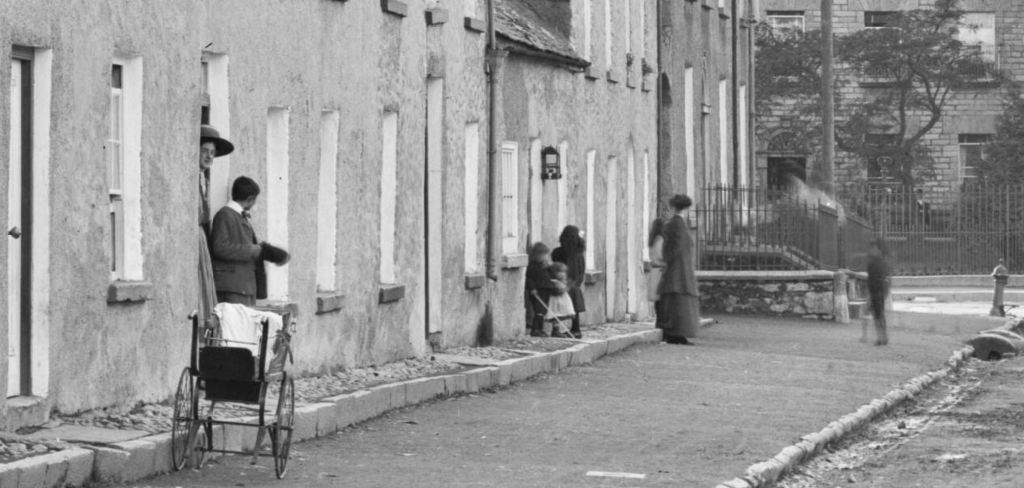
O’Moore street, c 1910. Courtesy of National Library of Ireland At the two doors may be the O’Rourke and the Carroll families, nos 4 and 6.(more…)
The fourth head lease in O’Moore Street granted by the earls of Charleville, and the last of significance, was that to the Tullamore printer Richard Willis in 1838 for the construction of the seven houses in Victoria Terrace, O’Moore Street. The lease from the second Lord Charleville was for 99 years from 25 March 1838 at £21 per year or £3 ground rent for each house. The first earl died in 1835 and, his son, the profligate second earl, was determined to extract more money from his estate to fund his expensive lifestyle and political ambitions. No more sweetheart deals as was done by the first earl for Thomas Acres in the 1790s who developed part of O’Moore Street and most of Cormac Street. The lease of 100 years instead of three lives renewable for ever was a change of policy on the part of the second earl who was disgruntled at his father having virtually alienated or sold much of Tullamore town for small money, as he believed.
Richard Willis was in the printing business for over fifty years. A few of his publications survive in the RIA (Hardiman pamphlets) and Offaly Archives. He worked from what is now the Insurance offices of Gray Cunniffe Flaherty and had a lane of cabins to the rear that was closed by 1854.
Moore Hall is an imposing two-story house over basement with two-story porch projection in cut stone, and coach arch and stables (now demolished). The façade is of three bays. The house is one of the finest in Tullamore, a fact that may escape notice because of its closeness to the street. In the front railing ironwork is the last gas lamp stand in Tullamore. This is the only surviving vestige of the era of gas lighting from 1860 to 1921.
The first overview of the street is available from the 1838 six-inch map and the 1843–54 valuations. By the early 1800s only one windmill survived and that was marked as in ruins on the 1838 five-ft manuscript map. Interestingly the 1838 six-inch map refers to windmills in ruins. Looking closer at both maps it does appear as if the second mill ruin was in the garden of no. 9 Cormac Street (see six-inch map). Moore Hall and ‘The Cottage’ were a hankering after rural life and as good quality houses were isolated from the town centre, but they made possible the attractive Willis-built Victoria Terrace of 1837–8.
Once on the edge of the town O’Moore Street, Tullamore was, in the 1800s, known as Windmill Street because of the two windmills erected by the 1720s on the hill south of O’Moore Street The hill (probably the Tulach Mhór giving Tullamore its name) is now obscured by the houses from the courthouse to Spollanstown Road erected after the 1790s. Today O’Moore Street still exhibits some of the mixed residential development that was commonplace before the 1900s and the building of class demarcated suburban housing. Yet O’Moore Street was itself comparatively rural in the early 1800s, but now serves as an artery for traffic to Cloncollog, Clonminch, Killeigh (Mountmellick) and Geashill – with their extensive housing and shopping facilities. In the once undeveloped field opening to Clonminch and Spollanstown the substantial Tullamore Court Hotel was built in 1997. The street has more than a 300-year history it its physical development. The lack of decisions on good planning neglected to be taken in the 1750s continue to impact almost 300 years later and contribute the configuration the street has today.
This is the story of eight new houses built by Tullamore Urban District Council in 1923 in what is now John Dillon Street. Turning into the street from Charleville Road, the first eight houses on the right were built as part of the Provisional Government’s £1 million scheme launch in 1922 in the midst of the Civil War. Opposite them are houses built by the Irish Soldiers and Sailors Land Trust for veterans of World War I. The eight houses may only have made a small dent in Tullamore’s chronically bad housing conditions in the early 20th century, but the circumstances surrounding when and how they were built provide some valuable insights into the history of the town and the country in these turbulent years.
John Flanagan the well-known builder and advocate for Tullamore and County Offaly died on 9 May 2024. He was the modest man from the Meelaghans, Puttaghan and Bachelors Walk, Tullamore who invested his whole life in making Tullamore a better place for people to live, work, bank and even pray in. In 2018 he was awarded the Offaly Person of the Year Award. John Flanagan was a realist in the Lemass mode. His focus was on getting things done. At the time Lemass came to be Taoiseach in 1959 John Flanagan was just 28 years old. It was ten more years, in 1968-9, before he got his first major break with the purchase of the Tanyard Lane property in Tullamore from the P.&H. Egan liquidator. The Bridge House, also owned by the Egan firm, was bought soon after by Christy Maye, and thirty years on Tullamore had two fine hotels, developed by the new entrepreneurs of the 1960s and 1970s, on lands that had been part of Egan’s extensive portfolio.
The town councils of Tullamore, Birr and that of Edenderry were abolished ten years ago in what some consider was a mistake and a hasty reaction to the calls for pruning in that recessionary period. Here we provides some headlines for significan events since the first council body – the Tullamore Town Commission – was established in 1860. This was followed by the urban council in 1900. We post this blog on the anniversary of the great balloon fire of 10 May 1785.

 offalyhistoryblog