
A contribution to Tullamore 400 and the Living in Towns initiative of the Heritage Council. Sit down and have a cup of tea with this blog!
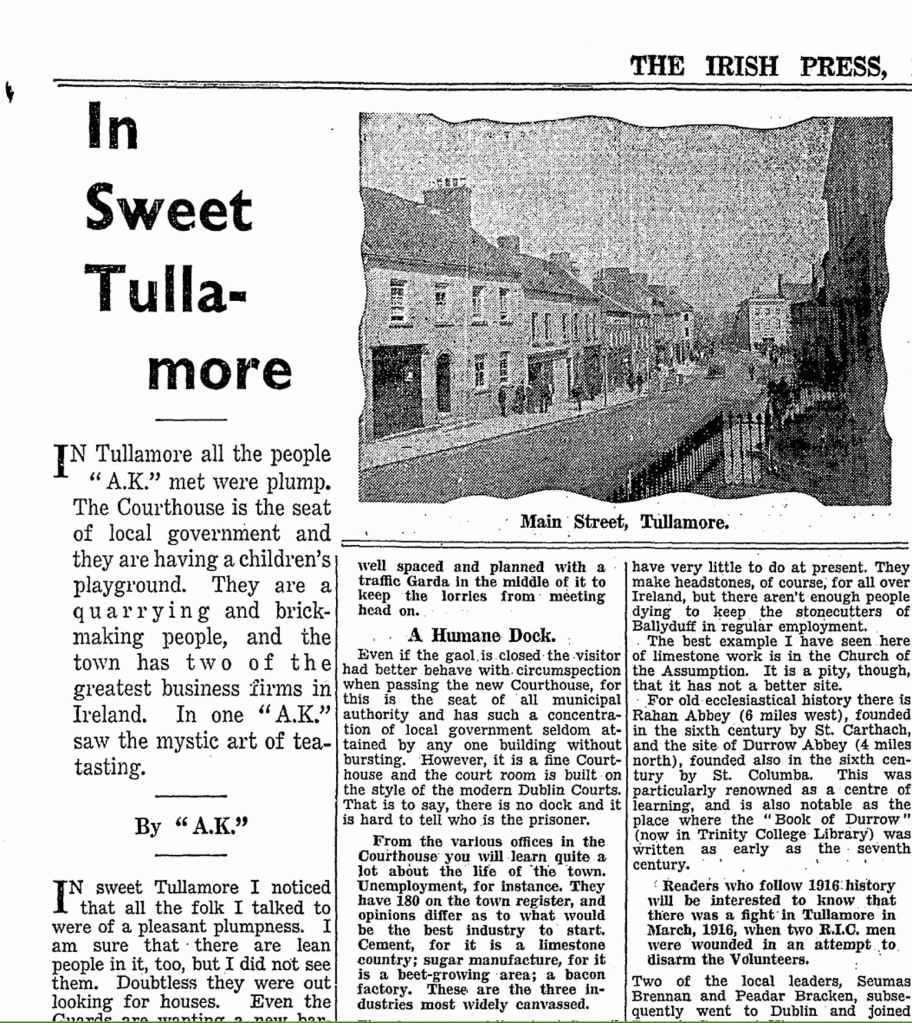
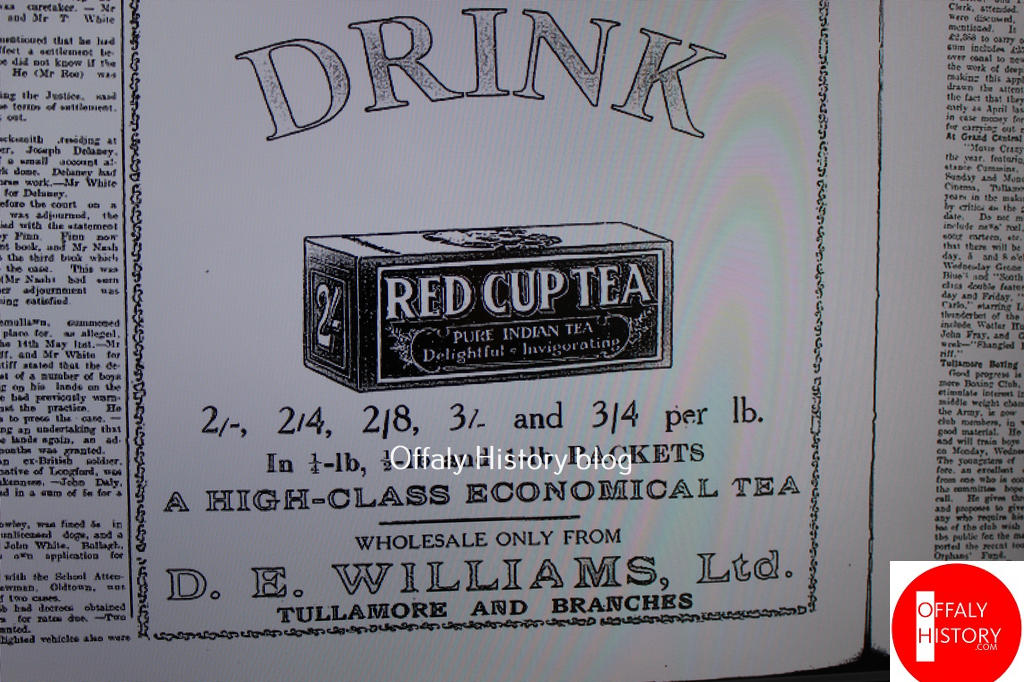
A visit by an Irish Press journalist to Tullamore in 1933 provided a nice puff for the Williams tea business and its brand Red Cup Tea. At the time Williams provided regular advertising in the Irish Press for its tea and Edmund Williams (d. 1948) was a founder director of Irish Press. D.E. Williams’ interest in tea can be traced back to 1895. In the Chronicle and the rest of the local press for February 1895 advertisements appeared in connection with the opening of a wholesale tea business by Daniel E. Williams. In a comment the Chronicle stated that most of the blending was done in London where D.E.W. had larger stores than hitherto. The draft 1917 accounts for DEW Ltd show sales at £8,324. This had risen to £13,807 by 1923. The business was much expanded in the 1930s led by the blender, a Mr O’Shea.
Many readers will remember the brand in the 1960s, but at that time competition was mounting from Barry’s and Lyons. Supermarkets were being developed in the decade and that in turn led to more competition and more choice for consumers. The day of the tea bag had arrived and sales of leaf tea declined. Does anyone recall getting the empty tea chests for 6d or 1s from the Williams yard behind the head office? Bewley’s continued to provided leaf tea in Indian and Chinese blends for the discerning buyer up to the late 1970s.

The 1933 article has its uses. For one thing the visit was at a time when Tullamore was without industry. Egan’s brewery had closed and the distillery was mothballed from about 1924 to 1938. Goodbody’s tobacco factory was destroyed by fire in 1886 and the business was moved to Dublin, as were the Tullamore families who wished to go with it. Salts Woollen Mill did not open until 1937–8 and the Tullamore creamery was in its infancy. That left only the great Williams and Egan companies to provide employment in the town. Fortunately work soon began on housing schemes such as O’Molloy Street, Callary Street and from 1937 the new hospital.
Here is A.K in the Irish Press in 1933 about his visit to Tullamore:
In sweet Tullamore I noticed that all the folk I talked to were of a pleasant plumpness. I am sure that there are lean people in it too, but I did not see them. Doubtless they were out looking for houses. Even the Guards are wanting a new barracks.[1]
Tullamore is full of facts and I have no time to roam and moon in this town.
The first thing a visitor sees on coming from the station is the Gaol and then the Courthouse. This should teach him to watch his step while he is in Tullamore – though the Gaol is a false alarm and has been closed this long time. William O’Brien and the other leaders of the Land Agitation were imprisoned here. William had refused to wear the prison clothes and one morning when the warders opened his cell door, they found him dressed in a grand new suit of Irish tweed. They never discovered how he got it.[2]
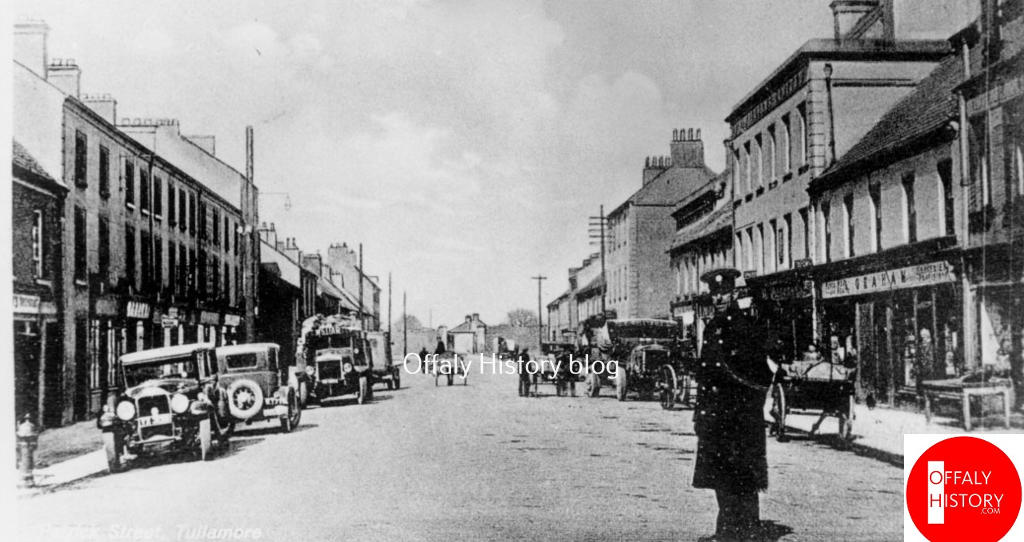
Tullamore, they will tell you, was only a village one hundred and forty years ago. Then it had the luck to get burned down and on the site was built a modern town, well-spaced and planned with a traffic Garda in the middle of it to keep the Lorries from meeting head on.[3]
A Humane Dock
Even if the gaol is closed the visitor had better behave with circumspection when passing the new Courthouse, for this is the seat of all municipal authority and has such a concentration of local government seldom attained by any one building without bursting.
However, it is a fine courthouse and the court room is built on the style of modern Dublin courts. That is to say, there is no dock and it is hard to tell who the prisoner is. From the various offices in the courthouse you will learn quite a lot about the life of the town. Unemployment, for instance. They have 180 on the town register, and opinions differ as to what would be the best industry to start. Cement, for it is a limestone country; sugar manufacture, for it is a beet growing area; bacon factory. These are the three industries most widely canvassed. They have some of the nicest Council houses I have ever seen on my travels. The Council are very proud of them, though they are having a tussle with the Local Government Board at present over the delay in the Government’s contribution after the execution of the mortgage.

Runs In Families
The garden streets called after Healy and Dillon have houses which are models of their kind. The present Council are building 54 more. Father O’Keefe, C.C., raised £100 and the Carnegie Trust also made a contribution towards a children’s playground.[4]
On the Council houses they are using tiles made locally of sand and cement, and the bricks are from Gallen Brickworks, out Banagher direction.
They have been closed for some years and are now re-opened for the housing schemes. The brick-making industry is curious and interesting. It runs in families and fathers and mothers and children all work at it.[5]
Another material they have in great quantity and perfection is limestone. At Ballyduff, outside the town, they have six limestone quarries, and they have very little to do at present. They make headstones, of course, for all over Ireland, but there aren’t enough people dying to keep the stone cutters of Ballyduff in regular employment.
The best example I have seen here of limestone work is in the Church of the Assumption. It is a pity, though, that it had not a better site.[6]
For old ecclesiastical history there is Rahan Abbey (6 miles west), founded in the sixth century by St. Carthach, and the site of Durrow Abbey (4 miles north), founded also in the sixth century by St. Columba. This was particularly renowned as a centre of learning, and is also notable as the place where the “Book of Durrow” (now in Trinity College Library) was written as early as the seventh century.
Readers who follow 1916 history will be interested to know that there was a fight in Tullamore in March 1916, when two R.I.C. men were wounded in an attempt to disarm the Volunteers. Two of the local leaders, Seamus Brennan and Peadar Bracken, subsequently sent to Dublin and joined Pearse’s Camp at Kimmage.[7]
The Tea-Tasters
Old Tullamore had a big tannery, a tannery, a bacon factory and Goodbody’s tobacco factory- Goodbody’s was burned down and the new factory was transferred to Dublin. There were also a brewery and a distillery, both now defunct.[8]

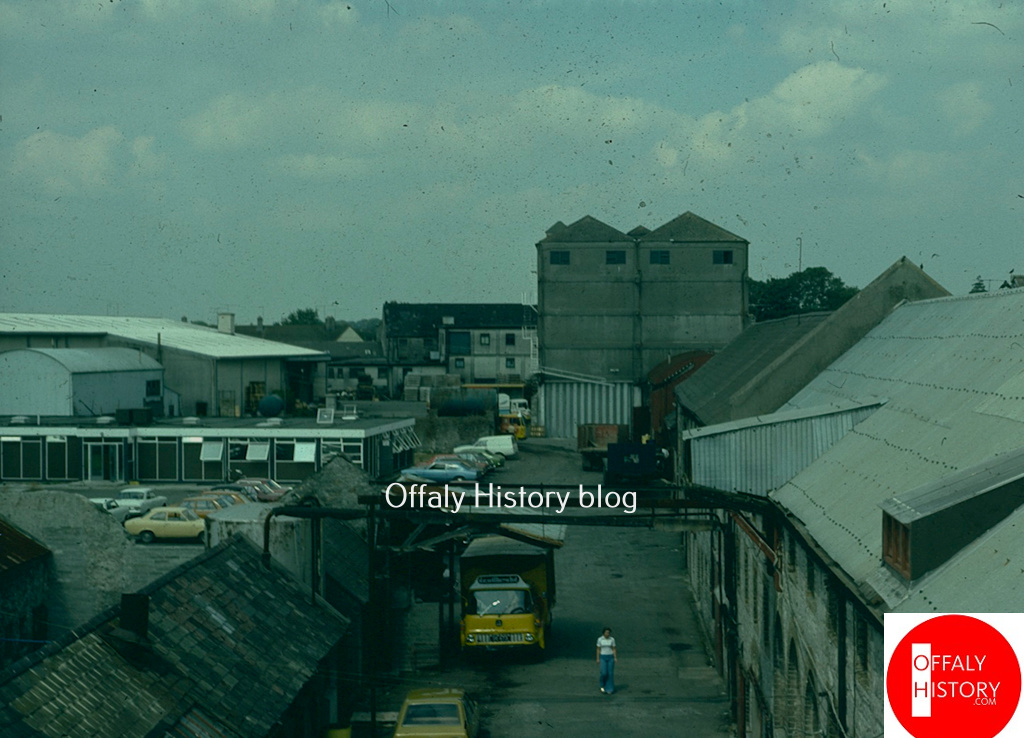
It is impossible to write much about Tullamore without bringing in Egans and Williams, those big distributing firms.
Everybody with a car has been dodging their lorries along the highway, not mention the byways. They own big stores and they sell everything from millinery to motor cars and from mineral water to ploughs. Soft goods and hard; wet and dry. They have chains of shops and fleets of motor transport.
I went to the nice cool upper reaches of Williams’ Stores where the tea-tasters work. The lofts were full of chests of tea with flowery names. They had come all the way from China, Ceylon or Java by way of James’ Street Harbour, Dublin, down the Canal to Tullamore. What an Odyssey. They are then put into bonded stores; girls were filling packets of Red Cup tea. By every post come samples. When the tea arrives from India, London sends out those samples and tea tasters of Tullamore, Mr O’Shea and Mr Rafter, [Wrafter] taste every one of them and order what they want.

70 to 100 Blends A Day
Mr Rafter puts the kettle on the boil. He then takes out his special tea-tasting pots, measures out a quantity of different blend into each. When the kettle boils he makes the tea at once. The kettle must never over boil for good tea, says Mr Rafter. Then he sets the stop clock. When the bells rings the tea is drawn. No milk or sugar. He pours the black tea into little bowls, a different bowl for every blend, and then he takes a sip of each. He waves the bowl under his nose and inhales the aroma like old brandy. He know every different taste, every different smell. That man could identify a tea leaf after it has been used to sweep a carpet. He says that the people of the West of Ireland are the best connoisseurs of tea. They generally pay something round about 4s a pound for it. On the whole, the country people have the best palate for tea. Himself and Mr O’Shea often taste 70 or 100 blends of tea a day. “And what do you drink when you get home?” I inquired. “More tea!” says he.
“A.K.” in an article in the Irish Press and reprinted in Midland Tribune, 13 May 1933
[1] Built in 1937 at Patrick St orse Barrack St.
[2] Destroyed in July 1922 during the Civil War. See previous blogs
[3] The ‘balloon fire’ of 1785 – see previous blogs
[4] At Park Avenue. Houses were built on the site within four years of the completion of the park. The footbridge was provided for access to this new facility and paid for by Col. Bury.
[5] See the recent publication on Polagh brick – now out of print but available to read at Offaly History and the six libraries in Offaly.
[6] Site provided in 1794 at ‘the back of the town’. Destroyed in 1983 and rebuilt but not with limestone.
[7] See Tullamore in 1916 and Offaly Heritage 9. Both books available from Offaly History Centre and Midland Books.
[8] The tobacco factory in 1886; the distillery was closed 1924–38 and the brewery about 1925.
 offalyhistoryblog