
Neville’s Atlas of the 3,000-acre estate at Philipstown in 1786 has not before been seen by the public and has probably not been consulted for fifty years. The surveyor was Arthur Richards Neville who was Dublin City Surveyor, 1801-1828 and he prepared the map on the instructions of the Molesworth Estate, the owner of 3,000 acres including the town of Daingean. Neville was in practice as a land surveyor from the 1780s or earlier. He succeeded RICHARD BURLEIGH WORTHINGTON as City Surveyor in 1801. He retained the post until his death in 1828 when he was succeeded by his son ARTHUR NEVILLE (Dictionary of Irish Architects online). The map is 154×128 cm and is 20 perch to the inch, taking in almost 3,000 statute acres and 130 land holdings. The map was conserved with the support of a grant from the Heritage Council. The map was donated to Offaly Archives in 2022. Our thanks to Arnold Horner for his assistance.

Daingean/Dengen of the O’Connor family was colonised in the 1550s as part of the Tudor Plantations and was named the county town in 1557 and provided with a fort as part of plantation security policy.


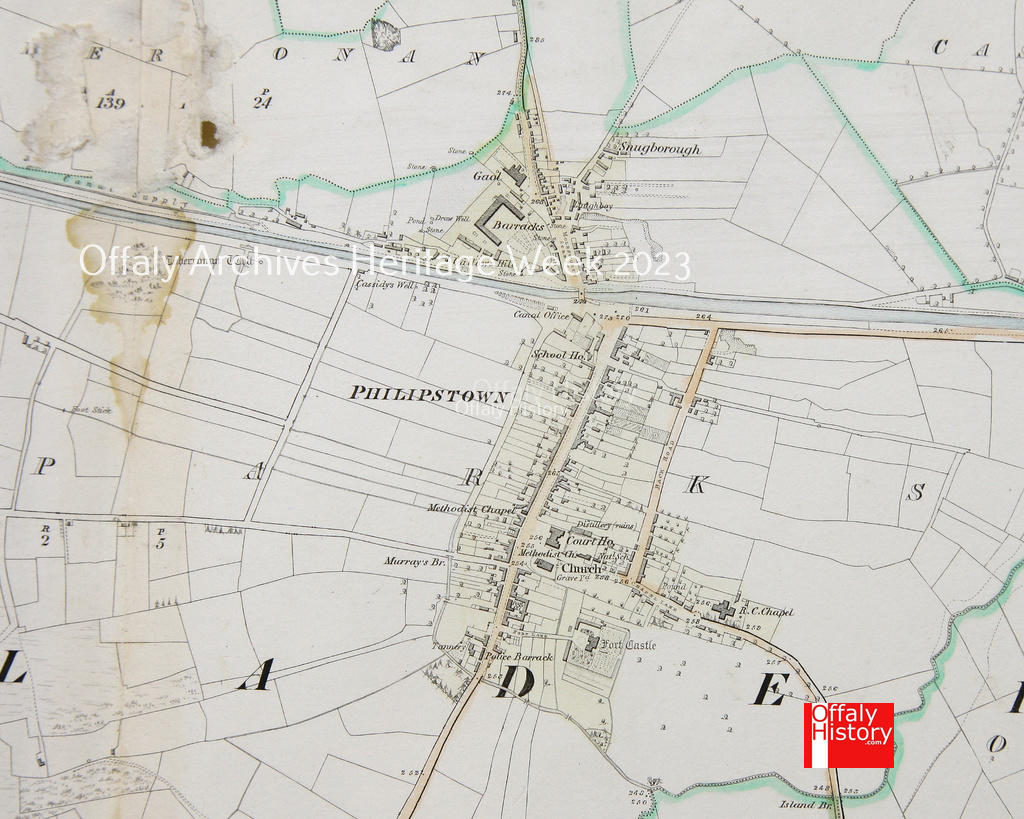
Philipstown 1786. The estate of the fourth Lord Molesworth (died 1793). Inherited from Bysse and passed to Ponsonby via Louisa Molesworth, a daughter of the third Viscount Molesworth. The barracks (later reformatory) at no. 37. The Protestant church of the 1770s is illustrated.
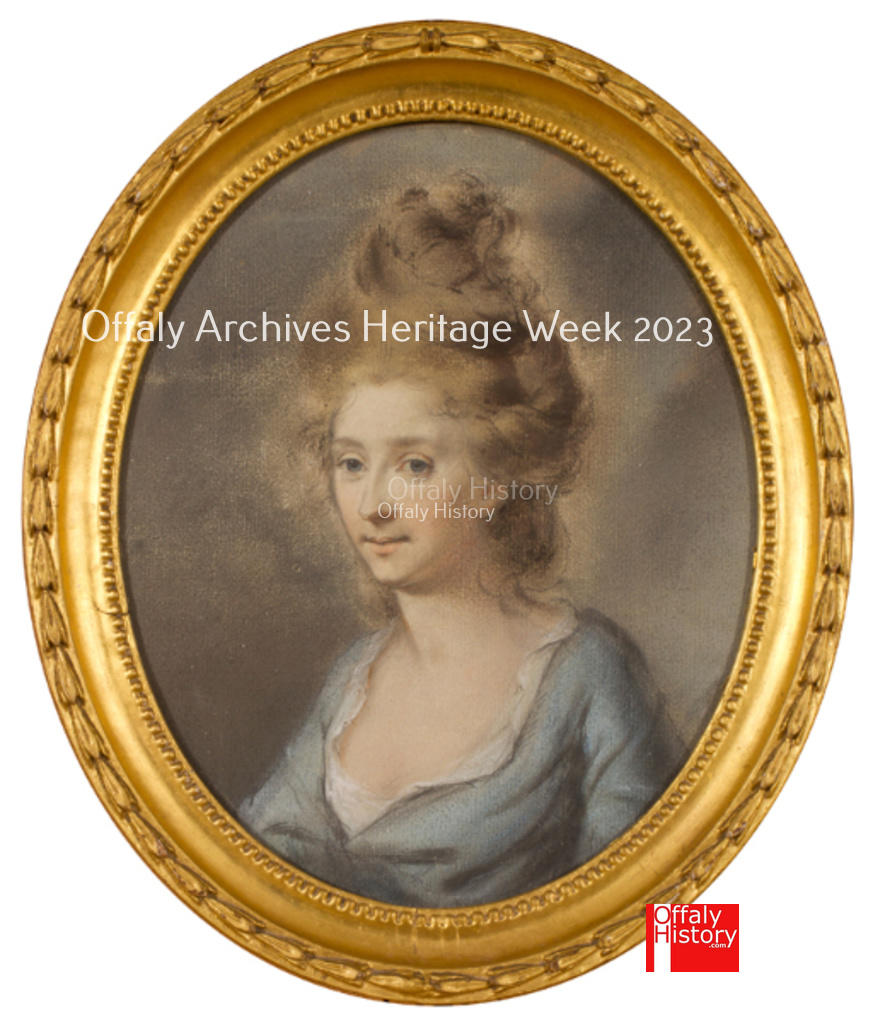
Louisa Ponsonby was fourth daughter of 3rd Viscount and her husband was William Brabazon Ponsonby. Their son William P. was killed at Waterloo. Louise died in 1824.
Richard Molesworth, third viscount, was the son of Robert Molesworth, 1st Viscount Molesworth and Laetitia Molesworth
Husband of Mary Jenney Molesworth and Jane Molesworth. Richard M. was Commander of the forces in Ireland. Sought to recover from his father’s overspending but was caught in the South Sea Bubble (died 1758) Succeeded by 4th viscount (died 1793).
Richard was father of Henrietta Molesworth; Richard Nassau Molesworth, 4th Viscount Molesworth; Hon. Louisa Ponsonby, Baroness Ponsonby of Imokilly; Elizabeth Molesworth and Mary Rochfort, Countess of Belvedere (Molesworth)
Brother of Capt William Molesworth, MP; Mary Molesworth; Charlotte Amelia Tichburne; John Molesworth, 2nd Viscount Molesworth; Wilhelmina Letitia Bolton and 9 others Half brother of John Phillips

After an initial burst of growth Philipstown declined after the 1750s. However, the impression given by General Charles Vallancey, then a young engineer, employed c.1770 to report to the Commissioners of Inland Navigation on the condition of the midland towns as a preliminary to the construction of the Grand Canal to the Shannon, showed a local economy under pressure. He was optimistic that the new canal line would help improve things. He wrote of Philipstown:
Provisions are extremely dear, and no manufacture of consequence going on, except a few hats and brogues. The town is full of idlers and beggars. The wool is sent from hence to Mullingar, and there bought up for Dublin; this extra carriage will be avoided when the navigation is finished, as the canal is proposed to touch the Town. Provisions also would be more reasonable. They are at present dearer than in the metropolis, being chiefly brought from thence, bread and meal in particular, and the poor would starve, but for the little circulation of money from the troops quartered here.
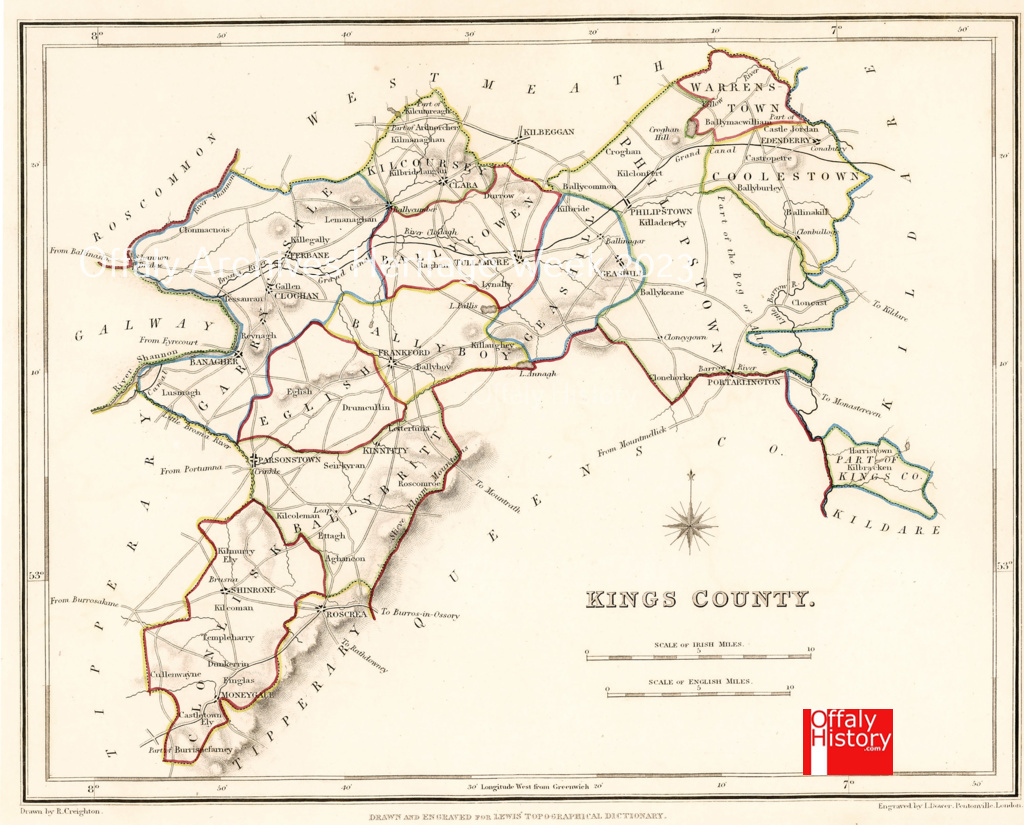
Sir Charles Coote in his survey of the county in 1800 (see an earlier blog) wrote of the barony of Lower Philipstown in which the Molesworth Estate was situated. The Grand Canal reached Philipstown in 1797. The borough status went with the Act of Union in 1800 as did that at Banagher.
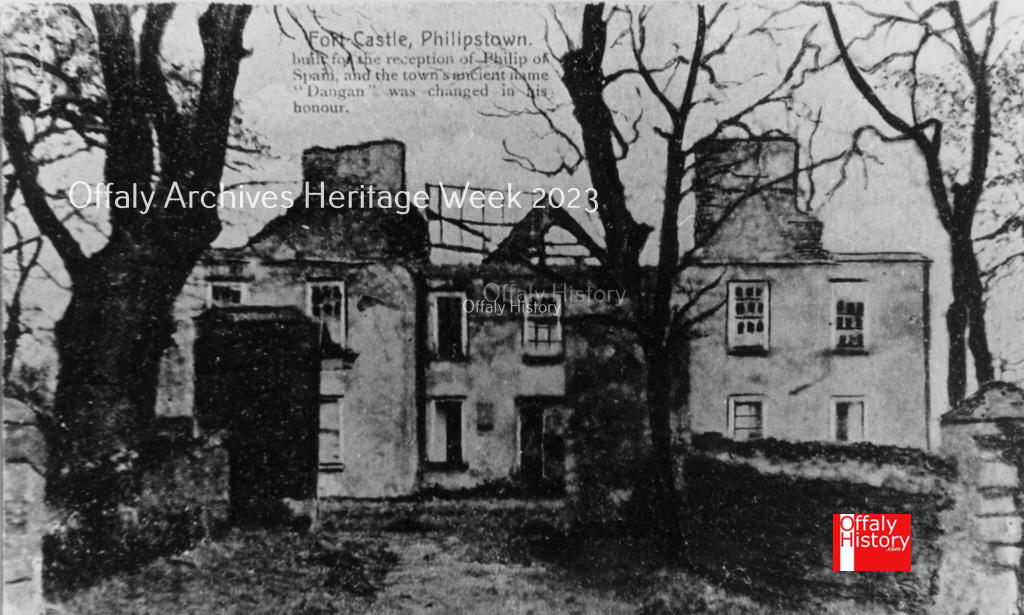
This country is very thickly inhabited; Philipstown which is the county town, and the only one in the barony, has hitherto sent two members to parliament; it has till lately been in a wretched state, and was rapidly fallen to ruin: now there is but little to recommend it. This town was originally part of the Molesworth estate, and, through family connections, is now divided into three properties; the most considerable part of it is enjoyed by the Right Honourable Mr. Ponsonby. The new leases now given are encouraging, and several new houses are erecting. [Probably in Molesworth Street]The Grand Canal passes at the northern end of the town, and, before this navigation, was complete to Tullamore, it was of very material service to this town, but now of inconsiderable advantage. A new county gaol is also erecting at the rear of the barracks, which are extensive, and command the town: it is almost entirely surrounded with bog, consequently fuel must be cheap and abundant; and provisions are in plenty, yet no manufacture of any kind is carried on. It had formerly a garrison, and the ruins of lofty castle are situated on the brink of the river. This town is thirty-eight [Irish] miles distant from Dublin
Thanks to Comerford’s History of Kildare & Leighlin diocese Philipstown has surviving estimates of population for the 1760s (Comerford, 2: 303-4); see also Gurrin and ors, The Irish religious censuses of the 1760s, pp 17-18. Killaderry (Philipstown) civil parish had 1,492 people and Kilclonfert 708 in the 1760s. Ballycommon at the time was said to have 98 Protestants, 6 Presbyterians and 490 Catholics. A total of c. 2,800 in the barony of Lower Philipstown. By the time of the 1813 census the estimate for the barony was 7,734.
Philipstown had almost 2,000 people in 1821 when the population of the adjoining commons is included. Source Horner, Mapping Offaly and 1821 census.
In 1841 the population of the barony was 7,223 and in 1851 5,320. Philipstown fell from 1,489 to 748 in the same ten years, bearing out the observations of Mr Binns (1836) about poverty in the town and also Vallancey and Coote’s comments.
Binns was an English Quaker who served as an assistant agricultural commissioner on the Poor Inquiry in the mid-1830s and as part of his instructions carried out investigations into the social conditions of the poor. Among the locations he visited in the course of his work was Philipstown (see Ciaran McCabe on Offaly History blog). For Binns, Miseries and Beauties of Ireland (London, 1837) see Corpus of electronic texts online. Also an original copy at Offaly History Centre Library, Bury Quay.
Binns wrote:
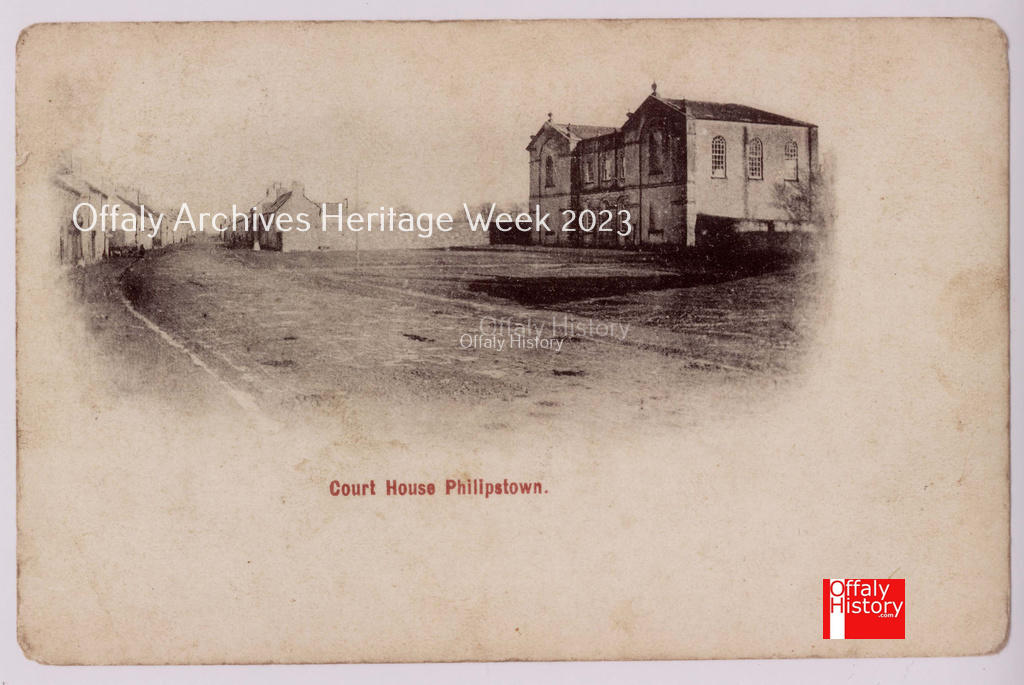
The town is well built and was formerly a place of note. It contains a capital Court-house and Prison, a large Catholic chapel, and a small Protestant church. The Grand Canal, on which two passage-boats ply daily between Dublin and the Shannon harbour, adjoins the town. Previously to the Union, [1800] Philipstown returned two members to parliament, and was a place of considerable trade. Lamentably, however, are things changed now. It is robbed of its representatives – the assizes are removed to Tullamore – its trade has disappeared – many of its houses are in ruins – its shops are falling into decay – and its population, as these signs sufficiently indicate, are poor and wretched. Although surrounded by miles of unreclaimed bog land, its inhabitants wander about the streets in search of employment, and find none. Nor is the desolation confined to the town. In a walk along the bog towards Dublin, we observed the roofless walls of a superb mansion, formerly the residence of Henry Lyons, Esq., one of the representatives of the county [River Lyons] There are several places which bear the name of Inns or Hotels. We took up our abode at the south end of the town, at an hotel kept by Mrs. Ellis, the post-mistress [now Brady’s] Here – after sufficient time to procure tea and coffee from Dublin had elapsed – we lived very comfortably; regaling ourselves in the meantime with excellent cream and eggs, and a joint, occasionally, of good beef or mutton. The chickens, like the generality of Irish poultry, were half starved.
My bed-room was part of the Barristers’ dining-room, in the palmy days of Philipstown: the sitting-room which we occupied, looked out upon the street, and the windows were frequently crowded with miserable women, carrying children upon their backs, and soliciting charity with pitiful lamentations. To relieve all was impossible-and to relieve only a few increased the number of those who begged. Under such distressing circumstances, my consolation was, that I was engaged in preparing a full and honest statement of their wretched condition, with a view to the introduction of legislative measures of relief.
Daingean was the capital of Offaly from the shiring of the county in 1556 – 1557 until the passing of a local act of parliament in 1832 the effect of which was to transfer the assizes or courts and grand jury meetings from Daingean to Tullamore as and from July 1835. Besides the prestige, the holding of court sessions in Daingean would have resulted in a considerable influx of litigants, witnesses and the lawyers for the several weeks of the sessions each year. The courthouse was erected in the first decade of the nineteenth century and is still used as a public building. The gaol of a similar date was incorporated in the convict prison and later used as a reformatory. The Grand Canal was eventually completed as far as Daingean in early 1797 and to Tullamore a year later. The assizes were transferred from Spring 1835 just a short time before the Binns visit. While the location of the county infirmary had been moved to Tullamore by 1768 the influence of the Ponsonbys (as successors to Molesworth) was able to ensure that the county town status stayed in Philipstown and that public money was secured to build the new jail and courthouse in the first decade of the 1800s. Within thirty years and new jail and courthouse were provided in Tullamore at a cost of about £30,000.

The town of Daingean/Philipstown in 1786. 130 tenants named and in possession of c, 3,000 stat. acres. Inc, bogs, otherwise mostly gardens of house property and adjoining town parks. Survey of estate in the same year as the of his neighbour Charles William Bury, later Lord Tullamore.The terrier or schedule to the map includes the location and size of holdings, and sometimes the land quality.
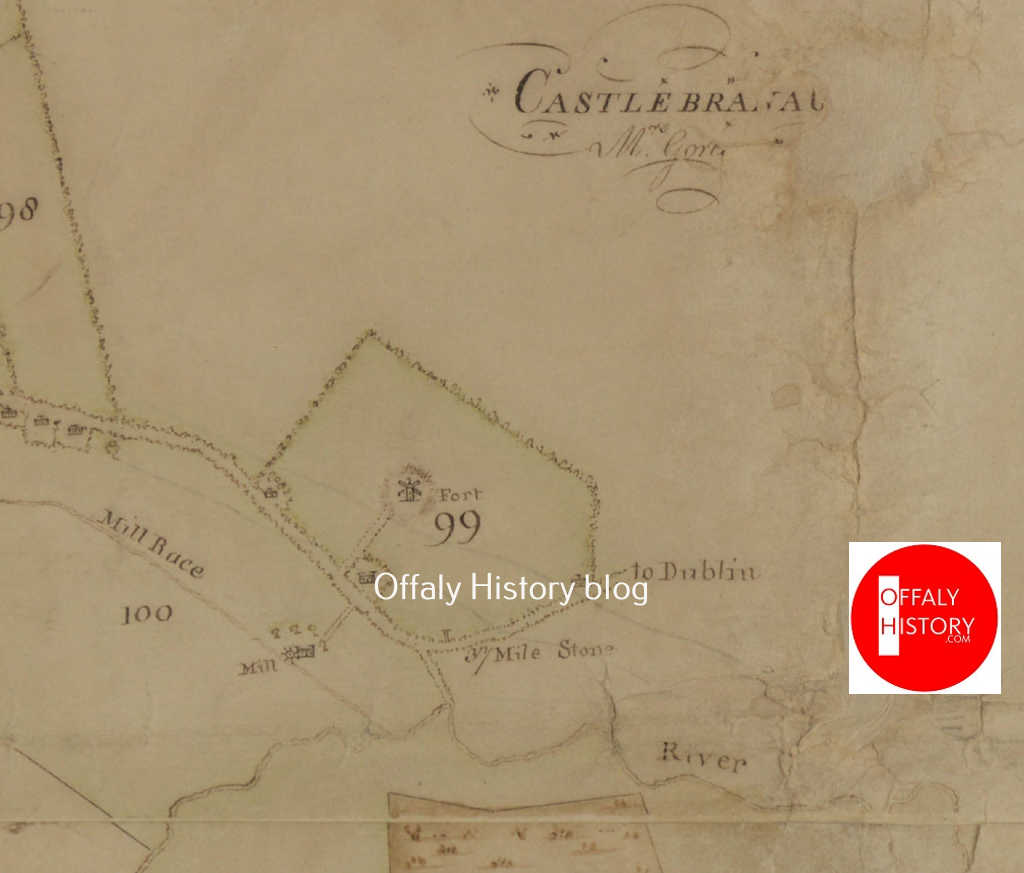
Some of the tenants listed will be familiar surnames in Daingean. These include Scully, Gillard, Hanlon, Fox, Owens, Merryman, Smith, Jones, Costigan. The map allows us to locate the tenants and to establish what rents were paid. The usage was meadow, pasture, ‘croft near old church’ (plot 17). Richard Scully had a sandhold and Charles Brickland a house and garden. About 35 houses are mentioned as are ‘Inn offices’, the barracks, the old barracks (plot 100), the jail, the Castle Demesne, commons, gallows road and turf plots. The full list of tenants will be published in Offaly Heritage 13 in 2024.
Visiting Judge Day wrote in 1811
The judges are entertained in this wretched town in high style at Mr Smith’s, tenant of Lord Ponsonby, who is seized of this one-third share of the Molesworth estate in right of his mother, and by his patent is bound to entertain the judges. But that they have got rid of the horses and servants whom I conceive them bound to provide accommodation for no less than the judges. Ride to Mullingar, 17 miles, passing near McCans, Usher’s, Rochfort’s and other fine seats. In general an excellent country. Lord Norbury arrives from Lord Charleville’s full of admiration of the splendid style of that splendid place’. [the new Charleville Castle]

The old Catholic church of c. 1800 was replaced about 1960.
Thanks to the work of Offaly Archives, Orla Connaughton, Breda Kenny, Offaly History Centre, Padraic Seery, Malachy Mangan, and Liz D’arcy of Paperworks – the conservator.

 offalyhistoryblog