

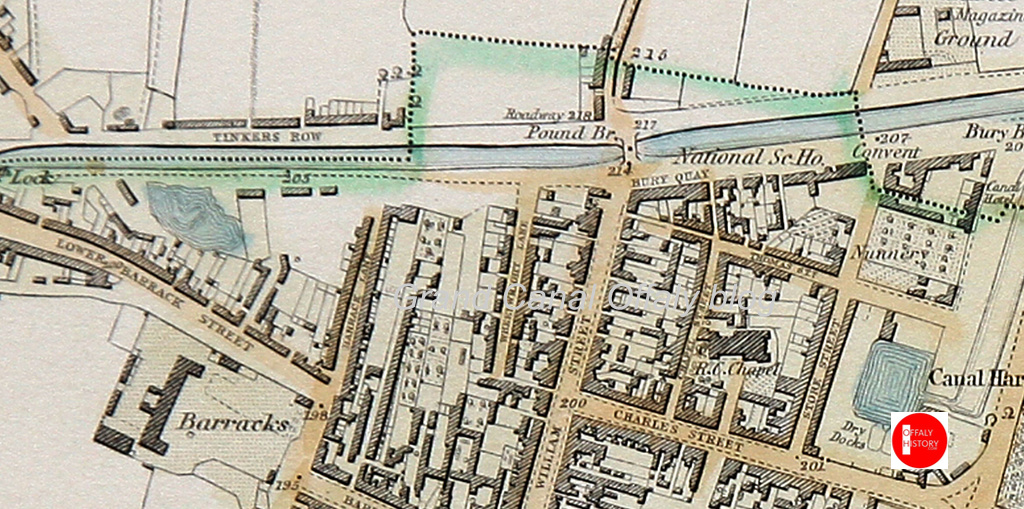
The line of the Grand canal to Philipstown and Tullamore is the only navigation through this county, and is material advantage to the district, through which it passes. Levels have been taken, and the line laid out for a further extension of this canal to the Shannon, with off branches to Birr and other towns, which is not yet put into execution.
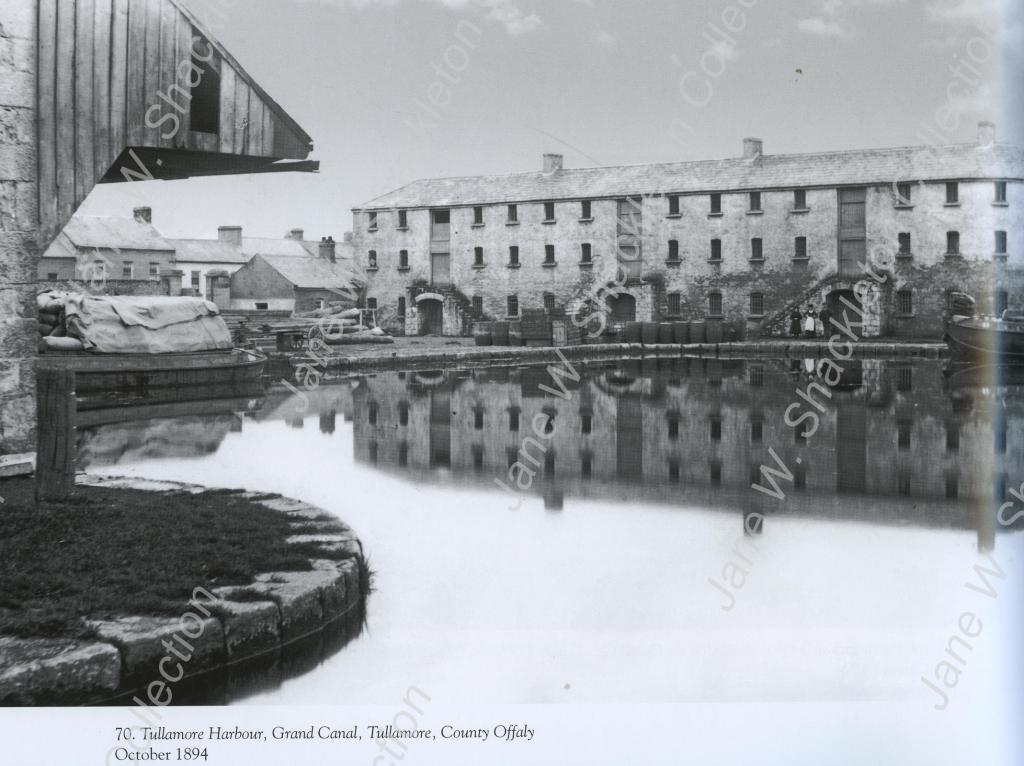
The terminus of the line from Dublin to the Shannon was Tullamore for the years 1798 to 1804 when the link with the Shannon was at last completed. In the 1790s a line to Kilcormac and Birr was considered but on the grounds of expense that along the Brosna was selected.
[175] Ballicowan village is the estate of the [176] Earl of Mountrath, and here are the ruins of a castle, which gives name to the barony. Turf fuel is in plenty, and had on the cheapest terms. . .

Tullamore is the market for grain, and indeed the produce of many adjoining baronies is sent thither, there being the fairest sale and a good demand amongst the buyers, occasioned principally on account of the many stores, which were established by the Grand Canal extending here, and which divides this barony for some distance. This proves the value of inland navigation and gives the farmer in these distant parts the advantage (as we may say), of bringing Dublin market home to his door.
Lord Charleville only tills green crops for winter food for his sheep. Wheat acre averages four barrels, oats eight, potatoes forty barrels of twenty stone; potatoe land sets for £.5, or guineas per acre, hay 6 guineas per ton, and the average price of land is but 14s. per acre through the barony. Wheat and Oats are the principal crops and make the best return; potatoes are generally sown in the moors, which, when they have dung, they sow in the uplands; they make but a poor sallow for their wheat, which succeeds their crop of oats, but they always break ground with potatoes. The implements of husbandry are only those of the oldest fashion. Cottier’s wages 8d. per day through the year, and provisions are cheap in general. Turf fuel is in great plenty and had on the cheapest terms.
Farms being so numerous, of course, the country is very populous of the lower order; but few resident gentry; of these are Lord Viscount Charleville, who resides at Charleville demesne, Mr. Stepney of Durrow, and the Rev. Mr. Turpin whose seat [Brookfield and now the lands of Tullamore Golf Club] adjoins Charleville; this gentleman has made improvements and adorned his demesne with well enclosed plantations.
Tullamore the best town in the county
Tullamore remarked Coote was the best town in the county, but of Birr/Parsonstown he went on to say that it was ‘by far the largest in the country; here are breweries, distilleries, malt houses, cloth and serge manufactories: it has an excellent market, is also a post town, and has a barrack for two companies of foot’.
[176] Coote described Tullamore as a very neat town situate on the river Clodagh, and owes its newly acquired consequence to the present Lord Charleville, from whence his Lordship takes the title of Baron, this town and about 2000 acres adjoining being his estate : about fourteen years [1785] ago it was but a very mean village, with scarce any better than thatched cabins, which were almost all destroyed by accidental fire, occasioned by the launching a balloon, and since has risen, Phenix [sic] like, from its ashes , to its present pre-eminence : it is certainly the best town in the county, and bids fair to be little inferior to any town in Ireland; the houses are all slated, built mostly two stories in height, and ornamented with window stools and top courses of a fine hewn stone.

The linen manufacture has been introduced here, and is likely to be pursued with spirit; as I have already stated when speaking of this manufacture in Kilcoursey barony [Clara and district] this, seems to be the proper place, and most central situation for a Hall under the superintendence of a seal-master; it would doubtless be of the first consequence to the trade, and the manufacturers would certainly consider it highly to their benefit to have the market established here, from the assured patronage every public work receives under the care of Lord Charleville.
[176] A brewery and distillery are worked in this town, and two more breweries are erecting; [177] here is also a bolting mill if inconsiderable powers on account of the lackage of water. This indeed is the only obstacle to its becoming a great manufacturing town; over the river Clodagh [in fact the Tullamore or Maiden River] is a neat bridge, and stream nearly divides the town into two equal parts. The barracks are spacious and very handsome, the market is well supplied with provisions, and a neat market house has been built at his Lordship’s expence. The fairest regulations are here adopted for buyer and seller, which wise policy promises a steady resort and a sure supply of commodity to this market.[Not all agreed and there were difficulties in regard to the collection of the tolls.]
Lord Charleville gives the utmost encouragement for building, he has hitherto invariably let leases for ever of the townplots at 1s. per foot in front, and the tenant gets three lives of a reasonable proportion of the adjoining parks from 16s. to 20s. per acre; so rapidly has this town increased in wealth and consequence within these few years, and these parks now set for six guineas per acre, and are sought for with avidity at a still more enormous rent.
It is certainly a great pity this is not the assizes town, as independent of its elegance and excellent accommodations, it is considerably more central, and aptly situated than Philipstown, but the new gaol which is nearly finished there, seems now to have determined the point, which for some time past it was in the contemplation of parliament to have established at Tullamore. [The new county gaol in Daingean was completed about 1802 and a new courthouse about 1807. An effort was made to have Tullamore designated the county town in 1784, but it was successful opposed by the Molesworth and Ponsonby owners of Philipstown. Lord Charleville and his son Lord Tullamore secured county town status in 1832 and it came to pass in 1835 when the courthouse was completed and the assize judges sat in Tullamore for the first time.]
The woollen manufacture is also getting forward here, and from the great encouragement and peculiar attention [178] of his Lordship to every branch of manufacture, we may expect to see little undone to establish its consequence. The navigation extending to this town must be of the most material advantage to its manufactures; roads and bridges in but indifferent order in this barony, particularly so, between Tullamore and Birr, in which wild waste everything seems to militate against improvement. The streams, that water the barony, flow into the Brosna river. I do not learn that there is yet established a school of consequence in Tullamore, but here is the County Infirmary, which is humanely attended to by Lady Charleville, and a machine for restoring life to persons apparently drowned, is now erecting at her Ladyship’s expence. So many fatal accidents, that have occurred on the lines of canals for want of medical assistance, call for the universal adoption of this humane institution. Little specie is seen, and principally purchased by the yarn buyers, who frequent Connaught markets. The plantations in this barony are confined to the demesne grounds of Lord Charleville, and those of Mr. Stepney of Durrow. There is no nursery for sale, building timber is got from Dublin by canal, and at Lord Digby’s woods at Killeigh, about four miles distant, is had that for country work. The quantity of waste ground from the extreme shallness of soil, and extent of bog, is very considerable, and occupies above half of the barony; the immediate appearance of the rock on the surface of the [179] uplands, and the moors [bogs] being full six months under water every year, present great and almost unconquerable natural obstacles to their improvement. Indeed, sinking the bed of the river, is the only experiment could be tried to remedy the flooding of the bottoms, and might probably have some good effect, but the extent of the line, and great expense, must render if rather a hazardous undertaking. The want of industry as well as of capital is the bane of this country, and the true cause of the desolate, and uncultivated appearance of many places, which have not the same great natural disadvantages of other parts of the barony, and only want fair play and industrious application, to repay a careful improver.
[181] Several chalybeate spas of sulphureous quality are also found in this neighbourhood. The ruins of Stra Castle are near to Charleville, [182] on the eastern side, and on the western is Ballicowen castle, from whence the barony takes its name. This castle has yet the vestiges of great magnificence; over the entrance is the following inscription, “This house was built by Sir Jasper Harbert, Mary Dean Finglass his wife, in the year 1626; under this inscription is the family arms with this motto,
By God of might,
I’ll hold my right.
Durrow is a small village, about two miles from Clara, adjoining which, is the fine mansion and demesne of Mr. Stepney. Raghan is a very inconsiderable village in this barony.
This country was originally the property of the O’Dempsey’s [O Molloys], a famous Irish clan, and no other matter on record relative to its history but what is given in the introduction.
The most remarkable piece of antiquity in this province is that ruin, called the white obelisk, or Temple of the Sun, erected long before the introduction of christianity into this island; it is a large pyramid formed of white stones, situate in the Slieve Bloom mountains, and resenble those, which have been seen in all the Celtic nations.
Bladhma is said to be corrupted from Beal-di-mai, whence Sliabh-beal-di-mai is the mountain of the worship, or necromancy of Beal’s day. These mountains form the most remarkable feature in the view of this country, being conspicuously seen from every part of it, and have been celebrated by Spencer in his Fairy Queen, from whose summits he probably was furnished with the scenery of his poem.

POLITICAL ECONOMY.
SECT. 1. Roads & Bridges.
[186] THE roads of this country coming under general consideration, certainly require more care and attention than now seems to be practised, and nothing can be said to recommend them. Materials are excellent and convenient enough, as gravel is very plenty: the breadth is in most places sufficient, but the gravel is laid with too staring a hand; bridges are too generally narrow, and with very low arches, which throw much back water on the adjoining flats.
SECT. 2. Canals.
 offalyhistoryblog