
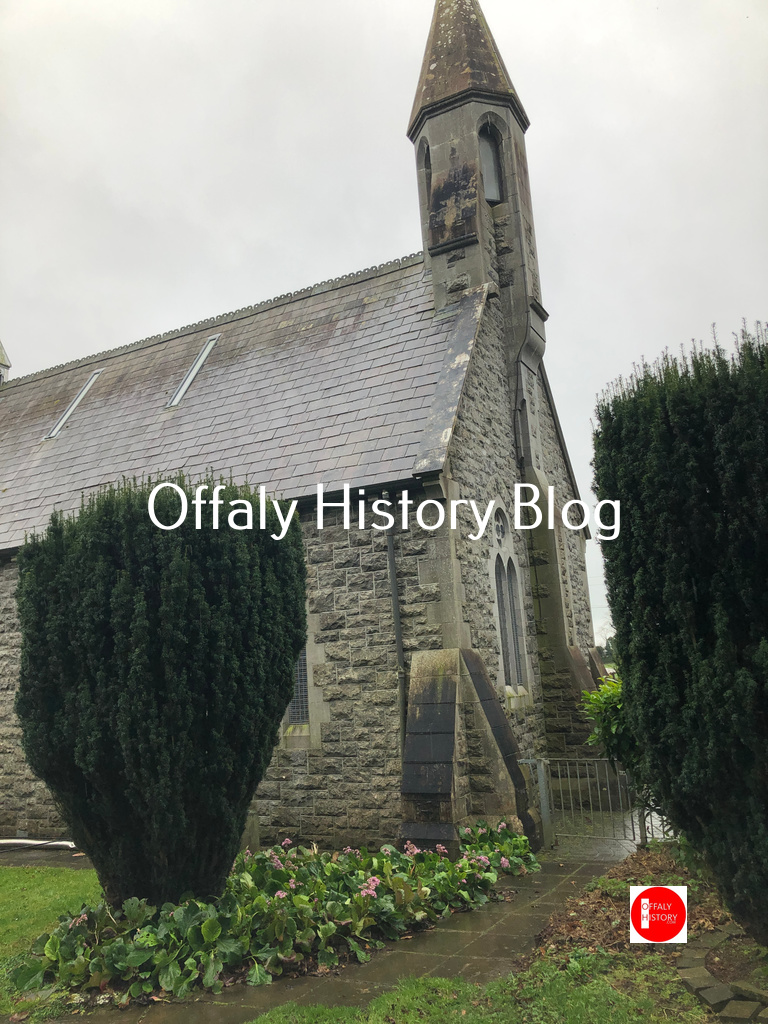
The James Francis Fuller-designed church was one of two new Church of Ireland churches in the Tullamore area completed in the 1880s. The other was at Lynally and was the gift of Lady Emily Bury (died 1931) to mark the recent death of her young husband Charles Kenneth Howard. That at Durrow was to replace the 150-year-old church in Durrow Abbey demesne and which had been rebuilt in about 1730. Other churches such as Tullamore, Killeigh and Geashill had all benefited from funding in the early 1800s and were in better order. That said there was probably a degree of self-interest as much as selflessness in the gift of the new church at Durrow by Otway Fortescue Graham Toler. The old church was in Durrow Demesne close to the manor house of the Norbury family and one could understand them wanting to see it placed elsewhere. The well-known agent, Toler Garvey, had beautified the demesne with the provision of a new well and the placing of the High Cross in the graveyard in a line from the entrance door to the old church. The Norburys had purchased the Durrow estate in 1815, and it was here that the second earl was murdered by an aggrieved tenant in January 1839. It appears that the family did not take up residence in the new manor house until the mid to late 1850s.

Otway Fortescue Graham Toler (1824–1884), the owner of Durrow, was the brother of Hector John Graham Toler, third earl of Norbury. Otway F.G. Toler was unwell at the time of the consecration of the new church in June 1881 and died three years later. You will note from the report below that it was his agent Toler Garvey who presented the conveyance of the lands on the day of consecration in 1881. Otway F.G. Toler was succeeded by Hector Robert Toler of Durrow Abbey, High Sheriff 1893 (died 1899) and in turn was succeeded by Otway Scarlett Toler who was a minor, born in 1886 and would have come of age in 1907. He was High Sheriff of King’s County in 1911. It was he who attempted to close off the right of way to the abbey graveyard when it was closed for burials in 1913. He donated additional ground for the Catholic cemetery at Durrow in 1917. The first Lord Norbury (the so-called ‘hanging judge’ had donated the magnificent site for the Catholic church built in 1831, a few months before his death.

Durrow Abbey house was destroyed during the civil war in an act of vandalism as that wasteful war was all but concluded. It was rebuilt with compensation from the state and Otway Scarlett Toler lived there until his death in about November 1940. His wife, Mona Graham Toler, had fond recollections of Durrow and died only in 1982. In the 1950s the estate was acquired by the Slazenger family and sold in the mid-1960s to Michael Williams, a grandson of Daniel E. Williams. He in turn sold it to the O’Brien family about 1992.
Coming back to 1881 the Lawrence studio arranged the photograph of the opening of the new church. Does anyone have a copy? Like Lynally the new Church of Ireland Church did not survive in use for 100 years. It was sold into private ownership in the 1990s and is now carefully and lovingly maintained by Enrica Bertilini Cullen.
By courtesy of the owner it will be opened for the Offaly History visit during Heritage Week on 18 August at 3 p.m. The tour will include a visit to Durrow RC cemetery, the Church of Ireland cemetery and the former Protestant church at Durrow built in 1881.
The report of the opening of the new church from the King’s County Chronicle, 30 June 1881
Evidence, if it were wanting, of the healthful, active vitality of the Protestant Church, disestablished and disendowed as it is in Ireland, was amply forthcoming in the King’s County on Thursday last when a new building, erected at an individual cost, was consecrated to sacred uses. The locality was Durrow, close to Tullamore, the edifice its parish Church, and the donor the Hon. Otway Toler. Happily for the present and future of the Church of Ireland such proofs of the place it holds in the affections of its members are neither singular nor infrequent, and it is no exaggeration to say, that during the decade that has passed since the legal confiscation of its property, more practical testimonies of this feeling have been given than, probably, its previous history affords. This observation, be it noted, refers to the work of renovation and restoration, and without trenching on its other aspects, which, however, may be regarded as equally hopeful, and despite the “pressure of the times” it is a matter for congratulation that the work progresses apace. Nearer home, the parish in which we write, has lately shown that it can take its part in the restoration of the fabric and in many minor instances, while the King’s County Protestants were thus evincing their attachment to the Church of their fathers it remained for that portion owing its allegiance to the diocese of Royal Meath to enter into its share with a generous whole heartedness which at once completes and crowns the glorious cycle of local Church work.
Having said so much, by way of preface, it may be added that for some years past the disproportion, thorough age and dilapidation, of the ancient parish Church of Durrow to the requirements, called for a radical improvement, but whether the change should be one of restoration or total re-building was a matter for consideration. Many and serious objections were urged against the latter source, the first and main one was that of expenses and this, in addition to one of sentiment. In these latter-day periods at the first blush it is quickly conceded that – to use a popular idiom – when expediency enters at the door, sentiment is very apt to fly out through the window. But it in out always way to draw a hard and fast line at where the one should begin and the other end, and after making due allowances for the claims of expediency it will be admitted that on few occasions is sentiment so strongly to the front as in the time of the old parish Church, Hoary and grey as it has grown in the service of generations, its ivy covered walls in themselves so many have loved memories, from its very stones there speaks, if thought of the past, the memories of the treasured past. Under its moss grows roof, bending with weight of ages, did not our forefathers worship, and in its little ‘ God’s Acre’ outside do not their bones lie mouldering is in the dust awaiting the one great day of general assembling, it profile of of tombstones tell us sometimes, in the quaint old language of bye-gone days of the merits of those whose very names are only recallable by the study of their inscriptions. These and many other reasons pressed themselves so strongly against the substitution of the old for the new, and coupled with the seemingly insurmountable expense attendant on an entirely new building all but determined the parishioners on abiding by the ‘old love.’

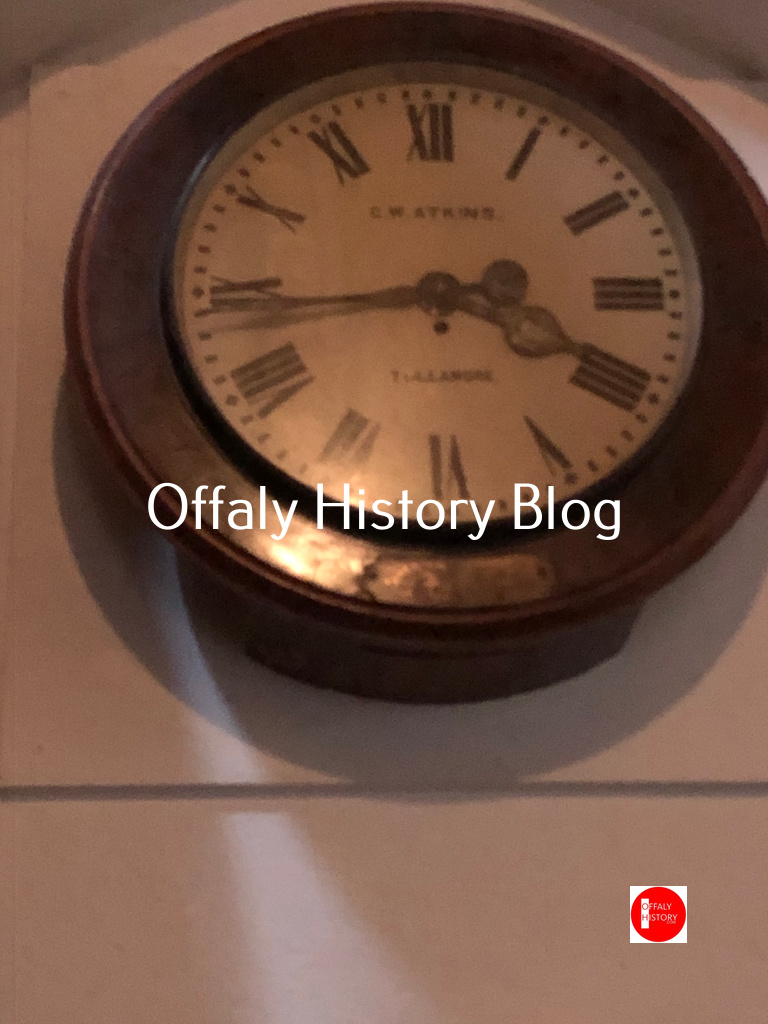
At this juncture the Hon Otway Toler, with a large-hearted munificence which is beyond all praise, came forward and taking the step which culminated in the services of Thursday last, relieved the Protestant neighbours of further anxiety. The parish, comparatively a poor one, the resident Protestant population consisting principally of a sturdy, though naturally not a wealthy yeomanry, how the offer of their friend – and in many instances – landlord was received can be well be appreciated, and although the sacrifice of the old edifice, situated as it is in the demesne and forming almost an integral portion of Durrow Abbey, came home to him with redoubled keenness, yet Mr Toler resolved at once to put personal considerations aside and have a new parish church more centrally conveniently situated. How his generous intentions were fulfilled was best seen by those who had the pleasure of joining in Thursdays’ services. That in no one resect was it found wanting can be understood it is said that to his excellent agent. Mr Toler R. Garvey, was confided the bulk of the responsibility and to the veriest detail from first to last that confidence was, it need hardly be added, not misplaced. Standing on an enclosure of some couple of acres, also gratuitously presented to the parish by the same donor, the new church of Durrow forms a striking object in the surrounding scenery. Although not large it amply meets the requirements of the district, and externally as well as internally it may be regarded as a model of gratefulness and utility combined. To Mr J F Fuller, F.R.SA, the eminent ecclesiastical architect, Dublin [1835–1924][1] was entrusted the designing, and if unanimity of admiration be accepted as the criterion of success, Mr Fuller may be said to have won it in its completest shape. The builder was Mr Henry Sharpe, of Kells, and he likewise gave the fullest satisfaction in carrying out Mr Fuller’s design. The pretty little edifice, which is calculated to seat somewhat over one hundred people, is built in the style known as that of the “Early Decorated” period, though of decoration there is little beyond its charming outline. It consists entirely of cut stone, and is surmounted by a cupola or bell tower, in which has been swung a sweet-toned bell. Internally there is little to note. The sittings, constructed in the prevailing fashion, comfort being the object rather than elegance, are of polished pine and the pulpit and reading desk of richly carved Irish oak. The eastern or chancel window is of stained glass of floral design. On the western gable is placed a brass tablet recording the fact that the Church is erected by the Hon. Otway Fortescue Toler in memory of his father, the late Earl of Norbury, and over the entrance door is a neat clock a contribution from Mr. James Mitchel, the worthy manager at Durrow Abbey (see image).
On Thursday last the ceremony of consecration was performed by the Right Hon. and Most Rev. Lord Plunkett, Bishop of Meath, assisted by his Registrar the Rev. Garrett Nugent, Rector of Kells, and a large number of the clergymen of the diocese as well as some from the adjoining diocese of Killaloe, including the Ven. Archdeacon Chester, and the Rev. A. O’B. Brandon, curate of Birr. At Durrow Abbey a large circle of guests were staying to meet the Bishop who arrived there the previous evening, and on Thursday morning he drove down from the Abbey, robed in full canonicals. Long before twelve o’clock every seat in the Church was filled, even the aisles and passages were occupied, and in the grounds outside numbers stood awaiting the Bishop’s arrival. At the entrance gate his lordship was received by the assembled clergy in processional order, habited in their surplices and academical hoods, and when the door was reached Mr James Mitchell, one of the Churchwardens, presented the petition for consecraton, which his lordship in turn handed to the Rev Garrett Nugent who read it aloud. The Bishop then took his place at the helm of the procession which filed up the aisle, repeating psalm XXIV, the responses being given by the clergy. The Bishop and his chaplains having taken their places within the Communion rail, Mr Garvey, on the part of the Hon Otway Toler, handed in the deed of conveyance which was laid on the table and the service proceeded. The Rev Joseph Chapman, for over thirty years the respected and beloved pastor of the parish, recited the ordinary litany while the special sermons for the day were read by the Rev Graham Craig and Mr Toler R. Garvey. At the conclusion of the Litany the Bishop ascended the pulpit and preached the sermon printed below. After sermon the Holy Communion was administered and immediately succeeding it the work of consecrating the portion of the grounds set apart for burial purposes was preceded with. The boundaries having been pointed out by the churchwardens, the Bishop and clergy walked in procession round the space reciting the prayers ordered for such occasions, and when these were concluded the Sentence of Consecration was read by the Rev Garrett Nugent, the formal deed of conveyance by which the Hon Otway F. Toler, joined by his son and heir, Hector John Toler, made over for ever the ground and its buildings were recited by the Bishop having ordered its enrolment in the archives of the diocese, the Benediction was pronounced and the interesting ceremony brought to a conclusion.
On returning to the Church door Mr William Lawrence, of Dublin, took a photograph of the entire group, with the bishop in the centre, the Church forming an admirable background.
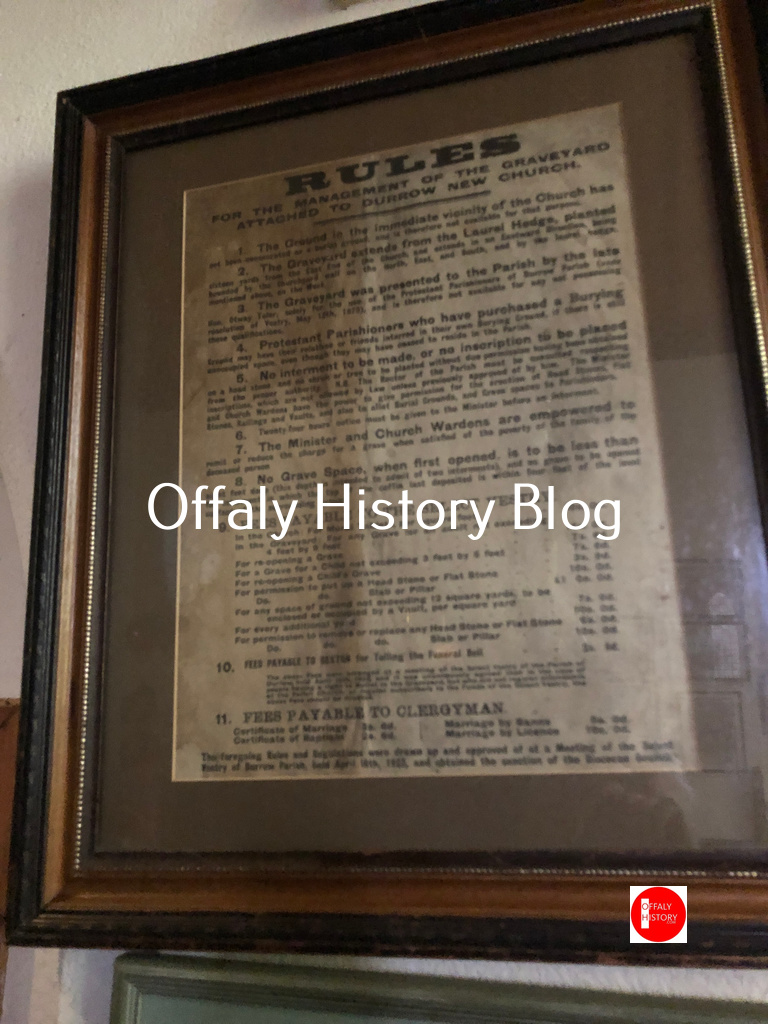
Later on a large party was entertained to luncheon at Durrow Abbey, and never probably did the fine old pile – splendid even in its unfinished proportions – look to better advantage. Nature, as if in unison with the events of the afternoon, had put on her most pleasing face, the frowns and tears of the previous days had given place to the most radiant smiles. On and through the dense masses of many-hued foliage with which the place is enriched, the sun – tropical at times in intensity – glinted and glistened, throwing a glamorous sheen over a picture worthy of an artist’s brush or a poet’s pen. Now, its rays penetrated some dark cavernous passage in the far off woods, lighting it up momentarily as if a thousand fairy lamps were glistening within, and as suddenly they withdrawn, leaving it involved in its original gloom. Again, a slanting beam fills like a golden mass on a variant slope, for a moment bathing the prospect in its glorious refulgence. St Columbkille’s cross, once lying neglected and uncared for in the little churchyard close by, but now, thanks to the thoughtful mind that leaves no detail unattended to, is standing proudly erect, a grim, grey monument of antiquity, was not without its admirers
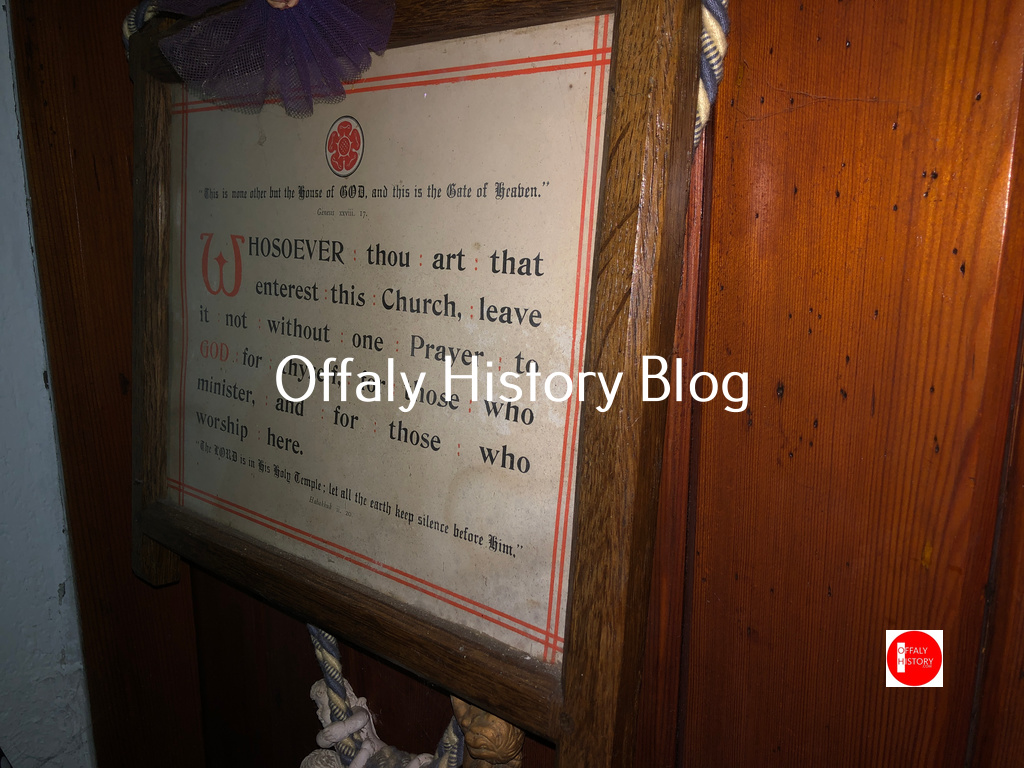
————-
Pilgrims, too, though worn who paid their devotions to his old saintship well, which the same kind hand reasoned from the regions of oblivion or Vandalism, and carefully fancing its youth put up the tablet which, tells the reader that-
“St Columcille used this well when he preached the Gospel, and built an Abbey near it A.D. 550,”
Then follows the quaint old couplet –
“Here angels shall enjoy my sacred cell
My sloe, my nut, mine apple, and my well,”
The portion of the wood – painful though its memories be – where the late Earl of Norbury was felled by the bullet of a cowardly assassin, came in for its share of notice, and the tree which the revered nobleman was then ‘marking’ when he received his death message, is pointed out. In a place teeming, as it is, with antiquarian delights, it is easy to understand how in the moments fly by the sun, a comparatively short time since high up in heavens, is rapidly sinking to his home in the west, getting deeper and more fiery in his shades as he sinks from view; the guests who so hearthly enjoyed the hospitality and witnessed the munificence of the noble donor – absent through bodily infirmity but doubtless with them in spirit – are separating. Is it any stretch of imagination to suppose that the eloquent language of the preacher that day found an echo in every breast, and that the prayers were deep, if not loud, for the generous heart and willing hand that provided so freely for the spiritual want of his native parish of Durrow?
[1] Fuller was for a time a diocesan architect and post1871 acted for the Representative Church Body. He was considered an authority on the Hiberno-Romanesque style. See DIB and Dictionary of Irish Architects (both online). Other work of Fuller’s in Offaly included Ettagh, Shinrone, Tisaran Glebe, Oxmantown Hall, Leinster villas in Birr opposite the RC church. Of Durrow the Dictionary records the following references: Irish Ecclesiastical Gazette 21, no. 246, 1 Sep 1879, 648; 23, no. 79, 2 Jul 1881, 461; IB 21, 1 Nov 1879, 344; Irish Times, 24 Jun 1881, 7; J.F. Fuller, ‘Reminiscences of Fifty Years’, IB Jubilee Number 1909, 24; J.F. Fuller, Omniana (1916), 183
18 August at 3 p.m. visit to Durrow RC cemetery, the Church of Ireland cemetery and the 1881 former Protestant church at Durrow built in 1880. This is now a private residence, and the visit is courtesy of the owner.
 offalyhistoryblog