
120 years has passed since the motor vehicle and driver licences registrations had been introduced in the UK and Ireland. The King’s Co (Offaly) county council was responsible in the collecting and registering drivers’ details and collecting fees. There were motor vehicles on the county roads from the late 1890’s, although there was no administration register for them. With the increase in motor transport on the roads by 1900 the council adopted rules of the roads act.[1] This included a twelve mile per hour speed limit in the country and eight mile per hour in the towns and villages. Bicycle and motor car owners must carry lights between sunset and sunrise, and a driver of a bicycle or motor vehicle dismount if they encounter a horse driven carriage, wagon or any other beast of burden until they were clear of the area to continue driving their motor vehicle. This law was updated 25th May 1901.[2]

The inside cover label of the 1904-23 King’s County vehicle registration ledger. Athlone Printing Works was owned by Thomas Chapman and was a subsidiary of the Westmeath Independent Newspaper (1883-1920). Courtesy Offaly Archives
In November 1903 at a meeting of the county council in Tullamore courthouse the council adopted regulations under the 6th section of the new Motor Car Act, which would come into force on the 1st January 1904.The principal rules were that “The county shall keep a numbered register of cars and motor bicycles; owners of motor register, and pay a fee of 20s, and in the case of motor cycles 5s. On the change of ownership, a re-registration fee of 10s for a car and 2s:6d for motor cycles. Persons driving any motor vehicle must be licenced and pay a fee of 5s per year. The legal age to obtain a licence was seventeen”.
The task of motor vehicle/licence administration was carried out by the council secretary’s office headed by Charles P. Kingston a local Birr native.
In the summer of 1903 Ireland received the letter (I) for its first licence plate letter and each county received a second letter in alphabetical order of counties. Offaly then (King’s Co) receiving the letter (R). Each vehicle was issued with its own alphanumeric number starting with IR.1 as the first vehicle registration. There were two categories for vehicles, private and public convenience, the latter being hired out by its owner to anyone who possessed a driving licence. Registration numbers could be transferred from one type of vehicle to another type and be registered in another county where the owner may have resided. This continued in many counties up to the early 1970’s.
The first people to embrace this new technology were affluent industrial families and large landowners were among the first motor vehicle owners in the county. Clergy and police were also encouraged to use motor transport for their day-to-day activities. The increase in vehicle registrations in the county from 1904 can be describe as slow and steady. From 1st of January 1904 to 23 February 1911, one hundred vehicles were recorded, and from 2nd November 1912 showed 150 vehicles registered. However, the beginning of the first world war, saw a large increase in registrations that included commercial vehicles. From the beginning of the 20th Century to the late 1920’s saw an increase in commercial businesses activity in the county. Road transport became more important for the supply of goods to branch houses throughout the midlands and beyond. Buildings in the county towns were re-developed and enlarged with new facade advertising a wider choice of imported goods. This can be seen more evident in the textile merchant businesses such as the many drapery buildings of the larger towns.
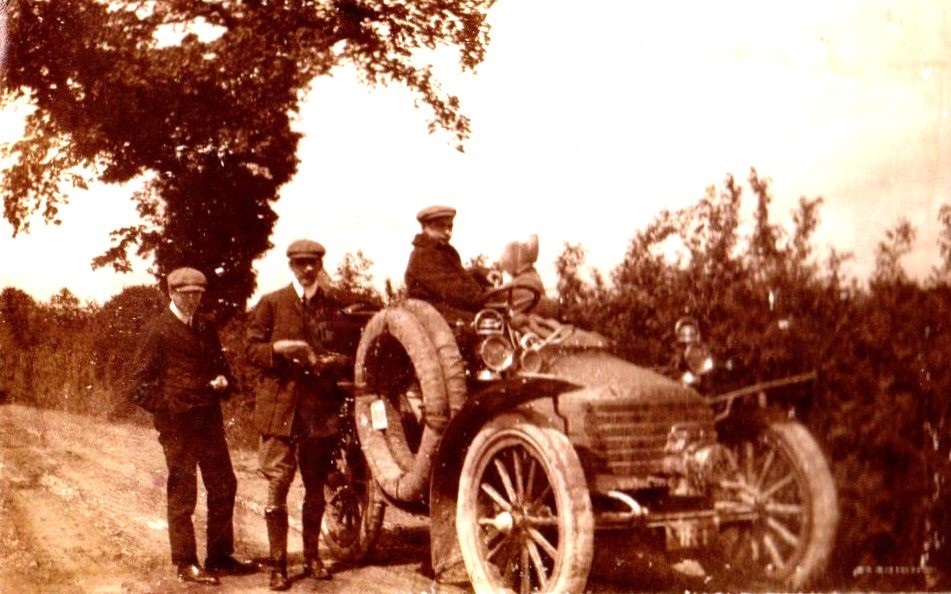
Motor Tour of the west of Ireland in 1906 , James Perry and party aboard IR 1 Wolseley[3]
The first vehicle registered in King’s Co (Offaly) IR.1 was a Wolseley 10 hp black car lined red for private use, James Perry Goodbody, Inchmore Clara.[4] The Wolseley Tool and Motor Car Co, Ltd Adderley Park, Birmingham. This company was acquired in 1901 by Vickers, Sons & Maxim engineering empire with Senior engineer Herbert Austin taking over the design of the car and motor.
This Wolseley power plant was a horizontal flat twin cylinder motor, chain drive to the back wheel, top speed 20 mph designed by Austin, and the first wholly British car to be mass produced from their Birmingham factory in 1902.The price with 36-inch tyres was £380.00. This registration number would stay in use on different vehicles in the Goodbody family well into the mid 1920’s.

D. E. Williams also registered IR 165. A four-seater Ford model T Car on the same date for trade. These new Ford cars were aimed at the commercial traveller and services that could now attend multiple destinations in one day’s drive and return. They came equipped with electric lights and window wiper, a hod and inflatable tyres that could the repaired quickly. Ford dealerships springing up all over the country in this period.
This new mode of transport had an impact on other professions such as: Agricultural consultants, Bank Managers, Doctors, legal administration and policing, Political, Religious and Sporting assembly’s and events etc.
Another large merchant business in the town with sixteen shops and licenced premises, across the midlands with their main office on Bridge St. was P & H Egan Ltd. Over the years this company built up a transport department and on 16th July 1915 they registered their first motor lorry, a Commer 2 ton for trade registered IR 236.
From 1912 local garages started to appear in the town. Robert H. Poole in Bridge St. was a motor and cycle agent with a large garage, service department and car hire. He was an accomplished competition cyclist and started selling Triumph motorcycles from 1904, also sales of used motor vehicles and in 1915 Ford and Overland cars.
James Arthur Kilroy, started his hardware, Ironmonger and garage supplying Ford model T cars from 1914 and later Maxwell five seat touring cars. James registered IR 162, a 3 HP Premier Motorcycle, 23 February 1913.
The first resident of Tullamore to register a motor vehicle was James Hayes b.1863 lived in Charleville street with his family. He was manager of the Charleville Arms Hotel and was a justice of the peace for many years at local petty sessions. He registered a Ford (Model T) car IR.11 in 1913 for commercial use, transporting guest around the area with a morning run to the town’s railway station. This car was assembled at the Henry Ford & Sons ltd factory Trafford Park, Manchester.
In 1914 Charles Kingston applied to the county accountant John Mahon for an increase in salary for himself and the county surveyor as well as additional staff to cope with the increase in road works across the county.[6]
As other smaller businesses were expanding around the town, Thomas English baker and general merchant William St. Registered a 20hp motor van IR 205, on 23ed April 1915 and held this number until 1923.This was a re-released Ford Model T, new to the market in late 1914 and was targeted at smaller local delivery business. This was a turning point for commercial transport as no longer did business owners need to burden the cost of horse drawn delivery carts and a man to look after them.

There is also a separate short index for Vehicles with registrations from outside of the county.
For example, John Henry Wakefield was a store assistant and driver for Joseph A. Lumley grocer, William St. On the 6th May 1916 John registered a Ford model T four-seater car RI 2971 (Dublin). In July 1917 he set up his own grocery business (Central Stores) on the corner of Bridge Lane and Bridge Street, now part of the Bank of Ireland building. He then transferred this number to his new Ford delivery van. These new ford vans were capable of carrying up to one ton with its long wheel base and factory-made body. This limited the speed between 15-20 mph.
Registration of motor vehicles during the war period was slow as most of the motor manufactures changed production to supply the WD (War Department) with transport of all types of machines, equipment as well as munitions. By 1919 the motor market became saturated with repurposed military machines, that drove down prices. As well as returning soldiers and mechanics struggled to find employment in garages, this led to low wages and high unemployment in the country.
From January 1920 the first signs of change hung over the country with outbreaks of hostility against the Crown Forces from the Republican Army, and the pursuing War of Independence continued until December 1921, and was followed from June 1922 when the Civil war began.
During these years registration of motor vehicles was slow. From 1922 most vehicles were taken off the roads by their owners, as they were being targeted and used for transporting armouries and republican volunteers to and from ambushes around the county. Other cars were adopted with armoured plate on the sides to protect the drivers and passengers as the country fell into lawlessness. Garages, general merchets were targeted constantly with fuel stores raided along with anything of value, the owners threatened and intimated into selling up or in some cases burning of premises and homes. This was the case with Robert Poole Tullamore and George Lee Castle St Birr, both men and families had sold out and eventually emigrated.
By 1924 motor registrations had bounced back with most large industries purchasing goods vehicles. (3) D. E. Williams Barrick St. (2) P&H Egan, Ltd Bridge St. (1) M.J. & L. Goodbody Clara. James Kilroy High St (Hackney). (1) Joseph A. Lumley William St.
By the mid 1920’s car sales started to increase, this led to another new garage in Tullamore.

O’Conner Square mid 1920’s[8] L-R: Rafters Drapery Store with facade of advertising. George N. Walshe premises, fire engine parked outside his shop. Access to his garage was through the gate to the left of this building. This was an old coach yard and stable building. Building to the right of Walshe was Egan’s brewery house, Daly’s shop and arch entrance to Egan’s brewery and stores houses. The town switched to electric lighting in 1921.
Other families in the area that would go on to set up their own garage and motor works shortly after the first Motor Registration ends. Frank Hurst, O’ Moore St. started his Motor works in 1926, repairing agriculture machinery (Irish made Fordson tractors and small stationery engines) that was now replacing the work horse. Among his many staff was a young George Colton (1899-1931) Gorteen, Killeigh, motor mechanic who worked for G. N. Walshe before joining F Hurst Motor Works.
Unfortunately, the vehicle registration ledger is incomplete and ends in June 1923. There are no motor vehicle registration legers known to exist between 1923 and 1945.
Offaly Archives is the depository for all motor licences ledgers from 1904-1928 however there is also a gap from 1928-45 for licence registration’s (OFCC 10/5/1). The surviving ledgers are a wonderful source of information to anyone with an interest in early motor transport in the county and the early pioneers who embraced this technology.[9]
[1] K.C.C. 12 November 1903 p.1
[2] This was the (Locomotives on Highways Act) that was amended in 1896.
[3] Image Courtesy of Michael Goodbody
[4] Offaly Archives (OFCC10/5/1)
See also: James Perry Goodbody, Offaly’s leading industrialist and county council member for 21 years (1853-1923) By Michael Byrne April 19, 2023 Offaly History Blog.
[5] Image Courtesy of Offaly History
[6] K.C.C. August 1914 p.3
[7] Image Courtesy Offaly History
[8] Image Courtesy of Offaly History
[9] Supplementary index 1924/25 OA
Our thanks to Tomas Ó Helion for all his research for this blog article on a subject that touches most of us. A second article on this subject will be published in the Anniversaries Series in October 2024.
 offalyhistoryblog