Patrick Lopeman was born at Riverstown, Birr in 1893 (although army records sometimes list 1894). Over the next decade, his parents Patrick senior and Letitia (Sometimes listed as Alicia) moved with the family between several addresses in Kildare and Birr. Patrick Sr worked as a painter.
In Lopeman’s youth his family suffered from economic hardship, living in lanes around Birr like Mount Sally which were essentially slums. In 1917, Birr’s parish priest Canon Horan described the conditions in which families like the Lopeman’s dwelled…
‘In many cases there were neither doors to the front or to the rear, and the roofs were also in a defective condition. It could hardly be said that there were floors to the houses and their condition generally was deplorable. In fact, he said the houses were nothing more or less than mouldering heaps of rubbish. How the poor people managed to live in such hovels he did not know…. they were unfit to kennel a dog’
Even by the standards of the time Patrick endured a very difficult childhood. In May 1904, his ten-month older sister Agnes died of hydrocephalus. In November 1905 his six-month-old his brother James died of convulsions. Three months later James’s twin sister Esther died of whooping cough and pneumonia. By the time of 1911 census Patrick Lopeman Sr had died, and the family were spread across different addresses. Eighteen-year-old Patrick was living in a boarding house at High Street, Birr with his younger sisters Bridget and Catherine.
The outbreak of the Great War in 1914 saw a surge in recruitment in the British Army, particularly from towns like Birr. Patrick Lopeman’s family had longstanding links to the British army. His cousin, brother-in-law and brother were all in military service at the beginning of the Great War, and in 1915 he enlisted in the Leinster Regiment which was soon dispatched to the Macedonian/Salonica Front as part of the 10th Irish Division.
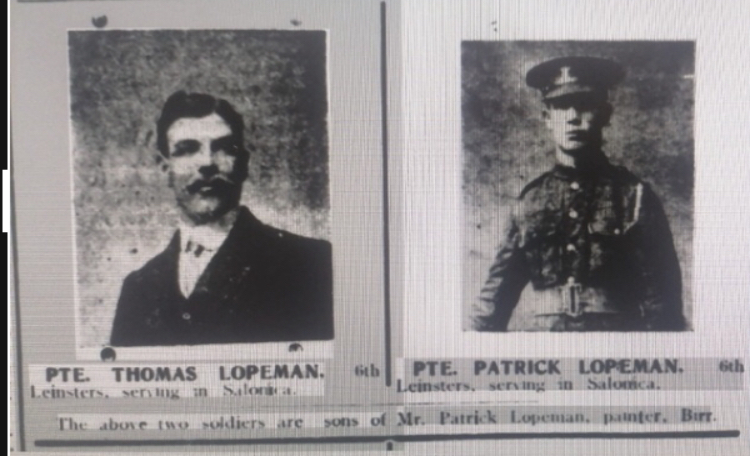
The Leinster’s were part of a multinational force which landed in then neutral Greece and proceeded to reenforced Serbian troops in their engagements with Bulgarian, Austrian and Ottoman armies. While the death toll on the Macedonian Front was lower than that experienced by troops serving in France and Belgium, illness was rife and Lopeman was one of the many soldiers to contract malaria while serving in the Balkans.
Deployed to Belgium as the war neared its completion, Lopeman reenlisted in the Connaught Rangers after the Armistice. The Rangers had been severely depleted in the early years of the war and several veterans from other regiments were recruited to bring their battalion strength up to the required numbers. On a return trip to Birr, he married Sarah Barkley who worked as a housekeeper in Birr RIC barracks.
By 1920, Lopeman and the Connaught Rangers were deployed to the Punjab of India. Conditions at the Wellington Barracks in Jullundur were far from ideal. Temperatures regularly reached 45 Celius and man management skills of some officers are reported to have left much to be desired. There was also serious uneasiness about the behaviour of British forces serving in Ireland. This disquiet often centred around Joseph Hawes. A Great War veteran, Hawes had witnessed the introduction of Martial Law in his native Clare before being deployed to India. Other rangers were reported to have been upset after receiving letters from Ireland detailing the activities of the Black and Tans.
On 28th July 1920, 5 Rangers including Hawes informed their superiors at Jullundur that they would no longer solider in the British Army in protest at the activities of the crown forces in Ireland. When these men were placed in custody, a large number of their comrades including Patrick Lopeman joined the mutiny in solidarity.
A standoff developed between the Mutineers on one side and their officers and those troops who had not joined the mutiny on the other. When work spread to a military outpost at Solon in the foothills of the Himalayas, more Rangers joined the mutiny.
Both groups of Mutineers asserted their rebellious streak by singing rebel songs and displaying tricolours. The Mutiny ended after a few days but not before the loss of life. While the protest at Jullundur was largely peaceful, privates Patrick Smythe and Peter Sears were shot dead when mutineers armed with bayonets attempted to capture the Solon armoury. Sears was probably an uninvolved bystander killed by a stray bullet.
61 men were convicted at the court marital which followed the mutiny and 14 were sentenced to death. All but one was reprieved. James Daly from Tyrrellspass, who had led the attack on the Solon armoury was executed by firing squad at Dagshai prison on 2nd November 1920. Another prisoner John Miranda from Liverpool died while imprisoned in India.
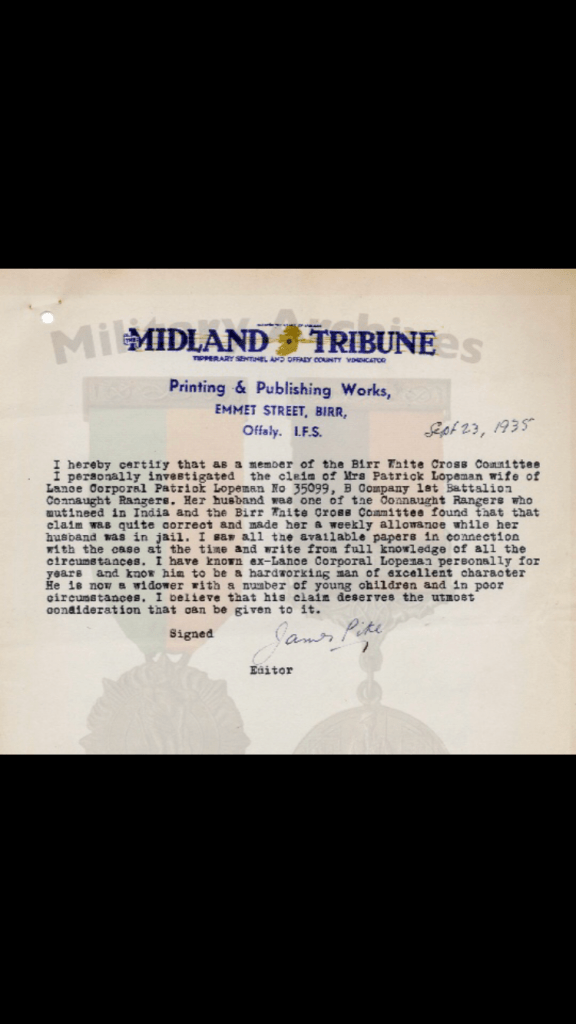
In August 1920, Patrick Lopeman was sentenced to 2 years imprisonment for his role in the munity and transferred to Woking prison in England from where he was released in early 1922. Returning to Birr he worked as a labourer on building projects and council road works.
Economic conditions during the twenties were deeply unfavourable and worsened further after the Wall Street Crash. In 1932, Patrick Lopeman led a protest march of the Birr unemployed and met with the urban council to discuss way of alleviating hardship among the town’s working class. A member of the ITGWU, he was elected to the town council as a Labour representative and served for 2 years.
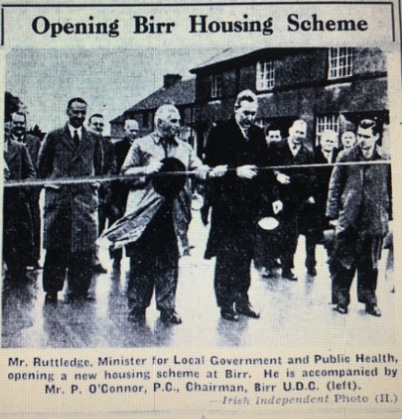
Sarah Lopeman passed away in 1935. A year later the government introduced legislation granting a small pension to those Rangers who had been imprisoned for their role in the mutiny and Patrick was one those mutineers to qualify. In the early 1940s, he moved to a new house High Street, one of a series of homes built as part of a slum clearance project in Birr.
In 1963 Lopeman was one of several mutineers interviewed by Sam Pollack for a BBC radio documentary and subsequent book ‘Munity for the Cause’.
James Daly, Patrick Smythe and Peter Sears were disinterred and return to Ireland in 1970. Smythe and Sears were buried at Glasnevin, while Daly was reinterred at Tyrrellspass after a large republican funeral. The remains of Liverpudlian Joseph Miranda still lay at Dagshai.
Patrick Lopeman passed away in February 1971 and was buried at plot 128 in Clonoghill cemetery Birr.

Note on other Offaly connections to the mutiny.
Joseph ‘Forty’ Walsh, Tullamore was convicted of mutiny and imprisoned in Walton Gaol, Liverpool. During his incarceration he composed a ballad on the mutiny. He served in the National Army and later moved to Dublin. On his death in 1948, he was buried at Clonminch cemetery with military honours provided by the Tullamore old IRA.
Michael Fitzgerald from Birr was given a life sentence for his role in the mutiny. The Irish Free State lobbied for the release of the Mutineers following the signing of the Treaty. Fitzgerald was one of the last mutineers released from custody in January 1923
Jack Lloyd was acquitted at court martial and discharged. A member of Tullamore’s British Legion during the 1930’s, he later emigrated to Scotland.
Edward Horan of Boolinarig, Eglish, took part in mutiny, but was not charged before a court martial.
The author wishes to acknowledge the assistance of PJ Dooley and Stephen Callaghan
Sources:
1901 and 1911 Census. Search online at http://www.census.nationalarchives.ie/search/
Military Service Pension Collection. Patrick Lopeman Con.Ran.10. Search online at https://www.militaryarchives.ie/collections/online-collections/military-service-pensions-collection-1916-1923/search-the-collection
PJ Dooley. Lopeman Family History Research.
Irish Independent. 2 November 1932.
Irish Press. 18 June 1934.
Leinster Reporter. 20 May 1916. 13 November 1916.
Midland Tribune. 20 February 1971.
Nenagh Guardian. 17 September 1932.
Nenagh News. 1 April 1922.
Offaly Independent. 20 July 1963. 3 April 1965. 7 September 1968.
Sources on addition note…
Military Service Pension Collection. Patrick Lopeman Con.Ran.10. Joseph Walsh Con.Ran. 149. Edward Horan Con.Ran.201. Search online at https://www.militaryarchives.ie/collections/online-collections/military-service-pensions-collection-1916-1923/search-the-collection
Freemans Journal. 18 October 1922.
Offaly Independent. 1 April 1922. 2 November 1935. 22 March 1952.
Derry Journal. 2 November 1921. 11 October 1922.
Irish Independent. 9 December.
Leinster Reporter. 3 November 1917. 11 November 1922.
 offalyhistoryblog