
Sean Robbins was born at Erry, Clara in 1892. After his father’s death he was raised by his mother Mary, a domestic servant. Robbins worked as a labourer in Clara’s main employer the Goodbody Jute factory.
Involved in amateur dramatics, in 1911 he played the role of a United Irish General in a patriotic play ‘Wolfe Tone’ staged by the local players group. A noted athlete, he competed in 220- and 440-yard races across Leinster. Having won a junior football medal with Clara in 1911, he went on to represent Offaly at senior level. Away from the field of play, he was club committee member, assisting men like Jim Rafter in the promotion of Gaelic games in the town. A well-known referee, Rafter dedication to the role, saw him described by historian James Clarke the as ‘The Knight of the Whistle’.
Robbins also served on the committee of the Clara detachment of the Irish Volunteers established by local nationalist councilor M.H. White in 1914. This unit appears to become dormant following the outbreak of the Great War. Following the Easter Rising both Robbins and White became associated with the growing Sinn Fein movement.

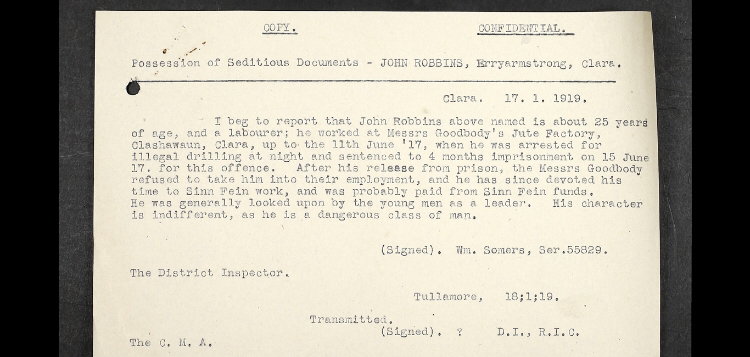
In 1917, Robbins helped organise an Irish Volunteers company at Clara. As a result, he was frequently imprisoned and lost his employment at Goodbody’s. While imprisoned in Belfast Gaol in August 1918, he took part in the GAA’s Gaelic Sunday and was one of a combined Leinster-Connacht team which lined out against a Munster-Ulster side on the prison’s exercise yard.
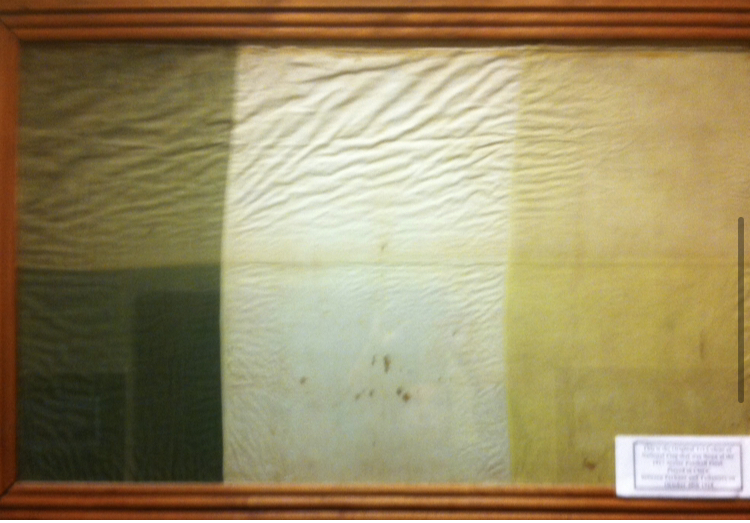
Shortly after his release from prison in 1918, the delayed 1917 county football was played at Clara. At the game, Sean Robbins hosted a tricolour manufactured by his neighbour Mary Margaret Bracken, herself an employee at Goodbody’s and Cumann na mBan member. This is believed to have been the first occasion at which a tricolour was flown during an Offaly County Final.
Arrested and imprisoned in late 1918, the following March, Robbins took part in the mass escape of 20 republican prisoners from Mountjoy.
While still ‘on the run’ he topped the poll as a Sinn Fein candidate in the 1920 County Council elections.
During the War of Independence, he participated in raids for arms, sabotage operations. As a Battalion officer Robbins took part in a series of attacks and hold ups on trains between Clara and Ballycumber.
In June 1920, he took part in the largescale IRA attack on Clara RIC Barracks.
Sean Robbins and Mary Margaret Bracken were married at Killina in September 1920. By the Truce he had been appointed Quartermaster of the IRA’s Offaly No. II Brigade.
Opposing the Treaty, Robbins was involved in a confrontation with pro -Treaty soldiers in April 1922 at Athlone, when Brigadier George Adamson was killed.
He was part of the anti-Treaty forces who fought National Army troops in West Offaly early in the Civil War. Promoted to O.C of the Anti-Treaty Offaly No. II Brigade, he was captured at Borrisoleigh in January 1923. Interned at the Curragh he participated in the camp hunger strike later that year.
Robbins moved to Birr shortly after his release from internment. He resigned his council seat following his appointment as a Home Assistance Officer for south Offaly but remained politically involved. A prominent Fianna Fail supporter, Eamon de Valera was a regular guest at the Robbins home in John’s Place.
Reengaging with Gaelic games he captained Offaly to a Leinster Junior hurling title for the 1924 season and lined out with the counties junior football side in the 1927 provincial final.
In February 1930, He refereed the first All-Ireland minor football final played at Birr between Clare and Longford and went on to officiate at numerous All Ireland hurling deciders including to two of the legendary Cork, Kilkenny games held in 1931.
A longstanding Chairman of Birr GAA, Robbins was one of the driving forces behind the club’s purchase and development of St Brendan’s Park. Chairman of the Offaly County Board on several occasions, he was appointed its Life President in 1959.
From 1936-38 he served as President of the Leinster Council. Throughout his administrative career he remained a vocal supporter of the GAA’s ban on foreign games, telling a meeting in 1939…
‘When we read of Ministers of State attending games under foreign codes, and when we read all the excuses and flapdoodle about Irish hospitality and Irish courtesy, we are inclined to think that the present ideal is far from the high standard of a score of years or so ago’ [1]
Having helped form a Birr Sluagh of the Volunteer Force in the 1930s, during ‘The Emergency’ he served as commander of the Local Defence Forces in south Offaly. He also took a leading role in the various ‘Old IRA’ veterans organisations.
On his death in 1960, Robbins received a military funeral to Clonoghill cemetery. T. McIntyre Cloghan; Peter Lyons and J. O’Brien Drumcullen; Carroll, Rathcabbin; W.Ryan, Moystown and T. McIntyre Galross served as pall bearers; while Michael Verney and Paddy Delahunty oversaw a firing party comprised of Bill Carroll, Roscrea; Sean Hynes, Banagher; Michael Clery, Carrig; Pat Riordan, John Verney and Michael Kavanagh from Birr.
Tyrrellspass native Tom Malone, who had operated as a Flying Colum leader in Limerick during the War of Independence under the alias ‘Sean Forde’ provided the oration. Malone had first met Robbins when they competed against one another on the GAA fields and at athletic meetings. Later they both took part in the escape from Mountjoy in 1919. Malone told the ensembled crowd…
‘There was no need to erect a monument to Sean Robbins there in that graveyard, because Sean Robbins had a memorial first of all in the Gaelic field in Birr, and he was sure he died a very happy death when he realised that all his work for the association was bearing fruit when the young men and boys of Offaly could at least hold their own with the cream of Ireland’ [2]
The long serving and at times controversial chairman of Offaly GAA Fr. Edmund Vaughan was a great admirer of Robbins and the central figure behind the acquisition of a cup to be presented to the winners of the Offaly senior hurling championship. Paddy Molloy of Drumcullen was the first captain to lift the Sean Robbins trophy in 1960. The Leinster council also acquired a Robbins cup, which is awarded to the Leinster under 21/20 hurling champions.
When the Offaly Senior Footballers returned to the county after the appearance in the 1961 All- Ireland final, they were led into Tullamore behind the flag which Robbins had unveiled at Clara in 1918. The flag remains in the care of Clara GAA club.

Sources:
1901 and 1911 Census. Search online at http://www.census.nationalarchives.ie/search/
Bureau of Military History Statements. Sean O’Neill Witness 1219. Search online at https://www.militaryarchives.ie/collections/online-collections/bureau-of-military-history-1913-1921/bmhsearch/
Military Service Pension File. Sean Robbins MSP34REF11307. Search online at https://www.militaryarchives.ie/collections/online-collections/military-service-pensions-collection-1916-1923/search-the-collection
Magic Memories Birr GAA through a lens. (2012) Birr.
Michael Byrne. The King’s/ Offaly County Council election of June 1920: ‘remarkable, memorable and revolutionary. Offaly History online at offalyhistoryblog.wordpress.com
John Burke. Athlone 1900-1923: politics, revolution, and civil war (Dublin) 2015.
Padraig Foy & Ciaran Reilly. Faithful Pioneers. (2011) Edenderry.
John Gibney. The killing of George Adamson, 25 1922. Online at https://www.westmeathcoco.ie/en/ourservices/planning/conservationheritage/decadeofcentenariesblog/thekillingofgeorgeadamson25april1922.html
Humphery Kelleher. GAA family sliver. The people and stories behind 101 cups and trophies. (Dublin) 2013.
Ian Kenneally ‘A Medium for Enemy Propaganda: the press, Westmeath, and the Civil War’, Journal of The Old Athlone Society, number 10, 2015.
Pat McLoughlin. ‘The Railwaymen: 1st Battalion, Offaly No. 2 Brigade the War of Independence and attacks on trains in the Ballycumber – Clara area.’ Online at https://offalyhistoryblog.wordpress.com/2021/07/28/the-railway-men-1st-battalion-offaly-no-2-brigade-the-war-of-independence-and-the-attacks-on-trains-in-the-ballycumber-clara-area-by-pat-mcloughlin/
[1] Irish Press. 20 February 1939.
[2] Midland Tribune. 6 February 1961.
 offalyhistoryblog