
One of the essays in the new book on Tullamore in the Sixties to be launched on Friday 6 December 2024 at 7.30 p.m. at Offaly History Centre (beside the new Aldi store in Tullamore, all welcome) is that by Terry Adams on his beloved Cormac Street, Tullamore where his family have been located for 150 years or thereabouts. Terry’s is an evocative piece and one of 29 essays in this new book on Tullamore with over 300 pictures.
I stood with my back to Lloyd’s field, surrounded by memories of childhood and family. On my left, back towards the town, my Grandmother Egan’s family home, The Hall, now the municipal council offices, nestles behind its railings and garden. Opposite, on the junction of Cormac Street and O’Moore Street, stands the building I was born in, now home to my brother Brian. My Adams grandparents’ house faces me across the street. Further along the imposing old courthouse and jail buildings sit in their solemn majesty.
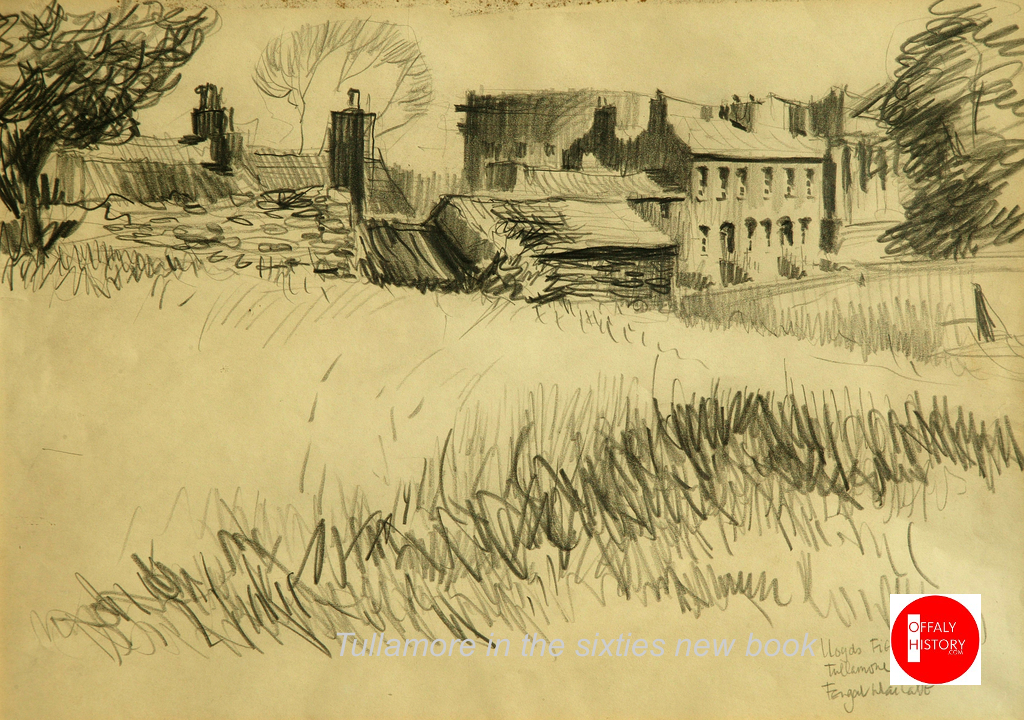
Cormac Street, my street, even if I have not lived here since 1981. When I think of home it is to this street, to these buildings, my mind roams. It is a major part of me, of my identity, of who I am, of who I always will be. I look back towards the town centre, the street has changed little since my childhood. The house exteriors, excluding The Hall, have not been radically altered but most of their old occupants have left us: my father, also Terry, Frank and Carmel Egan, Ray and Sylvia Courtney, Ray and Emer McCann, Mr and Mrs McNeill, Mr and Mrs Brennan, Bridie Byrne, Jimmy and Marcella Byrne, Mrs Behan, Paddy and Mrs. Lloyd……
The buildings may have changed little, having escaped demolition, reconstruction, alteration but the field behind me certainly has changed. I turn and enter ‘Lloyd Town Park’ the name inscribed on the plaque inside the gate. I’m delighted that old Paddy’s family name has been remembered in the official name but for me, and my generation, this field will always be simply ‘Lloyd’s field’.
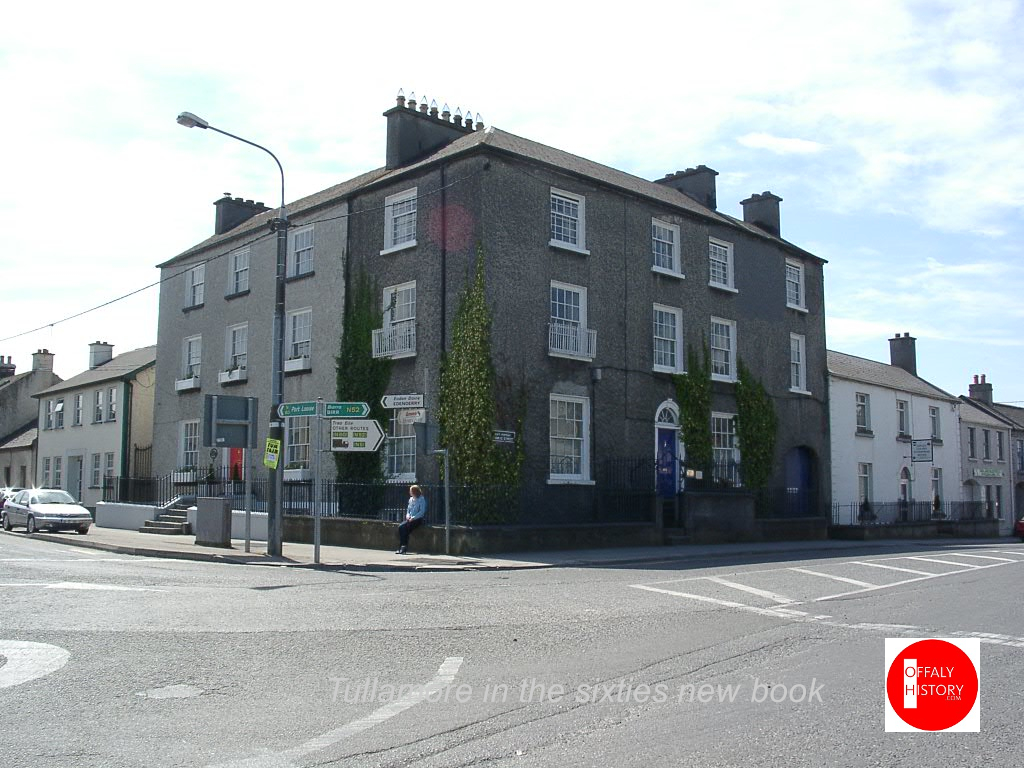
Cormac Street/Lloyd’s shop
I have fond memories of Paddy, an old-style gentleman. Really interesting to talk to if I’d only taken more time to talk to him, or more importantly listen to him, back when I was a teenager. He told me once that as a boy he ran messages up and down our very street for the IRA during the War of Independence. How many more stories had I never heard simply because I had more ‘important’ things to do than listen? His grocery, thirty yards back down Cormac Street, was a hive of activity when I was young being the main shop on the southern end of the town before Dunnes Stores and the supermarket era arrived.
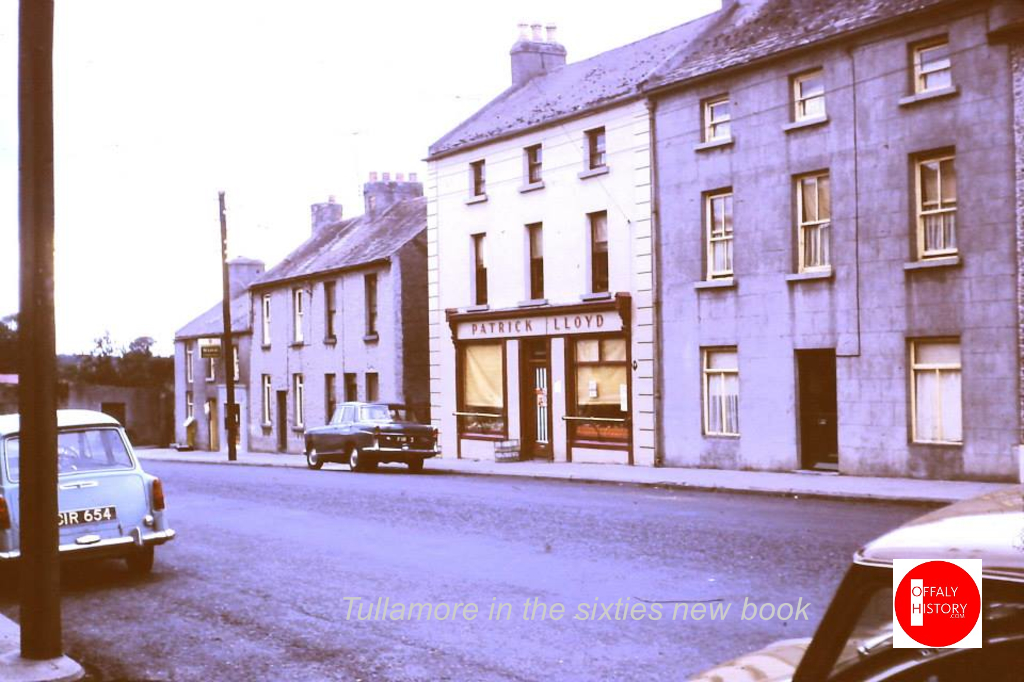
I stand and look out over the park’s green well-tended swards. I close my eyes and try to visualise what it was like back in the mid-sixties. I hear children of old play, play quietly, for strictly speaking we were not supposed to be in Lloyd’s field. It was private property, but I never remember being ejected.
Fruit trees graced the perimeters. Inside a long-overgrown hedge led to a little summer-house on a rise, unused then and long forgotten now. In winter we would wander down to the far corner against the river and the grain storage buildings. When the river overflowed a small shallow lake formed. If the weather was cold enough we had our own free ice-skating rink. Dan McCann from next door and Paddy Behan, from opposite the park entrance, might be with us. Dan was the older brother of my friends Ray and Jim, and quiet Paddy, with the distinctive white streak in his black hair, was a great soccer player with a lethal left foot. Sadly, both now have departed for the next world.
I reopen my eyes, replace the past with the present. The new landscaped park spreads before me. I walk down the slope, through the various apparatus in the children’s play area and on towards my destination, the cemetery. I glance at the plaque to the left of the gates. It introduces the cemetery and informs that in addition to graves of townspeople from 1770 to 1850 it contains a famine grave and graves of German soldiers. I lift the gate latch and enter.
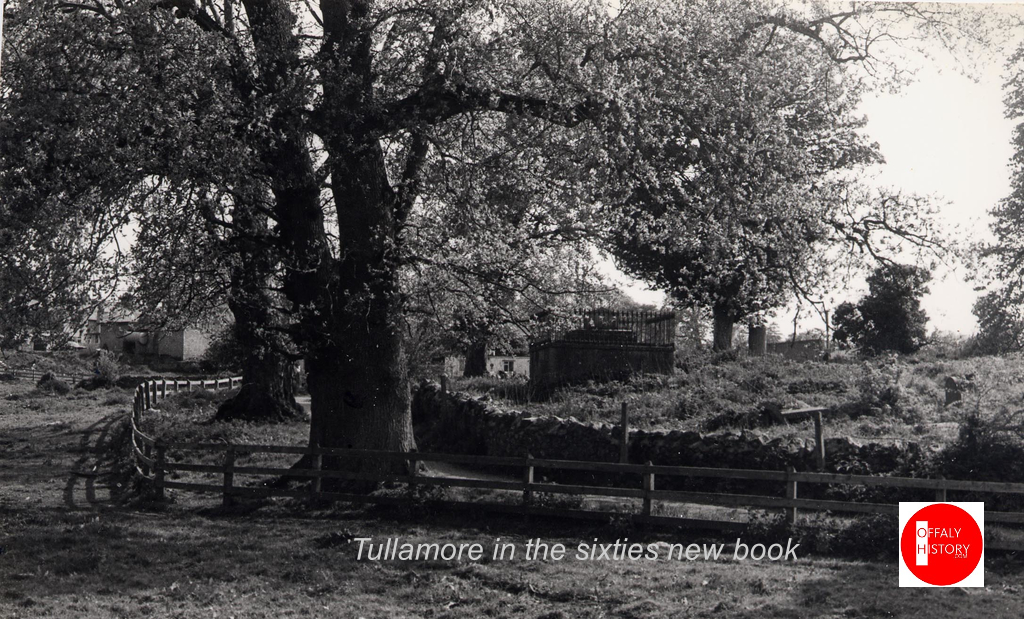
Kilcruttin Cemetery tombstones at Tullamore in the 1980s before the clean up. The Burgess mausoleum in the background.
With the aid of my booklet Kilcruttin Cemetery Tullamore[1] I locate the two German graves. First, Baron Oldershausen, late of His majesty’s 1st German Dragoons, who died on 22nd December 1808. Further on his compatriot, Christophe Koch, Rifleman of the 1st Light Infantry Battalion, King’s German Legion, who passed away on 26th July 1806. The Baron was said to have died in an ‘affray’ between German soldiers and Irish militiamen in 1808, but that was in fact two years earlier.[2]
Both these graves have headstones with names, regiments, dates of death and other details etched on them. Their fellow soldiers ensured their passing from this earth did not go unrecorded. Their efforts then ensure they are still remembered today. So it should be, most of us aspire to such a marker.
There are many other gravestones dotted around even one etched with my own family name, Adams, dating from 1796. No relation, however, as this predates the arrival of my ancestors to the town. On the other side of the graveyard, towards the river, there are very few gravestones. I walk over and sit on one of the few stone markers there, my back to the schools, Scoil Mhuire and Scoil Bhríde. Removing my sandals, I enjoy the feel of the soft grass under my bare feet.
I look down the length of the graveyard, out over the small stone wall, over the well-tended grass and trees of the park. It is so peaceful. Graveyards always seem to exude a feeling of peace. It is as if being in the presence of those eternally resting souls soothes those of us struggling through the present. The early sun warms, the smell of freshly cut grass delights, the quietness calms. I feel this would make a pleasant final resting place back to across the road from where I started.
I think of those lying under my warm bare feet. There are references to the burial of over 1,000 victims of the Great Famine here. According to a survivor’s report:
It was not an uncommon thing, according to Mr Pretty, to see as many as a dozen corpses at several intervals of the day, being carted to Kilcruttin for interment. The dead were buried in a deep trench ……..In this trench the coffins were piled one on top of each other daily for months. Men were kept busily engaged making coffins and digging trenches to receive the dead.’[3]
Day after day, dozen after dozen, score after score, accumulating to one thousand or more. So many were interred that the graveyard quickly filled to capacity. A new pit had to be dug on the northern side of the poor house, out the Arden Road, and perhaps another thousand souls found their last resting place there in the years after the Famine. Those unfortunates, at least, have a Celtic cross marking their resting burial place. You have to climb over a wall and walk across a field to get to this cross and the inscription is pretty much illegible but there is a cross, there is a physical visual marker.
My modern mind finds it difficult to picture those poor people: uncounted, unregistered, unwanted in life, unwanted in death. Hundreds of innocent men, women and children dying from starvation, from cholera in the middle of a rich agricultural land. Ordinary people trying to eke out a living and finding only slow painful death. It is hard to imagine surrounded as I am by bountiful nature and a prosperous twenty-first century town.
I wonder why we cannot, or do not, commemorate the ‘ordinary man’. If twenty, thirty, forty of the people buried beneath me had the energy to storm the police barracks and if five, ten, fifteen of them had been shot and killed in so doing, the whole town, and half the county, would be covered with streets, bridges, pubs named after them. We would sing songs glorifying their charge and learned men would write plays commemorating their deeds.
Alas, our famine heroes reposing in Kilcruttin Cemetery will remain forever unknown: their names, their number, their stories, their everything. They received no respect in life and they get no respect in death, not even a plain gravestone to mark their corner. I feel a sense of guilt for their neglect.
I rise off my stone perch. Say a prayer for their souls and leave the silent graveyard. Closing the gate behind me, I turn left, past the water fountains, across the footbridge linking old graveyard tragedies to new town realities.
Launch: 6 December 2024 at 7 .30 p.m. Offaly History Centre, Bury Quay, Tullamore R35 Y5VO (beside new Aldi and Old Warehouse). This is a bumper book and attractive and in full colour. The aim was quality and reliability. All are welcome to attend.
Now available from Offaly History Centre and online shop at http://www.offalyhistory.com and Midland Books in High Street. Bridge Centre for Christmas from 5 December.
456 pages, 350 pictures, €22.95. A limited number of signed hardbacks will be available at €29. 95. The contents amounts to 150,000 words and 350 pictures, many from the Sixties despite the scarcity of pictures in that decade due to lost collections from the professional photographers of that period. For the later pictures we have had the support of the leading practitioners since the 1970s.
Published with the support of Creative Ireland and Offaly County Council

[1] Kilcruttin Cemetery Tullamore, booklet complied by Offaly Archaeological Survey, September 1993.
[2]Information from Offaly Historical & Archaeological Society article – http://www.offalyhistory.com/articles/73/1/The-Battle-of-Tullamore/Page1.html
[3]Information from Offaly Historical & Archaeological Society article –
http://www.offalyhistory.com/articles/77/1/The-Famine-in-Tullamore/Page1.html
 offalyhistoryblog