
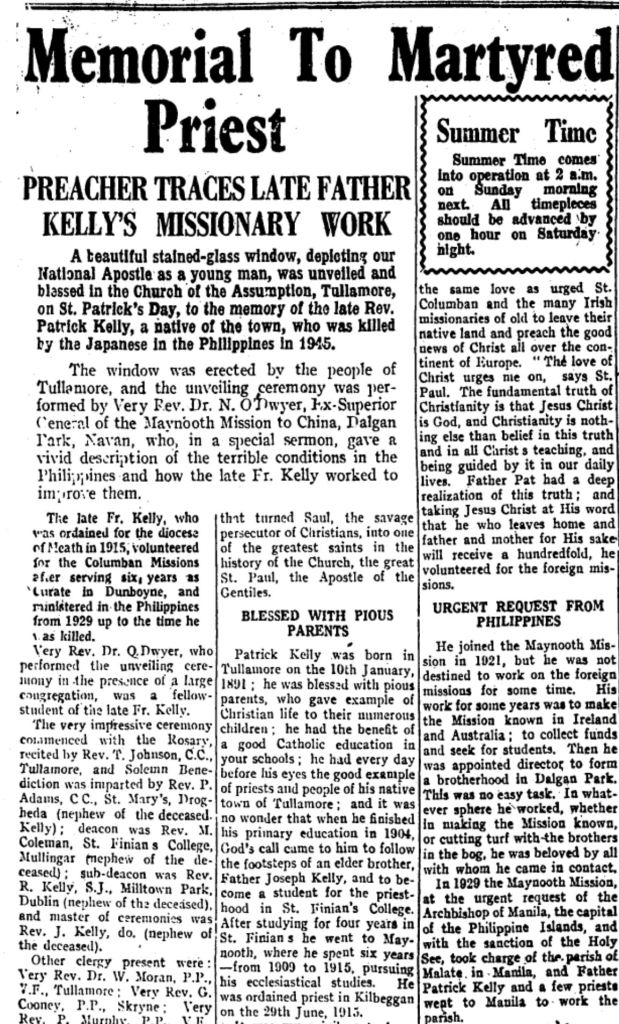
February marked the 80th anniversary of the Battle of Manila. Fought in the closing months of World War II, the operation to liberate the Philippine capital from Japanese tyranny turned into a massive slaughter of 100,000 non-combatants and the destruction of that beautiful city. Not widely known is that among those killed were five Irish Columban fathers who were based in the parish of Malate in Manila. One of them was Fr. Patrick Kelly from William Street in Tullamore. The others were Regional Superior, Fr. John Henaghan from Louisburgh, Co. Mayo; Fr. John Lalor from Cork; Fr. Peter Fallon from Dunmore, Co. Galway; and Fr. Joseph Monaghan from Banbridge, Co. Down.
On December 8th, 1941, just hours after they bombed Pearl Harbour in Hawaii, Japanese troops invaded the Philippine Islands. The defending forces, under General Douglas MacArthur, consisted of American and Filipino troops. Inexperienced and ill-prepared for battle, they retreated to the Bataan Peninsula, leaving Manila, the capital, undefended. By January 2nd, 1942, an advance column of Japanese soldiers had entered the city. Thus began a brutal three-year occupation of the islands.
American and Allied civilians were immediately arrested and interned at Santo Tomas University. As Catholic priests and foreigners, the Columbans were met with suspicion by the Japanese authorities. However, since they held neutral status, they were not imprisoned.

Fr. Kelly, the parish priest for the American Catholics in Manila, insisted on being allowed to visit them in Santo Tomas to hear confession and celebrate Mass. He was known to challenge the Japanese on their noncompliance with international laws regarding internees. Taking great risks, he maintained a crucial line of communication between the internees and the outside world, often providing support for escapees.
For the internees at the University, hunger was an issue from the start. For the first two years, local people were permitted to bring them food, medicine and clothing in what was known as the “packet line”.
By March 1942, Japanese forces had achieved significant territorial gains. To deny them the propaganda coup of capturing one of America’s most famous generals, MacArthur was evacuated to Australia. His promise to return served as a beacon of hope for the next three years.

Bataan fell on April 18th, followed by the island of Corregidor on May 6th. Subsequently, about 60,000 Filipino and 10,000 U.S. prisoners-of-war were forced to march over 100 kilometres under a blazing sun with little food or water in what became known as the Bataan Death March. Many of those who survived the march were transported to Japan while others faced death from disease, dysentery and starvation in local prisoner-of-war camps, where conditions were inhumane and minor or imaginary infractions resulted in death by bullet, bayonet or beating.

From the outset, the Columbans were involved in delivering humanitarian aid to the prisoners-of-war in the Bilibid and Cabanatuan camps. Their parish house in Malate served as a centre for storing food, medicines, shoes made from worn tyres and old clothes collected by Fathers Fallon and Monaghan. These were smuggled into the hard-pressed prisoners-of-war by Filipino resistance agents. Fr. Lalor ran a store outside the harsh Nichols Field work camp, where he provided the starving and overworked prisoners with food, medicine and clothing.
Over the next few years, about 250,000 Filipino guerrillas, 25,000 of whom were female, participated in a fearless underground campaign against the Japanese. Meanwhile, the Columbans sought alternative ways to alleviate what would become one of the worst humanitarian crises of World War 2.
In June 1942, the Irishmen took over a temporary hospital established by the Philippine Red Cross at their Catholic School in Malate. It was funded by wealthy Catholics and staffed by volunteer doctors and young women from Fr. Monaghan’s Legion of Mary. Fr. Lalor managed the facility, which he named Remedios Hospital in honour of the patroness of Malate parish – Nuestra Señora de los Remedios (Our Lady of Remedies). Using an assumed name and dressed as a doctor, he ministered to the sick and the dying. Initially, the hospital treated wounded and sick prisoners-of-war, but by the end of 1942, they were allowed to admit ailing or elderly internees from Santo Tomas.
In July 1943, the disappearance of their confrère, Fr. Frank Douglas, a New Zealander stationed in Pililla, Luzon, rattled the Columbans. The blood-spattered walls of the baptistery in the church in Pililla left no doubt as to the New Zealander’s fate.
By late 1943, food and medicines became scarce, and prices rocketed, while donations from the townspeople dwindled as they had barely enough for themselves. It was a struggle to fund supplies for the hospital patients, the civilian internees, the American prisoners-of-war and the local guerrilla groups.
In February 1944, the Japanese eliminated the “packet line”, which had been crucial for the survival of the civilian internees at Santo Tomas. The Columbans then arranged the delivery of aid through an underground supply network. It was a risky business because of the vigilance of Filipino collaborators.
On July 8th, following a major bombing raid on Tokyo, the Japanese interned 300 religious “enemy aliens” at the College of Agriculture at Los Baños, which became affectionately known as the “Vatican City”. The Irish priests, being of neutral status, were not imprisoned but had to wear red identity armbands. In December, the daily intake of calories in Los Baños was roughly 900 per person, and by January 1945, it had plummeted to about 570 calories. Their rations were soon reduced to “two scoops of thin rice water per day with corn and maggots”.
In September, with the war going against them, the Japanese appointed General Tomoyuki Yamashita to command their troops in the Philippines. By the time he arrived, American planes had already begun bombing strategic targets in preparation for their return to liberate the islands. When General MacArthur landed on the island of Leyte in October, many believed the occupation would soon be over, unaware that the worst was yet to come.
A few days before Christmas 1944, Fathers Kelly and Lalor, along with either Fr Henaghan or Fr Monaghan, were arrested. Meanwhile, the remaining Columbans cooked dinner for 200 starving Filipinos on Christmas Day. Tortured and beaten, the three priests were eventually released. Undeterred but more vigilant, they continued their humanitarian work.
Preparing to defend the islands, Yamashita divided his troops into three groups. Rear Admiral Sanji Iwabuchi was ordered to evacuate ammunition and food supplies from Manila, destroy her strategic infrastructure and then withdraw peacefully. However, in contravention of his orders, he fortified the city with landmines, gun embankments, concrete bunkers and strategically placed snipers for a fight to the death.
On February 3rd, 1945, U.S. troops broke through the gates of Santo Tomas and liberated the 3,677 emaciated internees, 480 of whom were children under the age of ten. They were just in time, as their food stores were nearly empty, and the supply of cats, rats, pigeons and weeds that had previously sustained them were exhausted.
With the liberation of Santo Tomas, MacArthur thought the war was over. He expected Manila to be an “open city” and anticipated a victory parade. However, the rest of the sprawling city, home to one million Filipino men, women, and children, remained under the control of Japanese troops, who were about to embark on a desperate and brutal killing spree.
They carried out systematic mass executions of men, women, children and members of religious orders by beheading, bayoneting, clubbing, hanging, burning alive, drowning and death by explosives. They inflicted unimaginable torture, raped women and girls of all ages, many of whom were mutilated or killed in the process and ripped unborn babies from their mothers’ wombs. In the background was the rattle of Japanese machine guns and the thunder of American artillery.
Iwabuchi sealed all the gates of Intramuros, the ancient walled city of Manila, and set it ablaze. It became a raging inferno as one section after another caught fire.
Soon after, American artillery began shelling the Malate and nearby Ermita districts. Most of the houses were made of wood, and soon, the district was burning, block by block.
The people of Manila were caught in a vice-grip between their oppressors and their liberators; if they remained in their homes, they risked being burned alive, and if they ventured outside, they faced the threat of Japanese snipers.
On February 7th, the Japanese looted and set fire to Malate church and presbytery. Fathers Kelly, Henaghan, Fallon, and Monaghan were arrested and taken to the nearby Syquia Apartments. Reports as to how they died vary. A Maryknoll nun, who was in Manila at the time, gave a harrowing account of their deaths to Professor James T Carroll of Iona University in New York in 1995 – “the Filipino guerrillas were assisted by the Irish Columban Fathers who maintained their cover well into the war. When the Japanese discovered that they were not pro-Japanese, they nailed them to the church doors”.
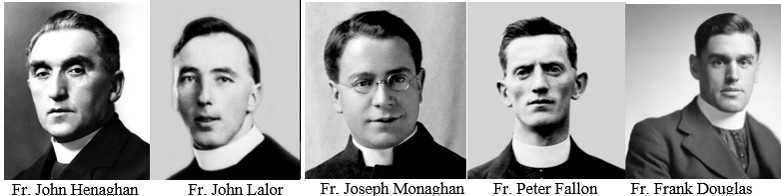
Fr Lalor was working that day and escaped arrest but was killed along with 200 others on February 13th when American troops shelled the hospital.
In all, sixty priests and Brothers were murdered in a brutal and cold-blooded series of executions by the Japanese.
The “Vatican City” was liberated on February 23rd in a daring and high-risk rescue by the combined Eleventh Airborne Division of the United States Army and Filipino guerrillas. The 2,132 starving inmates were rescued just minutes before they were scheduled to be executed.
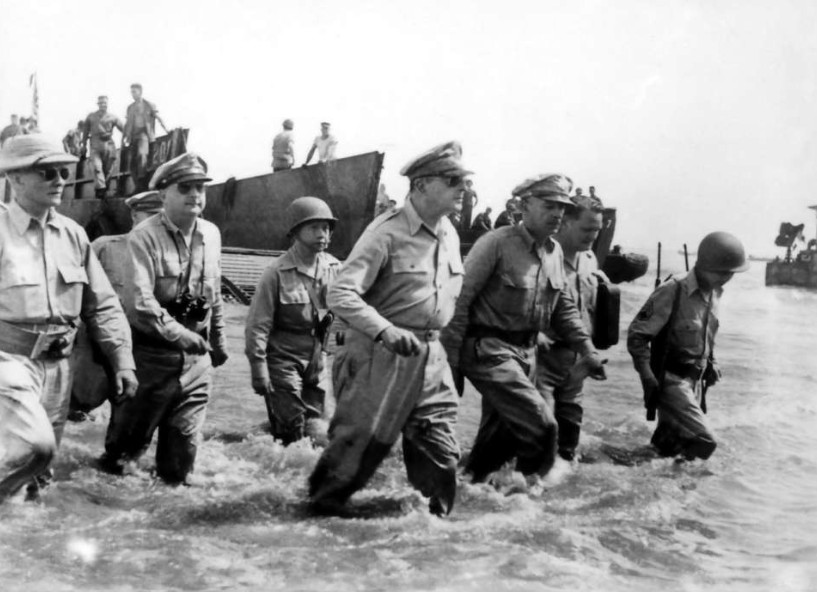
What remained of the beautiful city of Manila, once known as the Pearl of the Orient, was liberated on March 3rd.
Collectively known as the “Malate Martyrs”, the Columbans chose to remain with their people throughout the savage Japanese occupation, saving the lives of many and bringing spiritual comfort to countless others. Their bravery in the face of a brutal enemy is inspiring. Afterwards, letters of gratitude from survivors commending their courage and devotion flooded into the Columban headquarters at Dalgan Park, Navan.
In recognition of their commitment to the American prisoners-of-war, the US Marines bestowed the honorary title of ‘Leatherneck of God’ on Fathers Kelly, Henaghan and Lalor, Leatherneck being slang for a U.S. Marine.In 1948 the United States government officially recognised their “meritorious service to the United States during the Japanese occupation of the Philippines from 1942 to 1945” by posthumously awarding them the Medal of Freedom (with Silver Palm), the highest honour for non-American citizens.
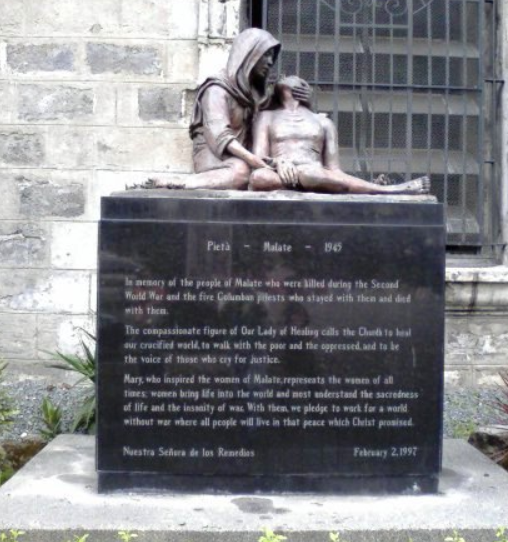
The grateful people of Malate erected a Pietà beside Malate church in 1997. Its emotive inscription, “in memory of the people of Malate who were killed during the Second World War and the five Columban priests who stayed with them and died with them”, captures the heartfelt appreciation of the great sacrifice made by the Irishmen on their behalf.
Our thanks to Mairead O’Brien for this article and to Offaly Independent who first published it earlier this year.
Published as part of the County Offaly 2025 Commemorative Programme with the support of Department of Tourism, Culture, Arts, Gaeltacht, Sport and Media

 offalyhistoryblog