
In the early days of the Irish Free State two ambitious projects stood out as justifying the struggle for national independence.
In 1925, out of a total national budget of £25 million, the fledgling government bravely invested £5.2 in the Shannon Hydro Electric Scheme. Finished within four years, it ensured a degree of energy autonomy and dramatically improved living conditions, particularly in towns and later in rural areas.
In a second progressive advance the State embarked on a programme to build a modern hospital in every county.
Up to then the cost of the public health service had been borne almost entirely by local authorities who derived their funding from their ratepayers. This made the construction and operation of local hospitals difficult as the Government itself was reluctant to come to the aid of the local authorities by increasing the level of parliamentary grants which had last been fixed in the 1850s.
Public health provision therefore was of varying qualities and outside of Dublin at least, available only in former workhouses or smaller private cottage hospitals. In the larger cities larger and more professional hospitals might be found; usually run by charitable bodies.
The hospital building programme was funded through the innovative Irish Hospitals’ Sweepstake, a private lottery company established in 1930 by three businessmen with political connections. Many of the tickets were bought by Irish emigrants in America and the United Kingdom; though lotteries were illegal in those jurisdictions. The ratio of winnings and charitable contributions to Sweepstake revenues proved low, and the scheme made its founders very rich. Nonetheless, large sums of money rolled in and paid for an extensive range of modern hospital facilities which were to become the bedrock of a later more extensive system.
The International Style
The building of the Shannon scheme had been outsourced to a German company, not just for cost reasons, but as a statement of the freedom of the new State to diverge from British funding and models. Equally, inspiration for the design of the hospitals was to come from Continental sources.
In 1933 the Government set up a Committee of Reference to advise it on the allocation of the burgeoning Sweepstake funds. A member of the Committee, the architect Vincent Kelly, made a tour of sixty-six hospitals in France, Switzerland, Germany, Czechoslovakia, Austria, Belgium and Holland and his subsequent report was to influence all of the designs prepared by a new generation of talented young Irish architects.
The clean and simple lines of the International Style with its emphasis on sunlight, fresh air and cleanliness was particularly suited to the requirements of advanced hospital design and was adopted by all of the architects commissioned to deliver the Irish projects.
Amongst the most talented of these was Michael Scott who was to go on to become the most renowned Irish architect of his generation. His striking Irish Pavilion at the New York World’s Fair in 1939 was an outstanding international success and his Dublin Busárus which opened in 1953 is still regarded as the high point of modern Irish architecture.
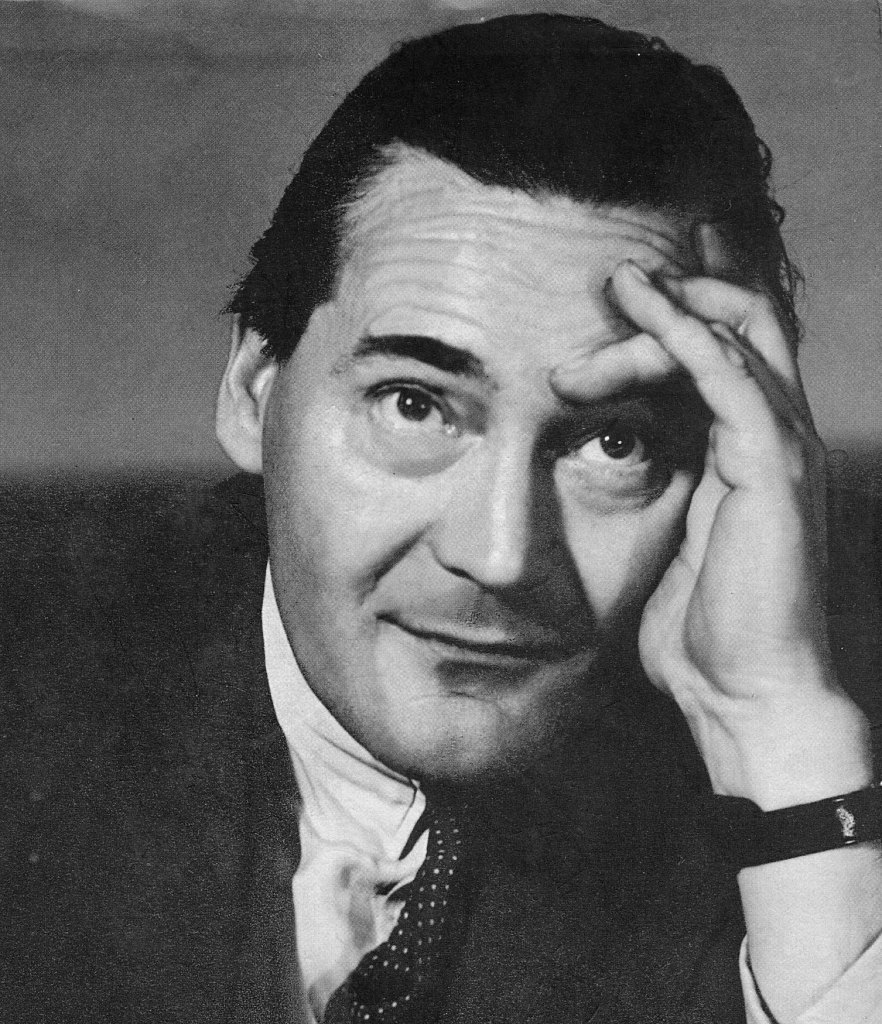
In his bid to secure the commission for the design of the proposed County Hospitals in Tullamore and Portlaoise, Scott teamed with the more experienced Norman Good. In the opinion of Paul Larmour[1], their designs were, along with Kilkenny Hospital by Joseph Downes, the three most successful outcomes of the countrywide hospital programme.
Providing somewhat similar accommodation, Tullamore and Portlaoise hospitals are three stories with each floor set back to give a sense of solidity. Both feature a central feature of thrust out day rooms with matching wings on either side.
As the principal design determinant was to give all the wards a southward facing aspect, the individual sites dictated a different design approach in each case. The Portlaoise site was on the southern side of the road allowing an impressive entrance to a north facing two storey administrative block with a link to the south facing ward block containing a central staircase and with the operating theatre at its centre.

Being on the eastern side of its access road, Tullamore placed its single storey administrative and entrance area on the narrow northern side, linked with an impressive glazed staircase to the lengthy south facing ward block.
In conformity with the principles of the International Style, both designs emphasised their horizontal character with continuous, parapets, canopies and cills combined with sun balconies and projecting concrete canopies.
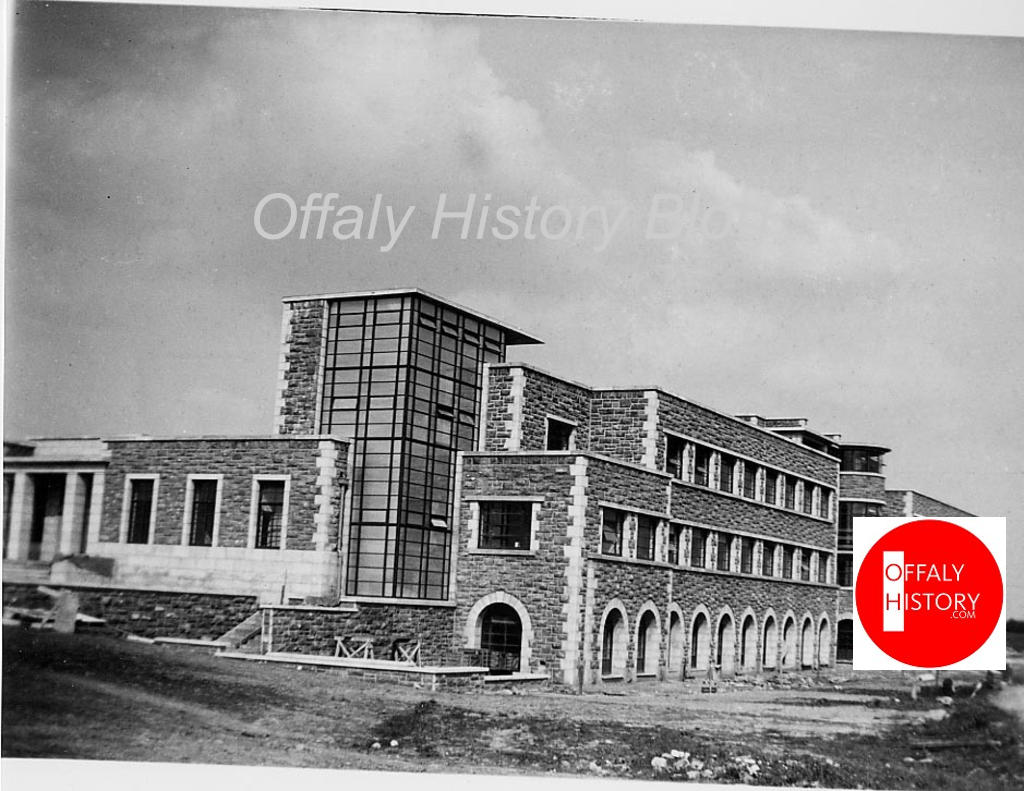
The Offaly County Hospital 1937–45
For many years Offaly County Council had sought to replace the rudimentary facilities available in the former Workhouse with a modern facility and this eventually bore fruit when in 1937 the foundation stone was laid on a virgin site in the largely undeveloped and open lands to the north of the town beyond the canal. The finished building opened five years later.
The building of Portlaoise Hospital had commenced in 1933 and served as a test bed for the Tullamore project. A more sophisticated design approach emerged in Tullamore and, though it must have added to the cost,Offaly County Council were determined to promote the local quarries at Ballyduff and directed Scott to incorporate the material into his design.
So, unlike Portlaoise which is finished in the smooth white plaster- the signature finish of buildings in the Modernist Style – Tullamore used blocks of roughly finished limestone contrasting with horizontal banding. The unique style which evolved proved highly popular and Scott was to go on to use it in the large range of work he carried out in the Midlands for D.E. Williams, the local commercial firm.
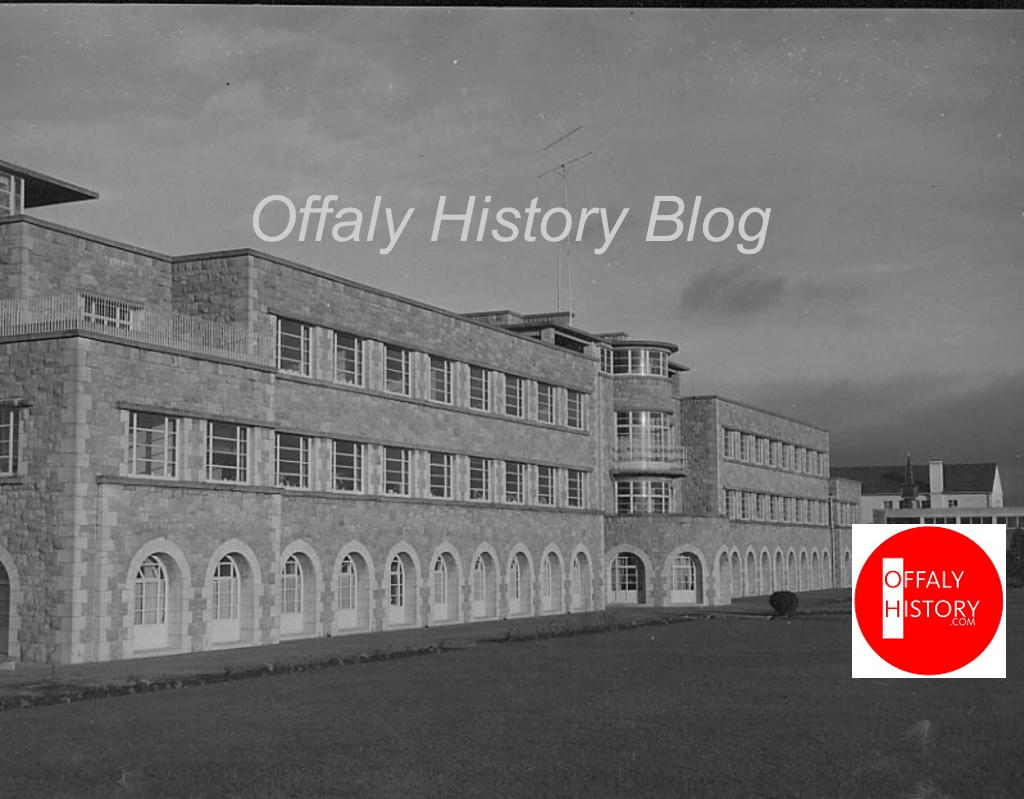
In later years Scott referred to the influence of the Dutch architect Oud[2] on the design of the hospital and the architectural historian Sean Rothery describes[3] how it:
’presents walls of traditional rugged limestone, but the strong horizontality, vertical stair glazing and the round bay over the central block show a Dutch modern influence. The main ward is symmetrical in the traditional Neo-Classical manner and shows, perhaps, the influence of Beaux-Arts school training on at least one of the young architects credited with the design. In contrast to this traditional massing, the device of entering on the end of the block enables an interesting asymmetrical end elevation to be formed in the true International-Style image’.
The design was part of an overall site plan which extended to the landscaping of its surroundings. Though it might rarely have happened because of the Irish weather, it was intended that patients’ beds would be moved out to avail of sunlight.
The layout of the south facing ward block was extended by two parallel pathways into a landscaped garden culminating in a circular feature and provided a setting for the symmetrical south elevation. Again, reflecting Continental models, this was intended as an exercise walk for convalescing patients. The GAA football pitch of O’Connor Park lay beyond, giving patients in the wards a restorative vista of greenery stretching to the Slieve Blooms.
Scott’s collaborators
As an architect Scott regarded himself as the leader of his orchestra who set the general theme and style of the work but who left its detailed design and delivery to the team of talented young architects in his practice and the hand of the dedicated Modernists Dermot O’Toole and James Brennan may be seen in his Tullamore work.
The entrance lobby contains the delightful painting of ‘The Legend of St Colmcille’ by Michael Scott’s friend, the talented artist Frances Kelly, later known as Judy Boland and mother of the poet Eavan Boland.
Her composition relies on large swirling shapes of strong colour onto which swift brushstrokes outlining the trees and leaves are applied. There is a wonderful contrast between the peaceful interaction of the Virgin and the Saint and the urgency and restlessness of the background.
Throughout his career Scott was an enthusiastic promoter of the integration of art into his designs. However, he recollected[4] the willing acceptance by the Offaly County Manager of the additional cost of thirty pounds for the painting, in contrast to his penny-pinching Laois counterpart who wouldn’t countenance such extravagance.

The County Hospital today
As the years went by and the health service grew far beyond the dreams of the hard economic times of the 1930s and 40s, the hospitals of Tullamore, Portlaoise and Kilkenny expanded to meet the increasing needs and advances in medical treatment. Soon even those additions and extensions were insufficient and brand new Regional Hospitals were delivered on adjoining sites. From the 1960s onwards new buildings overwhelmed the character and settings of the Portlaoise and Kilkenny Hospitals. Today neither enjoy Protected Structure status.
But apart from some additional roof structures the original design of Tullamore has largely survived. In the 1970s much of its southern garden was utilised as a site for a new building and car park whose design and layout somewhat compromised the setting of the original building. Nevertheless, sufficient land was left to display the full glory of the magnificent southern elevation.
Today the Tullamore Hospital and the Dublin Airport terminal building designed by Desmond Fitzgerald are regarded as the high points of the International Style of architecture in the Ireland of the 1930s. Both are designated as Protected Structures of national ranking.
The Hospital is the only building in Tullamore to be awarded this distinction which it shares with the castles of Birr, Charleville, Cloghan, Kinnitty and Leap, the houses of Cangort Park, Bellair and Gloster, Cloneyhurke Church, Banagher Bridge and Martello Tower.
Presently used for administrative purposes and closed to the public, ideally this important building might be open from time to time to display its architectural quality and Frances Kelly’s outstanding art work.

Pics and captions Offaly History save Frances Kelly.
[1] ‘Free State Architecture’ Paul Larmour Gandon Press 2009
[2] ‘Michael Scott Architect in (casual) conversation with Dorothy Walker’ Gandon Editions 1995
[3] ‘Ireland and the New Architecture’ Sean Rothery The Lilliput Press 1991
[4] ‘Michael Scott Architect in (casual) conversation with Dorothy Walker Gandon Press 1995


This series is supported by Offaly County Council’s Creative Ireland community grant programme 2025-2027.
 offalyhistoryblog