
Thomas Lalor Cooke, the Birr solicitor and historian, would be the last to consider himself an artist, but when pressed he was generally a good deal less self-deprecating. He published his first history of Birr in 1826 without adding his name to the title, rather akin to the ‘silver fork’ novelists fashionable at that time. Yet, there can be few in Birr or among the learned who did not know that it was Attorney Cooke of Cumberland (now Emmet) Street who was the author. No doubt he also provided signed copies for friends. And in Cooke’s own copy of the Picture he has recorded that he had two tokens (p. 109) and at p. 210 referred to one of the coins as ‘now in the possession of Mr Cooke of Parsonstown’.
In the course of the introduction he pleaded (anonymously, of course) that the profits of the book were go to charity and did not therefore admit of employing a professional engraver. Cooke pleaded that ‘However, roughly executed the plates, the reader has in them, at all events, a correct picture of such subjects as they are intended to represent.’[1] No doubt he had before him a copy of James Hardiman’s, The history of the town and the county of Galway, published in 1820 and issued from the printing works of W. Folds. Perhaps the most valuable part of the Picture of Parsonstown today is that from pp 169 to 249 and described as Picture etc. Part 11. Cooke may have got the idea for this from Warburton and Whitelaw’s Dublin (1818), or Hardiman who has a section 4 on the ‘the modern state and description of the town of Galway. Hardiman had two modern views of the town –one was an overview of the suburbs and the other of the courthouse. Cooke went one better and seven of the nine plates in his 1826 book were views of Birr town. ‘Rude’ as they may be they are the first street views of any Offaly town and were not to be repeated for 150 years until the work of Oliver Connolly and Fergal MacCabe (leaving aside the 1843 article in the Illustrated London News on the Birr telescope).[2] Furthermore, the section on Birr in 1826 was not included in the new edition of Cooke’s Birr in 1875 produced by his son from the annotated first edition that his father was working on and now in Birr Castle Archives.
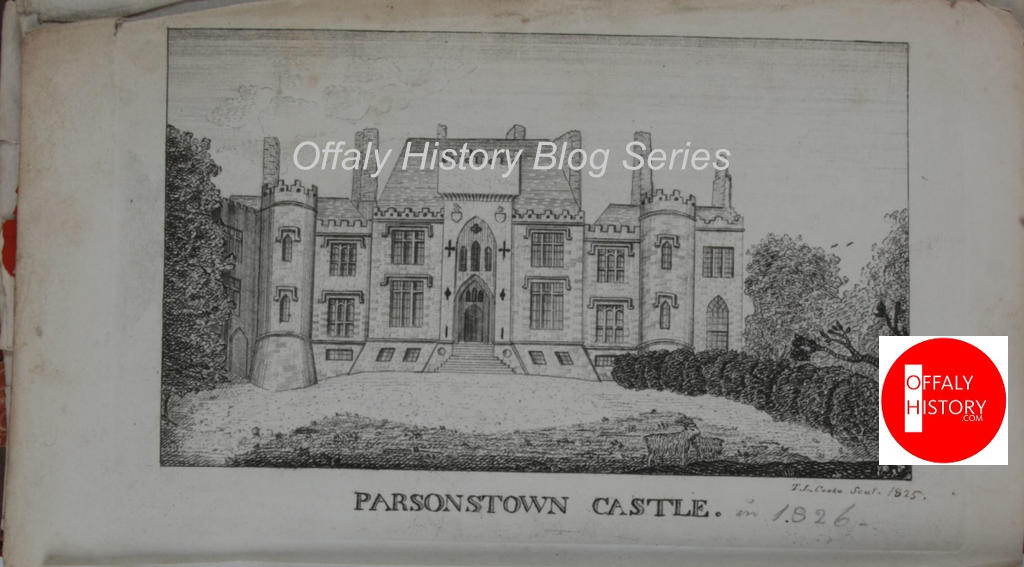
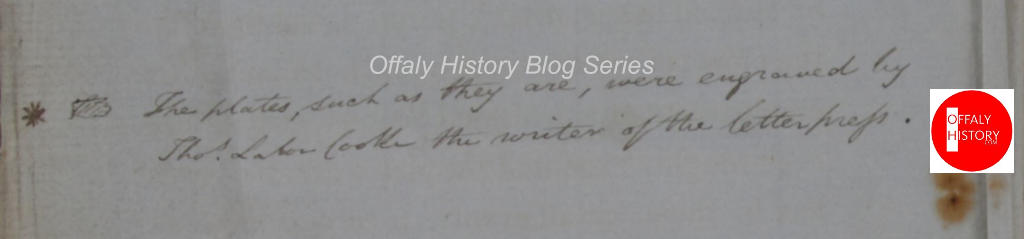
The question arises as to who the artist was who prepared the drawings for the The Picture of 1826. The answer to that is Cooke himself. In his own copy in the Birr Castle Archive (acquired in 1982 through the good offices of the late Knight of Glin from family descendants in County Roscommon). The first plate in the book, the frontispiece with Birr Castle, is signed, but only in that copy ‘T.L. Cooke scul. 1825’. He also has a note in the annotated Picture: ‘The plates, such as they are, were engraved by Thos. Lalor Cooke the writer of the letterpress.’

There are nine plates in The Picture of Parsonstown of which seven are buildings and two are coins and tokens. In the manuscript version in Birr Castle there is an eighth view of the Sheilds bookshop in Duke (Emmet) Square. This may be by Cooke and was tipped into the annotated version of The Picture and left unsigned and not dated.It seems too good to be by Cooke. It is likely 1846–50 in date. Of the original nine drawings most were intended to accompany the text of the description of Birr in 1826. Three are of churches, one of a memorial to the Synge family in the parish graveyard, one of the new courthouse and one of Main Street. Margaret Hogan, who wrote the introduction to the reissue of the 1875 edition in 1990 (by Esker Press, Tullamore) thinks this drawing may have been made from Cooke’s own door in Cumberland Street.
While the drawings, save that of the bookshop, are crude, they are nonetheless important and provide a valuable record of the main buildings in Birr at the time and fifty to seventy years before photographs became available of these subjects. In a later blog in this series we look at the pioneering work of Mary Rosse as a photographic artist.
Cooke’s Picture was held in great reverence and not superseded by the 1875 edition. Of course, by 1900 readers of the Midland Tribune, if not the King’s County Chronicle, were bringing their newly acquired critical apparatus (with a nationalist or language revival len) to play in assessing the merits of the 1826 publication.
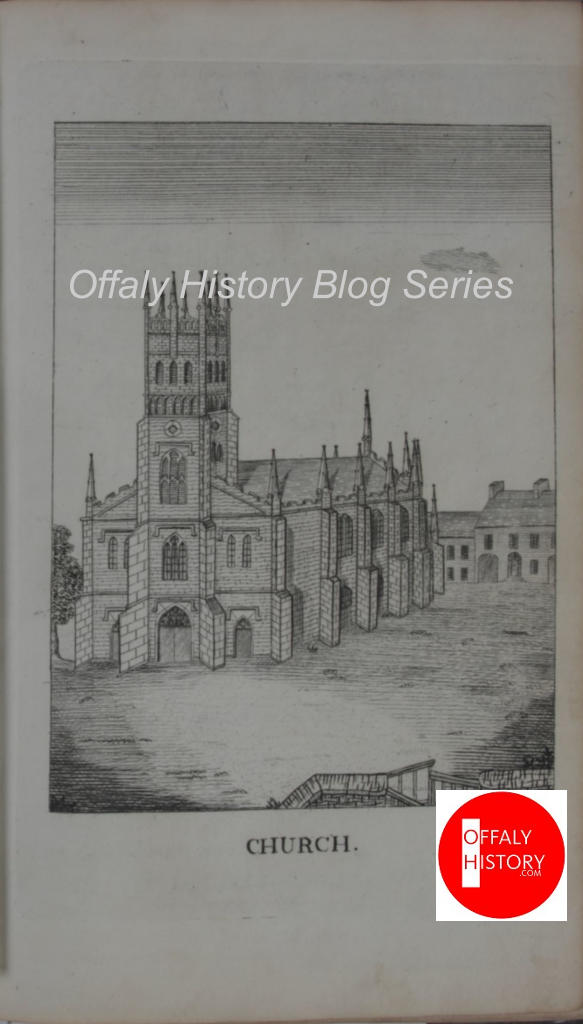
The Church: This was finished in 1815 and Cooke considered it a noble building with a fine tower 100 ft high. The building was said to have cost £8,000, or similar to that at Hop Hill, Tullamore, opened in the same year.

The Chapel was a splendid built, but as of 1825–6 its interior was not as yet finished with £5,000 spent to that time. Cooke needed an editor here to save his readers from tiresome digressions.

Wesley Chapel: Erected on the west side of Cumberland Street in 1820 to a style then popular in Methodist churches including that which was in Tullamore from 1814 to 1889. It looks from the drawing as if the east side of this new street was already well advanced. Cooke mentions himself here in connection with the find of a coin ‘Thurles 1657’.
The Glebe House is featured in the text of the Picture but regarded as old and not comfortable. This one was in Castle Street adjoining the old church and burial ground. Rector A. Downes had died in 1824. A new glebe house by Paine was then building.

The Synge monument in the old churchyard off Castle Street
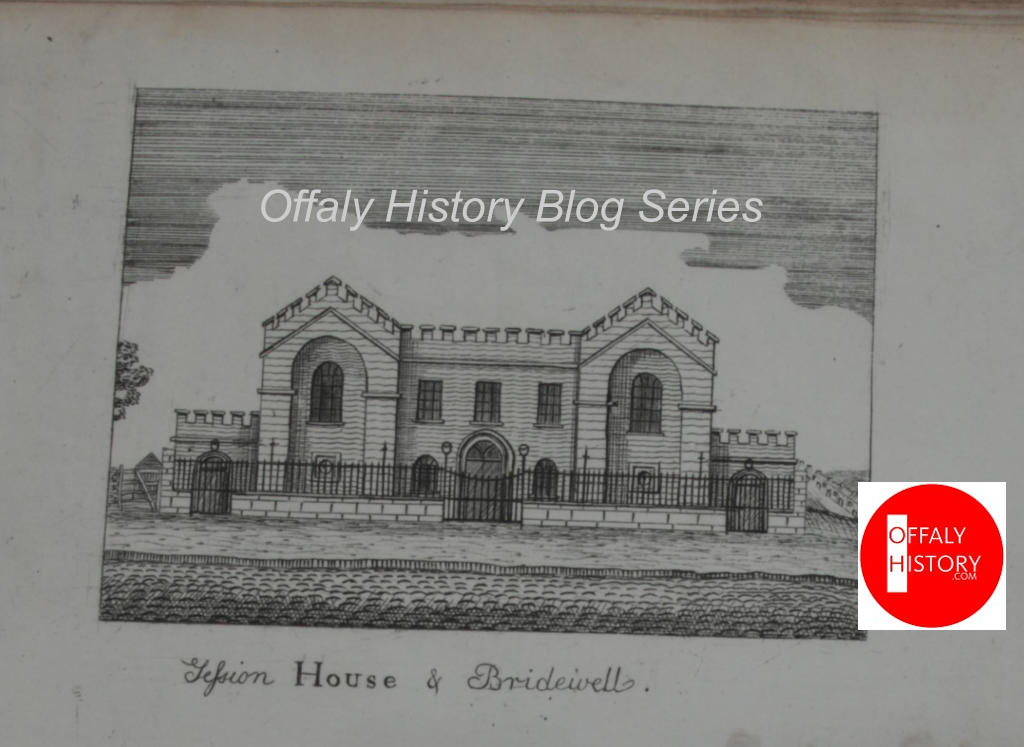
The Sessions House and Bridewell Cooke did not date but is thought to be about 1807.

The Bank: What is likely the first bank in Birr was a private bank that with others across the country failed in about 1816. One of its directors was the MP Thomas Bernard of Kinnitty Castle. The building was on the corner of Duke Square and Duke Street and was in ruinous condition such that’ It presents at present more the appearance of a forsaken and dismantled brothel, than a house of commercial reputation.’
A Birr writer of 1907 was glad of his copy of The Picture – for the most part
I wonder are there many of any people living in Birr to-day who remember what it was like 80 years ago. The writer of the present notes was born between 50 and 60 years too late to know anything about its appearance then, but he happens to have in his little library a very interesting book entitled, The Picture of Parsonstown, published in the year 1826. That was in the bad old days when the cultured and literary amongst us were to Anglicized and so denationalized as to try to obliterate from history the old historic name of this town. But thank God times are changed, and those who persist in dubbing this place Parsonstown now are not worth reckoning with. Apart from the criticism of the title- page, the book is very interesting and well worthy of a perusal. The first part of it is embodied in the larger History of Birr [1875] but the second part which gives a detailed description of Birr at the time at which the author wrote, is not, as far as I know, published in any other volume. The following are some extracts from it. Post Office – is situate at Surgeon Wilkinson’s in the Main Street at the corner of Church Lane. Here is a daily post, and very regularly attended by Mr Dooly the Assistant Deputy Postmaster. The Dublin Mail arrives at 8 o’clock in the morning, and sets off at five o’clock in the afternoon, so that a correspondent writing in Dublin on Monday evening, might have an answer from Parsonstown on the Wednesday morning following. In like manner, a person writing here before five o’clock in the afternoon on Monday could have a reply from Dublin on the Wednesday following by eight o’clock in the morning. The postage of a single letter (not weighing more than a quarter of an ounce) from Dublin, is eight pence British, and so in proportion for double and treble letters. There are also cross posts dispatched to the different adjacent country towns.[3]
[1] Picture of Parsonstown, p. vii.
[2] See an earlier blog in this series at offalyhistoryblog.com
[3] Midland Tribune, 10 Aug. 1907; The Picture, 221
This series is supported by Offaly County Council’s Creative Ireland community grant programme 2025-2027.


 offalyhistoryblog