
John Wesley, the founder of Methodism with his brother Charles, was the first person to record seeing the Van Nost memorial to the lately deceased earl of Charleville, the owner of Tullamore town and ‘the manor of Tullamore and Croghan’ – about 20,000 acres. Wesley recorded in his Journal:
Thursday 25 June 1767
I was desired to look at the monument lately erected for the Earl of Charleville. It observes ‘That he was the last of his family, the Great Moores of Croghan [sic].’ But how little did riches profit either him, who died in the strength of his years, or his heir, who was literally overwhelmed by them: being so full of care, that sleep departed from him, and he was restless day and night; till after a few months, life itself was a burden, and an untimely death closed the scene.
Wesley is here referring to the monument now in St. Catherine’s church, Tullamore which was commissioned by the Bury family, the earl’s successors, from John Van Nost the younger (1712–80). Homan Potterton in his Irish Church Monuments 1750 – 1880 (Belfast, 1975) states that the memorial was commissioned by Lord Charleville’s nephew, John Bury. Lord Charleville died childless in 1764. John Bury was the son of Lord Charleville’s sister, Jane Moore. The family home was Shannongrove, Co. Limerick and John Bury’s father, William, married Jane Moore, a sister of Charles Moore, Lord Tullamore in 1723. John Bury, the eldest son, inherited the Charleville property in 1764 at the age of 39. John Bury died in a bathing accident at Ringsend, Dublin shortly after, on 4th August 1764. Wesley appears to suggest that it was suicide as a result of depression.

John Bury’s only son was Charles William Bury, born 30th June 1764 and came of age on 30 June 1785, and not on 10 May 1785 as is sometimes suggested because of its association with the balloon fire in Tullamore. Charles William Bury presided over the fortunes of Tullamore until his death on 31st October 1835 (see Burke’s Irish Family Records (London, 1976) pp 190 – 192).
Wesley was no stranger to Tullamore and visited the town on most of the 21 occasions that he visited Ireland over the years 1747 to 1789.[1] The journals are mainly spiritual in character but nevertheless contain much that is useful about Irish life, the towns, estates and even the weather.

Wesley generally visited Ireland in the late Spring and stayed for two or three months; making what was in those days, the perilous journey across the Irish Sea. Wesley was born in 1703 and died in 1795 and was the fifteenth child of Samuel Wesley. Soon after being ordained, he went to Georgia (1735) On the boat, he met a party of German Moravians and after discussions began to have a more earnest view of the importance of evangelical doctrine. Wesley’s mission to Georgia was not successful and he returned to England in 1738. His ‘conversion’ is dated to this time and following the example of George Whitefield (1714 – 70), the originator of Methodism, he began his open-air preaching of which he did much across his ‘parish’ which was effectively England, Scotland, Wales and Ireland. The ODNB noted that his journal of missionary travel would serve as a guidebook to the British Isles.[2] To the last he continued to travel and is said to have preached 40,000 sermons and travelled 250,000 miles.
Wesley has also left us a brief account of his trip to Charles Moore’s (earl of Charleville from 1758) home at Redwood in what he called Charleville from c. 1740 when he purchased this part of what became Charleville Demesne.

Thursday, 15th July 1756: In the evening I preached at Tullamore, in Barrack-Street [now Patrick Street]. And many, who never had so much curiosity as to walk a hundred yards to hear the preaching, vouchsafed to hear it at their own doors. In the middle of the sermon came a Quarter-Master, very drunk, and rushed in among the people. In a short time he slipped off his hat, and gave all the attention of which he was capable. So did many of the soldiers, and many officers. O let some lay it to heart!
Friday, 16th July 1756: We walked down to Lord Tullamore’s (that was his title then,) and old mile from the town. His gardens are extremely pleasant. They contain groves, little meadows, kitchen gardens, plats of flowers, and little orchards, intermixed with fine canals and pieces of water. And will not all these make their owner happy? Not if he has one unholy temper! Not unless he has in himself a fountain of water, springing up into everlasting life.

This is an interesting reference to the old house of Redwood, erected in 1641, which stood near the farm buildings on what is now Charleville estate/ Charleville Demesne. Charles Moore, the second Lord Tullamore, had acquired Redwood about 1740 from the Forth family and renamed it Charleville. Moore was born in 1712 and married in 1737, Hester, only child of James Coghill of Drumcondra and was an heiress with, some say, a fortune of £100,000. He spent money on improvements to the estate including works on the river. It was possibly about this time that the grotto was built from funds provided by his wife. It stood (still stands) at the end of the garden of the old house.
A week before Wesley saw the monument to the earl in Tullamore he had called to Belvedere House, Mullingar and was more impressed with the gardens there. History repeated itself in 1912 for when Colonel Howard Bury inherited Belvedere from a cousin (Brinsley Marlay) he chose to live there in preference to his family home at Charleville.
Wednesday July 1 1767: A friend carried me to Belvidere, a seat built on the side of a clear lake, with walks and gardens adjoining, so curiously laid out, as to exceed even the Earl of Charleville’s.[3] One would scarce think it possible to have such a variety of beauties in so small a compass.
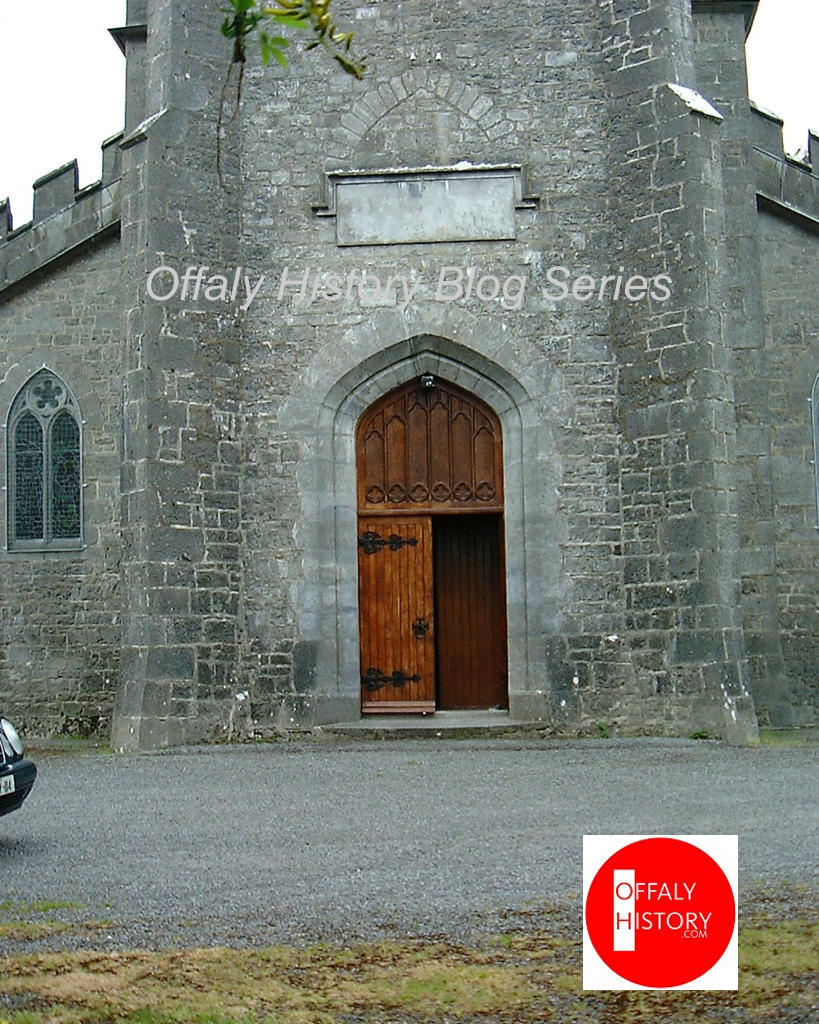
The Van Nost sculpted memorial in Tullamore
During the period 1750–65 Van Nost was the most important sculptor working in Ireland and responsible for virtually every major royal sculpture. . . Those who commissioned the sculptures may have intended them to be symbols of loyalty and gratitude for the protestant succession, but they were also important artistic creations in their own right. Van Nost combined elements of his Dutch heritage (highly naturalistic facial details) with the new attributes of classicism (Roman clothes, sandals, and batons).[4] In a recent estimate Van Nost was considered ‘the most important Ireland-based artist of his generation’. (Art and Architecture in Ireland: Sculpture, 1600-2000, Paula Murphy (ed.) RIA Dublin, 2014, pp 342-45). Just to note that the John Bury bust is not shown in the colour picture at p. 344).
The Charleville monument was first placed in the old Protestant church in the present Shambles, Church Street c. 1767, and in the present St. Catherine’s church in 1814. The old church was in what was then Church Lane west of what later the Foresters’ Hall (1924). This was the first Protestant church in Tullamore and was built in 1726 by the earl’s grandmother, Ellen Moore and was demolished c. 1820 to facilitate the making of the new Corn Market/Market Square and the new Shambles in place of that which was in Bridge Lane behind the new Market House of 1789 erected in O’Connor Square (now Eddie Rocket’s restaurant). About the year 1726 Ellen Moore, the mother of the first Lord Tullamore, provided funds for the building of a church at Tullamore.[5] The building was located about 100 yards from the William/Columcille Street. Apparently, the building was of no particular architectural interest, but it was considered good enough to hold a monument by Van Nost to the memory of Charles, the first earl of Charleville.
Considerations other than piety may have prompted Mrs Moore to build a church at Tullamore, for example, family and local pride and the needs of a growing population must have had some weight. If Atkinson’s judgement is correct Mrs Moore did not build on the palatial scale:
The church, which I understand is soon to be replaced by a new one, not in the town, but in its vicinity [Hop Hil]), is a building which has hardly anything but its age and the sacred use to which it is dedicated, to recommend it to notice.[6]
The grounds of the Church extended from was the Abrakebabra restaurant as far as Lees’ Lounge with the church in the vicinity of the Shambles – Foresters’ Hall. Was there a graveyard attached to the church? Perhaps there was. William Lumley (born 1819, died in 1900) recalled in a speech at the opening of the new Methodist church in Church Street in 1889 that an old man he has spoken to could recall that the former Episcopalian church was on the other side of the street where the Shambles now are:
That the graveyard was exactly opposite; that he saw the clay and even the bones of the dead carted away and spread on the fields for top-dressing. There was no street here [the wider part of Church Street]; all around was planted with fine oak trees.’[7]
In 1940 a portion of a tombstone was recovered in repair work and some members of the council referred to the local belief that part of the Market Square had once been used as a cemetery.[8] That said there is no tradition or other record (yet uncovered) and there was a burial ground at Kilcruttin, then a suitable safe distance from the town. The better off of the town were buried in the old graveyards attaching to the monastic sites at Durrow, Kilbride and Lynally.
Where the first earl’s father, the first Lord Tullamore (died 1725) was buried or earlier members of the family, is not known. Perhaps it was in the ancestral home of Croghan in a small church now demolished. No monument has been found in Lynally, Kilbride or Kilcruttin and the Church Street chapel was erected after his death. The five earls of Charleville drawn from the Bury family who all died within a space of forty years over the period from 1835 to 1875 together with Lady Emily (died 1931) and her son Lt. Col. C.K. Howard Bury (died 1963) are all buried in the crypt under the chancel of St Catherine’s church.
Was it the Countess of Charleville or Mrs John Bury who procured John Van Nost, the younger, to complete the monument? Homan Potterton, a former director of the National Gallery, stated that the memorial was commissioned by Lord Charleville’s nephew, John Bury, but he was dead within a few months of his inheritance.[9] The monument was removed from the old church in Church Street to St Catherine’s in 1814.
Regarding the monument, Lord Charleville is represented by a supplicating recumbent effigy, partially naked under a thin shroud and ‘with his veiny hands and double chin pitifully human’, flanked by female allegorical figures, emblematic of Justice and Religion. John Bury is commemorated with the bust sitting on the urn.[10]
Van Nost was born in the same year as the earl (1712) or possibly one or two years earlier. According to the Dictionary of Irish Architects (online, DIA) he may have been:
a son of JOHN NOST [1] , in which case he must have been born around the time of his father’s death in 1710 or 1711, or one of the two sons of the John Nost, who carried on John Nost the Elder’s business and died in 1729. On 17 October 1726 he was apprenticed to Henry Scheemakers in Westminster for seven years. It is possible that he then worked in the Nost workshop, which remained in the family until 1739, (1) but there is no record of his career until he settled in Dublin in about 1749. On his arrival he was immediately taken up by the Dublin Society, which commissioned busts of some of its founder members and, arranged for a number of pupils to become his apprentices.(2) He ‘soon enjoyed an almost complete monopoly of sculptural work in Ireland’.(3) He made a number of visits to London: these included one in 1753 or 1754 to hold sittings with King George II for the equestrian statue in St Stephen’s Green, another in 1763, when he even had a London address ‘At Mr Clarke’s, St Martin’s-lane, opposite May’s-buildings’,(4) and another in 1765 to make a model for his statue of George III for the City Hall in Dublin. A much later visit in 1776 is said to have been much prolonged on account of his poor health. He died in Dublin in October 1780. His will of 24 October 1779 appointed his wife ‘Ann Van Nost otherwise Armstrong’ as his executor and made bequests to a widowed sister, Catherine Legross, and a nephew, Richard Lynd. (5) He appears to have had no surviving children.
Addresses: Aungier Street, Dublin, 1752(5)-1760;(6) ‘in the Gardens of the Right Hon. Anthony Malone, the east side of Stephen’s-green’, 1763;(7) 21 Mecklenburgh Street, 1779-1780. (8).
For his works see a useful report in https://moxhamireland.wordpress.com/2022/04/30/john-van-nost-the-younger/. See also Strickland’s dictionary.

References for the DIA entry
Genealogical and biographical information in this entry is from S. O’Connell, ‘The Nosts: a revision of the family history’, Burlington Magazine 129, December 1987, 802-6, and Paul Spencer Longhurst & Andrew Naylor, ‘Nost’s equestrian George I restored’, Sculpture Journal II (1998), 33, which further amends O’Connell’s account. There are entries on Van Nost in W.G. Strickland, A Dictionary of Irish Artists (1913), II, 478-487, Rupert Gunnis, Dictionary of British Sculptors 1660-1851 (revised edition, n.d.), 282, and Homan Potterton, Irish Church Monuments 1570-1880 (UAHS, 1975), 85.
(1) The Nost workshop belonged to an Anthony Nost in 1739, when it passed to John Cheere (O’Connell, op. cit., 803).
(2) Potterton, loc. cit.; the School of Modelling was not established until 1811.
(3) Gunnis, loc.cit.
(4) O’Connell, op.cit., 803; he is described as ‘lately arrived from London’ in Faulkner’s Dublin Journal, 11-14 June 1763.
(5) P.B. Eustace, Registry of Deeds Dublin: Abstracts of Wills II 1746-85 (1954), 310 (no. 629).
(6) Faulkner’s Dublin Journal, 21-25 Jan 1752.
(7) Faulkner’s Dublin Journal, 22-26 Jan 1760.
(8) Faulkner’s Dublin Journal, 11-14 Jun 1763.
Michael O’Neill notes (as per the vestry minutes) that the Charleville monument was located in the chancel until the carrying out of refurbishment works in 1869 and he reproduces a plan of St Catherine’s by Welland & Gillespie in that year. The memorial was then moved to the south transept where it is located to this day.[11]
[1] See Irish Geography, vol. 8, 1975, pages 86 – 96 and Rev. F. W. Macdonald (ed.), The Journals of the Rev. John Wesley, A.M, Everyman edition, London, 1909. References to the Journals in this article will be by date rather than page numbers. There is also the Curnock edition in eight volumes, 1938.
[2] Oxford Dictionary of National Biography.
[3] Wesley, Journal.
[4] Dictionary of Irish Biography (DIB), 2009- in progress and now online. See entry by Daniel Beaumont.
[5] Lodge, Peerage Ire., p. 89; See also a typescript of Bishop O’Beirne’s visitation of Meath in 1818, pp 60-61, in the library of the Representative Church Body, Dublin (hereafter R.C.B.) O’Beirne states that the church was built by Mrs. Moore. This lady died c. 1727 (see Vicars, Prerog. Wills p. 333. William Moran in Early History of Tullamore, (Athlone, 1962), p. 30 states that the church was built about 1726, but he provides no source. The date stone of this church was found in the 1990s in the garden of the old rectory and is now in the Offaly History Centre.
[6] See A. Atkinson, The Irish Tourist (Dublin, 1815), p. 72
[7] Booklet for opening of Methodist church(1890). The memorial to William Lumley in the Methodist church provides date of birth. This book is now in Offaly Archives.
[8] OI, 9/11/1940.
[9] Homan Potterton , Irish Church Monuments 1750 – 1880 (Belfast, 1975), p. 86 and fig. 41-2.
[10] Potterton, Irish church monuments and Tierney, Central Leinster, p. 620.
[11] Michael O’Neill, An architectural history of the Church of Ireland (RCB, Dublin, 2023), pp 142–3.
Art and Architecture in Ireland: Sculpture, 1600-2000, Paula Murphy (ed.) RIA Dublin, 2014, pp 342-45).
M.G. Sullivan, ‘ “The strange and unaccountable” John Van Nost : the making of a sculptural career in eighteenth-century Ireland’ in Fenlon, Jane; Kenny, Jane; Pegum, Caroline; Rooney, Brendan (ed.), Irish fine art in the early modern period: new perspectives on artistic practice, 1620-1820 (Newbridge: Irish Academic Press, 2016).

 offalyhistoryblog