
It is strange that we should start with the most modern of buildings in Tullamore completed in 2001 and since 2015 Boots Pharmacy. Prior to that it was Menarys fashion and homeware and opened in 2001 as #1 Bar and Restaurant. It is the newest of the new buildings in the town and replaced one of the oldest – Hayes’ Hotel. The hotel was built in 1785 as a new hotel for Tullamore but was perhaps a refurbishment and not a new build.
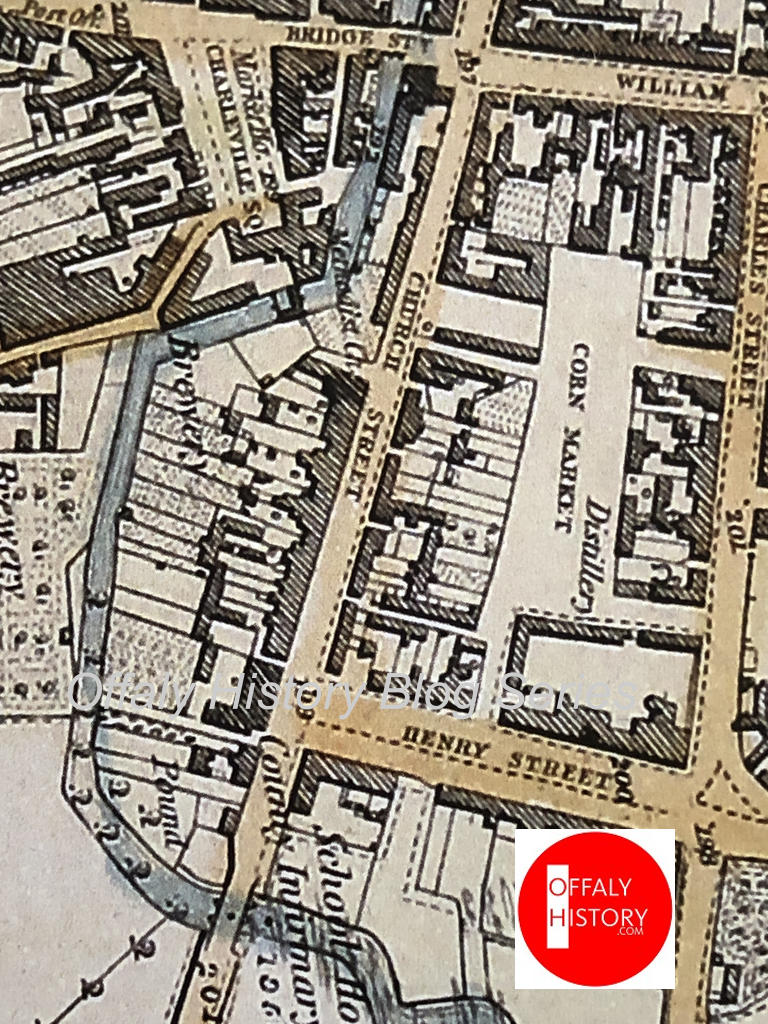
The building is in a strategic location with four streets intersecting and was known for many years as Hayes’ Cross. The original building was L-plan in shape not unlike no 3 in O’Connor Square (the insurance brokers) and its neighbour south of the river Flynn’s bakery, also L-plan until street widening in 1938 removed the two front rooms to Bridge Street. The hotel was on the south-west corner of the narrow part of Church Street – the oldest part dating back to at least 1726 when the first Protestant church was built in what was later the Shambles and market south of the Foresters Hall, now as to the ground floor a Thai restaurant.
Hayes’ Hotel, formerly known as the Charleville Arms and prior to that the Bury Arms was erected or refurbished by Charles William Bury, later first earl of Charleville in 1785 at a cost of £200. It was then leased on a perpetual renewal basis for £15 a year. It is probable that the inn was built to promote the case for having Tullamore made the county town, then under review by parliament and to fill a public need. The hotel had thirteen beds at this time which was ten years later considered by the Grand Canal Company to be inadequate. As a result a hotel was built by the company at St Brigid’s Place in 1801 costing over £4,000. The Bury Arms by 1798 had no more than thirteen beds and the competition before the canal hotel was completed was weak with Murphy’s ‘an inferior kind of inn’ and beds also supplied by Flanagan’s public house and Beahan, a canal contractor. The Bury Arms (Doherty’s) was rated a good hotel by Colt Hoare who stayed there in 1806 while on an Irish tour.
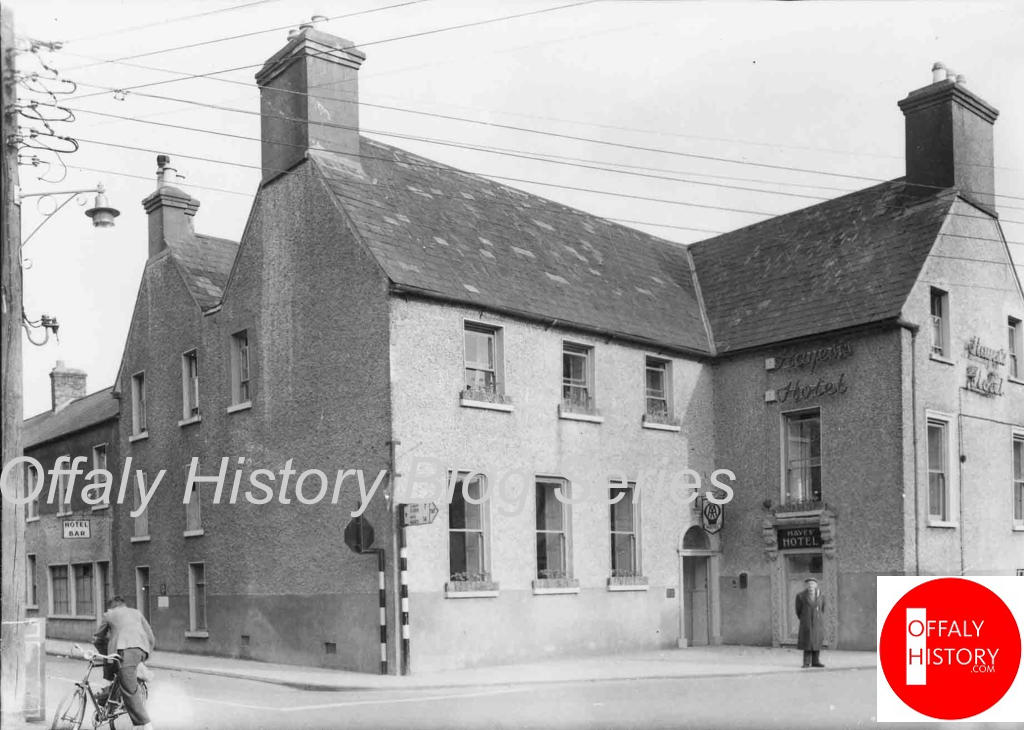
Tullamore’s young owner, Charles William Bury, was just 21 on 30 June 1785. He built the Tullamore inn, the Charleville Arms (pre-2000 the Phoenix arms hotel ) in 1785 at a cost of £200. It is probable that the inn was built (or refurbished) to promote the case for having Tullamore made the county town. That Tullamore had an inn before the Charleville Arms was built is certain because the will of John Clough, a Tullamore inn Holder, was proved in 1768 and also his inn was the meeting place of the Tullamore manor court (a body with functions not unlike the pre 2014 urban district council) in the period 1765 to 1769.
Our earliest legal record of the Charleville Arms hotel will be found in the lease granted by C.W. Bury to a Mr John Tydd, a gentleman of Tullamore, in March 1786. The hotel was described as ‘the Inn house with the out offices, yard and garden in Tullamore, measuring in front from the river to Church Lane Church Street ) 64’6’’ and in the rear from the garden wall on the north side to the wall adjoining the fair green on the south side 85’6’’ and is 429’ deep from the channel in front to the wall adjoining the preaching house, containing one rood 18 perches plantation measure. The garden of the hotel was extensive and ran as far as what would soon (1788) be the Methodist preaching house. In effect Church Lane as it was then set out was owned as to its southern side by the hotel proprietor and east of it was an area used as a fair green. The site along Church Street was wide enough to attract good houses but investors did not care much for side streets and only cabins occupied the long garden until late in the nineteenth century.
Tydd received the usual lease of three lives renewable for ever (virtual alienation by Bury) on payment of an annual rent of £25 and a renewal fine of £12.10s.0d. On a first reading the size of the head rent comes as a surprise as the more usual figure is £2 to £3. However, this is explained further on when we hear that Bury spent £200 in erecting the inn. The insertion of a covenant that the head tenant ‘shall and will during this demise uphold, maintain and keep the said demised premises in good repair and condition for said purpose and keep a Public Inn theron’ and further that the annual rent will be reduced to £15 provided this covenant was adhered to was intentionally restrictive despite the rent abatement. The will of John Tydd was proved in 1798 and that of his son Benjamin in 1799. However, the hotel was sold by Benjamin Tydd, earlier, in April 1796, to Michael Doherty. Doherty agreed to pay £50 annual rent and a renewal fine equal to one half year’s rent thus giving Tydd a profit rent of £35 per annum. Besides the profit rent Tydd retained two thatched houses fronting Church Lane (the site of the former Bracken’s flower shop and the adjoining house). It was written into the lease that ‘Benjamin Tydd will have liberty of ingress and regress to thatch the houses partly built on the north side of the garden wall at all proper times.’ The increased rent reflected goodwill and Tydd’s own investment in the property.
The deeds tell of a succession of owners from Tydd to Doherty, Ridley, Horan, Hayes and Egan’s and into last fifty years when numerous re-openings were reported in the local newspapers.
When the first valuation survey was carried out in 1843 Mrs Hanna Ridley was stated to be the hotel keeper and the building was given the quality letter I B, later altered to I B- indicating that the property was in good but not excellent repair. The valuation surveyor noted that Mrs Ridley holds from a Mr Tydd of Ennis, Co. Clare and that the concern is well situate and long established, well enclosed and with a large garden. In November 1849 John Ridley, M.D., perhaps a son of Hanna, conveyed the Charleville Arms to George Ridley. George Ridley remained in possession of the property until June 1861 when it was conveyed to a Mr. Eugene Robbins. Robbins was paying a rent of £81. 5s. 0d. per annum to continue for the life of Mary Towers. At the time the hotel property carried a rateable valuation of £38.
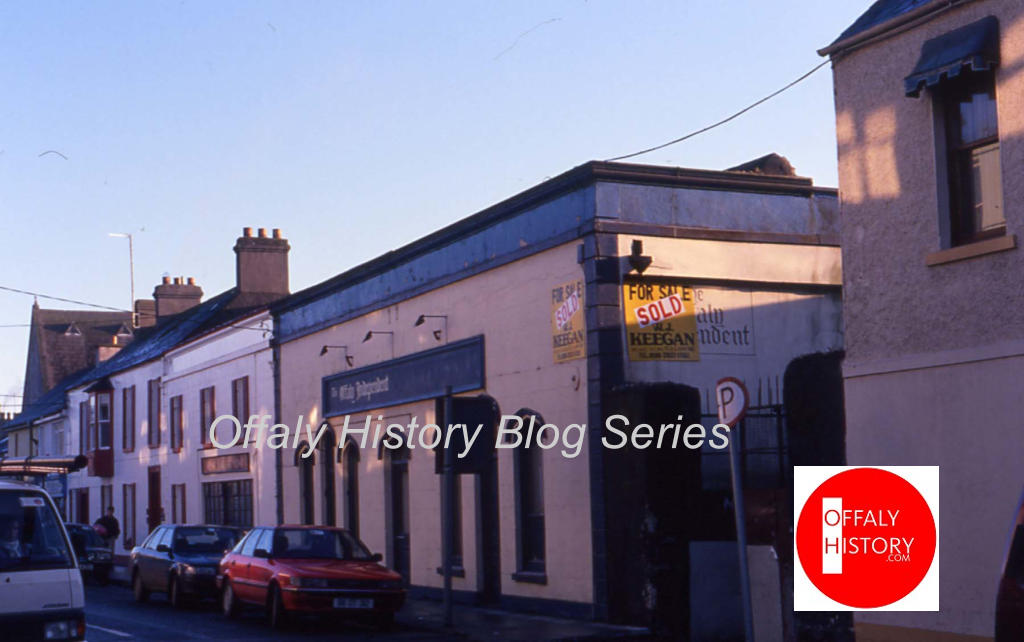
Robbins converted a house later the Offaly Independent Office into a spirit store and shop in 1861 and this increased the valuation by £4. Robbins died in 1868. The hotel then became the property of Thomas J. Horan.
From Horan the hotel passed to James Hayes of Tullamore who became the occupier in August 1876 on the basis of the lease given to Robbins in 1861. The lease agreement was for the life of Mary Towers and died with her in February 1877. The hotel was in a bad state of repair when Hayes took over and in the conditional contract made between the guardian of John Towers, a minor, and James Hayes dated 13th June 1878, Hayes was granted a sixty-one-year lease subject to the following: First he was to spend £300 in repairing and improving the hotel within five years. Secondly, he was to keep the improved hotel in repair. Thirdly, he was to pay a yearly rental of £90.
The records of the Commissioners of Valuation provide information on the improvements carried out by Hayes. The rateable valuation of that part of the property marked 1 increased from £38 to £41 because of the improved new roof of 1881-2. The valuation of sections 2 & 3 was increased from £4 to £6 at this time. Extensive improvements were carried out in the mid-eighteen-eighties. The valuation of Section 1 was increased in 1884 from £41 to £44 because of the addition of a restaurant. Was this the first described as such in Tullamore?
In the period 1884-88 a great deal of new building and improvements were carried out to sections 2 & 3 of the property. The new work included the addition of kitchen, scullery, pantry, bed and sitting-room, resulting in the rateable valuation rising from £6 to £18.
About the year 1890 an out-building was demolished at the rear of the hotel and the two-storey house east of the Church Street entrance gate was built. The valuation of section 1 was increased from £44 to £50.
Mr James Hayes acquired the Charleville Arms Hotel in 1876 and it was during his time that the hotel became well known under his own name. A surprise visitor in 1882, who spoke from a window of the hotel, was none other than the chief secretary, ‘Buckshot’ Forster. Lydia Goodbody recorded in her diary at 6 March 1882: ‘W.E. Forster in Tullamore. Jonathan [Goodbody] lunched with him. He spoke to the people about rent, outrages and murder.’ It was during the height of the Land War and Forster’s daughter noted that that her father had called on the priest, lunched at Hayes’ hotel and later spoke to some 300 people from a window of the hotel. She went on: ‘Amongst all the incidents of Father’s public life there is none at which I would rather have been present than at this speech at Tullamore.’
Arthur Fisher, working in Warren’s drapery nearby in the early 1880s recalled the visit too:
When I first saw him he had no guard, he walked first through the town with the fat old parish priest to the chapel, where I presume he, as a Quaker, kept silence, and then returned to the balcony of the Charleville Hotel where I heard him preach a fervent condemnation of such desperate deeds. Father McRory D.D. [McAlroy] stood beside him, so says someone near me, to cover him if he is shot at!
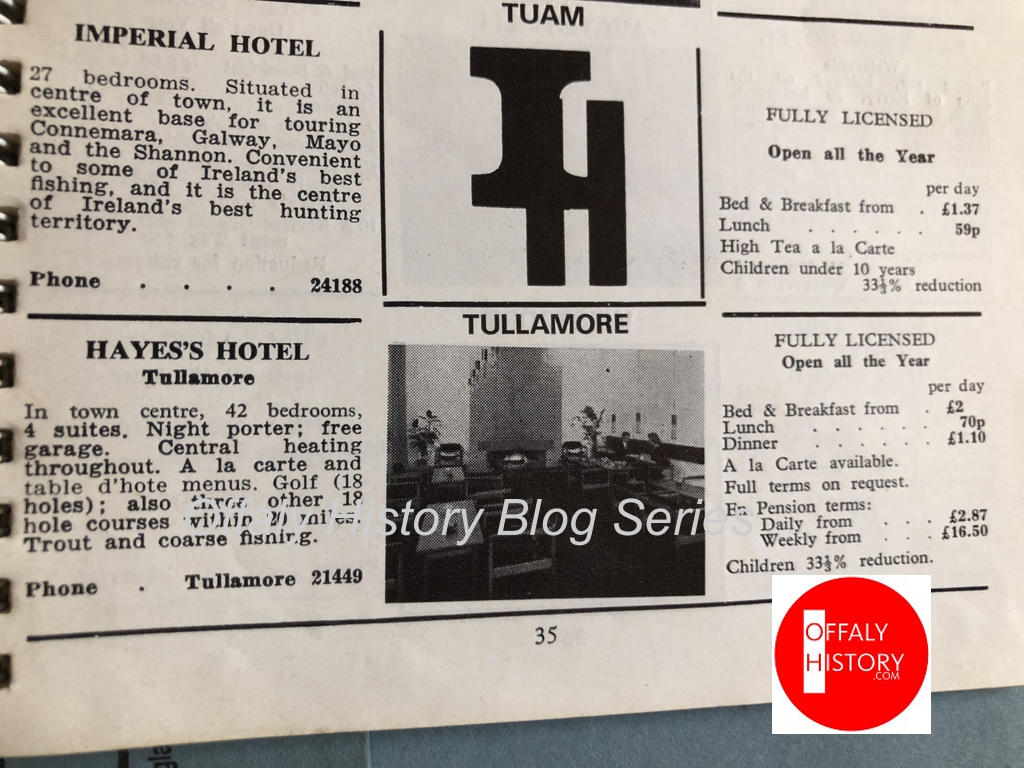
James Hayes sold the hotel to P. & H. Egan Ltd. in 1905, and Egan’s later set up the Midland Hotels Co. Ltd. From the 1970s the hotel had a succession of owners including the Bird family and James Spolllen. The hotel was purchased by the Flanagan Group, owners of the Tullamore Court Hotel and demolished in 2000.

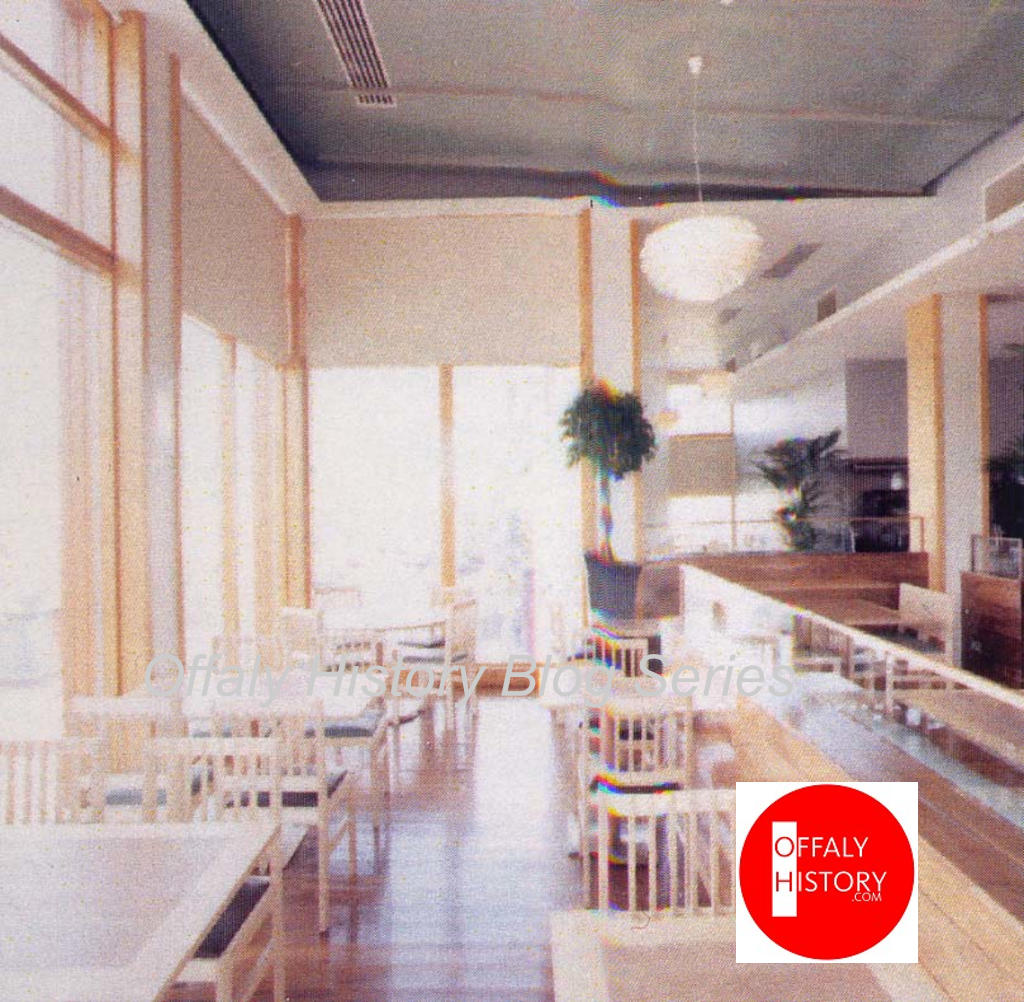
The new building, consisting of a bar, restaurant and nightclub, was designed by Tullamore-based Denis Duggan, architect, in the modern style. The restaurant upstairs had a great view of Patrick Street and Columcille Street while the bar and nightclub were very trendy. It was closed in 2007 and re-ordered as a retail shop for Menary’s in November 2008. The year 2008 was the first time in over 200 years that the part of the site fronting Bridge Street was used as a retail store. It was strange that from the early 1960s when Egan’s modernised the old hotel and despite a succession of owners and considerable expenditure the place never seemed to thrive. Nonetheless it was a major focus in the history of Tullamore and no doubt those who remember the hotel in the 1940s and 1950s would have many stories to tell. If one could go back to when it was first completed in 1785 possibly all of the history of Tullamore could be told from its prime vantage point. One remembers the ‘corner boys’ who spent all day at ‘Hayes’ Cross’ surveying the scene until the practice died out in the 1960s. The old guests’ registers if they survived would tell a lot. So too could the Ridleys and owner James Hayes over thirty years from the mid-1870s. Later the Egan family were the owners with Hayes’s, Colton’s in High Street and Dooly’s in Birr (recently sold to the County Arms, Birr).
The modernisation of the 1960s facilitated the new craze for dinner dances. The hotel was under the very capable Gerry Moynihan and was the centre of social life at least until the increasing competition from the new Bridge House of 1971 and the new dance venues at the Harriers, the Harp and Central Ballroom. The Fork Supper craze may also have reduced reliance on hotels. James Spollen, the house builder and garage owner acquired the hotel about 1974.
Published with the support of the Heritage Council

 offalyhistoryblog