
The Goodbody family is widely associated with the prosperous Quaker industrial dynasty that emerged in Clara and Tullamore during the nineteenth century. However, this article focuses on a lesser-known and far less successful branch of the family: the descendants of Thomas Goodbody (1783–1848), brother of the prominent miller Robert Goodbody (1781–1860). While Robert’s line flourished, Thomas’s life and that of his children was marked by repeated financial failure, instability, and eventual decline, culminating in the disappearance of the Goodbody name from Birr by the early twentieth century.
Early Life and Move to Dublin
Thomas was born in Mountmellick in 1783, the third son of Mark and Elizabeth Goodbody. His father ran a shop and tanyard and was active in the Quaker community. After surviving smallpox, Thomas attended Ballitore School, where he received a broad education. When Mark died suddenly in 1800, Thomas and his brother Robert took over the family business to support their widowed mother and younger siblings. Mountmellick was then a thriving Quaker centre, but Dublin offered greater opportunities, and in 1815 Thomas moved there to join his cousin John Pim, a major corn merchant, in partnership as Pim & Goodbody.
Thomas prospered initially. He became active in Dublin Quaker affairs and civic charitable efforts, chairing meetings on poverty relief and contributing to educational initiatives. In 1816 he married Eliza Penrose, with whom he had nine children over the next two decades.
Business Ventures and Financial Collapse
Despite early success, Thomas’s fortunes deteriorated sharply in the mid‑1820s. He continued trading independently after Pim married and moved away, and he became a director of the Dublin Corn Exchange. He also invested in the Mining Company of Ireland. But in 1826 the Dublin Quaker Monthly Meeting reported that Thomas had failed to pay his debts, a serious breach of Quaker discipline. He had accepted bills of exchange to help an associate, the bills became “very extended”, and he lost all his capital, falling under a commission of bankruptcy
His difficulties were compounded by a High Court case in which he was held liable for the loss of 200 bags of flour in a canal boat accident on Lough Derg, costing him £158. He sold property, including his interest in Brusna Mills at Clara, and wrote a remorseful letter of self-condemnation to the Quakers, which was accepted.
Failure at Ferbane and Expulsion from the Quakers
With Quaker approval, Thomas attempted a fresh start by taking over the mills at Ferbane. But he lacked capital—beginning with only £800 compared to the £4,000 which had been invested in the Clara mills—and quickly lost money. By 1830 he had failed again, paying creditors only twelve shillings in the pound. He again wrote a contrite letter acknowledging that he had not kept proper accounts.
Returning to Dublin, he opened a grocery shop, but this too collapsed within two years. The Quakers, concluding he had “not profited by the lesson of his experience”, disowned him in 1832—an event that deeply marked him for the rest of his life.
Move to Birr and Modest Stability
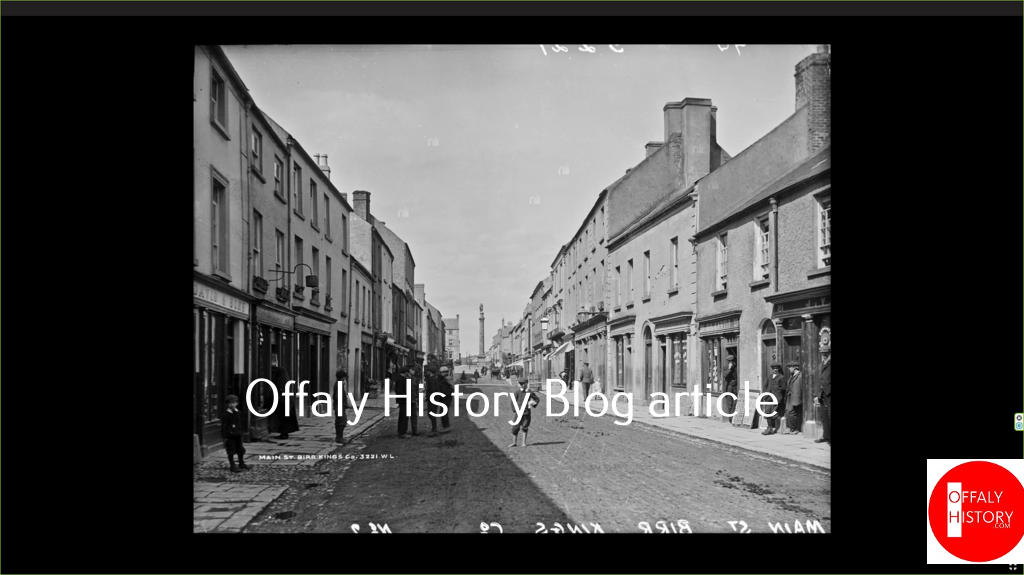
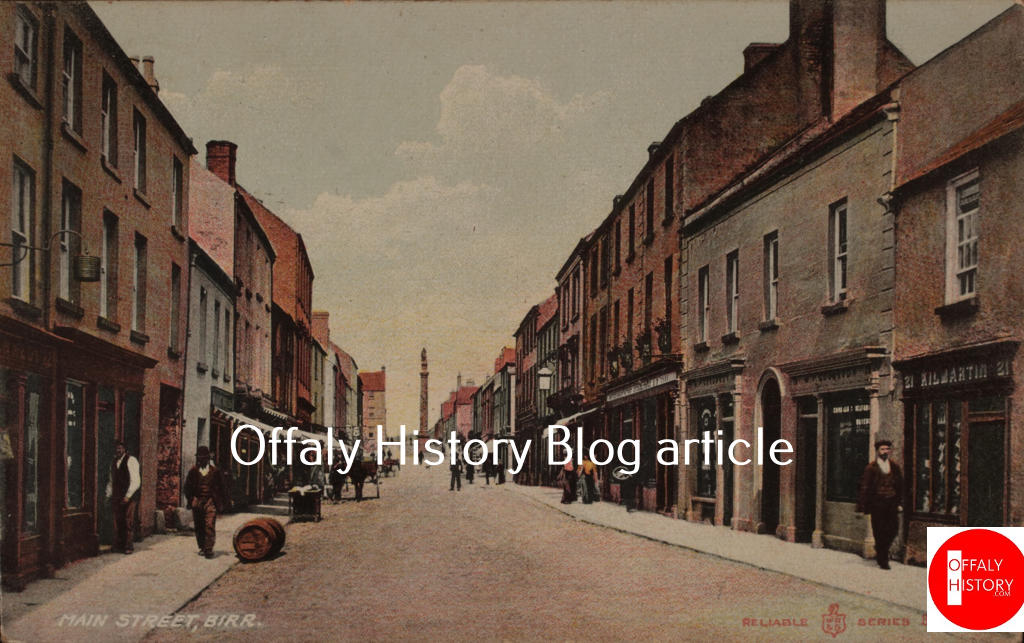
Thomas, Eliza, and their nine children then moved to Birr (then Parsonstown), where they opened a bakery on Main Street. Eliza’s inheritance from her aunt Anne Shannon likely made this possible. The business seems to have achieved modest stability, and by 1843 the premises were described as “a good business situation” with added shops.
Thomas continued to struggle financially, although his brother Robert of Clara quietly supported him, paying school fees for the children and occasionally visiting. Despite being disowned, he continued to attend Quaker meetings in Birr and longed for reinstatement. In 1848, sensing his end was near, he applied for readmission. After investigation, the Mountmellick Meeting agreed, noting he was “fully sensible of having brought reproach on the society”. He died days later, on 28 July 1848, and was buried at Rosenallis.
The Children: Emigration, Modest Trades, and Limited Success
The Goodbody children grew up amid constant financial insecurity, and their education suffered. Several were sent to the Quaker Provincial School at Mountmellick, often with fees paid by their uncle Robert. As adults, their prospects in famine‑stricken Ireland were limited.
• Mark, the eldest son, emigrated to Canada soon after Thomas’s death, married in Kingston, Ontario, and died young in 1859.
• Samuel Penrose and William Pim briefly attempted a joint business in Bath selling china and glassware, but it continued under the management of Samuel. William took over the Birr bakery.
• Thomas (junior) emigrated to New York, working as a porter and clerk, marrying a widow, and eventually returning to Dublin, where he died in 1901.
• Robert (born 1832) became the most successful of the siblings, establishing himself as a merchant in Birr selling flour, seeds, coal, and acting as an emigration agent. He leased a suburban residence, later known as Woodlands, and raised five sons—yet all but one eventually emigrated to the United States.
• Eustace Wallace, the youngest of Robert’s sons, remained in Birr. A popular local figure, rugby player, and cyclist, he inherited the family businesses but became entangled in the debts of his uncle William and was eventually declared bankrupt after his death in 1911.
Decline and End of the Birr Goodbodys
The final decades of the nineteenth century saw the gradual decline of the Birr Goodbodys. Robert’s sons all emigrated, or died without having children, leaving no next generation in Ireland. William, who ran the bakery, suffered mental illness and died in 1909 with substantial debts. Eustace, who had been managing William’s affairs, was removed as receiver after legal action by creditors, including the Perry family of Belmont Mills. His own bankruptcy followed.
By 1912, the Quaker Meeting House in Birr—long associated with the Goodbodys—was sold to the Freemasons. The Quaker roll of 1909 listed only three members in the town, including William Pim Goodbody.
Contrast with the Clara and Tullamore Goodbodys
The Birr branch stands in stark contrast to the prosperous Goodbody families of Clara and Tullamore, who built major milling, jute, tobacco, and commercial enterprises and rose to the status of landed gentry. Although there was occasional contact between the branches, their lives diverged sharply. The Birr Goodbodys remained small shopkeepers, millers, and emigrants, marked by repeated misfortune and financial instability.
This is a partly automated summary of an article prepared by Michael Goodbody for inclusion in the forthcoming (2027) Offaly Heritage 14.

