
The difficulties caused for historians of Ireland by the wholesale loss of our historical records has been likened by one scholar to peering through a keyhole at a ballroom and trying to see the dancers. Occasionally a couple moves into focus but ‘for all one knew, just out of view, there could be a group of naked men and women dancing the Siege of Ennis’. The problem is exacerbated in the case of women’s history because even fewer of their records survive. However, the correspondence of women in the 18th and 19th centuries provides us with one of the most effective implements with which we can prise open, even just a little, the door to that ballroom, giving us all a better view of the action.
The personal letter is quite a remarkable literary artefact. The fact that it has now been superseded by other forms of communication should not cloud our appreciation of its history and its cultural impact. Its role in the history of Irish women is nothing short of revolutionary. Long denied access to education by an oppressive, patriarchal society, women are practically absent from the historical record up until the end of the early modern period. All this changed in the 18th century when for the first time Irish women in numbers began to be afforded their right to an education. One of the first things they did was to begin to write – and by so doing to reinvent – the personal letter. What survives from this time in the archive contains not only factual information that cannot be found elsewhere, but because of the nature of letter writing we can glimpse even more intangible information. This is due to two main characteristics of the letter. Letter-writing is a very self-referential activity meaning that writers frequently referred to the practice of letter writing. They apologise for not writing or for bad spelling, they speak of the agonising wait for a missing letter, they tell stories of the pleasure someone had upon receiving a letter. In this way historians can see that the behaviour itself was culturally important which is every bit as interesting as the actual words on the page. The other characteristic is the manner in which a letter, particularly a woman’s letter, facilitates storytelling and in telling stories the letter allows the modern reader to catch a glimpse of otherwise vanished human experiences including those of members of society such as children and domestic servants whose voices, much like women’s voices, have been otherwise very much lost to history.
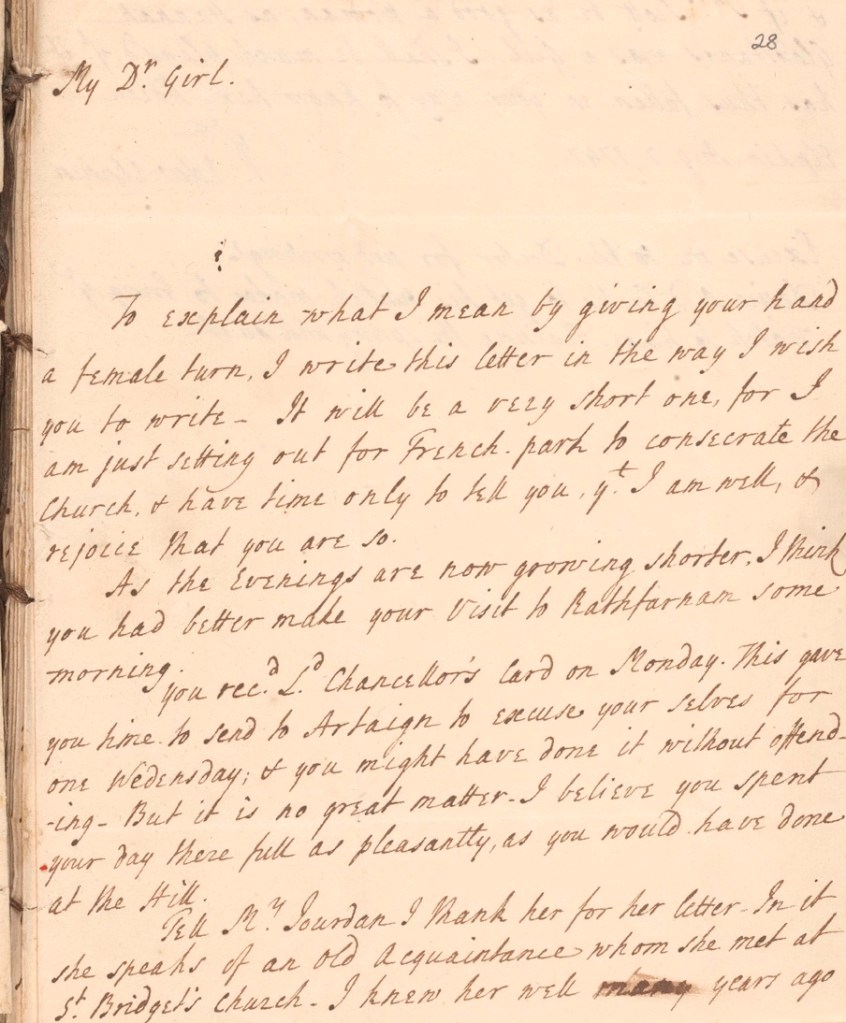
The absence of women from much of what passes for national history of course means that that history is at best partial. The work of reintroducing not only women’s voices but a distinct female world view into the national story faces two very great obstacles. The overriding characteristic of Irish history is that it was distorted by the culturally toxic effects of colonialism. This frequently means that for a subject such as women’s history one can really only rely on sources produced by the wealthiest persons in society. The impoverishment and oppression of the majority population and the delayed development of a Catholic middle class means that where their voices are to be found at all it is mostly through the stories told by their employers. The other major problem is the dearth of sources. It is widely accepted that the number of Irish personal letters which survive in research repositories represents a tiny fragment of the quantity which would have been produced. One historian of 18th century Ireland suggests that all of the records which survive for Ireland in the 18th century only refer to about 5 percent of the population of whom even a smaller percentage can be studied in any detail. For women it is even more problematic as women’s records survive much less frequently than men’s. And some places – mainly the cities, where the wealthy tended to congregate – are better served in terms of the survival of archives than elsewhere.
It is not all doom and gloom when one wants to discuss women’s history and women’s letters. While the quantity that survives remains heartbreakingly small, developments in the last 40 or 50 years in the way historians approach personal records have revolutionised the value of these records. Personal records were long considered to not be appropriate material for history mostly because private life, even of that stalwart of so much history The Great Man, was not considered suitable for public discussion. The main focus of historians was overwhelmingly war, politics and wealth right up till the 20th century and for these subjects public records were most useful. Personal records were also considered by historians to be difficult to use as they were to be considered unreliable witnesses to events. What is written in one person’s letter can rarely be corroborated and where the letter writer is otherwise unknown to the historian, it can be difficult to evaluate what she has written. However, an evolution in historiography has since raised the profile of the personal letter as a valuable and usable document. Firstly, with the introduction of social history as a major research strand in the middle of the 20th century the research spotlight moved away from the monied class to consider all elements of society. The surviving records of all kinds of people were scrutinised for what they could reveal to enhance national histories. The best-known example of this (and one of the earliest uses of such records) was research based on the letters of emigrants. Social history, or grassroots history, forever altered how people understand their country’s development and it broadened the audience for history generally. It was matched by the interest in women’s history which itself was a direct corollary of the positive social upheaval effected by feminism towards the end of the 20th century. Sad to say the first work specifically dedicated to women’s history in Ireland only dates to the late 1970s, so we have a lot of ground to make up.
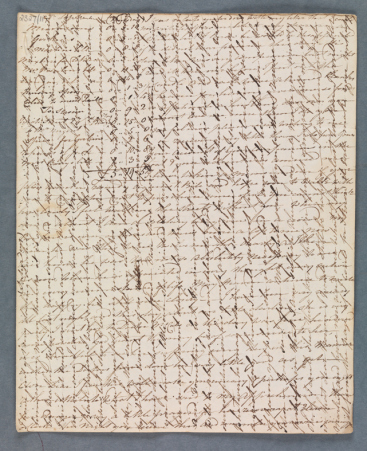
Women’s archives, having long been ignored by historians looking for information on national activities from which women were excluded, began to be much sought out by those researchers interested in domestic life and in social life, in both of which arenas women shone. One other change in current research methodology can be mentioned which allowed women’s letters to be appreciated as unique and distinctive. That was the growth of interdisciplinarity in research. No longer would a historian read a personal letter the same way as she would read a set of committee minutes or a ledger. Now, the methodology of the literary scholar began to be deployed by the historian in recognition of the fact that the personal letter is a literary composition, as much as a poem is, rather than being a strict documentary record. The characteristics of women’s letters, for example the inclusion of multiple subjects and the fact that they were often quite long, characteristics which had traditionally drawn opprobrium, began to be appreciated for the fact that they bore testimony to much more than just the text on the page. They revealed the cultural significance of correspondence networks, they revealed the role letter writing played in people’s friendships, they revealed the workings of marital relationships, they gave insight into the lives of servants, and they showed something of the lived experiences of children.
Dr Jane Maxwell
‘Letters say: 18th and 19th century women’s personal letters.’ By Jane Maxwell.
Dr Maxwell will be speaking at Offaly History Centre, Bury Quay, 7. 30 p.m. on Monday16 November. Blog no. 827, 11 Nov. 2026. All are welcome. Adm is €5 to non-members Beside Old Bonded Warehouse restaurant and new Aldi.

