
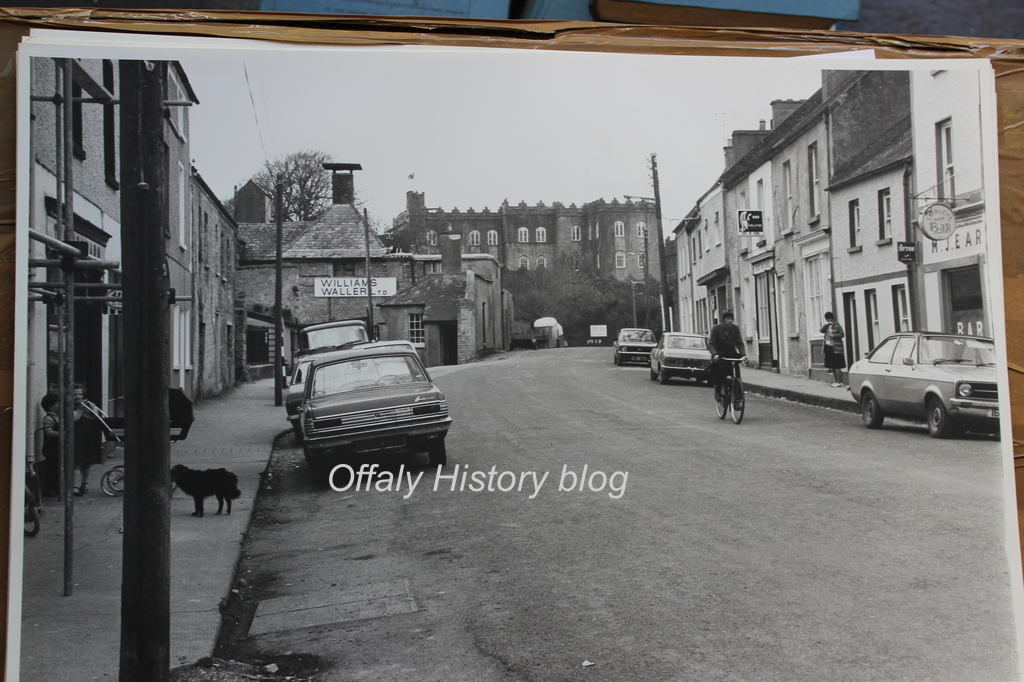
Castle Street, Birr comprises a mix of about thirty commercial and residential properties close to the Camcor river to the south, Main Street and the old parish church to the north, and to the west Birr Castle. On the east at the Market Place or Market Square the street opens into Main Street, Bridge Street and from the 1880s into the new Brendan Street. The market house stood from the 1670s where the memorial to the Manchester Martyrs was placed in 1894. Surprisingly, when the market house was taken down in the late 1700s it was not replaced with a new building in a less disruptive location.[1] The new courthouse and jail of c. 1809 took care of the legal functions, while two plots were reserved in Castle Street for the markets.
Castle Street varied greatly in character from the strong residential houses of two and three-storeys to the robust commercial warehouses close to the boundary of the castle, attracted by the availability of water-power and facilitating in the 1800s the development of distilling, brewing and malting houses. Castle Street was also the principal marketplace in Birr with markets held each week and large fairs three or four times per year. There was a strong base in agri-business in the street and this in turn created businesses such as draperies and boots and shoemaking to especially cater for the farming clients from the prosperous hinterland. That Castle Street was intimately bound up with the rural economy is clear from the surviving early photographs of the 1900s and one of 1856–7. The early photograph is by Mary Rosse and is of a market day in Castle Street.[2] This would make it the earliest surviving photograph of a busy street in Offaly, as most others are not before 1890 or 1900.

The heritage of the street today very much reflects the distilling and malting presence in the shape of buildings converted since the 1990s to accommodation for visitors and restaurants. A substantial part of the distillery and malt houses on the southern side have been demolished to make way for new housing, with survivals in The Maltings guest house and a bonded warehouse west of a former Presbyterian church. The brewery beside the old churchyard has gradually been converted to the Spinners’ restaurant and accommodation over the period since the 1990s. The only institutional building in the street was the Crotty church (later Presbyterian) erected in 1837–8 and in the 1880s converted to warehousing and industrial uses. It is a surprising location for a church in the first place when compared with those erected in Birr in 1815–25 for the Protestant, Catholic and Methodist communities. The location of the first Presbyterian church has its origins in the Crotty ‘schism’ in the 1820s and 1830s about which a good deal has been written.[3]
In his review of the history of the town of Birr published in 1826 Thomas Lalor Cooke wrote that Castle Street was once fashionable and was one of the oldest streets in Birr. At the junction with Main Street formerly stood the market house and the sessions house and can be seen on the Michael Richards’ map of 1691 showing the defence works erected against the Jacobites. Cooke was of the view that Main Street was called High Street in 1628 and the upper half of the street was called North Street. The view of Castle Street, Cooke remarked, was terminated to the north-west by the lofty walls of the castle, over which the high turrets of that building appeared with good effect. Castle Street may well have been formed as early as the 1620s with the commencement of new works by Laurence Parsons (d. 1628) at the former O’Carroll Castle site and lands.

Parsons began to make extensive improvements to his Birr estate almost immediately. He gave leases to about sixty people in 1620.[5]
Parsons had received a grant of the lands of Birr in June 1620 as part of the Plantation of Ely O’Carroll during the reign of James 1. His grant was extensive in that he was enabled to create the manor of Parsonstown. Later in the same year he received a grant or licence to hold markets and fairs. Parsons very quickly set about making improvements to Birr castle and the parish church and by the late 1620s had given leases to tenants some of whom may well have been located in Castle Street. Both Philipstown and Banagher were created borough towns but Parsonstown was not. In his review of the Calendar of the Patent Rolls of James 1 the late Aidan Clarke stated that some patents were not summarised entirely, and that the grant to Laurence Parsons contained an unimplemented provision by which Birr/Parsonstown was to become a parliamentary borough.[4]
Cooke summarises by stating that:
About the year 1628, Castle Street was the principal street in Birr. There were then also Laurence Street, St. Brendan’s Street, “Northe” Street, and High Street, with some lesser streets and lanes. At this time, however, there were only a few houses, including the gaol, beyond the old bridge; and it appears from a plan of the town, so late as 1691, that even then the town did not extend northwards beyond the present Cumberland Square. In fact it was only in the commencement of the present century [post 1800] that the first houses in Cumberland Street were erected. Some of the streets above-named existed in Birr long previous to the coming there of Sir Laurence Parsons. [6] If they did it was probably as thatched cabins.
Cooke writes of a second bridge that was located near the castle from about 1620 and was near the end of Castle Street.
This bridge crossed the river opposite to the old church, where the distillery yard was in later days, and led from Brendan’s Well, which was close to the river on the opposite side; and from Killeen and Croghan in Tipperary, by a now long unused and closed up road. This old bridge was swept away by a flood in 1787, but some remains of it were to be seen in late years. There was also a wooden trough formerly across the river here, which conveyed water, raised by a wheel worked by the river, from Brendan’s Well to a cistern which stood where the distillery yard was afterwards. There was then likewise a passage leading to this well from High Street, through the present Post Office Lane.[7]
Birr as a township was the most advanced of any Offaly town from the 1620s to the 1850s. Evidence of trade and business activities comes from a range of sources including leases, valuation records, maps, old photographs and trade directories.
In this blog we are looking at the trade directories, remembering that not all traders were listed
High Status residents in Castle Birr, 1824–
Pigot Directory 1824
Nine entries for Castle Street
Rector Downes lived in Castle Street close to the old parish church. The new rectory was completed in the late 1820s close to the new church at Oxmantown Mall. The academies listed were two of the four in this directory. By 1824 most of the Birr businesses were listed for Main Street with some in Duke Street, Moor-park Street, Green Street and Connaught Street.
Gentry etc
Downes, Rev. Abraham, Rector, Castle Street.
Academies
Kelly, Patrick (English)
Shields, John (English) [later the bookseller and publisher]
Bakers.
Dignan, Christopher, Castle St.
Brewers and Distillers.
Robinson, Robert, Castle Street.
Robinson, Arthur, Castle Street.
Carpenters and Builders.
Warren, Edward, Castle Street [also in Tullamore]
Grocer
Smith, Mary, Castle Street
Miscellaneous.
Carroll, William, Silversmith, Castle St
Bowen, Patrick, Castle Street, publican
Dignam, Christopher, Castle Street, baker
Dignam, Christopher, Jun., Castle Street, baker
Klephel William, Castle Street, professor of music
Fitzgerald, Maria, Castle Street, straw bonnet maker
Meara, William, Market Square, wine & spirit merchant [of the Meara later O’Meara family]
Murphy, William, Castle Street, market toll collector
Robinson, Simpson, Castle Street, distiller
Rourke, William, Castle Street, tailor
Slater’s Directory 1856
Bergin, John, Castle Street, publican
Carty, Charles, Castle Street, fishmonger
Dignam, Christopher, Castle Street, baker
Fitzgerald, Mary Anne, Castle Street, bonnet maker
Fitzgerald, Maria, Castle Street, straw bonnet maker
Glennon, John, Castle Street, tailor
Hart, Patrick, Castle Street, cork cutter
Horan, Michael, Castle Street, builder
Horan, Michael, Castle Street, publican
Kilmartin, William, Castle Street, publican
Horan, Michael, Castle Street, timber merchant
Lawlor, Teresa, Castle Street, milliner
McDonald, Hugh, Castle Street, carpenter
Mulhall, James, Castle Street, free school
Palmer & Booth, Castle Street, bacon merchant
Spain, Patrick, Castle Street, Boot and shoemaker
Wallace, Alexander, Castle Street, medical attendant at dispensary

Slater’s Directory 1870
Charey, Richard, Castle Street,
Fitzgerald, Maria, Castle Street,
Fitzgerald, Mary Anne, Castle Street,
Glennon, John, Castle Street,
Keighary, Patrick, Castle Street,
Keighary, Patrick, Castle Street,
Kilkeary, Patrick, Castle Street,
Kilkeary, Patrick, Castle Street,
Meara, John, Castle Street,
Molloy, Sarah, Castle Street,
Woods, William, Castle Street,
Woods, William, Castle Street,
Slater’s Directory 1881
Cleary, Patrick, Castle Street, corn and wool dealer
Coady, Martin, Castle Street, egg and game dealer
Cully, Mary, Castle Street, public house
Dooley, James, Castle Street, seed and manure
Fahey, Bridget, Castle Street, milliner, dressmaker
Flood, Michael, Castle Street, saddler
Horan, Julia, Castle Street, linen and woollen draper
Keighary, Patrick, Castle Street, Boot & shoemaker
Malone, Anthony, Castle Street, pawnbroker
Molloy, Sarah, Castle Street, public house
Murray, John, Castle Street, provision dealer
Ryan, James, Castle Street, pawnbroker
Woods, William, Castle Street, maltster
Slater’s Directory 1894
Cleary, Patrick, Castle Street, corn and wool dealer
Cleary, John, Castle Street, grocer
Cully, Mary, Castle Street, spirit dealer
Eades, Robert, Castle Street, draper
Fahey, Patrick, Castle Street, boot & shoemaker
Flood, Michael, Castle Street, saddler
Hogan, Denis, Castle Street, saddler
Horan, Julia, Castle Street, draper
Horan, Michael, Castle Street, undertaker
McNamara & Sons, Castle Street, coach builders
Molloy, Sarah, Castle Street, spirit dealer
Ryan, James, Castle Street, pawnbroker
Sammon, James, Castle Street, boot and shoe manufacturer
Watterson, Bessie, Castle Street, Birr, grocer
Woods, William, Castle Street, maltster

Porter’s Directory 1909
Kennedy, J., Castle Street, publican
O’Carroll, J.M., Castle Street, draper, clothier
Wood, W., Castle Street, maltster
Cleary, P., Castle Street, Corn and wool merchant
Gaffney, Owen, Castle Street, Furniture DLR
Horan, Julia, Castle Street, outfitter
McDonald’s Directory 1912
Lee, G.A. Castle Street, cycle agent, boot manufacturer, outfitter
Doolan, K., Castle Street, General Draper, Milliner, Boot & Shoe Warehouse
Woods, W., Castle Street, maltsters
Hogan & Sons, J., painters
The articles on Castle Street are about charting the history of this and in time every other street in Birr. You can help with photographs and memoirs.
Next week: some of the old leases for Castle Street, Birr
[1] Thomas Lalor Cooke, The early history of the town of Birr or Parsonstown with the particulars of remarkable events there in more recent times also the towns of Nenagh, Roscrea, Banagher, Tullamore, Philipstown, Frankford, Shinrone, Kinnetty and Ballyboy and the ancient septs, princes, and celebrated places of the surrounding country (Dublin, 1875, reprinted, Tullamore, 1990 with a new introduction and biographical note on Cooke by Margaret Hogan, pp i-xxxi), pp 49-50.
[2] David Davison, Impressions of an Irish Countess: the photographs of Mary countess of Rosse, 1813-1888 (Birr, 1989).
[3] Useful listings of publications about Birr will be found at wwwoffalyhisory.com. Go to the library catalogue in Research Offaly. Also see www.irishhisoryonline. Search under county for 773 items of Offaly interest as of 2019.
[4] Aidan Clarke, Review of The Calendar of the Irish Patent Rolls of James 1 in Irish Historical Studies, 15:60 (Sept. 1967), pp 480–1.
[5] Cooke, History of Birr p. 384.
[6] Cooke, History of Birr, pp 50–1.
[7] Cooke, History of Birr, pp 45–6.


 offalyhistoryblog