
Business and residential
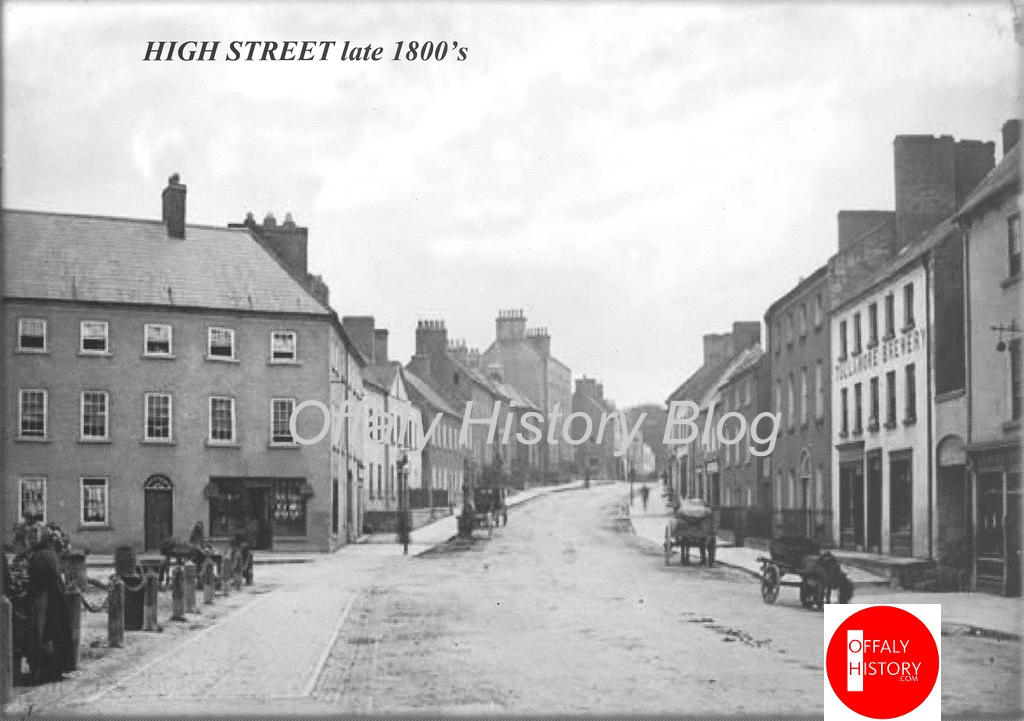
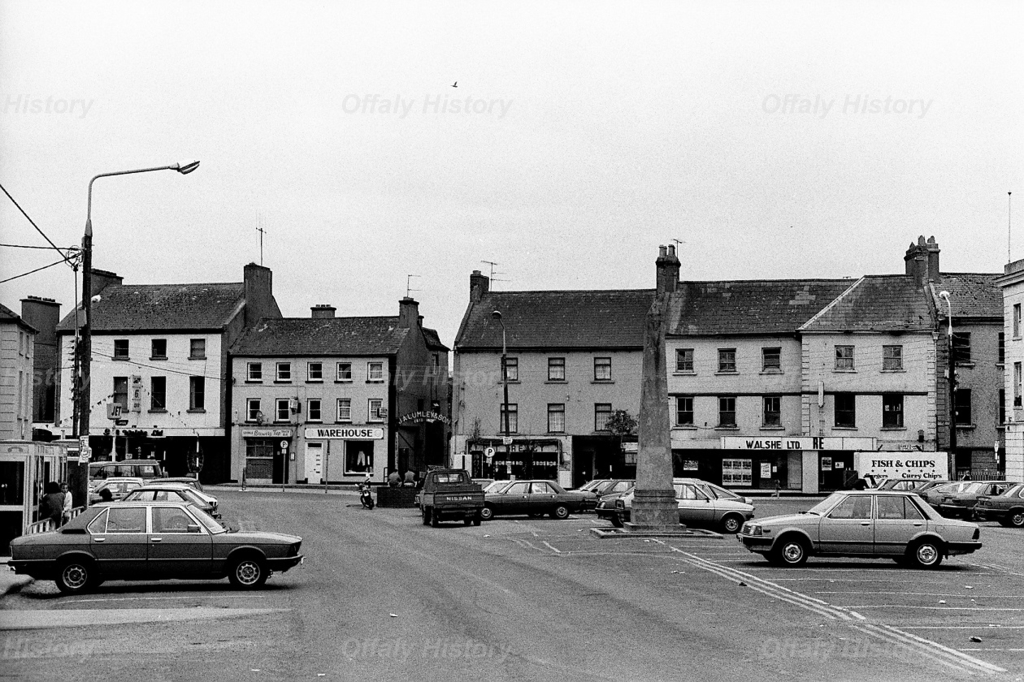
The square proper never had a public house until that in GV 5 in recent times, while the Brewery Tap on the western side at GV 3 High Street has served the public for well over 100 years. It was only in 2018 that a new public house and night club was opened at GV 5, now known as The Phoenix. The great garage of G.N. Walshe (GV 1 High Street) replaced the Goodbody hardware store which was in business from the 1840s to 1930 and with a tobacco factory at the rear until 1886.
George Walshe had worked for R.H. Poole, the first Ford dealer in Tullamore who lived until 1920 at GV 4 High Street.

The market house (GV 11) always had trading and civic functions with the former on the ground floor and the latter, a courthouse, and then an Anglican chapel on the upper floor. The market house function gave way to town hall by 1820 by way of a savings bank and charitable loan fund bank and meeting room upstairs. The branch offices of insurance companies, such as Hibernian and Yorkshire/General Accident occupied all or part of GV 5 and 6 O’Connor Square. Of groceries and hardware the square had Goodbodys until 1930 and Cecil McNeill’s (at GV 2) from the 1920s until about 1969. McNeill was succeeded in this location by Barry Keegan and the house is now used as a stationery and a turf accountant at ground level. West of Keegan’s were drapery businesses for many years such as Ginnelly’s and Tony Corcoran’s (GV 1 and 2). Miss Colton lived in GV 3 until the early 1980s as a private residence while the Kelly family (of the three sons Jesuits fame) lived at GV 10 (now Farrell & Partners). At GV 11 were the Gaelic League rooms from 1933. It was Kelly’s Sunshine Café and shop from the early 1960s while the market house became the Capri Café.[1]
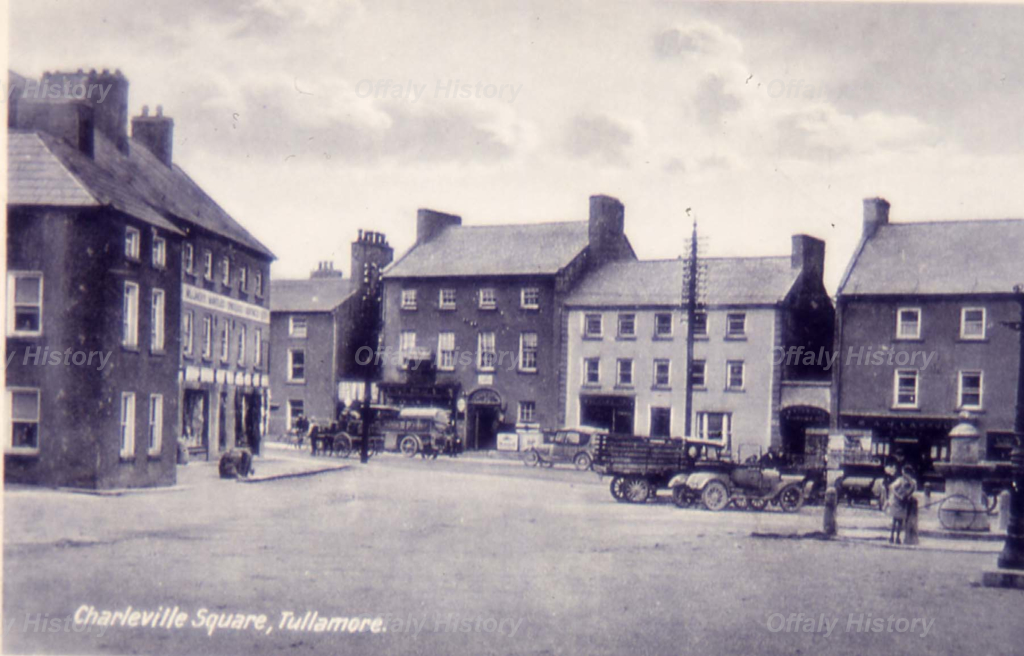
Not surprisingly there was no public house in the body of the square (save on the west side and the perimeter with High Street) for 300 years.
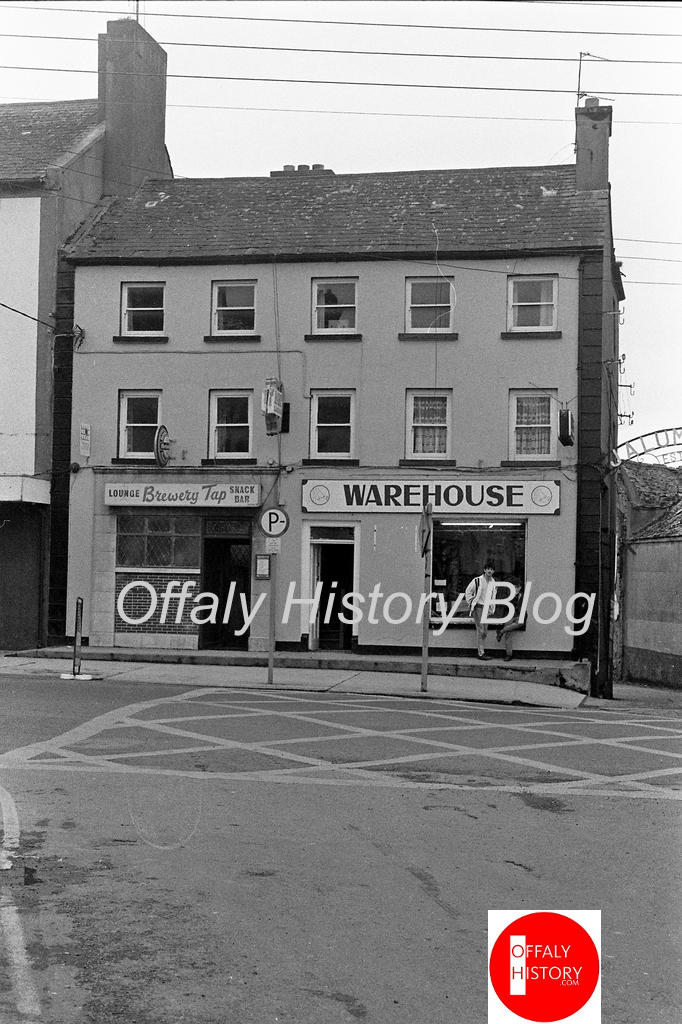
No. 3a High Street, the Brewery Tap
The background to the 1713 building lease for the Brewery tap building was the development of the market place as a square. This took eighty years with the houses on the north including the market house not completed until the 1786-93 period. On the south side the large Flanagan building on the corner of O’Connor Square was a significant achievement with the completion of GV 49 High Street and GV 1 and 2 O’ Connor Square. What was built first was the line from the present-day Bridge House to the Brewery Tap. These sites for building were made available by the Moore landlords from 1713.
The Brewery Tap, a five-bay three-storey house with (in the 1970s) two ground floor shop fronts, both of which has now been incorporated in the Brewery Tap public house. It is not clear when this house was erected. It may be a late eighteenth-century reconstruction of a house first erected about 1713. In June 1713 John Moore of Croghan and Colley Lyons of Clonarra [Clonarrow] near Daingean leased to Richard Brennan, a tobacco spinner, a house, garden and town parks in Tullamore during the lives of Thomas Moore of Tullimore, Elinor Moore, wife to said Thomas and the said John Moore. It was further agreed that the demise could be held for the lives of Richard Brennan, Richard Holmes near Lehinch [Clara] and John Early of Mountmellick with the property to revert to John Moore if Brennan should die first.[2] There is a draft lease of 1752 in Offaly Archives referring to this property and bounded on the north by William Kershaw’s (GV 3) and on the south by Richard Moore’s garden (GV 4) and referring to William Thornburgh as a nephew.[3] The house of Richard Brennan is mentioned in the manor court book for October 1768 in reference to the fixing of a grate on the opposite side of the road.[4]
In 1786 the property was leased to Joseph Thornburgh by Charles William Bury in a new lease. Bury had inherited the Moore estates in 1764 when just an infant and came of age in June 1785. Thornburgh, was a merchant, who died about the same year of 1786.[5] He probably gave his name to the present Thornberry Estate in Puttaghan. In 1821 John Hamilton of Tullamore sold the long leasehold of the property to rent-seeking Robert Belton Slater for £100 and an annuity of £20 a year, payable to Hamilton and his wife (née Pringle). The property was described as the house formerly held by the late Richard Brennan and afterwards in possession of Joseph Thornburgh, and containing 41 per. and 350 ft. The property was then in the possession of Thomas Wilson, a merchant.[6] In 1831 Robert Belton Slater of Coolraine, King’s County, together with Martha Hamilton, a widow of the 2nd part sold the property to William Deverell, a Tullamore grocer and spirit merchant, for a yearly rent of £40 and the renewal fine under the head lease of £1. 7s. 8d. The Belton family of Coolrain, Tullamore were in the linen business and this was the sale of their investment to Deverell. The house was described as lately in the possession of Thomas Wilson and bounded on the north by Thomas Manly’s holding and on the south by that of the late Richard Moore.

In 1843 the out-offices of the house included a stable, chandling house, a cow house, a beer store, a brew house, a barn and cow shed. William Deverell was in possession in 1843 and 1854. The valuer noted that Mr Deverell had erected considerable offices, i.e. outbuildings, on this concern. The place had no garden but had an extensive yard.[7] Indeed that is how people remember it in more recent years up to the demolition in the mid-1990s of most of the buildings for the new Bridge Centre.
In 1843 the valuer reported:
3a (68) William Deverell – grocer and spirit merchant
D.F.37.0, H.30.0, 1B+ (I.A-).
Also basement, stable, chandling house, cow house, beer store, brew house, barn and cow shed.
Mr Deverell has erected considerable offices on this concern. There is no garden but the yard is very extensive and situation for business excellent (dwelling well finished).
Robert George Deverell purchased the fee grant of the house from the third earl of Charleville in September 1853. This followed on an entitlement under the Renewable Leasehold Conversion Act of 1849. The Robert G. Deverell house and the brewery were valued at £70 in 1860–1 but was reduced to £50 by 1867 and remained at that level into the 1890s. Of course, the improvements may have been noted on GV 5, being the house and premises formerly owned up to about 1884 by Constantine Molloy (now Conway & Kearney).[8] GV 3, the public house, was noted as very old but in a good situation and valued at £12 while it was noted in 1883 that the brewery to the rear was rebuilding.[9]
The Deverell family were prominent in business in Tullamore with one Richard Deverell, a brewer, purchasing GV 10 High Street (more recently McGinn’s/ Dempsey’s/Copper Pot public house) about 1805, but this appears to have been out of business by 1843 when this property was let to another and a second property of his, an old malt house in Tanyard Lane, was described as going to ruin. The same poor condition applied to 48 High Street let, possibly in the 1820s or 1830s, to Robert Deverell and later T.P. & R. Goodbody. Richard Deverell had acquired this property about 1798 and was described at the time as a dealer and chapman. By the 1860s the property was owned by Robert George Deverell who died on 2 June 1866 intestate, aged 44, leaving five minor children and their mother Charlotte Deverell as legal guardian.[10] This Robert George Deverell was the grandfather of Averil Statter Deverell (1893–1979), Ireland’s first woman barrister. She was born in Greystones in 1893 where her father, William, was a solicitor and clerk of the crown and peace. Following on the change in the law in 1919 to allow women to become barristers Miss Deverell and Frances or “Fay” Kyle, were admitted to King’s Inns in Dublin and made history by becoming the first women to be called to the bar in the UK, of which Ireland was still a part. [11]
Soon after the death of R.G. Deverell the brewery was advertised for letting for seventeen years during the minority of William Deverell as a ward of court.
This long established and well reputed Brewery is now in full working order, and actually at work. It is supplied with all the modern improvements in machinery, has very extensive accommodation of every kind. Offices, stores, &c, is held in fee, and every way suitable for the business, which has been successfully carried on for many years, and the goodwill of the flourishing trade attached to the Concern will pass to the tenant. There is also a retail shop and dwelling-house over it, fronting the square, used as a grocery.
For all further particulars apply to Mrs Deverell, on the premises and/or her solicitors.[12]
Patrick Egan, senior and Patrick Egan, Junior agreed to take a seventeen-year lease of the brewery at £100 per year from 1 November 1866. This was to include the Deverell malt houses in Tanyard Lane (where the council carpark is now located) held under fee farm grants of 3 September 1853 and 19 June 1861. At the time Henry Egan, the brother of Patrick Egan, Jun. was a registered maltster. In 1884 Patrick Egan and Henry Egan were able to secure a 999-year lease at £90 per year from the Deverell family. This was the buy out of the premises as soon as the children came of age for a then attractive rent in perpetuity. For Deverells this represented a net profit after the head rent was paid to Charleville of £88 per year. They also took over malt houses in Tanyard Lane comprised in fee farm grants of 3 September 1853 and 19 June 1861. These latter holdings reflected what was comprised in the Wilson tanneries of one hundred years earlier and were located where Tarleton Hall and the council carpark are today.
The brewery had for its neighbours the Goodbody tobacco factory (GV 1) on the north and the R.I.C. constabulary barracks (GV 4) on the south. The Egan brothers extended the brewery in April 1884 by purchasing lands behind what is now Conway & Kearney, solicitors (GV 5) for a sum of £700. The vendor was barrister Constantine Molloy whose family had owned GV 4 and GV 5 for many years. A valuation record for 1882 for 3a High Street noted the existence of two licensed houses – very old, the brewery, stores (and a new store) with the valuation of lot 3a increasing from £12 to £40 by 1886.[13]
Following on the expansion of the brewery in 1883 it was not surprising that it should be written about in glowing terms by the local press:
The only brewery in the county is owned and worked by P. & H. Egan, Tullamore. It is a most extensive concern and turns out from thirty to forty barrels of ale and porter per day, which is disposed of in the surrounding towns. The corn stores, three in number, attached to the brewery are capable of containing 15,000 barrels of grain, and in the splendid malting houses, also attached, upwards of 8,000 barrels of malt are made during the season. The brewery affords considerable employment, the wages expended, on labour alone amounting to nearly £1,500 per annum.[14]

Another report put the number employed at fifty employed and that the season was from October to May. The place was under the management of William Hoey. By way of distribution the firm kept twenty-seven horses on the road. The steam sawmill was cutting about 2,000 feet of timber daily and the total number employed throughout the firm was not less than 100. A new four-storey brew house was completed by December 1884. New corn stores and bottling rooms had been erected on the premises purchased from Constantine Molloy (GV 5).[15] By 1887 the firm had doubled its output of excisable beer.[16] In the meantime a library had been opened for staff as early as 1883.[17] A report in 1895 (just prior to incorporation) stated that the firm was buying 15,000 barrels of barley each season, paying £60 to £70 a week in wages (presumably at about 10s. per head), and had spent up to £12,000 on the brewery in the previous ten years. The water supply was from springs in the Tanyard. A new malthouse, 300 ft in length and 80 ft in breadth was located at the old Pentland distillery in Market Square as also were the sawmills. The principal grocery was at Bridge House.[18]
Most of the property of the Egan brothers was transferred to the incorporated P.& H. Egan Limited in 1896 including the Bridge House in Bridge Street (GV 1 Bridge Street) and the brewing and malting concerns. By this time the company’s nominal capital was £80,000, 250 hands employed and thirty horses on the road each day. The plan was to extend malting capacity from 15,000 barrels to 20,000 or 25,000 barrels. The firm was buying up to 25,000 barrels of barley annually by 1902.[19] The famous mineral waters business had its origins in the acquisition of the Stirling mineral water business in Church Street at the time of incorporation in March 1896.[20] This business was cleverly operated under the name of Power & Co.[21] Power, a former manager of the Tullamore branch of the Hibernian Bank took over as managing director of the P. & H. Egan Ltd following the sudden death of Patrick Egan in May 1897. The brewery closed in the early 1920s due to excise duties and depression in trade. The Egan firm continued to trade from Brewery Lane until the winding up of the firm in 1968 and the sale in 1969 of the old brewery yard and buildings to J.A. Lumley & Son Ltd and Melco Preserves Limited. Lumley acquired the entire from Melco in 1972. The property was sold by Lumley’s in the late 1980s to Ravine Limited for the Bridge Centre development.
The pub to the front, the well-known Brewery Tap, was sold by the Egan liquidator, Desmond Reynolds, in 1968 to Kevin Adams of Tullamore. In 1989 the property was acquired by Kevin and Marge Carragher.[22] Kevin’s father was P.J. Carragher who lived and worked at Quirke’s Medical Hall up the street (GV 10). The pub was sold to Paul and Cathyann Bell in 2002. Both men had trained at Bridge House under C. Maye at GV 1 Bridge Street.

The earliest surviving street photograph of Tullamore of perhaps c. 1895 shows the brewery premises at O’Connor Square west or GV 3 High Street. The house was then leased to Daniel Galvin who was in possession with his family and staff at the time of the census in April 1901.
GV 3 High Street, Census 1901 No 4 Charleville Square 1st class Private dwelling of Galvin family, husband, wife, one assistant, one servant and one apprentice. The house had six rooms and twelve windows to the front.
| Galvin | Daniel | Head of Family | RC | 29 | Shop Keeper Publican | M | Kings Co |
| Galvin | Anne | Wife | RC | 32 | Shop Keeper Publican | M | Kings Co |
| Malone | Joseph | Assistant | RC | 18 | Shop Assistant | NM | Kings Co |
| Smith | Bridget | Servant | RC | 17 | Servant | NM | Kings Co |
| Carroll | Denis | Apprentice | RC | 14 | Apprentice | NM | Kings Co |
By 1911 the Galvins had departed and the public house and grocery was again held by the Egan firm and managed by Peter Daly.
GV 3 High Street, 1911 Census – No 2 (in the census0 Charleville Square 1st class, public house and dwelling of Daly family. Husband and wife, three daughters, four Sons and two boarders. The house had four rooms and fourteen windows to the front.
| Daly | Peter | Head of Family | RC | 42 | Manager of Shop | M | Kings Co |
| Daly | Mary | Wife | RC | 36 | – | M | Kings Co |
| Daly | Mary | Daughter | RC | 14 | Scholar | S | Kings Co |
| Daly | Patrick | Son | RC | 12 | Scholar | S | Tullamore |
| Daly | Kathleen | Daughter | RC | 10 | Scholar | S | Tullamore |
| Daly | John | Son | RC | 8 | Scholar | S | Tullamore |
| Daly | Joe | Son | RC | 6 | Scholar | S | Tullamore |
| Daly | Bridget | Daughter | RC | 4 | – | S | Tullamore |
| Daly | Peter | Son | RC | 1 | – | S | Tullamore |
| Ennis | Jas | Boarder | RC | 26 | Shop Assistant | S | Co Meath |
| Byrne | John | Boarder | RC | 34 | Farmer’s Son | S | Kings Co |
Census 1901 No 5 Charleville Square, brewery with extensive out-house and sheds.
Census 1901 No 6 Charleville Square, malting house, unoccupied
Census 1901 No 7 Charleville Square Boiling House unoccupied


Our thanks to the Heritage Council for its support for this Historic Towns Initiative

Michael Byrne
 offalyhistoryblog