
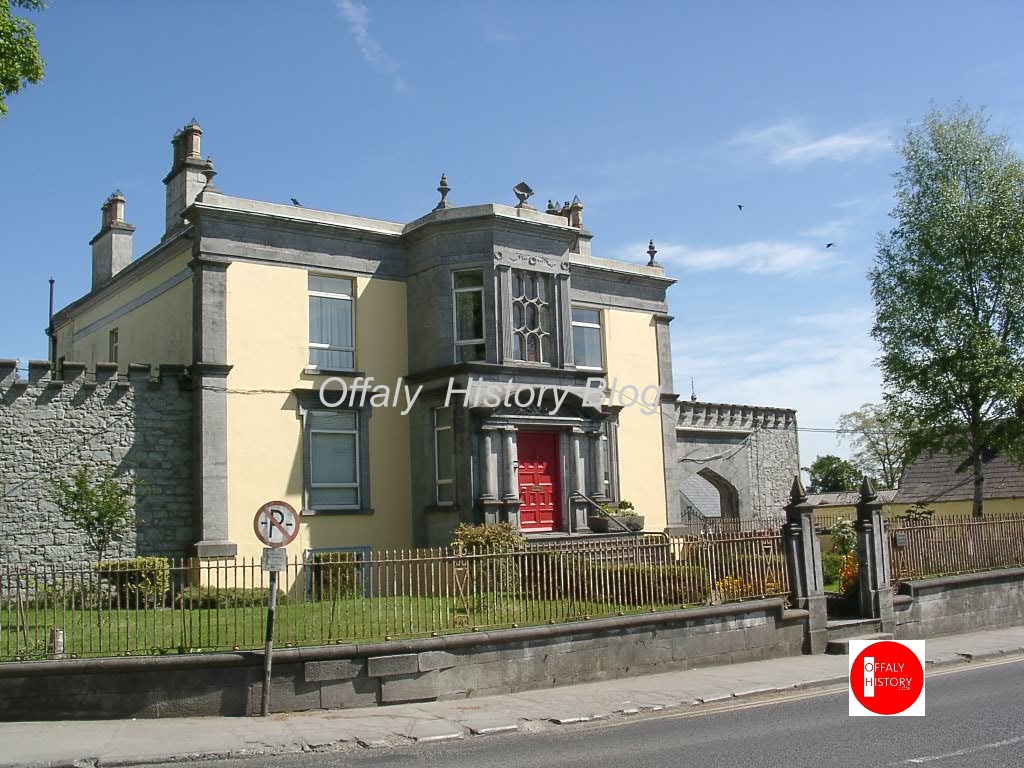
Moore Hall is an imposing two-story house over basement with two-story porch projection in cut stone, and coach arch and stables (now demolished). The façade is of three bays. The house is one of the finest in Tullamore, a fact that may escape notice because of its closeness to the street. In the front railing ironwork is the last gas lamp stand in Tullamore. This is the only surviving vestige of the era of gas lighting from 1860 to 1921.

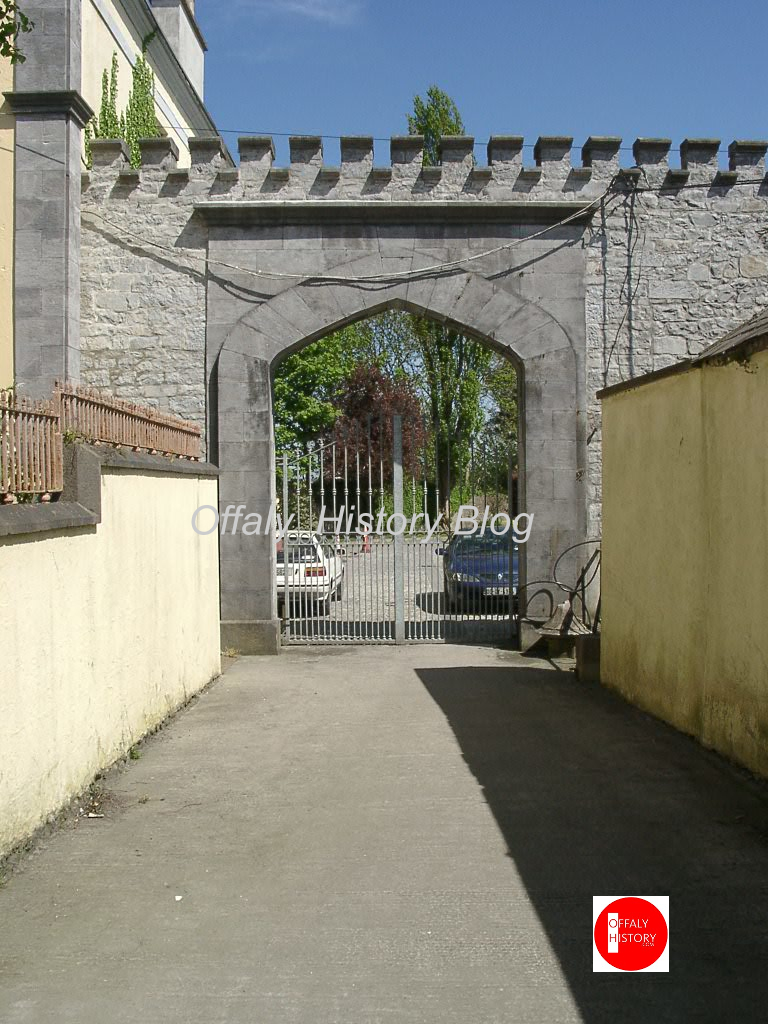
Moore Hall has a mid-nineteenth-century facade but the house is very deep and apparently dates from the 1750s. The facade is of three bays and two storeys over a basement smooth rendered and painted. In the centre is a remarkable, full-height bow of limestone ashlar, rectangular on the ground floor and a half-octagon on the first floor, with a grotesque Doric doorcase composed of short, paired columns on pedestals and a squat, segmental-headed, leaded fanlight. It is not so much the strange, exaggerated design but rather the massiveness of the individual elements which makes this doorcase so bizarre. Over the doorcase is a large window with reticulated tracery flanked by fluted pilasters. Brackets with carved bunches of grapes support the lintel which has a wreath carved in the centre. Over the side windows of the bow are panels with lilies carved on them. The ground floor windows have shouldered architraves while the first-floor windows are plain. The whole facade is flanked by pilasters and topped by a frieze, cornice and blocking course. On the blocking course are stylised urns and over the bow a shell. The hall door is approached by a wide flight of steps with moulded nosing.The garden is fronted by a low wall with wrought-iron railings, lamp bracket and limestone gate-piers. The piers to the yard entrance are octagonal, the arch into the yard is crenelated and the yard is cobbled.
At one stage it was proposed by the local authority that the street be widened and that part of the garden to the front of the house be used for this purpose. Fortunately this proposal was not proceeded with.
In 1756 Lord Tullamore conveyed a plot of ground with the dwelling house, in all a little less than one plantation acre to one Richard Moore. The plot included what is now the Spollen public house in High Street (no. GV 41 High Street) and also Moore Hall with a narrow strip of land connecting the two. This can be seen on the 1838 map and the 1869 leaseholders’ map.[1] The coach arch and stables may have been built in the late 1860s as part of the improvements at the time. The 1843 valuer drew attention to a neat house with a cut stone porch and all very good.

The property passed to Richard Moore junior in 1774 and was conveyed by him to Thomas Ryan in 1796 for a yearly rent of £11.7.6. Richard Moore’s remaining interest in the house passed to Thomas Moore in 1804 and he sold this for a cash sum. He also sold land which had been part of the original plot. The plots comprising Moore Hall garden to the rear may be made up of the back of gardens to the Crofton/Collins holdings in High Street ( GV 29 and 30) and as to Moore Hall part of the 1750s lease. The map with the 1756 lease would suggest that it comprises only the lands on which Moore Hall was built with the site of the former Hurst garage (now the Heffernan-built commercial units opposite the hotel) and the filling station adjoining). The freehold title to Moore Hall and the Cottage are derived from lands put together by Samuel Collins who, in the early 1800s, owned no. 30 in High Street and the former Roberts/Motor Works property (see under 29 High Street in earlier blogs).

Collins sold his interest in the one-acre site and house at Moore Hall in 1802 and the purchaser, Pilkington, sold a part of this for The Cottage in 1809-10 to O’Flanagan. By 1842 O’Flanagan had the superior interest in both The Cottage and Moore Hall. This would explain the common front of low walls and wrought iron railings which appear to have been in place by 1843-54 when the valuers noted that the house had a basement, coach house and stables and was well enclosed with a large yard and garden.[2] In 1842 Moore Hall, then in the possession of A.J. O’Flanagan, was sold to George Duignan, a solicitor. Duignan sold the house to Dr John Ridley in 1850 for £100 and an annual rent of £20.[3] Ridley probably bought out the Duignan interest because in about 1870 – when complaining of an increased valuation – Ridley stated that he had spent £1,400 on the purchase of the house and that he had since spent £2,000 on improvements.[4] The valuation in the 1840s and 1850s was £15 on the buildings while The Cottage was £14. The Moore Hall valuation was increased to £32 in 1868-69 because Ridley doubled the house in size and added the large garden of The Cottage to his premises bringing the garden to £3 valuation and overall to £35.[5] This is a high valuation exceeded by Acres Hall and post 1900 by Dew Park.


Substantial improvements were carried out to Moore Hall in the 1860s including the erection of a crenelated entrance gate and Gothic-style stables (now demolished). The valuer of 1843-44 was sufficiently impressed to give the house 1B+ to 1A status noting that the house with its basement, coach house and stables was well enclosed and had a large yard and garden. So the present-day facade dates back to improvements of the late 1860s.
The Moores of Moore Hall
Moore Hall is situated on the northern side of O’Moore Street. The street name has no connection with the house as it refers to an old Irish family once chieftains of Laois. Moore Hall was probably built about the year 1756 as the legal title to the house dates from 20 August of that year. Lord Tullamore gave a lease to Richard Moore, the elder, of Tullamore, a merchant, of ground already in Moore’s possession and described as ‘All that piece or plot of ground with the dwelling house, buildings and improvements containing 3 roods, 38 perches, 40 ft including half the road adjoining also the turbary in the bogs of Spollanstowne.’ The lease was typically for three lives with the right of perpetual renewal (in effect a fee simple grant). The annual rent payable to Lord Tullamore and his successors was fixed at £2 stg per annum. The lives nominated in the original 1756 lease were Richard Moore, the younger, aged 28 years (second son of Richard Moore the elder); Sarah Moore wife of Richard Moore the younger aged 19 years; and Mary Anne Moore, eldest daughter of Richard Moore, the younger, aged about nine months and survivors. When the nominated lives were dead the lease could be renewed on payment of a fine of about twice the annual rent. The tenant was not to alienate without first giving preference to Lord Tullamore, not to sell to a Papist and to do suit and service at the lord’s mill.[6] These were standard provisions at the time. From the 1700s to the relief acts of the 1790s the Protestant community and dissenters such as Quakers held all the long leases from the landlord in the town of Tullamore.
The map attached to the 1756 lease shows that it was in respect of an area from Moore Hall to Spollen’s public house in High Street connected by a strip of land stretching from the house back to what is now Spollen’s public house in High Street via what is now the Costcutter shop and filling station. It seems that the lease was taken in furtherance of a marriage and family settlement under which Richard Moore the elder retained lots (2) and (3) of the 1756 lease for his own use while lot (1) was assigned to Richard Moore, the younger, in 1757.[7] The three parts of the property are shown on the John Mooney of Geashill map attached to the 1756 lease as being (1) what is now the Spollen pub and garden (2) a garden to the rear of what is now Moore Hall and (3) a plot of ground from the Moore hall site to what is now the Heffernan/Costcutter filling station. In front was High Street and the Killeigh Road and beside the High Street portion was the Thomas Hadley’s holding with land to the north of Moore Hall and to the east in possession of Captain Crofton (see illustration). It was not great planning of leasehold land and would have implications right down to the present day. The south side of O’Moore Street was not laid out for building as was High Street and O’Connor Square. It was messy with two large gardens that ended up being used as garages in the new business of post 1921 Ireland when motor sales began to improve, i.e. the Motor Works lands (GV 29) and the Moore Hall lands where the Hurst garage was located from 1925 to the 1980s.
The parties of the marriage settlement of 19 November 1757 were Richard Moore, Senior, John Greene of Clonculloge (now Cloncollig) Tullamore and Mathew Moore of Tullamore. The latter was probably a brother of Richard Moore, Senior, and carried on the business of chandler in what was formerly Colton’s of O’Connor Square (now Gray Cuniffe Insurance and others). The parties to the marriage were Richard Moore, the younger, and Sarah Greene, daughter of Richard Greene. It was agreed that in consideration of £80 paid by John Greene as a marriage portion Richard Moore, Senior, would make over to the newly married couple the dwelling house (now Spollen’s) in High Street and certain lands near Tullamore town. It was further agreed that if Richard Moore, Junior, should predecease Sarah Moore and there be no issue born or begotten at the time of death then Richard Moore, Senior, could buy back the properties on payment of £80.
The Moore family were prominent Tullamore businesspeople and had leases at no 3 in O’Connor Square (to Mathew Moore) and in High Street. Both Moore family members served on the Tullamore manor court. Richard Moore may have died c. 1784 and his son c. 1804.[8] References to the family after the 1820s are scarce and it seems to have died out locally by that date. The surname Moore does not feature in the Pigot 1824 provincial trade directory for Tullamore.
Richard Moore, Junior, appears to have sold Moore Hall in 1796 to Thomas Ryan.[9] In 1802 the house was in the possession of Samuel Collins who sold it in that year to Henry Pilkington of Tore, near Tyrrellspass who came to live in Tullamore with his wife and son. The description in the sale document states it was the dwelling house where Samuel Collins lately dwelt bounded on the east by the garden of Richard Moore, on the west by the garden of Mrs Smith (possibly now the Masonic lodge), on the north by the garden of Thomas Benson, and on the south by the Killeigh road and comprising about one acre. Pilkington paid a fine of only £50, but also a substantial rent of £45. He was able to reduce this in 1810 by selling part of the land to Andrew James O’Flanagan who built ‘the Cottage’ and agreed to pay a rent of £8 or £9. Pilkington appears to have been aware of his impending demise for in the same year he settled his house on trustees to hold for his son in the event that his wife remarried. He died that year, his son in 1836 and his wife in 1841. The following year Moore Hall was sold by the owner of the adjoining ‘Cottage,’ Andrew Joseph O’Flanagan, to George Duigenan, a solicitor, subject to a rent of £20 per year. It was a sign of the times that Duigenan included a right of surrender.[10] When Flanagan acquired Moore Hall is uncertain, but it may have been from the trustees. However, no deed has been discovered as yet to confirm this.
An intervening occupier from the time of the death of Henry Pilkington c. 1810 may have been Richard Wilson of Westmeath who married Margaret Egan of the Meelaghans House, Tullamore about 1810 and they have five children who were baptised in Tullamore. Richard Wilson died before 1829 when his widow disposed of Moore Hall. Margaret was left with a large and young family.[11]
The Ridleys of Tullamore
Moore Hall was considerably improved during the years of Dr John Ridley’s ownership. Dr Ridley purchased the long leasehold interest in the property from George Duigenan, the solicitor, in 1850. Duigenan had purchased the house in 1842 and had practised in Tullamore for a time. He departed from Tullamore in 1850 for Kingstown (now Dun Laoghaire). Duigenan had a renewable sub-lease at £20 p.a. He sold his interest in the property subject to this rent and £100. Ridley told the valuers he paid substantially more. Moore Hall was described as measuring 52 feet 6 inches in front, greatest breadth in the rear from the turf house across to the party wall of the cottage garden in said A. J. O’Flanagan’s possession (a reference to the adjoining single storey house, known as ‘The Cottage’ 56 feet and in depth from front to rear 228 feet. The O’Flanagan to Duigenan lease of 1842 was converted into a fee farm grant (a freehold subject to a rent) in 1890 – in Flanagan to George Pierce Ridley for a rent of £20.1s.0d. p.a. In 1854 A. J. O’Flanagan gave a lease of ‘Moore Hall garden’ of c. half an acre, formerly to Dr John Ridley at a yearly rent of £10. The land was already in his possession and came with a right of surrender.[12]
Dr. John Ridley belonged to an old Tullamore Protestant family. His ancestors had lived in Tullamore since at least the 1750s. His father, John Ridley, had purchased the Charleville Arms Hotel (later the Phoenix Arms and demolished in 2000 to make way for No. 1 Church Street, Menarys from 2008, now Boots Pharmacy) c. 1819. On his death this property passed to his mother, Hanna Ridley, and in the 1840s to John Ridley, junior. About this year 1849 John Ridley sold the property to his uncle George Ridley.
John Ridley, junior, was born c. 1816 and qualified as a medical doctor. He married in 1852 Elizabeth Pierce, daughter of Dr George Pierce, of Acres Hall and granddaughter of Thomas Acres. John Ridley died in May 1875 at the age of 59 leaving issue, Ellen Ridley, wife of John William Moore, a Dublin surgeon and George Pierce Ridley their only son. He was born in 1853, qualified as a doctor and married in 1883. However, his wife died a year later. George Pierce Ridley died in 1906. He died at High Street and not at Moore Hall which had already been sold to the Scally’s, the drapery family of Columcille Street, Tullamore and Kilbeggan, once owners of what is now the Columcille Street shopping mall.
Dr John Ridley carried out considerable improvements to Moore Hall following his purchase in 1850. The money from the sale of his interest in the Charleville Arms Hotel and his marriage provided sufficient incentive and besides the house was now almost one hundred years old. From valuation records it would seem that the cut-stone porch was added in the 1860s as also the stables (now demolished) and entrance gate on the eastern side of the yard. There may also have been an extension to the rear of the house. According to a note in the valuation records c. 1870, it is stated that Moore Hall cost originally £1,400. Dr. Ridley expended £2,000 lately and complains of increased valuation. The valuation on the house in 1854 was £15.10s.0d. and on the land of 0a. 0r. 18p. it was £0.10s.0d.[13] In 1976 the valuation on the buildings alone was £27.0s.0d. Little more is known of the house in the nineteenth century other than that in January 1893 a fire occurred in the dining room ‘which is reached by about a half dozen steps from the yard’. However, the house and most of the furnishings were saved. Mrs. Ridley, widow of Dr. James Ridley was living in the house at the time.
Dr John Ridley died in 1875 possessed not only of Moore Hall but also of farms at Cartron East and Tinnycross, near Tullamore, (known as Hollow House). He left Moore Hall to his wife and his farms to the children of George Pierce Ridley, subject to a £120 annuity payable to George P. Ridley. Mrs Elizabeth Ridley died in May 1888. Mrs. Ridley had lived in Dublin from her husband’s death and there appears to have been a family arrangement whereby her brother-in-law, Dr. James Ridley and his family occupied Moore Hall, although it may have remained the property of Mrs. Ridley’s son, George Pierce Ridley. It was Ridley who bought in the fee farm grantor’s interest in the 1842 lease from Flanagan in September 1890.[14] In 1897 and 1898 it was George P. Ridley[15] who created two mortgages on the property which now included a half-acre field across the road (later Kenny’s and where the 16 apartments were constructed in 1995-6). The mortgages were valued at £770 and were released in 1899 probably when Moore Hall was sold to Malachy Scally, the well-known Tullamore draper. George P. Ridley died a widower and childless in November 1906 at the age of 53.
Mandeville Inquest
The Ridley family was now almost extinct in Tullamore. George Pierce Ridley’s uncle, George Ridley, J.P., died in May 1899 aged 80. One of his sons, Dr James Ridley, the occupant of Moore Hall, had committed suicide on the morning of the famous Mandeville inquest at Fermoy in July 1888. Dr James Ridley, the Tullamore doctor and surgeon to the King’s County infirmary and Tullamore gaol was attending the inquest on John Mandeville, an important political figure who died six months after leaving Tullamore gaol, allegedly from harsh prison treatment.[16] Dr James Ridley left a wife and three sons. One of the latter children, George Ridley, worked in Guinness, Dublin, and died in 1907, aged 32. A second, James Ferguson Ridley, emigrated to South Africa and joined the Cape Mounted Rifles at 17 years of age. He died in 1918 and was buried in South Africa where his grave is maintained in perpetuity for his work in helping the Spanish flu. His descendants visited Moore Hall in the 1970s. The family was not well provided for arising from the sudden death of their father and in 1889 the grand jury petitioned for an annuity for Mrs Ridley.[17]
The Twentieth Century
Malachy Scally of Kilbeggan purchased Moore Hall c. 1899. He and his Roscommon-born wife and family were living there in 1901 and 1911. Scally was in business as a draper in what was then William Street (now Columcille St), Tullamore. He was successful and in 1912, when aged 40, opened the large new store (Melville’s shop from 1961). Unfortunately, after the First World War, business was not as prosperous as it had been early in the century. The shop was sold in about 1960 to Melville’s and after a fire in 1984 was converted into a shopping mall in 1985.
Malachy Scally died in October 1935, and Moore Hall was advertised for sale in 1942. The furniture was sold in July 1943 and the house the same month. The purchaser was Dermot D. Williams, a son of Daniel Williams and a grandson of Daniel E. Williams, the founder of D. E. Williams Ltd. Dermot Williams died in Kilkenny and was the last surviving member of his immediate family. His late brothers included Desmond (died 1970), Vincent, Daniel George and Dick Williams (died 1968).[18]
Dermot Williams departed from Tullamore in the mid 1950s. In May 1956 he sold the house to Dr Aidan M. O’Hara for £2,800. O’Hara sold the house to Mr Joseph Daly c. 1968. Mr Joseph Daly sold Moore Hall to Mr Billy Heffernan in 1979. Mr Heffernan has restored the house including the stonework, windows and roof. Work on the exterior of the building was substantially completed in August 1980.
In the 1990s it was partly residential, part offices and part used as a playschool.
[1] 1756 lease, see below. The 1869 leaseholders map is in Offaly Archives and was repaired with the support of a Stewardship grant from the Heritage Council in 2022.
[2] 1843-4 valuation survey, no 461 (6 in Griffith, 1854).
[3] This may be George Duignan who was admitted to King’s Inns in 1810. Duignan bought Moore Hall, in 1842 and is listed in the 1846 trade directory as practising at Moore Hall ,see Byrne, Legal Offaly, p. 311, footnote 46 on that page should read 44.
[4] Ridley improvements are noted in the Valuation office records for Tullamore electoral division, 1870-82, p. 182.
[5] Do., Valuation book, 1862-70.
[6] Original lease in Offaly Archives with map attached, Lord Tullamoore to Moore.
[7] 1756 lease
[8] See Vicars, Prerogative Wills,
[9] (Registry of Deeds, memorial 647-367-446235.
[10] Hoey & Denning papers : 2/3/1842, lease for lives renewable , Andrew J. O’Flanagan to George Duigenan; 25/6/1810 Henry Pilkington and ors – deed of trust.
[11] History online of the Wilson family.
[12] 9 February 1854, A. J. O’Flanagan to John Ridley, medical doctor, original lease in Hoey & Denning.
[13] Valuation Office records
[14] Hoey & Denning papers: O’Flanagan to George Peirce Ridley, fee farm grant of the 1842 Duignan lease.
[16] Irish Times, 28/7/1888.
[17] Irish Times, 28/2/1889.
[18] See the Byrne and Flanagan (eds) Irish Mist: The story of Tullamore’s whiskey liqueur, 1945–85) (2023) for more information.


 offalyhistoryblog