
This handsome house was built in 1786 by Thomas Acres and is set well in from the street. The valuer of 1843 wrote: ‘This has always been considered the best house in Tullamore – it is well situate – extensive pleasure grounds in front and rear, and well walled garden.’[1] Acres Hall, the town hall since 1992, is a five-bay, two-storey house with a limestone ashlar façade. In this respect it bears comparison with the house of Dr Wilson of 1789 (now Farrellys) in High Street and was built at the same time.
Acres Hall was the first house to be constructed in Cormac Street. In the back garden of the house, better observed from the courthouse, is a mock tower house known as Acres Folly, and said to have been erected about 1812 to commemorate the Wellington victories in the Peninsular War. The houses between Acres Hall and Dervill Dolan’s offices (formerly Poole’s shop) were built on the garden of Acres Hall and nearly all date from the 1800s with the exception of the two houses with the red brick string-courses and cornices, beside the smaller house also owned by the town council. Before the brick chimney stack was plastered the date 1898 could be seen. Red brick was commonly used around Tullamore for a short period from the 1890s to the 1920s.[2] Clancy’s was also rebuilt in the 1970s and was similar to its two neighbours to the south – one now vacant and the other the sports gear shop.

It is entirely appropriate that Acres Hall, where so many projects were initiated which have had the effect of giving Tullamore the urban character and shape it has today, should have been adopted as the civic centre for Tullamore and the home of Tullamore Town Council, a worthy hotel de ville fit to stand beside the best of European towns. Its Georgian austere simplicity and domestic scale provides both comparison and contrast with the county courthouse, formerly the home of Offaly County Council and a ‘Greek revival temple of justice’ erected in 1835, shortly before the death of Thomas Acres.
Acres Hall, as it was known up to the early 1990s is situate at the junction of High Street, Cormac Street and closes off the vista from O’Moore Street. Set back from the street, it was described in the Foras Forbartha report of 1980 prepared by William Garner as part of the National Heritage Inventory series as:
A very handsome, five-bay, two-storey, gable-ended house with a limestone ashlar facade, similar to the house now occupied by the Christian Brothers [Farrellys, no. 43 High Street]. The windows have block and start dressings set flush to the wall but have lost their original glazing bars. The windows on the first floor (with one exception) have wrought-iron balconies. The round-headed Gibbsian door-case has blocked-architrave dressings with fluted blocks and a scroll keystone supporting a tiny cornice. Flanking the house are single-bay, two-storey, lean-to wings with rendered walls. One has a double-sash window set over a niche containing an urn.[3]

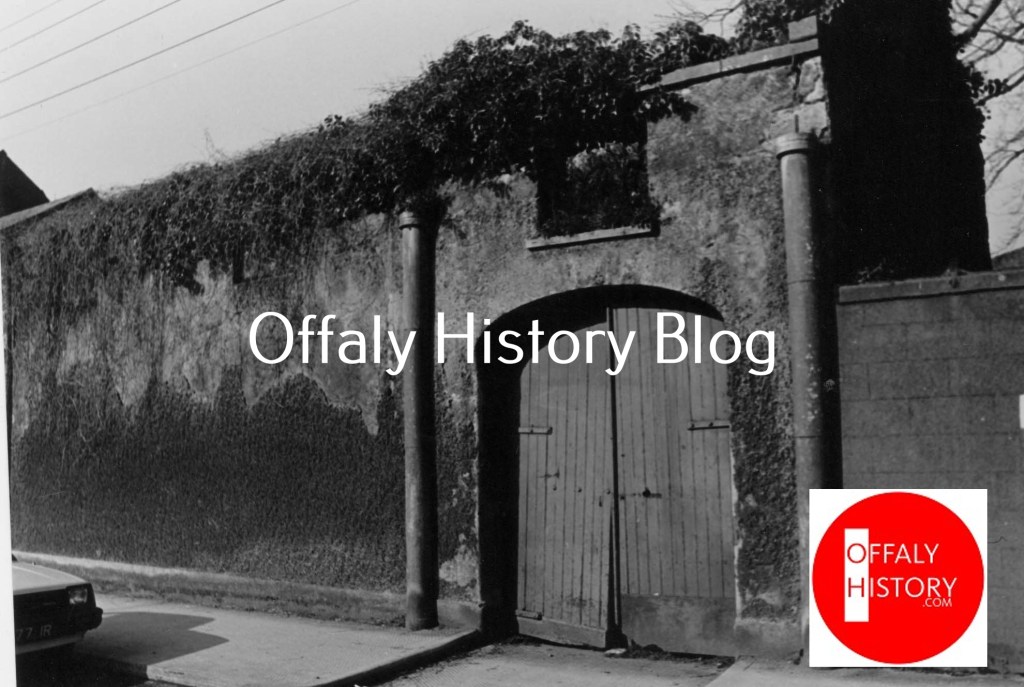
In the course of the renovation by Tullamore Urban District Council the small two-storey lodge with tall slender engaged columns and a facade inset under a hipped roof to the north of the house was removed. So also was the carriage arch on the south side which with its own tall, slender Doric columns sought to balance the lodge on the north side. The effect has been, it is said, to remove ‘later encrustations’ and to allow the house to stand alone, but for the lean-to wings, now suitably restrained to minimise their effect on the house itself. However, it was unfortunate that the wall on the southern side at the car park entrance is so bare and devoid of detail. The loss of the lodge house beside the Presbyterian church was also unfortunate. Of course the property is no longer residential and the building works of the early 1990s have completely removed the interior and the houses which now functions as offices with formerly a town council meeting chamber (now the Tullamore Municipal Council) which, because of its scale, is suitably intimate for smaller public functions and very different to the large lighted space in the new Aras an Chontae offices of the county council. The beech tree which can be seen in the older photographs was taken down in the 1990s.

Thomas Acres, 1755-1836, died aged 81
Thomas Acres was a remarkable man about whom little is known of his early life. He was in some way connected to Charles William Bury (1764–1835), earl of Charleville and was from the south Offaly/ north Tipperary area as was Catherine Sadleir (of Sopwell Hall), the mother of the town’s landlord from his youthful inheritance in 1764 when only six weeks old. Thomas Acres was born about 1755 and was a son of Adam and Sarah Acres (née Whitton) of the Roscrea area. Acres married about the year 1796, when he was 41, Elizabeth Slator of the Wood-of-O, Tullamore. His wife brought £800 to the marriage and one moiety of the profits of lands at Aghananagh, Rahan, County Offaly. There were five children of the marriage of Thomas and Elizabeth Acres but only one daughter Ellen survived.
The family plot is at the old Lynally cemetery near Tullamore and recites:
Here lies the remains of Elizabeth Acres, daughter of Thomas and Elizabeth Acres of Tullamore. Departed June 1823 aged 21 years. Farewell blessed child, thine earthly warfares oer, And thou safe landed on that blissful shore, where pain and sorrow thou shalt know no more. This monument is erected to the memory of Thomas Acres Esq died 31st October 1836 aged 81 years. The memory of Mr. Acres will long live with the inhabitants of Tullamore and its vicinity. His unbounded charity will not soon be forgotten by the poor of the town and it may with truth be said that his long and prosperous life was devoted to the benefit of all around by whom his loss will be irreparably felt.
Here intered [sic] are the remains of Adam Peter Acres and Anne Acres who died infants. Also Rebecca Jane Acres died 20th April 1809. She died in her 10th year much regretted children of Thomas and Elizabeth Acres of Tullamore.
To the memory of Mrs. Elizabeth Acres relict of the late Thomas Acres of Tullamore who died 6th March 1839 aged 73 years. Full of years of good works, and of the fruits of the spirit she resigned her soul into the hands of her redeemer knowing in who she had believed.
Thomas Acres died on 31 October 1836. His will, dated 8 April 1831 and to which he subsequently added three codicils, has survived. His properties were left in the hands of trustees, Adam Acres of Roscrea and George Pierce of Tullamore (his son-in-law) in trust for Elizabeth Acres, his wife to pay her £200 a year out of estate lands. A life interest in Acres Hall and its furniture he gave to his wife and he gave his daughter, Ellen Pierce, an annuity of £150. Subject to these payments of £200 to his wife and £150 to his daughter the remainder of his personal property was to be invested in government securities to accumulate for the benefit of the children of Ellen Pierce and to be shared among them equally on attaining twenty-two years of age. The houses and lands were to be divided between them except Acres Hall ‘which I hereby desire to be retained in the possession of the eldest son of my daughter after her death’. The terms of the will and its injunctions was such that his children were forbidden to alienate the property so as to prevent its being ‘frittered away’.[4] Such wills nearly always provide plenty of work for solicitors long afterwards.

‘Popish’ Attack on Lord Tullamore in the chapel grounds
Acres had intended to bequeath a yearly donation to the poor of the parish of Tullamore and Lynally, but this was revoked under the codicil to his will of December 5th 1832 because of ‘the vile and false calumny and rascally attack made on Lord Tullamore by popes, priests and people and on the very spot his father in the most munificent manner gave them for a place to worship as well in every other aspect his lordship gave the most honourable encouragement to all classes on his estate seeing the base ingratitude and vile disposition of these people towards him and many other respects my feelings compel me to revoke this part of my will wherein I bequeath a yearly donation to the poor of the parish of Tullamore and Lynally.’
His will also makes reference to disgraceful speeches of the popish party against my Lord Charleville and his family in the chapel yard, at the time of the December registry (of voters, presumably in 1832). The reference to Lord Tullamore is that to Charles William Bury’s only son who took a considerable interest in politics and was for a time an M.P. The church was that built c. 1802 on the site of the present church in William Street.
Acres had the benefit of a short obituary in the Leinster Express:

His superior position in the town of Tullamore is clear from the ranking published to call a public meeting to thank Lord Tullamore for his exertions in securing county town status for his property in 1832.
Elizabeth Acres, the wife of Thomas Acres, died on 13 March 1839 and her only surviving daughter, Ellen, died on 25 September 1860. Ellen Acres married George Pierce of Gayfield, Tullamore, a doctor and who was the son of George Pierce of Gayfield, a solicitor (admitted 1789). George Pierce M.D. was attached to the King’s County Infirmary at Church Street, Tullamore from his appointment in 1817. He and Ellen Acres had ten children – that is, four sons and six daughters. George Pierce died on 31 January 1859 and bequeathed all his property to his wife and children. He had accumulated additional property over that of his father-in-law, Thomas Acres, including four of five houses in Cormac Street between the council yard and the courthouse and property in O’Connor Square. At the time of Ellen Acres Pierce death in 1860, nine children had survived and six had attained the age of twenty-two years and were allotted their respective shares of the estate. At the time of the death of Ellen – the total amount of money in the settled property fund amounted to almost £5,000.
[1] MS valuation, Tullamore, 1843, no. 520. Curiously for the best house in town it was the last in the list for Tullamore town at no. 520, but ahead of four properties in the townland of Puttaghan.
[2] Registry of Deeds, 13 January 1790, Bury to Acres, 552/316/366407. A date-stone is set into the back wall of the house. Some other modest decorations at the back of the house such as urns and loaves were stolen from the house in the period of its neglect in the 1980s. The late David Egan in his blog in this series on 7 Nov. 2020 recalled: ‘The date stone for Acres Hall, which was set into the wall above the garden entrance to the conservatory, reads ‘Spes Tutissima Coelis Thos Acres 1786’, and below in English, ‘The Safest Hope is in Heaven’.
[3] William Garner, Tullamore: Architectural heritage (Dublin, 1980).
[4] National Archives, will of Thomas Acres, T. 12873; the gravestone inscription is from Lynally and was published in the booklet on that cemetery.

To be continued next week.
 offalyhistoryblog