
This article is not about the fashionable ‘Chopped’ clean food eateries. Instead, it concerns what was fed to our horses, in particular, before World War 1. That was a time of increasing use of motorised transport and less of horse-drawn vehicles. It was in 1904 that Motor Registration was introduced in Ireland, the War began in August 1914 and by 1924 the Goodbody Chop business in Tullamore was gone. Now read on in this our new Anniversaries Series. Our thanks to Michael Goodbody for this contribution to our blog series. You can find almost 650 articles about Offaly History on our website, http://www.offalyhistory.com. If you wish to write an article contact info@offalyhistory.com. Our blogs get 2,000 views per week.
Nineteenth century towns and cities were alive with the bustle and noise of people going about their daily business. Sometimes overlooked are the thousands of horses that were needed to support all this activity. Before the invention of the motor car horsepower was what drew cabs, coaches, heavy goods carts and light passenger vehicles. A city such as Dublin probably contained up to 20,000 horses and ponies.[1]
Feeding and watering these animals was a constant requirement. Horse troughs were ubiquitous and provided drinking water, but less easy to deal with was the constant demand for fodder, usually contained in a nose bag. Having one large enough to hold sufficient hay or oats for a day’s work was a problem and created the demand for an alternative which could be fitted into a smaller container.
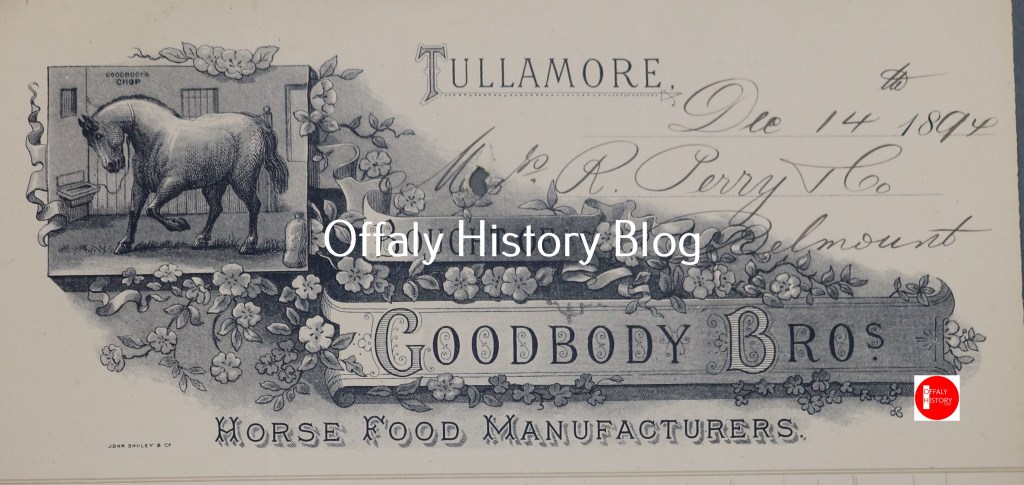
One such product was developed and made in Tullamore by the Goodbody family, who had a sizable grocery shop, a steam sawmill and an agricultural supplies business located in Charleville Square. T.P. & R. Goodbody started to advertise their ‘Chop’ at the Steam Mill and were also taking orders at their tobacco factory at Harold’s Cross, Dublin in December 1892. The firm claimed that by feeding a horse on their product ‘you save 25 per cent’ and ‘no Hay or Corn loft’ was needed.[2]
The following year a separate partnership known as Goodbody Brothers was formed and ‘Goodbody’s Chop’ was marketed extensively in local newspapers such as the Leinster Reporter, the Midland Counties Advertiser and the Dublin Evening Telegraph. The name chosen was a little curious and imaginative since only three of the partners, Albert, Marcus and James Perry Goodbody from the Inchmore, Clara family were brothers. The firm also included their cousins, Richard Goodbody of Clara House and Richard Henry Goodbody of Tullamore. All of them had existing business connections with the area so the forage business was a useful and profitable sideline. It was financed by M., J. & L. Goodbody of Clara and, under an unspecified side agreement, James Perry and Richard’s share of the profits went to Marcus.[3]
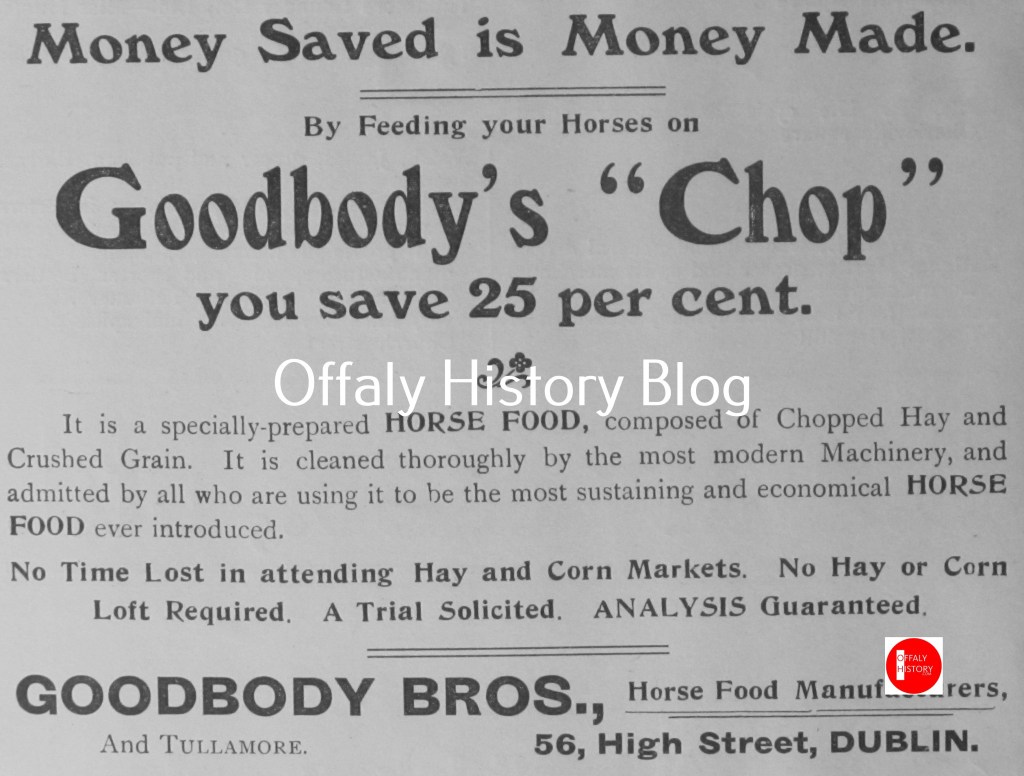
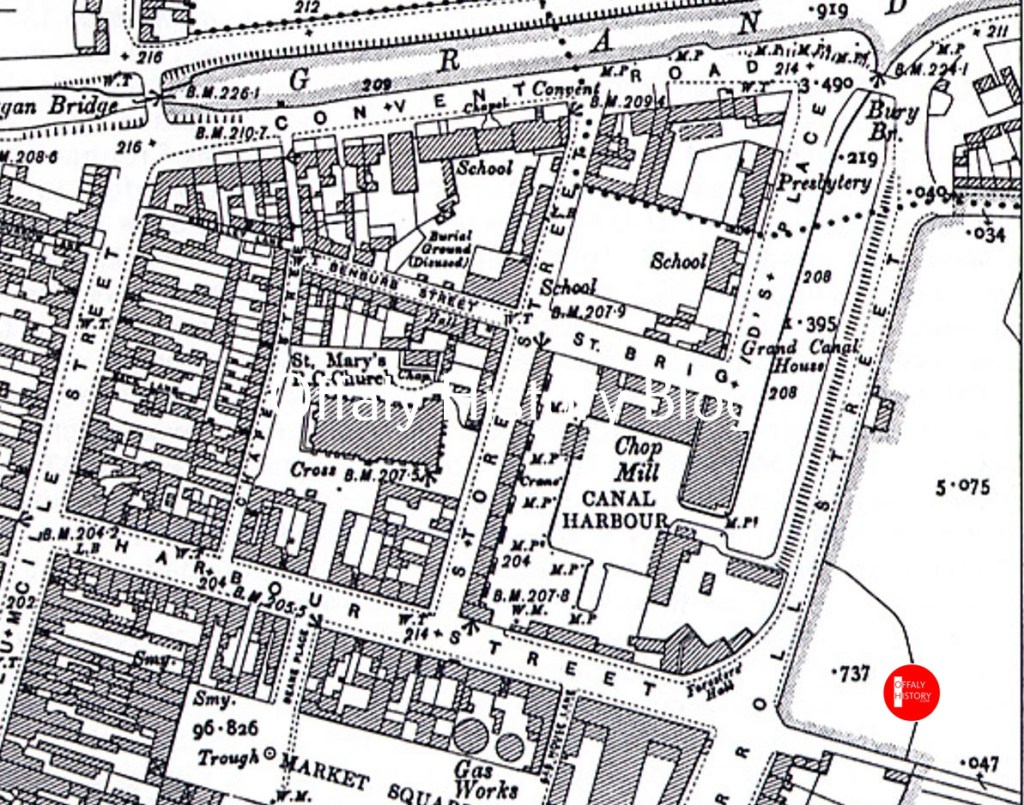
The Tullamore operation was based at Canal Harbour and an outlet opened in Dublin at 56 High Street in 1893. The fodder, which was made up of 35% cleaned hay and 65% grain was packed in bags and sent by rail or canal. The ‘grain’ element consisted of crushed oats, maize, beans and peas and the firm helpfully provided a recommendation for how much should be given daily to different types of horse: ponies or cobs 14 to 16 lbs., harness or light dray horses 20 to 24 lbs. and heavy dray or float horses 28 to 32 lbs.[4]
The firm also had ambitions for the English market, using the tobacco company’s warehouse in Cardiff as an outlet in Wales. Their stand at the Cardiff Horse Show in September 1893 was favourably reviewed by the Western Mail, which helpfully stated that ‘Messrs. Goodbody guarantee the analysis of their feeding stuffs, and purchasers are therefore certain to get good value for their money.’[5]
In Birr the Chop was sold by a less successful cousin of the partners, Eustace Wallace Goodbody, who in 1904 had a hardware and coal business on the Green. Eustace probably thought that advertising it as one of his products would enhance his business, which a few years later was in trouble. In 1911 he died of dropsy and was declared bankrupt.[6]
However, the principal market was clearly Dublin, where the firm had a stand at the Royal Dublin Society’s Spring and Winter shows in 1904, 1905 and 1906. Goodbody Brothers exhibited their ‘chop’ as well as their own ‘Paragon’ mixture. At this time, they were also acting as agents for E. Criddle of Liverpool, makers of ‘Alcorn Sugar Feed Meal’, used by horses and other farm animals.[7]

There may have been some difficulty in obtaining grain during the war years, as the firm were advertising for ‘Black and White’ oats at Tullamore in 1916. In Dublin newspaper advertisements stated that customers could have their own oats or barley crushed.[8]

Demand for the ‘Chop’ continued until shortly after the first World War, when cheaper motor cars and lorries quickly replaced horse-drawn vehicles. The business was gradually run down and came to an end on the death of the last of the three brothers in 1923. Apart from newspaper advertisements, few other records of the business or its employees remain. James Perry and Richard Henry Goodbody were responsible for it, and it is known that the manager for many years was a member of the Haines family.[9]
[1] This estimate is based on the figure of 300,000 horses in London, which had a population of five million in 1901.
The Irish census gives the Dublin population at 290,000 in that year.
[2] Evening Herald 7 December 1892.
[3] J. Harold Goodbody and Michael Goodbody (editors), One Hundred Years of Clara History, A Goodbody Family Perspective (Tullamore, 2021) p. 285.
[4] Westmeath Guardian and Longford Newsletter 27 September 1901.
[5] Western Mail 14 September 1893.
[6] Leinster Reporter 20 August 1904, advertisement.
[7] Irish Times 7 December 1904 and 18 April 1906.
[8] Leinster Reporter 9 December 1916 and Evening Irish Times 25 August 1916.
[9] Midland Counties Advertiser 30 September 1937. An obituary for Mary Haines, whose husband had predeceased her, stated that he had managed ‘Goodbody’s chop yard’.
 offalyhistoryblog