
The political machinations surrounding the transfer of the assizes (since the 1920s the High Court on circuit) to Tullamore, involving as it did the passing of an Act of Parliament in 1832 declaring it to be the place of the assizes (read county town) in place of Daingean (Philipstown) is a story in itself that goes back to when Daingean was created the county town as part of the Laois Offaly plantation project of the new colonists in the mid sixteenth century.
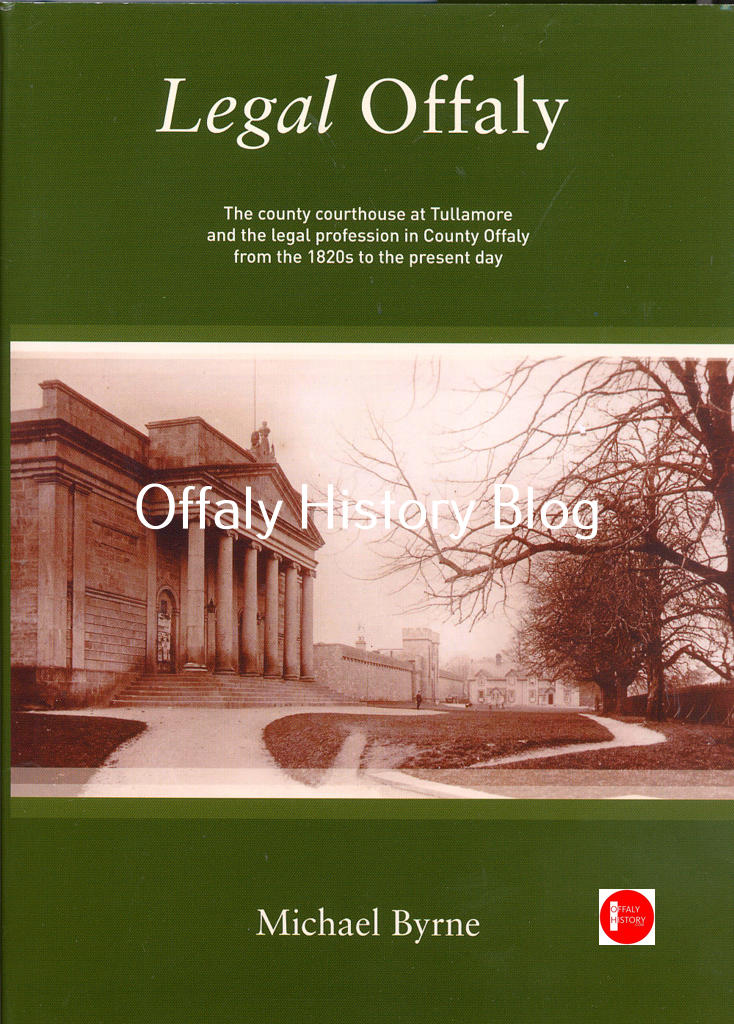
It is intended in this article to look at the architectural history of the Tullamore courthouse. The sites at Cormac Street, then called Charleville Street, for both jail and courthouse had been reserved by the ground landlord since the 1810s. The foundation stone of the jail was laid in 1826 (see earlier blog), and work on the courthouse commenced in 1833, and it was completed in time for the summer assizes in 1835. The securing of the jail and courthouse for Tullamore was the culmination of efforts on the part of Lord Tullamore and his father, Charles William Bury, earl of Charleville, to secure the long merited and long denied county town status. This came with the holding of the assizes and having a county jail.
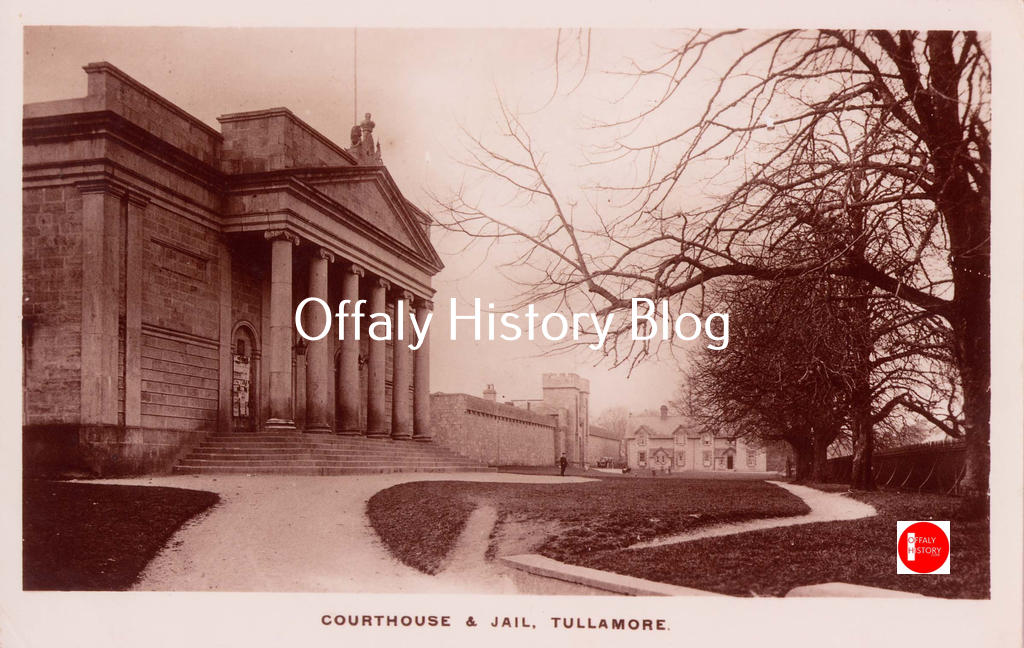
Garner (1980) wrote:
[The courthouse] is set back from the road behind a battered wall, topped by heavy railings, and a row of mature trees. The main feature of the buildings is a splendid portico of fluted ionic columns with a parapet and acroterion over the pediment. Under the portico are five round-headed arches, the centre three with doorcases. The doorcases have no windows over them, but there are windows over the outer arches. Flanking the portico are blank walls, channelled on the ground floor and sunken panels on the first floor. The walls of the wings facing the road have fine pedimented windows on the ground floor and architrave windows on the first. Since there are so few windows on the facade the building looks forbiddingly impressive. The returns of facades, of seven bays and two storeys’, have more incidents. The centre three bays are slightly recessed, with cornices over the ground floor windows, then single bays, Doric pilasters and further single bays flanked by pilasters which terminate the facade. The whole building is unified by a full entablature. See also Andrew Tierney, Central Leinster (2019), pp 622-24.
The commissioners for the building of a new courthouse at Tullamore were appointed by the King’s County Grand Jury (the oligarchical predecessor of the county council and largely comprised of the county’s leading landowners) in 1829. In order to finance the project it was necessary to obtain a loan from the central government and application was made to the lord lieutenant in the same year. The case made out in the loan application was similar to that which had been used when a loan was sought to build the Tullamore jail in the mid-1820s:
Philipstown, it was said, was an unsuitable place to build because of its remote location, want of accommodation and the boggy hinterland. Now there was an additional argument that transferring the prisoners from the courthouse at Philipstown to the jail at Tullamore (by canal boat) would be cumbersome and expensive. It was also stated that the Philipstown courthouse, built about 1807, was constantly in disrepair.
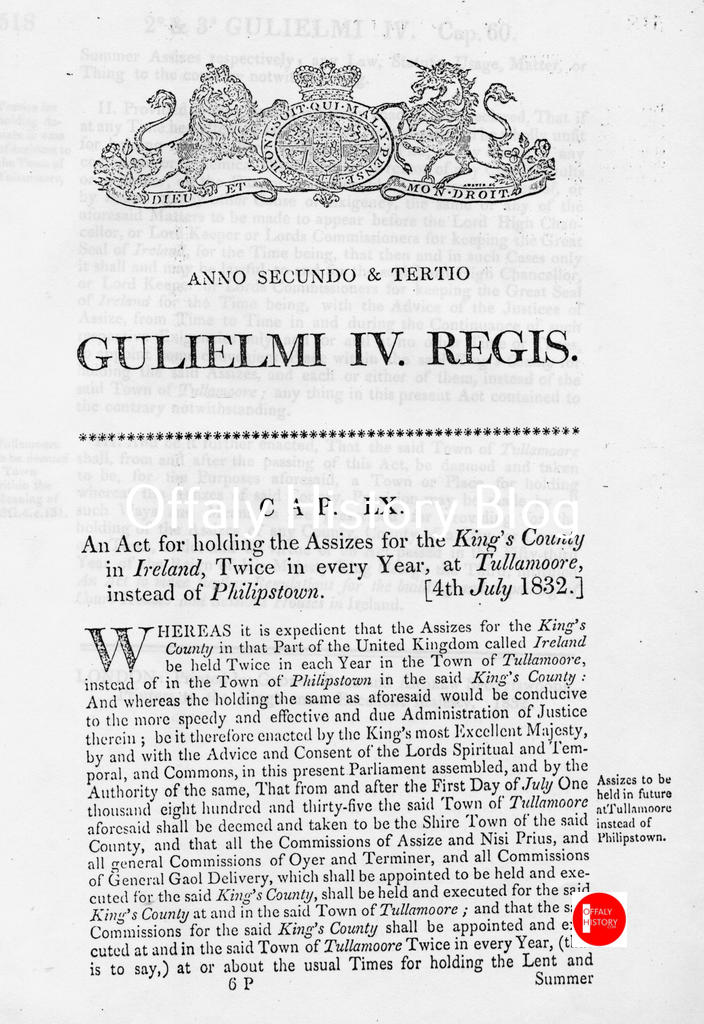
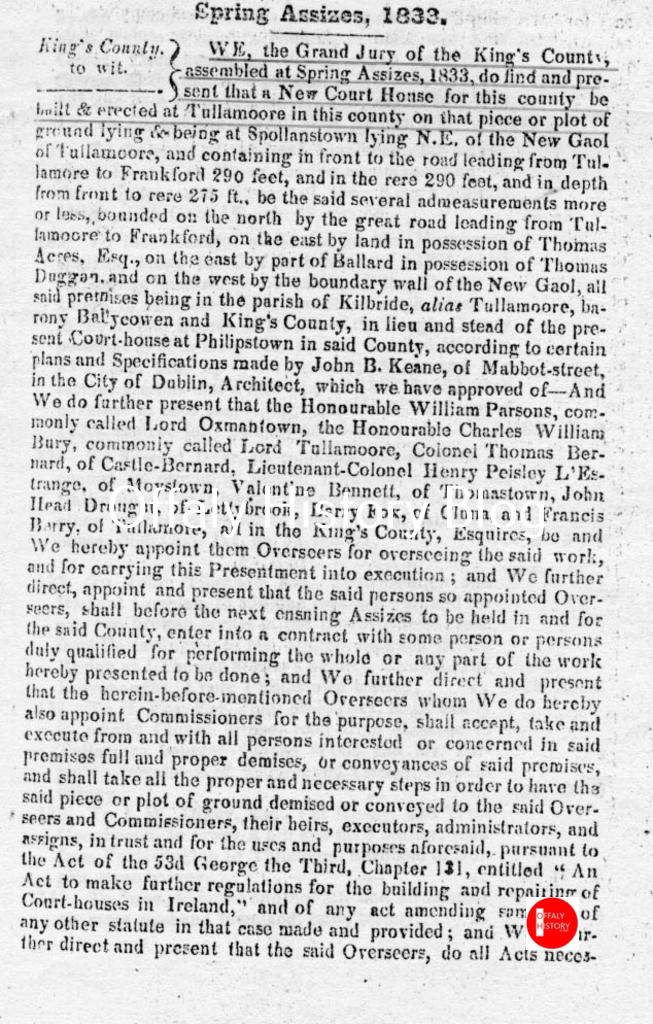
At the Lent Assizes of 1830 it was announced that the Lord Lieutenant “concurs with the commissioners as to the advantage of removing the courthouse from Philipstown.” But as the opposition of the Ponsonby family, the owners of Philipstown, to the removal of the courthouse and assizes had to be overcome, and a parliamentary Bill legalising the assize transfer prepared, it was not until 1833 that the money for the building of the courthouse was voted by the Grand Jury. The sum of £9,890 was advanced by the Commissioners of Public Works and this was repayable by the county over a twenty-year period. The presentment at the Spring Assizes of 1833 named John B. Keane as architect and Henry & Mullins as contractors.
Keane’s design for Tullamore was awarded first place in a competition for the design of the new building which exceeded twenty candidates. Among those who submitted designs were W.D. Butler (awarded a premium), William Murray and William Vitruvius Morrison. Morrison had designed the courthouse at Tralee (1828) and Carlow (1830) both in the Grecian style. In his designs for both courthouses Morrison seems to have followed Sir Robert Smirke’s Gloucester courthouse. At Gloucester Smirke had provided access to semi-circular court rooms from corridors surrounded them and Morrison followed this design at Carlow and Tralee. Keane had competed with Morrison at Tralee and Carlow and now at Tullamore he beat him with a design very similar to Morrison’s own. Besides this the commissioners for building the courthouse at Tullamore seem to have agreed that it was a design similar to Smirke’s Gloucester that they wanted. Lord Tullamore, one of the commissioners, in a letter written from Bath to Lord Leverson-Gower, the Chief Secretary, in November 1829 stated: ‘I have been at Exeter and shall visit Gloucester courthouse, on my road to Ireland, for the purpose of adopting all the latest improvements.’ The point was reiterated by Francis Berry, agent to the Earl of Charleville and a commissioner, in a letter to William Murray of 15 November 1832: ‘the overseers think the plans of Gloucester (and Kerry courthouse) a good model, lately erected by Sir Robert Smirke.’
Other courthouses by Keane
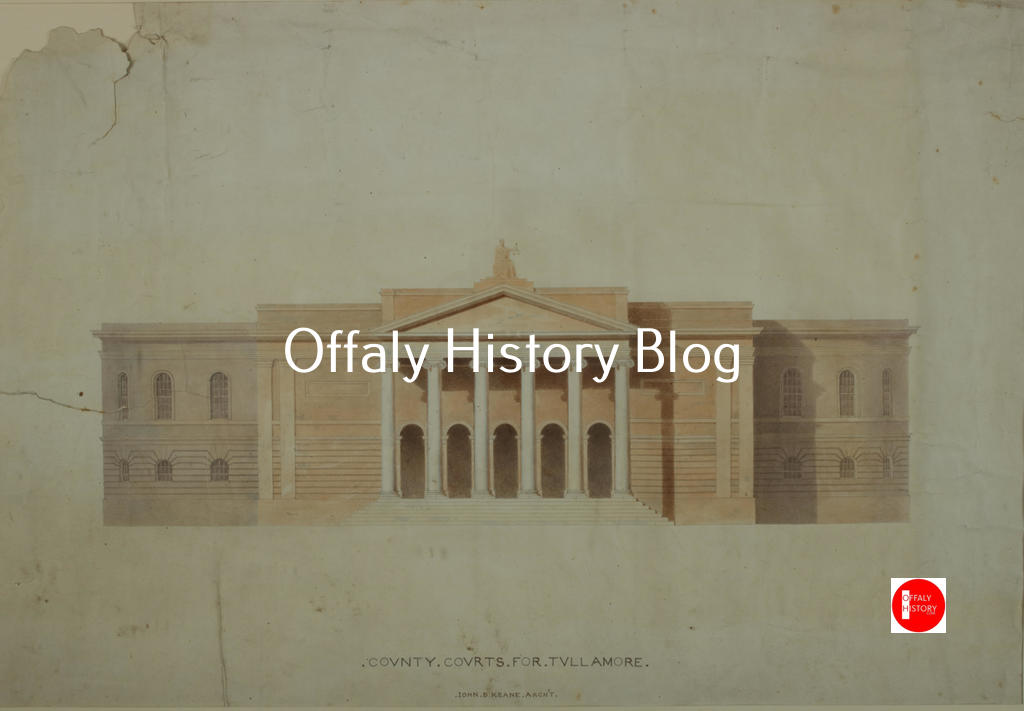
Keane later designed courthouses for Nenagh (1833-), Ennis (1845) and Waterford (1849), all in the Grecian style. Regarding architectural drawings of the courthouse at Tullamore only one is held locally – a front elevation, signed by Keane – was known to survive and was lately donated to Offaly Archives. Another set of drawings was discovered in Lismore Castle, Waterford in 1989. Copies can be seen in the Irish Architectural Archive.
The courthouse was burned by the Republican IRA in July 1922 during the wasteful Civil War. Restoration and rebuilding began in 1925. The architect T.F. MacNamara (he had designed the Catholic church in Tullamore (1906), Scally’s (1912) and the Foresters Hall (1923) ) did not adhere to the original ground plan and only one of the semi-circular courts was retained. The new courthouse was formally opened in June 1927. It was the first public building in Tullamore since the workhouse was completed in 1841. The churches and the market house were all privately owned as was the barracks. All three buildings – barracks, jail and courthouse were destroyed by the Republicans in departing Tullamore in July 1922.
The public room in the new courthouse, so much praised at the opening in 1927, was used among other things, as a dance hall until its destruction by fire in February 1960. Subsequently, this area was converted into offices for the county council.
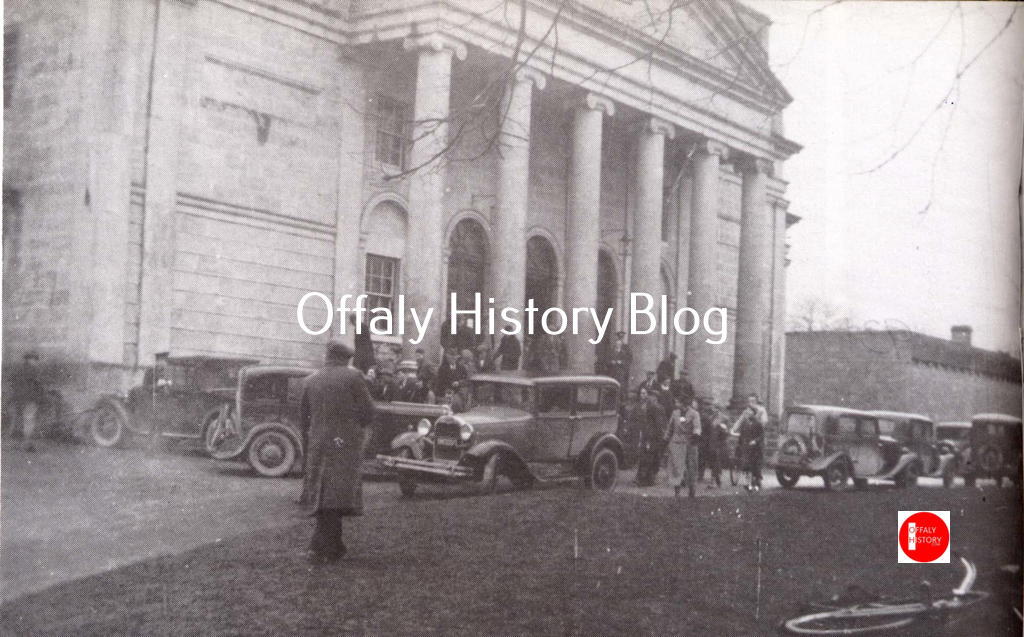
Substantial funds were spent on upgrading the courthouse in the 1970s and 1980s. Due to the continuing demand for office space a temporary building for the Planning Section was added to the rear in the late 1990s. In the context of the council’s own planning policies on the preservation of historic buildings this must have been something of an embarrassment as the courthouse was a grade 1 listed building and of national importance. On the appointment of Niall Sweeney as County Manager in 1997 it soon became articulated policy that new county offices would be built. In 1998 a three-acre site was acquired at nearby Elmfield, on Charleville Road for £1million and work on the new building were completed in September 2002 at a cost of c. €21million. The courthouse link with the administration of the county for 167 was severed.
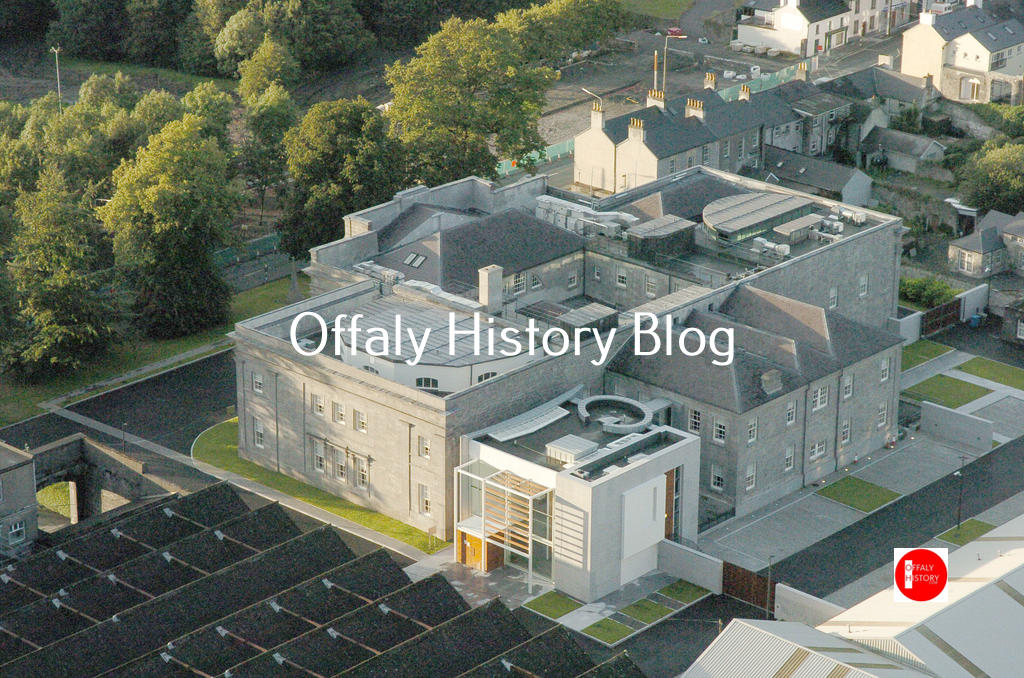
The Courts Service set about modernising the old courthouse so long used mostly for offices for the council staff while at the same time respecting the building’s architectural integrity. Work on the plans commenced in 2002 under the supervision of Newenham Mulligan and Associates Architects and completed in phases over four years. The greatly improved building was formally opened in 2007. The work was all completed before the banking crisis of 2008–10 and the subsequent recession. The Birr courthouse was not so lucky and after much planning the renovation project there did not proceed. The courts held at Birr for several hundred years were transferred to Tullamore. The Birr courthouse is now to be an arts and community hub but funding of upwards of €5 million will be needed and will have to be found by the council as the Courts Service did not endow the building prior to departure in 2013.
The Tullamore courthouse is the finest of the older public buildings in the county. Perhaps the county hospital would fall into the contemporary category. Perhaps the courthouse and part of the old jail (the façade area) could be open to the public for tours once a month during the summer. Both are in such good order. Want of ready money prevents the county from taking on major tourist projects such as Durrow Abbey (in state ownership) and Charleville Castle (privately owned). A start has been made with the plans for the Tullamore Harbour and Tullamore town centre Regeneration. In the meantime the Rosse family have done great things for Birr Castle and demesne to preserve the house and park and support tourism. At the street and village level we could do more: Kinnitty is following the lead of Geashill (both estate villages), but in our high streets there is so much to be resolved from The Cottage in O’Moore Street to the Mr Price building in High Street – both in Tullamore. Good tidings in Banagher also with the old hotel to be attended to and works in progress on Birr courthouse and St Brendan’s Church of Ireland. As Mark Girourard remarked sixty years ago Birr has a stellar collection of buildings.
Across the county the regulatory stick needs to be matched by the compensatory carrot if older buildings are going to be brought back into acceptable uses and transformations. There are good things on the horizon such as revamped Boora, Clonmacnoise Monastic Centre and a suggested new Turf Heritage Visitor Centre in northwest Offaly – the latter a Bord na Mona project with over 100 permanent jobs promised.
This brings to an end the Cormac Street and O’Moore Street series of seventeen articles supported by the Heritage Council. There are now over 650 blog articles, including detailed reviews of O’Connor Square and High Street (both in Tullamore) and Castle Street in Birr in the Heritage Council supported series. The series reaches more than 2,000 views per week. It has reached 94,000 views since Jan. 2024.

Comments and suggestions are always welcome and can be sent to info@offalyhistory.com attention Blog Contributors. Articles are also welcome and can be sent to info@offalyhistory.com
Midland Tribune 13 Feb. 1960
 offalyhistoryblog