The registration of motor vehicles began in 1904 and the early registers are now in Offaly Archives. In the period from 1904 to 1923 about 820 motorised vehicles were registered in Offaly. This would include motorised bicycles and some registrations from other counties. In the first year 14 motor cars and 20 motor cycles were registered in Offaly.[1] The Birr-based King’s County Chronicle published the first list in 1909 of 68 registered motor vehicles and commented:
In view of the fact that motoring has come to stay it will be of interest to publish a list of gentry in the King’s County, whose means have enabled them to add this new form of locomotion to their personal luxuries. Through the courtesy of Mr. C.P. Kingston, Secretary of the King’s County Council, we are enabled to place the full list before the readers. C indicates the four-wheel coach, and B the bike petrol machine. The code letters for this County are I.R. …. It should be added that there are several local owners in Birr not in this return whose registration is entered in other counties, for example:- Mr. Dunn-Pattison, I.K. 113; Dr. W.A. Morton, I.K., 357; J.W. Nolans, V.S. 8243; Captain Dalrymple, 10, 187; H. Gairdner, R.I. 853; Dr. D’Alton, R.I. 846; G.A. Lee, I.K. 236; J. Green, I.K. 237; C. Ludgate, R.I., 488; Captain Cowan, R.I., 542.[2]

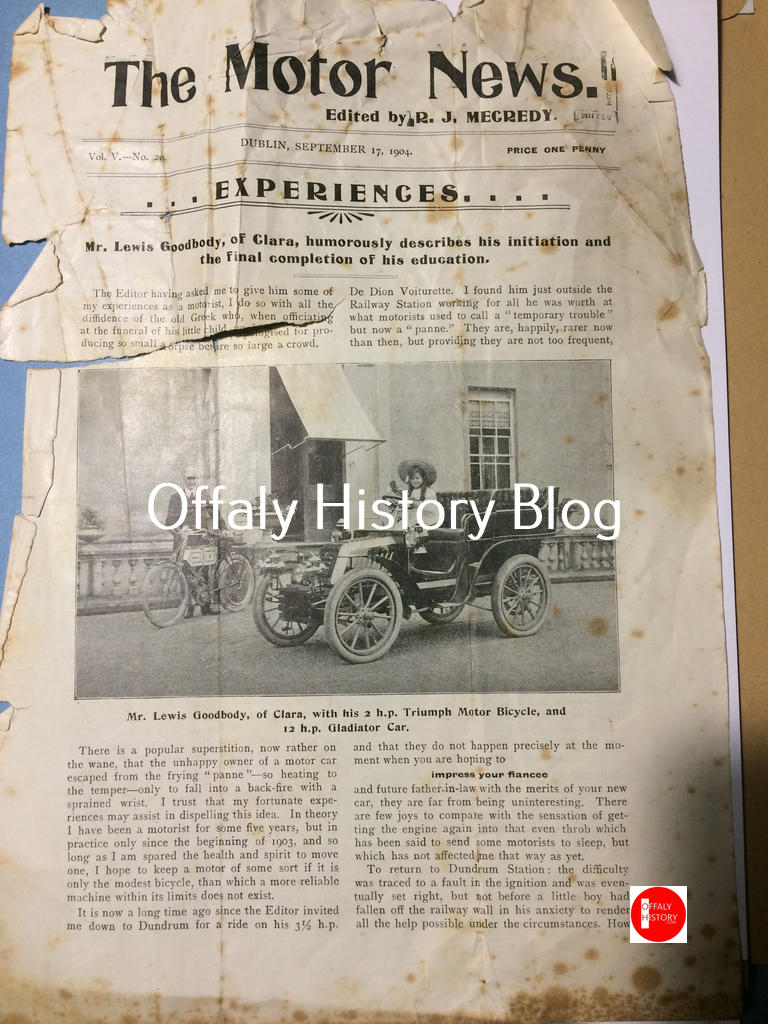
In the seven years to 1911–12 55 cars were registered and 49 motor-cycles. James Perry Goodbody (d. 1923), the leading Offaly industrialist had IR 1 while Eben Goodbody and Richard Goodbody has IR 4 and IR 5. Alesburys, M.P. O’Brien, Williams, Egan, Perry and other Offaly businessmen feature strongly in that list of 105 registrations and so also do clergy and medical men. The Tullamore hotelier James Hayes had IR 11. Mary Rait Kerr of Rathmoyle, Edenderry may have been the first woman registered together with a smattering of other gentry including Sir Andrew Armstrong, Clibborn of Moorock, Biddulph of Rathrobin, Reginald Digby of Geashill, Ruttledge of Woodville, Birr, Lord Rosse, Marshall of Barrone Court, Nesbitt of Toberdaly and Moony of the Doon.

The motor dealer R.H. Poole of Tullamore was in early with 1R 13.[3] His registration number may have been unlucky for Poole as his was said to be the first prosecution in Ireland for speeding. It was in 1909 and it was for driving beyond a safe limit at Aughnacloy, Country Tyrone, at a speed calculated to endanger public safety. Poole said he had nine years’ experience of motoring and admitted to a technical offence for which he was fined 10s. and 20s. costs with an endorsement on the licence.[4] One wonders about the first prosecution claim as in 1907 Richard Waller of Banagher, a ‘motor fiend’ was fined in Banagher for speeding in the streets of Birr at up to 20 mph on his motorcycle.[5] Another cycle dealer was Gilbert A. Lee of Castle Street, Birr who was registered with IR 101. An accident in the same year of 1907 saw George Eades of Townsend Street, Birr lucky to survive serious injury. The Midland Tribune reported:
Details of a serious motor accident have come to hand. It appears that on Monday evening last, shortly after eight o’ clock, as Mr. George Eades, of Townsend Street, Birr, was driving his cattle to a field, he heard Mr. Peter Nolan, carpenter, Pound Street, calling him to look out as a motor-car was coming. However, before he had time to attend to the warning, the car dashed into his stock, killing a cow, a calf, and a sheep dog. That no human lives were lost is simply marvellous, as the pony he was leading by the head was just grazed. Mr. Eades was swung round, the stroke injuring the left leg. The other man, who had shouted sustained a compound fracture of the leg. The car is a 30 h.p. Humber, belonging to Mr. F. H. Dunn Pattison, and whose chauffeur, J. E. Dolan, was driving into Birr. The chauffeur was charged at to-day’s Petty Sessions in Birr, and an important statement was made.

Tullamore had an early fatality with the death of Philip Reilly, a carter who was killed in 1911:
Mr. Coroner Conway held an inquest at Tullamore on Monday on Philip Reilly, carter, who died from shock, caused through being run over by a motor car. Mr. Harold Goodbody, Clara, said that he and his father, with some friends, were returning from Tullamore, travelling at 15 miles per hour. Some distance away they saw an object, which he recognised as a man, lying on the centre of the road. He turned to avoid running over the head, and the left wheels ran across the legs. He stopped the car and conveyed him to the infirmary where he soon after expired.[6]
Pleasure driving could also end up nasty for those concerned. Mr J. Egan of Tullamore was out driving with friends in April 1911 when it appears the brakes failed on their motor. This may have been James F. Egan of The Hall, Tullamore (now municipal council house) who was registered with IR 59.
Mr. J. Egan of Tullamore, and his motor party met with a serious accident on Thursday night. Accompanied by a son of Dr. Moorhead, and Mr. Murphy, Rathangan, he motored to Edenderry, where they asked Dr. Kinsella to take a run with them, but after passing Mr. Egan’s, gaining Carrick Hill, the motor ran down the hill, and coming against the wall, threw the occupants into a field. Dr. Kinsella’s arm was broken. Mr. Moorhead suffered concussion of the brain, had his left wrist bruised, and he got a cut over the eye, into which several stitches had to be inserted. The two others got ugly bruises. The injured were removed to Dr. Hamilton’s residence. It is feared Mr. Moorhead will have to undergo special treatment in Dublin.[7]
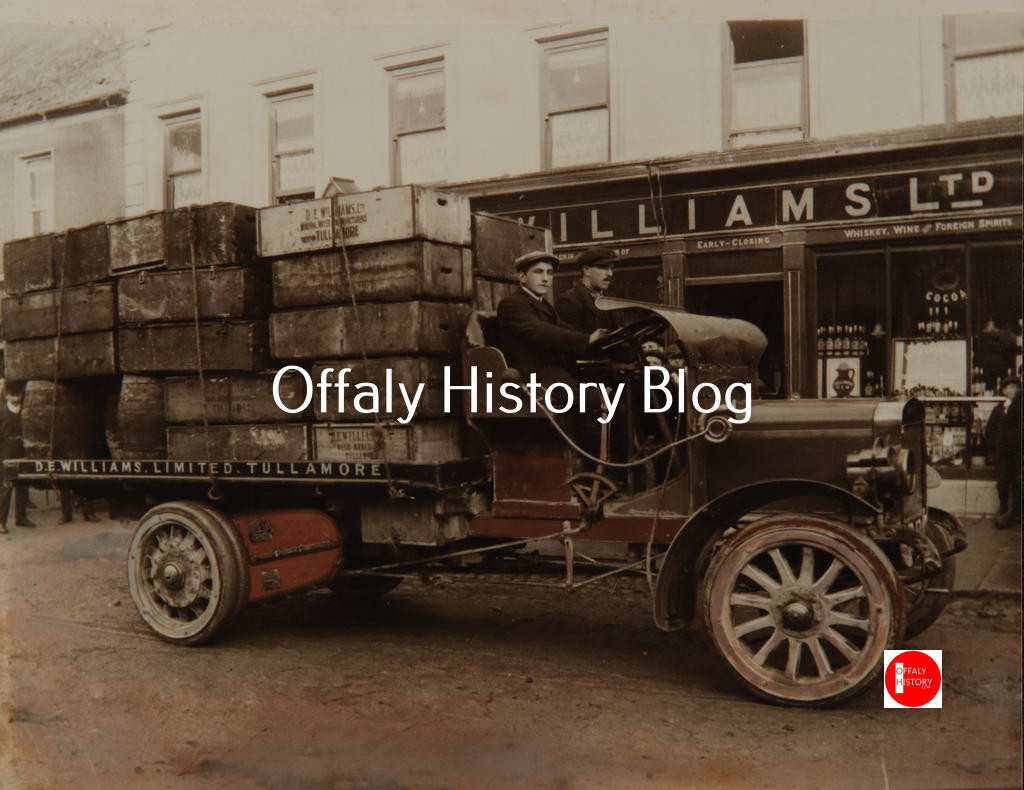
In the ten years before the war Tullamore had clearly made great strides. D.E. Williams was the first to introduce motorised transport to Offaly in 1898, the vehicle taking three hours for a trip from Tullamore to Birr. Both of the Egan’s and Williams’s firms mechanised with the adoption of the motor lorry, which initially their workers had objections to, but by 1916 was very much in use to serve their respective branch-shop networks. Thomas English, the Tullamore baker, was the first to introduce the motorised bread delivery van in the town in 1912. Hayes’ Hotel followed in early 1916 and even the Post Office was having mails delivered from a depot in Moate by late 1916.
The wartime restrictions on petrol use greatly reduced sales at Tullamore motor pioneer and Ford agent R.H. Poole who was selling Ford cars from £125 at his garage in Barrack/Patrick Street in August 1914.[8] It was the same for J.A. Kilroy who operated a car sales and car hire business besides his hardware and cycles in High Street until a disastrous fire in 1915. He reopened in 1916. G. N. Walshe was in pre-war days still in William/Columcille Street and he too had a motor hire business at the easy to remember tariff of 6d. a mile to include the driver. The transport of people by bus soon followed and in 1926 the motor dealer, George N. Walshe organised a daily service to Dublin via Daingean. Walshe had taken over the Poole business in 1920 and it survived until the 1980s. Some would utilise a motor car or taxi as with Irish Volunteer, Liam Ó Briain, who was sent from Dublin to Edenderry and Tullamore via taxi on Sunday 23 April 1916 to deliver instructions that the Rising had been called off.

From 1906 the motor lobby and business lobby were pushing for better roads and the growth of motorised traffic was making it essential. The speed of traffic was also a concern raised regularly at local council meetings and the Automobile Association was asked to assist with signage. But it would be almost fifty years more before the horse-drawn carriage of goods would terminate in either Tullamore or Birr. Lewis Goodbody organised ‘a roads conference’ in 1906 at his house at Drayton Villa, Clara (now owned by Offaly County Council) which the chairmen and representatives of the councils of Westmeath, King’s, Queen’s County and Tipperary were invited to attend.[9] It would be seven years more before action was taken on this project in Birr and Tullamore.
The steamrolling of roads in Birr and Tullamore began in 1913–14 with the advice of E.J. Hackett (of Ballycumber) who was the county surveyor in South Tipperary. It was pressure from the motor lobby that got this work started and the same grouping was active in their protests at the condition of the county roads in the early and mid-1920s. After a local government sworn inquiry in 1924 Offaly County Council was dissolved for four years and local government handled by a commissioner (see the chapter on local government and that on sanitation).
A writer from Birr mused on the declining appreciation of the pedal cycle in a letter to the press in April 1914:
It is evident from the number of motor-driven machines of all types, one meets on the highways at present, that the pedal-pushed cycle is getting somewhat out of favour. I don’t mean, however, that there are less users of this type than formerly, but that the number of such riders is not increasing at the same rate as ten years ago. The average rider at the present time thinks that a journey accomplished on a pedal-pushed cycle is not after all a thing to which much pleasure can be attached, and consequently, if his means permit, provides himself with a class of machine which gives superior speed without any serious exertion on the part of the rider. It is only a short time since road-racing was carried on about the Model Town [Birr] when some very fast times were accomplished on the push machines. Twenty miles in 54 minutes was done by Mr P. J. O’Donohue in competition. This famous rider had, however, to succumb to both H. Rourke and R. Drimmie who were conceded three minutes handicap. Still faster is the time accomplished by H. Rourke in 1898, when being placed on a tandem ridden by Messrs T. and F. Henshall from Banagher Church to Oxmantown Mall. This distance, eight statute miles, was covered in 19 minutes. In 1904 the same rider covered same ground unplaced in 19 minutes. This speed would represent over 25 miles in the hour and would render the driver of a car liable to a penalty for exceeding the legal 20 miles per hour.[10]

[1] King’s County Chronicle, 9 Feb. 1905.
[2] King’s County Chronicle, 24 April 1909
[3] Henry G. Tempest (ed.), The Irish Motor Directory and Motor Manual for 1911–12 (Dublin, 1912 ), pp 261–3.
[4] Bob Poole was one of the earliest motoring enthusiasts in the county, and his name is recorded with winning the second ever motor race organised in Ireland. That special event was held in the late summer of 1900 as part of the programme of the annual sports day in Portarlington – see Ronnie Mathews, ‘Some early car registration numbers’ in Offaly Heritage 4 (2006), 233–7.
[5] Midland Tribune, 3 Aug. 1907.
[6] King’s County Chronicle, 2 Feb. 1911.
[7] Ibid., 4 May 1911.
[8] Tullamore and King’s County Independent, 1 Aug. 1914; Byrne, Tullamore in 1916, pp 75–6.
[9] Michael Goodbody, The Goodbodys: millers, merchants and manufacturers, pp 323–4.
[10] King’s County Chronicle, 23 Apr. 1914.
 offalyhistoryblog