
The recording of my mother Josephine was made in 2006 as part of my research on local history and my mother’s interpretation of it. At the time, little did I know the significance that it would have, not just from a local history record perspective but also in a deeply personal context.
Our family connection here in Tullamore began in 1923, when a young Dublin native, Josephine Moore came to work at McCann’s as a housekeeper. This building later became the Tullamore Enterprise board ( now occupied by Jigsaw) Cormac Street. She married William Gorman, a local man. My mother, also called Josephine, was born in 1928. Mum left school aged 14 and she would have been the first to admit that she lacked a proper education. In those unkinder days, walking to school barefoot and being put to clean up in the home economics room by the nuns after the wealthier girls had cooked was all too often a regularity. She would have liked to have had a career as a nurse she often said.

After working at Dr Moorhead’s home as a kitchen aide and acting as the parental head of the family looking after her brothers and sisters whilst her mother, my nana Josie, was at work at the county hospital; my mother secured a job at Salts factory in the 1940s. She seemed to enjoy working there very much. She loved the social aspect of the workplace and also going to the cinema and dancing. Dancing became a shared love and connection that brought her and my dad, Frederick, a proud Londoner, together when she left Ireland in 1947, to seek work in Southern England, as so many of her contemporaries did in that period.
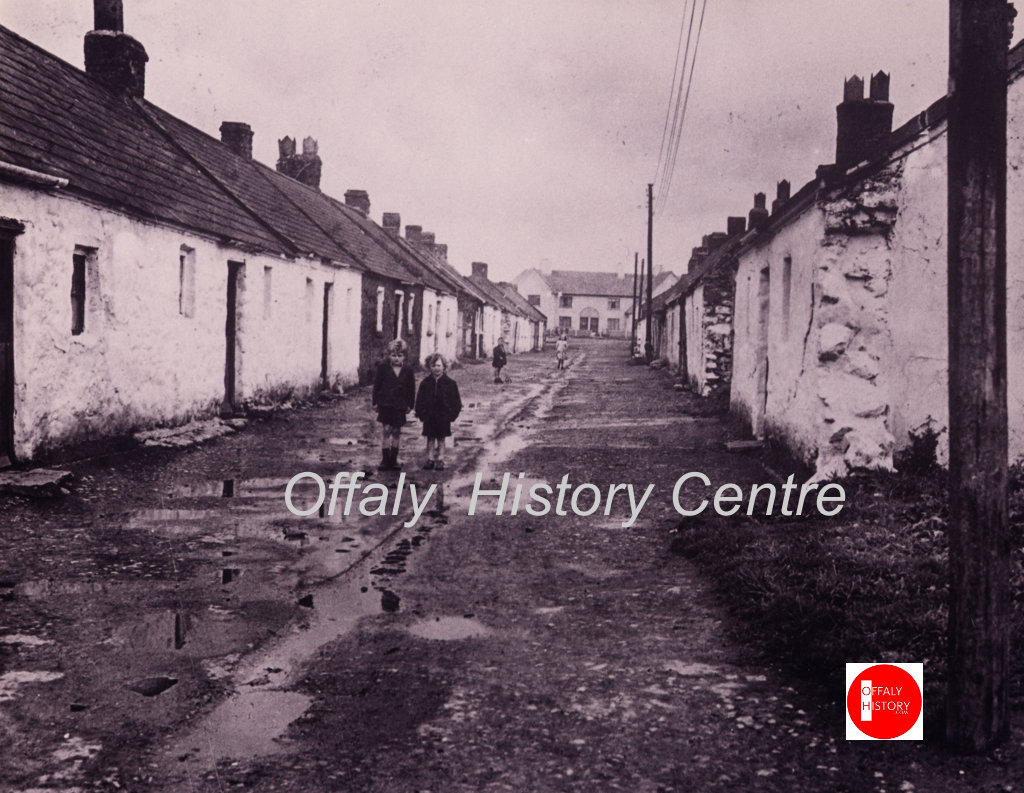
This recording is my mother’s experience and memory of growing up in Tay Lane, a place that no longer exists physically, yet at one time was a central area within Tullamore where many families lived. It was one of the slum areas that Dr Moorhead effectively managed to eliminate in Tullamore as part of his social work. My mother remembers a water pump situated in Kilbride Street, talks about the typical furnishings found in the house and of her memories of the area at that period.

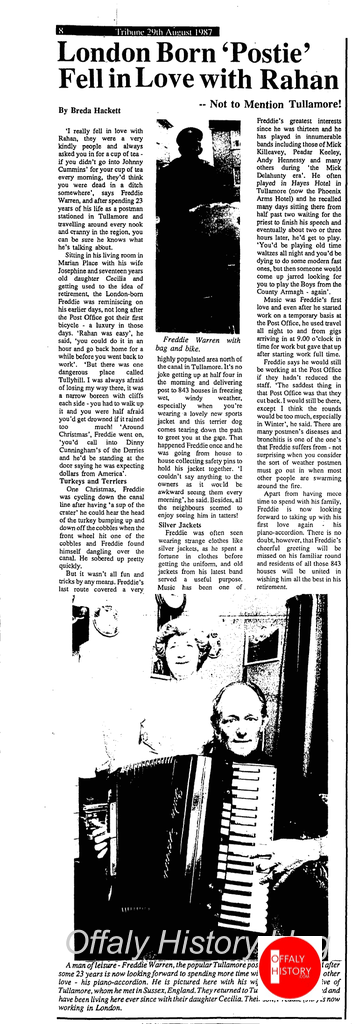
I want to say a few words about the personal significance of this recording. On returning to Ireland, my mother and father later moved in 1954 from O’Brien Street to Marian Place, a new council housing development and brought my nana Josie to live with them. They spent over fifty very happy years here and raised two children, first my brother Freddie and then 16 years later, I arrived! My father was a gifted musician who played trumpet with Andy Hennessy’s band in Kilbeggan whilst holding down a daytime position as town postman, a job he really loved and carried out for 23 years. He was known as the “flying postman” because of his punctuality on a daily basis. He was a hard worker and a wonderful family man. My parents had a great social life and enjoyed social dancing in the Harriers at the weekends. My father spent a period working in Ken Roberts’s garage at High Street in the 1960s and I found a work reference which I never knew existed in his wedding bible after his passing. Another interesting record of that period. My father retired from the post office in 1987, and he recounts his experiences in a Tullamore tribune piece that was written at that time. Newspapers, we must remember still remain another valuable means of memory capture despite the advent of this digital and AI age.
As the years passed, sadly our family suffered personal tragedy. My brother, Freddie died in England aged 46 in 2000 from a brain tumour. My father later developed atrial fibrillation, COPD, dysphagea, vascular dementia and then passed away from skin cancer in 2022. My mother developed a myeloproliferative disorder controlled by oral chemotherapy and then was also diagnosed with dementia shortly before she passed in 2020.
Luckily, before their passing, I had the foresight to record my parent’s memories and special messages in a diary which has proved to be a wonderful legacy for their granddaughters, Annaline and Hayley. Recording memories and thoughts is a process I strongly urge anyone to act on sooner rather than later. I am so grateful that I had that foresight. When I think of all the illnesses my parents experienced, personally, dementia was the very worst. It robs people of the essence of who they are and of their memories of loved ones and life. We, who are left behind when they pass, experience many emotions as anyone has been bereaved will identify with. But for those who have lost loved ones particularly to dementia and its devastating effects, there is a sense of something very precious and wonderful having been taken from us forever.
When I rediscovered the recording of my mother’s reminiscences after she passed, it really was a wonderful sense of getting her back. It made me realise the huge power of memory, the importance of making records in digital or oral form that capture the essence of our loved ones as they once were, whilst they are capable of remembering, before that too is lost to the ravages of disease or time.
This recording is now my mother’s wonderful gift to her remaining family and relatives and the town she and her husband called home. It is a firm legacy that now lies in the worthy hands of our local Offaly Historical Society. The fact that this will endure now as an valuable archive record of Tullamore spanning the 1930s to the 1950s, a period of which we are just starting to really understand, is fantastic.
My father used to say “life is like a garden if you put good things into it you get good things out”. I’d like to think that this valuable piece of oral history is one of those things. It defies terrible illnesses that tear apart family bonds and steal our loved ones. These valuable, unique records preserve our family’s wonderful spirit and memories and ensure their presence endures as we so desperately want them to. They are a poignant and accurate piece of social history, a time that will never ever come again and, in my opinion, they also are our family’s cherished gift and legacy to us – the infinite, truthful essence of who they once were.
Thank you very much.
Josephine Warren – ‘Tay’ Lane, Tullamore from the recording of 2006 with thanks to Cecilia Warren for making it available and to Aidan Barry for his technical assistance. To hear the recording go to http://www.offalyhistory.com or google Offaly History Sound Cloud where there are now twelve recordings including that of the late Josephine Warren.
Introduction:
This is a recording for my local history project for the Cultural and Heritage Studies course, 2005 to 2006. The subject is Tea or ‘Tay’ Lane, also known as Barrack Lane that existed in Tullamore, County Offaly and this interview is with my mother, Josephine Warren.
Mammy, can you tell me about ‘Tay’ Lane? What you remember about it? Where was it located?

Well, it was located in near …..??? the canal, you know, up there. As you’re going up towards the Bond store and all up there, you know.
Yeah.
The canal was there. Yes. Yeah, yeah.
And, was it a long lane? Was it very long?
It was, I don’t know how many houses that was in it.
I know from my research it’s 37 houses. Yeah. About that
And, your father lived. Your family lived in one of the houses. I think it was number 35. Yeah. And what did the house look like?
Well, it existed in one big room and a big open fire. And I had, this big settle bed, they used to call it. Right. It used to open up at night and take up half of the room.
What was it made of?
Wood. Wood and springs. And, of course, they’d. Mattress. Feather mattresses inside. And bring it up in the daytime against the wall and on springs. And, then it would do as a seat. Okay. They would seat 6 or 7 people, you know. Right.
And then they had to eat in the other room, the other part of the room. And then there was just one more room off of that small room leading out onto the yard. Right.
And, so what was the basic items of furniture? There was the settle. It was a settle bed.
It was called
Table and chairs. A table and stools, actually.
There was no chairs. Right.
It was a dining table. And stools and a dresser.
A dresser, you know. Right.
And what did the dresser look like?
Was it large? It’s wood.
It’d be like that now, (pointing to a display case) with shelves and the bottom part of it would be cupboard. Right.
And the top part. You just put your Delph. Lay out your cups and saucers and things. Right. Okay.
The cupboard, then. For your food.
And what year would this have been when you would have been in the house?
I would’ve been in the house. I was only young. Sure.
What age?
You were born in 1928, was it?
Yeah, I was about, I think I was about six, six years of age.
That would make it about 1934. Yeah, yeah. Okay.
And, was the house slated or thatched? Slated and half doors.
Oh, there was half doors.
Well, there was the half doors in all the houses.
Half doors in all the houses? Yes. Right.
And you mentioned something about the garden.
Was there a garden to the house?
Well, as you went off out to the back half, the back of the little room, there was a back door.
And just out there was a very small backyard. All I remember was a cherry tree in Gorman’s anyway, right? Okay. Yeah. ????? cherries. Right.
So you’re saying all the houses then were all slated at that stage?
You can’t remember any thatched house at that stage? No.
And they had half doors. Half doors. Okay.
And, Tay lane. Tea lane. How do you think it got its name?
Well, I don’t know I think they got them from the having tea rooms the corner right there where the butcher shop is now. What butchers is that? Grennan’s. But it would be his grandparents now that run that you see. So was it a kind of a business at the time, or would it have been just a private house?
It was a private house, but they used to use the room to make tea – cups of tea for the market and the farmers, and all used to come in and have tea and bread and butter or whatever was there, you know. Right.
So they used to sell the tea and the people who go in for it.
And where was the market? Was the market nearby?
The market was held? Well, as far as I know, I don’t know now the market is held over it. That’s a long way. Like the Market Square from there. Yes, but do you remember there a few years ago, there was a, like, a bit of selling going on in Kilbride’s say. Oh, yeah. There was a fair there
Where what they call the quarry was. Yes.
So was there a fair there?
Would there have been a fair there?
Yes, I’d say it was because the next one it would have been the Market Square. That’s the oldest one now and then O’Connor Square came up next. Then that was later years. Right. So I’d say it to be in the quarry. Right. Okay. And I remember there was once a month or I think once a fortnight, I don’t know. Okay.
And what can you remember being sold at the market.
Oh, there was sheep. Cattle, you know, calves, lambs, you know, all the vegetables sold or fowl and, yeah, potatoes and cabbage and carrots. All these.
So do you think the people then from Tay Lane would have got their food from there, or would there have been shops around that time?
There would have been a few shops, I think. Little shops. I suppose that I can remember now.
And what did your father work at, at the time? He was a labourer, right? Yeah. Okay. Yeah.
Well, my grandfather would have been a labourer, you know.
That’s William’s father. Yes. Right.
He worked for the council. And in that day he used to go out on the roads. And they had these stone hammers breaking stones like there was no crushed stones on the road in them days.
Oh I see.
He broke piles and piles of them with a big hammer. Right.
Kind of piece work. They’d goggles on them and all, and they’d done them all day, and they were all heaped onto the road then for grit, you know, like the way they do it now in lorry loads. Right.
And what did your mother work at, at the time? I know your mother wouldn’t have lived in the house.
They married over there. No, she didn’t live there. Yeah, but she came from Dublin. She came to her house for her domestic work. To Tullamore.
She came to work in McCann’s. What year was that? 1923. Right. So she worked for McCann’s. The vet first. And then?
Did she go to work for the county infirmary? Then after that?
She went to the hospital. Then years after she worked in the old hospital. Right.
She worked in Williams’s and everywhere. Right. You know, it was all domestic.
What was Williams’s now?
Oh, a big firm in Tullamore. You know, Egans and Williams, they were distillers. Yeah. Distillers. Right. Big shops.
Oh, into shops.
And spirits and everything. Yeah.
Just the same now as The Bridge house is. Egan’s. Yes. Yeah.
And considering your grandmother, and her mother, that would have lived in the house in Tay Lane. What did they do during the day? I mean, they were there down on the census as having been housewives.
Well, housewives. But they did work outside the home. They done cleaning and washing and they done ironing for people, you know, for cleaning houses.
So they did work out….. Yes. And bring in a bit of money. Right. Yeah.
You know, it was all part time work. Right. Okay.
You know, because money was scarce at the time. Was it?
The fathers were only labourers. I don’t think they were getting too much work. You know. Right. Okay. Okay.
As regards the sanitary, you know, services like water and electricity and so on. How were the houses serviced?
Sanitation? There was no sanitation as I said, there was no – no running water. There was no electricity. And they had lamps they were paraffin or candles or were paraffin oil lamps. Yeah.
And where did they get the paraffin oil from?
Well you had to go and buy it in different hardware stores. You know, you buy a gallon or a quarter or a pint. Right. And you put the light, the lamps at night
And put the globe on them. Right. If not, it was candle late, right? That’s all that part.
Can you tell me about the diet that my grandparents would have eaten?
Well, I think their main diet would have been potatoes and bread.
Did they have milk?
Oh, they did have milk. All right. And probably porridge in the morning. That would be the good meal. That was the basic food, like, you know. Right, right.
Can you tell me about the pumps? There used to be pumps in the Kilbride Street/Tay Lane area. Can you remember any pumps being there at the time-
You would have been in the house?
Oh, yes. There was one there right in the corner. Now, where the Tay Lane where the tea rooms were. Then there was another one up further up to be near the Kilbeggan Bridge.
Up there by them little houses there, near to where there is the thatched house. The Thatch. Right.
The pumps were stationed nearly at every corner wherever there’d be 20 or 30 houses, you know.
And was the water always fresh?
Oh yeah only when the frost will come, the water gets frozen and people had to wait till it thawed down or light fires underneath it, you know.
Yeah, yeah, yeah.
But there’s pumps in O’Brien St too.
There’s pumps, you know, everywhere.
Right, every corner.
And, the old barracks would have been taken and destroyed in 1922.
So you wouldn’t have seen that building? No.
Was the present garda station or the old garda station -Was that built at the time? No, no.
What was there then?
That was the old meadow. That’s where the soldiers used to have all the horses grazing. And then they moved all that.
And that’s where they built Marian Place on. All right. Okay.
All that from the barracks down. Right. Okay. Okay. Yes. Yeah.
We used all the horses because there was an army there, you see. Yeah.
So English soldiers, I think they were. That’s right. Yeah.
That was originally built in 1716.
So mammy, we’re at the end of the interview Now, I suppose, you know, even in that short space of time, really, in terms of the history of the whole Lane, say back to the 18th century, even since the 1930s, you must have seen a lot of changes in Tullamore.
Oh, I did see a lot changes. So all the old houses are gone, even up along Kilbride Street. They’re all new houses built there now. Right. Yeah.
Yeah, there’s pubs and restaurants and all the way up there. They were all small houses, right?
Of course, The Thatch is still there. The only thatched house that was saved from the time of the balloon fire in 1785.
I don’t know about that little house on the top, down past the Thatch has a half door.
Yes, it’s the remaining one.
It’s the only one I think. (Was the name of them?)
Wasn’t there before? Right.
That’s the only thing now.
And of course, you worked in Salt’s factory in the 1950s, which was a, you know, to do with the cotton, wasn’t it?
Yeah, yeah, yeah.
Threads and wools. Yeah, yeah.
And of course, that’s gone now. Yeah.
Not only had half the population of Tullamore worked in there right until it gone plop. Right. Nice.
And, of course, there’s new streets have gone up now in the town.
You talk about main streets everywhere.
All the old lanes are gone. And places now they’re all renewed. Yeah. Yeah.
There’s nowhere really left. Yeah.
Do you think it’s for the better or for the worse?
Oh, it is for the better. All right.
People are living better.
They were very hard times. Them days.
Very poor – people had nothing, you know. Yeah. Yeah.
They had to rear families in one room and all that, you know? Yeah. And big families too, with that. Yeah. You couldn’t do it today. They wouldn’t do it, you know.
No, no, of course not.
Well, thanks very much for agreeing to the interview. And, I will give you a copy of the, published report when it’s done. Thanks very much.

 offalyhistoryblog