
This volume of essays brings together the contributions of eighteen people who kept a keen eye on developments in Tullamore in the 1960s. Perhaps none more so than the late Joe Kenny who came to Tullamore in the 1950s as a vocational schoolteacher and was held in high esteem for his sound judgement and abilities as an impartial chairman. In that capacity he was the inaugural president of Tullamore Credit Union in 1963. Fergal MacCabe, as a Tullamore native, with a professional life in architecture and town planning in Dublin, brings a unique contribution by way of his recollections of Tullamore in the 1950s and his review of the first town plan of the 1960s. The same can be said of Vincent Hussey as a planning officer with Offaly County Council with his recollections of Tullamore since the 1960s. Niall Sweeney, an engineer and former Offaly County Manager, takes a close look at the provision of public infrastructure in Tullamore over the period from the 1960s to 2014. The late Jack Taaffe, as town clerk in Tullamore in 1970–72 demonstrates just how underfunded urban authorities were in those years. He went on to become county manager in Westmeath presiding over the progress of the county from 1981 to 1988. Michael Byrne looks at the history of business in Tullamore and sought to cover the principal enterprises of the 1960s in manufacturing, distribution, shopping, entertainment and dancing. Noel Guerin, as a former employee of ‘the bacon factory’, was able to write of a company that employed up to 100 people in Tullamore over forty years and made the name of the town famous for the Tullamore sausage. Ronnie Colton, from his own extensive involvement in the motor business brings a knowledge from the garage floor and sales yard that few others can match.
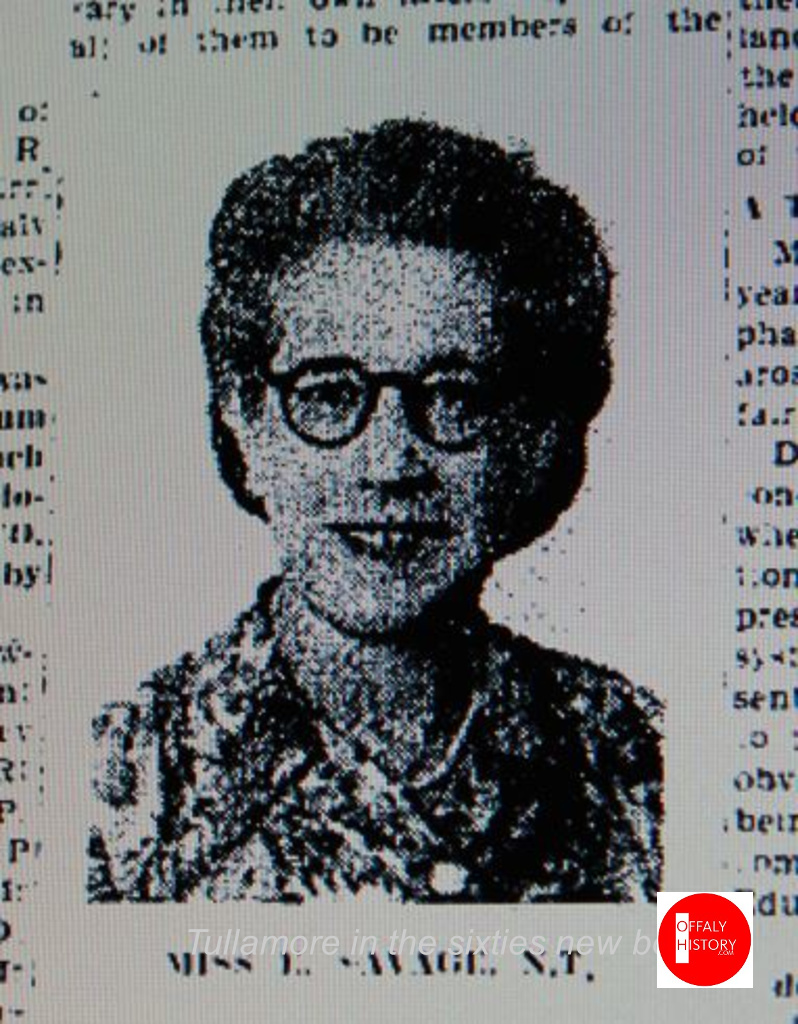
Alan Mahon, as the grandson of an innovative cinema proprietor, recalls two cinemas in Tullamore whose cultural contribution is perhaps forgotten now but was all important to the people of Tullamore and district over a period of sixty or seventy years, if one takes it from the commencement of the Foresters cinema (later the Grand Central) in 1914.
Sport, so important to so many, brings us to the essay by Kevin Corrigan who looks at a formative decade leading on to the GAA Senior Football All-Ireland victories in the 1970s. Kevin had the challenging job of reducing to a short essay what could fill twenty books were one to address in detail each of the sporting activities that came to the forefront in the sixties.
How others saw Tullamore in the 1960s
How others saw Tullamore in the 1960s may have been a wake-up call in some instances, but these are appreciative portraits, while not uncritical, from Conor Brady, Ian Nairn and Margaret Stewart. These three contemporary pieces are reproduced from publications of the 1960s and 1970s and provided here as readings in how others saw Tullamore at the time, and not with the benefit of a post 2008–15 lookback after the recessionary years. This later view is provided for us by the late Jim Cullen and Pat Cronin. Terry Adams, whose family have long lived in Cormac Street reflects on ‘Kilcruttin’s Forgotten People in an evocative piece. All three men had strong associations with Tullamore but were living abroad.
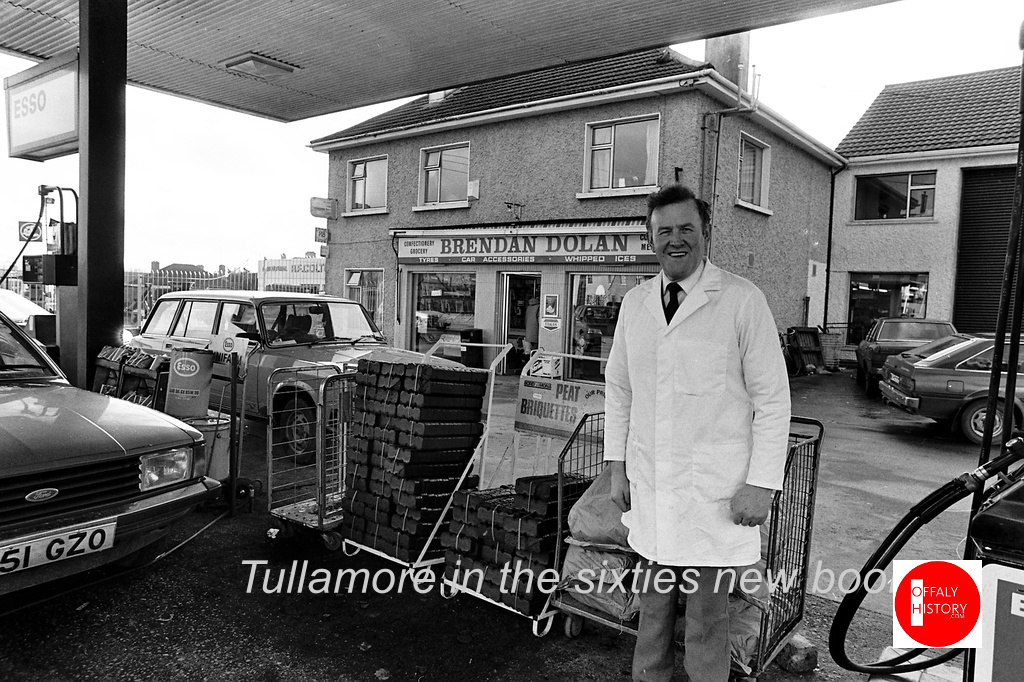
While the emphasis was on the 1960s a spill-over to later decades seemed relevant in a few instances. In writing about the Catholic parish of Tullamore it seemed essential to take the story to the destruction by fire of the old church in 1983.That said there are topics that had to be left to one side for reasons of space and deserve comprehensive treatment in a second volume. This is true of the all-important subject of education which could easily take a full volume. The voice of women needed to be heard, but was absent from local politics, the courts, law and policing. Likewise, the contribution of the caring professions, the voluntary sector and the provincial media. The introductory essay has sought to repair these deficiencies by way of no more than short notices. A lot more work needs to be done and we hope that students and researchers looking for thesis topics will take note. Offaly History publishes a journal and is always keen to receive carefully researched topics for publication. Essays that we could not include here we are ready to see developed for a forthcoming issue of Offaly Heritage now heading towards its thirteenth issue
Launch: 6 December 2024 at 7 .30 p.m. Offaly History Centre, Bury Quay, Tullamore R35 Y5VO (beside new Aldi and Old Warehouse). This is a bumper book and attractive and in full colour. The aim was quality and reliability. All are welcome to attend.
Now available from Offaly History Centre and online shop at http://www.offalyhistory.com and Midland Books in High Street. Bridge Centre for the twelve days before Christmas.
456 pages, 350 pictures, €22.95. A limited number of signed hardbacks will be available at €29. 95. The contents amounts to 150,000 words and 350 pictures, many from the Sixties despite the scarcity of pictures in that decade due to lost collections from the professional photographers of that period. For the later pictures we have had the support of the leading practitioners since the 1970s.
Published with the support of Creative Ireland and Offaly County Council
The twenty-nine chapters
- Tullamore in the 1960s: a decade of significant change, Michael Byrne
The 1950s background
- 1950s Tullamore revisited, Joe Kenny
- From An Tostal to The Runners: the spirit of Tullamore in the 1950s
Fergal MacCabe on Tullamore and The Runners, as reported by Geoff Oakley
Town management, development of infrastructure and public health
- Tullamore in the 1960s: A town in transition, Fergal MacCabe
- Reflections on the expansion of Tullamore over fifty years since the 1960s, Vincent Hussey
- An overview of the development of the Health Services in Offaly and the midlands since the 1960s, Denis Doherty
- The enhancement of Tullamore’s public infrastructure: early 1960s – 2014, Niall Sweeney
- A look back into the past as Tullamore Town Clerk, 1970–72, Jack Taaffe
Religious change
- Change in Tullamore Catholic Parish since the 1960s, Michael Byrne
Innovation in industry and management
- Tullamore D.E.W. Distillery: An iconic brand leader for Tullamore and Ireland, Michael Byrne
- The Williams Group Tullamore: making the transition in the 1960s from a family concern to one of the largest private companies in Ireland, Michael Byrne
- P. & H. Egan Limited, Bridge House, Tullamore in the 1960s, Michael Byrne
- Salts/Tullamore Yarns, 1938–82: the largest employer in Tullamore for over thirty years, Michael Byrne
- The Midlands Butter & Bacon Company Limited, Tullamore, 1928–89, Noel Guerin
The development of the service sector from the 1960s
- Shopping in Tullamore since the 1960s: the coming of self-service and supermarkets, Michael Byrne
- Banking and Insurance in Tullamore since the 1960s, Michael Byrne
- History of Motor and Farm Machinery Garages in Tullamore, 1960–2013, Ronnie Colton
Cultural shifts and Entertainment
- Tullamore Hotels since the 1960s, Michael Byrne
- The eating out experience in Tullamore in the 1960s, Michael Byrne
- The Tullamore Cinemas from the 1930s to the 1970s, Alan Mahon
- Dancing Days in Tullamore in the 1960s: From the marquee to the nightclub, Michael Byrne
- The pub in Tullamore since the 1960s: from licensed grocery to super lounge bar and ‘meeting in the smoking area’, Michael Byrne
Sports
- An overview of sport in Tullamore: the 1960s, Kevin Corrigan
Views of Tullamore from the eyes of others
- How visiting journalists saw Tullamore in the 1960s: Readings from articles by Margaret Stewart, Ian Nairn and Conor Brady
- Recollections of Tullamore, 1963-2013, Jim Cullen
- A note on Tullamore by a frequent visitor from South Africa, Patrick Cronin
- Kilcruttin’s Forgotten People, Terry Adams
- Tullamore town: a timeline of events from 1960 to 1972, Michael Byrne
- Tullamore: a select bibliography, Michael Byrne
Contributors of essays

Terry Adams was born and raised in Tullamore. He has lived for over thirty years in Luxembourg city. His most recent book of poems and prose was After the Break (his eighth collection).
Michael Byrne is a solicitor and notary public. He has been active in the promotion of local studies in County Offaly for many years and is general secretary of the Offaly Historical and Archaeological Society.
Ronnie Colton went to school in Killeigh, was brought up on a farm, and so gained a good understanding of machinery and farming practices. He spent two years in secondary school before starting work in Hurst’s garage Earl/O’Moore Street, Tullamore in 1960, where he gained valuable experience, having spent six years in their parts and service departments. He then moved to Drogheda where he worked in farm machinery parts and sales, until starting his own farm machinery business on Clara Road, Tullamore in 1972. While officially retired, he continues to do some IT maintenance for Colton Motors.
Kevin Corrigan has been sports editor of the Tullamore and Midland Tribune since 2005 and has worked in local media since 1990. He has written history books on Kilcormac-Killoughey GAA Club and Tullamore Harriers Athletics Club and is currently working on a comprehensive history of Offaly GAA. He lives at Killina, near Rahan.
Pat Cronin was born in Johannesburg, South Africa on 1 May 1949 – his father, like his uncle, after whom he was named, were natives of Tullamore. Educated at Marist Brothers College, Inanda after which he studied commerce and law at the University of the Witwatersrand in Johannesburg before joining ENS Africa (now the largest law firm in Africa) where he has worked all his life. He is married to Penelope and has two daughters and three grandchildren.
Jim Cullen was a retired brigadier general in the U.S. Army and last served as Chief Judge, U.S. Army Court of Criminal Appeals. He had long been involved in human and civil rights campaigns and was among those retired U.S. generals and admirals who spoke out against inhumane interrogation and detention programs authorised by the Bush regime. Jim was raised in Ballykeenaghan, Rahan and went to school in Ballykilmurry. He frequently returned to his home in Munny, Kilcormac. Jim Cullen died in December 2017.
Denis Doherty served as Head of Personnel of the Midland Health Board between 1972 and 1975 and as CEO between 1980 and 2002. In the course of his career, he was a member of many national health policy bodies.
Séamus Dooley is Irish Secretary of the National Union of Journalists. He is a former editor of the Roscommon Champion and worked as a sub editor with the Irish Independent before his appointment as a full time official of the National Union of Journalists. A native of Ferbane he began his journalistic career in the Midland/Tullamore Tribune.
Noel Guerin is a long-time resident of Tullamore and a member of the Offaly Historical and Archaeological Society. He has an enduring interest in local history, but the combination of his scuba diving activities and pursuits in underwater archaeology in association with the National Museum of Ireland has focused his study on material examples of Irish glassware and their histories, in particular the glass and ceramic bottles unearthed in and around the waterways of Offaly.
Vincent Hussey is a former planning officer with Offaly County Council and now retired.
Joe Kenny was from County Mayo and came to Tullamore in 1954 to work in the Tullamore Vocational School where he became vice-principal in 1969. He was a founder member of the Tullamore Credit Union in 1963. Noted for his fairness and sagacity he was regularly asked to chair meetings. He was keen on drama and literature. Joe Kenny gave over 60 years of his life to Tullamore and he made a difference for the better. He died in 2016.
Alan Mahon qualified as a Barrister in 1977 and became a Senior Counsel in 1988. Having practised at the Bar for over 25 years he was appointed a Judge of the Circuit Court in 2002 and was promoted to the Court of Appeal in 2014. He retired from the Judiciary in 2018, and shortly thereafter was appointed Ombudsman for the Defence Forces, a position he still holds.
Fergal MacCabe is a Tullamore-born architect and town planner. He is a past president of the Irish Planning Institute and a member of the Water Colour Society of Ireland.
Niall Sweeney is a Tullamore native. He was educated at Saint Columba’s CBS Tullamore and subsequently at University College Dublin where he received a degree in Civil Engineering. He is a Fellow of The Institution of Engineers of Ireland. He has served as an engineer with Offaly County Council, Laois County Council and as County Engineer with Clare County Council before returning to Offaly County Council as County Manager in 1997. He retired in 2007. He is a member of Offaly Historical and Archaeological Society and a Director of Offaly History.
Jack Taaffe The late Jack Taaffe served as town clerk with Tullamore Urban District Council in 1970–72, and as county manager in Westmeath from 1981 to 1998. He died in 2023.

 offalyhistoryblog