
The first indication that Birr/ Parsonstown (as often called in the 19th cent.) had used gas to illuminate the town during the dark winter months was an editorial comment that appeared in the King’s County Chronicle of January 9 1850[1] that extolled how the use of portable gas had made the town safer to move around at night.
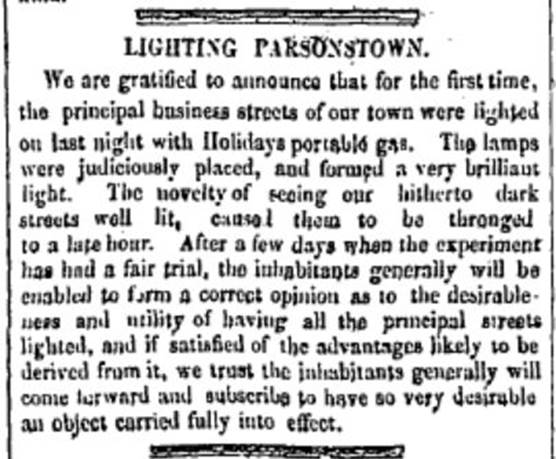
A new method of illuminating larger towns across the United Kingdom and Ireland was discovered through the decomposition of water.[2] As with crime on the rise[3] during the hours of darkness, it was vital that towns had some lighting and not to depend on the moon for guidance for those travelling by night. It was also hoped that this lighting of the town would continue in the future and to this end, the principal merchants in the town held a meeting on January 16 1850 to discuss how to continue the lighting of the streets for the foreseeable future and to ascertain the costs of doing so. A committee was established with prominent businessman, John Egan, as the chairman, to raise the necessary finance from the local businesses and those ratepayers that could afford to contribute to keep Parsonstown lit up during the long dark nights and to guarantee a supply of gas to do so.[4]
Another editorial appeared in the King’s County Chronicle of January 30 1850[5] that expressed the desire that the recently formed committee would commit to the continued lighting of the town during the autumn and winter months. With Parsonstown’s streets now adequately lit up during hours of day and night, it was much easier to detect nuisances in the town that were detrimental to businesses and their removal led to a relatively safer environment.[6] The decision was taken by the merchant committee to hold additional fairs in Parsonstown that would facilitate traders from areas nearby to travel home when the town was lit up at evening time as some areas of the town previously were dangerous for travelling in darkness and made those hoping to buy or sell livestock, think twice about coming to Parsonstown.[7]

The next mention of the lighting of Parsonstown did not happen again until September, when a ratepayer wrote to the King’s County Chronicle to enquire if the town was to be lit up as it was at the end of 1849 and earlier in 1850 and was there sufficient finance available to guarantee it?
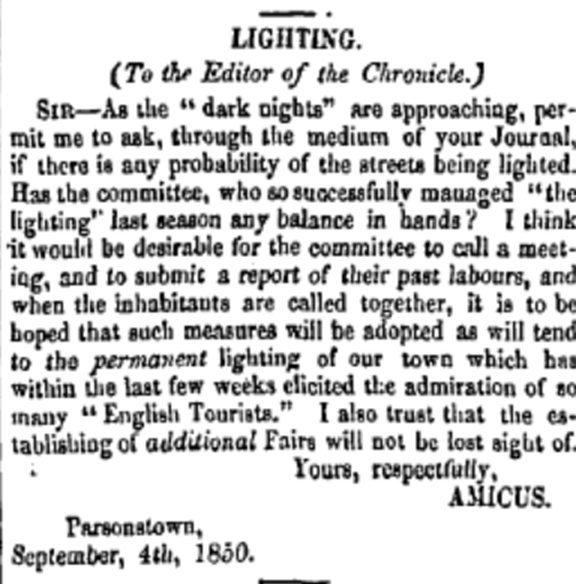
William Woods replaced John Egan as chairman at the end of 1850 as Egan was thanked for his guidance over the previous ten months. This voluntary committee had both Catholic and Protestant business people involved that highlighted the diversity of religious groups in Parsonstown that united together for the good of the town with proprietors like Mrs. Matthews of the Coach Hotel strongly indicating a willingness to continue to subscribe towards the lighting of the streets over the dark, winter months and into 1851.The considerable support of the Earl of Rosse was desired to give further clarity to the lighting of Parsonstown and to explore the long-term possibilities of being able to illuminate the town and the surrounding streets and districts.
The first meetings of the newly formed Town Commissioners[8] that discussed the issue of lighting in the town of Parsonstown on record were held on March 16 and 23 respectively in 1853, as the town remained in darkness apart from some houses that were lit up by candles and lamps that illuminated from light created by oil burning. A contract was secured with the proven provider of a gas supply, John Hollwey [or Holloway], who learnt his trade across England and was known for his ability to construct competent gas works and with the Parsonstown Town Commissioners desperate for the town to be lit up, Hollwey was in a strong position to dictate favourable terms for himself. This contractor enjoyed a monopolistic position over the next three years for Hollwey despite some protestations from the odd commissioner during this period but the consensus was that the supply of gas was more than adequate for the purposes required in the town. There was an expression by some of the town commissioners from as early as this year – 1853 – about the establishment of independent gas company for Parsonstown that would have control of when and where to light the lamps but these were just murmurings and nothing concrete would emerge for many years about seriously exploring this avenue.
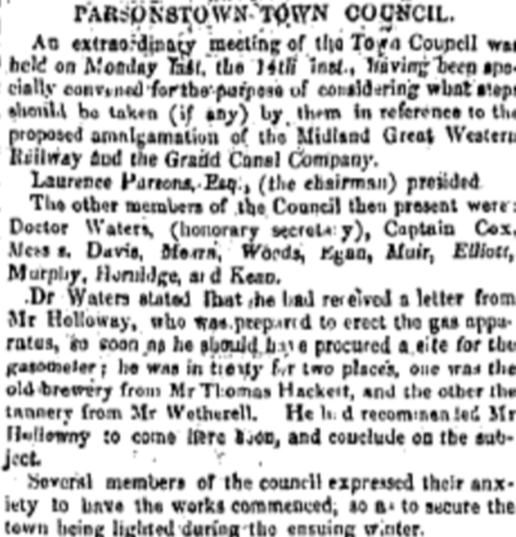
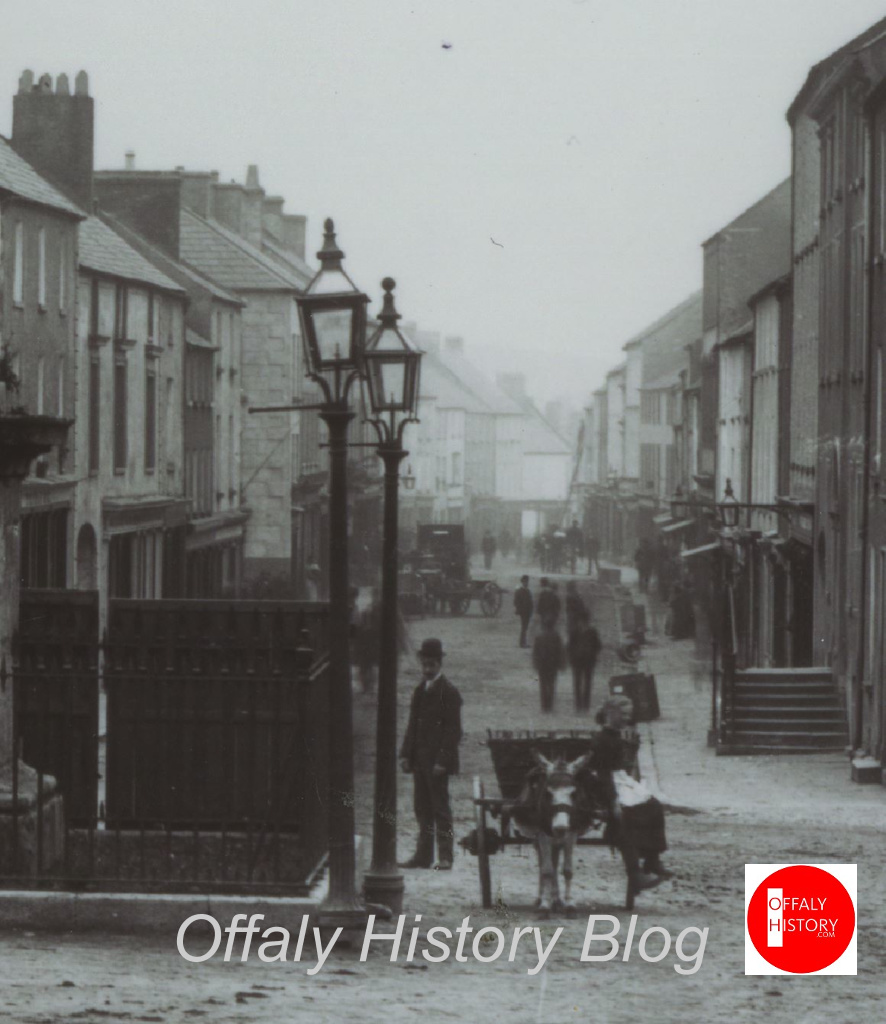
The desire to light up Parsonstown began in earnest at the end of 1849 and through the initiatives of the local business people set up a working committee to use portable gas into the early years of the 1850s. This momentum was continued by the Town Commissioners as they made contact with John Hollowey/Holloway and entered into a contract for the supply of gas to light the lamps in the town for an initial period of three years from 1853 to 1856 with an annual review of the services provided.
Martin Hoctor.
[1] ‘Lighting Parsonstown’, King’s County Chronicle, Jan 9 1850.
[2] King’s County Chronicle, Feb.7 1849.
[3] Agrarian violence organised by the Ribbonmen against landlords and their agents.
[4] The committee established over lighting up Parsonstown had Michael Molloy as the treasurer, Mr. Toole was the secretary with the following prominent business people making up the other members; John Meara, William Graham, William Glasco, Henry Davis, William Coghlan, William Woods, and James Connolly.
[5] ‘Lighting the Streets’, King’s County Chronicle, Jan 30 1850.
[6] King’s County Chronicle, Mar 20 1850.
[7] King’s County Chronicle, Mar 27 1850.
[8] King’s County Chronicle, Aug.4 1852.
Supported by the Department of Culture Communications and Sport as part of the Commemorations Series for 2025.

 offalyhistoryblog