
Background to the Poor Law Inquiry
The Commission of Enquiry into the Poorer Classes in Ireland was the result of the United Kingdom government’s investigation of rapid increases in population living in extreme poverty. From their official reports in the post-Napoleonic period Ireland’s growth-rate had remained high. In the 1831 census Ireland returned a population of 7.8 million up from 6.8 million in 1821. In the year 1831 the population baronies of the Upper and Lower Philipstown was 17,311. The town of Daingean had a population of 1,454.[i] For King’s County in general please see our previous blog.[ii]
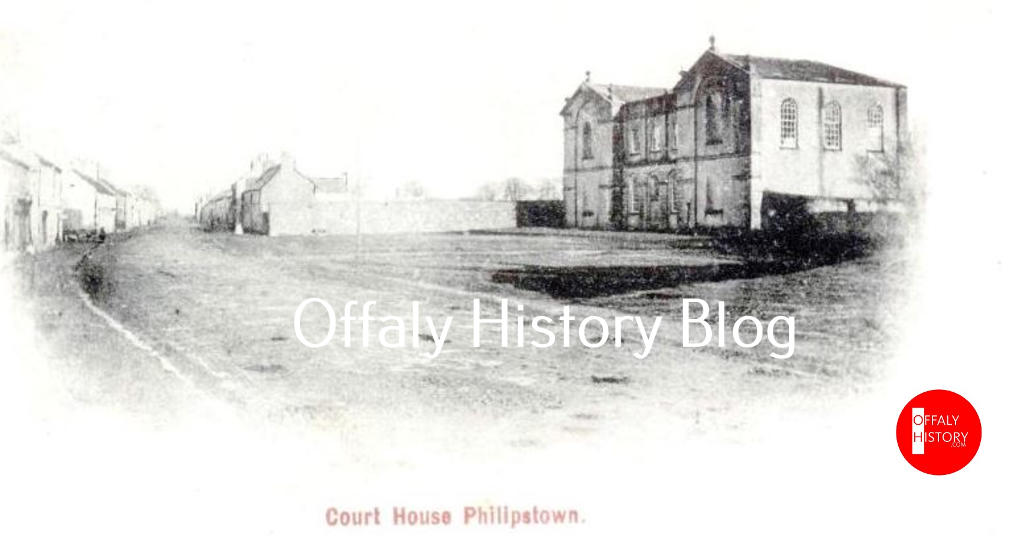
In the baronies of Philipstown Upper and Lower two commissioners were appointed: Jonathan Binns and James O’Hea. It should be noted, previous to the dissolution of the Parliament of Ireland in 1800, Philipstown returned two members to that legislature.[iii] In 1835 Tullamore became the county town and with that the assizes were moved there from Philipstown.[iv] As the Poor Law Commissioner Jonathan Binns reflected:
‘Its trade has disappeared – many of its houses are in ruins – its shops are falling into decay – and its population, as these signs sufficiently indicate, are poor and wretched.’[v]
The inquiry’s purpose was to discover the extent of poverty in Ireland through the methods of oral hearings and socio-economic surveys. It would eventually result in the publication of the poor law act in 1838.[vi]
1,164 labourers existed in the baronies of Philipstown Upper and Lower according to the population returns of 1831. The poor inquiry divided them into three classes, viz., cottiers, farm-servants, and day-labourers. Cottiers were the best off of the three classes. Farm-labourers were paid poor wages and similarly day-labourers wages and employment were noted as being on the decline. The Poor Inquiry examination met at Philipstown on 16 November 1835.[vii] 22 Persons in total were questioned:
Persons who attended the Examination.
NAME OCCUPATION
Simon Bolling labourer
James Brock labourer
John Brophy labourer
John Dowlan farmer
Thomas Dunn labourer
Mr. Fawcett large farmer
Patt Gilligan labourer
Mr. W. Hamilton –
Wm. Harper labourer
Mr. Kelly schoolmaster
Mr. Kennedy farmer
Malone sergeant of police
Mr. Lewis Morriss farmer
Mr. Murray farmer
Mr. James O’Connor farmer
R. Odlum, Esq. –
Mr. Potter farmer
Raite, Esq. –
Thomas Renkins labourer
Ridgeway, Esq. –
Mr. Sunney farmer
Mr. E. Walsh farmer
The agenda of Binns and O’Dea
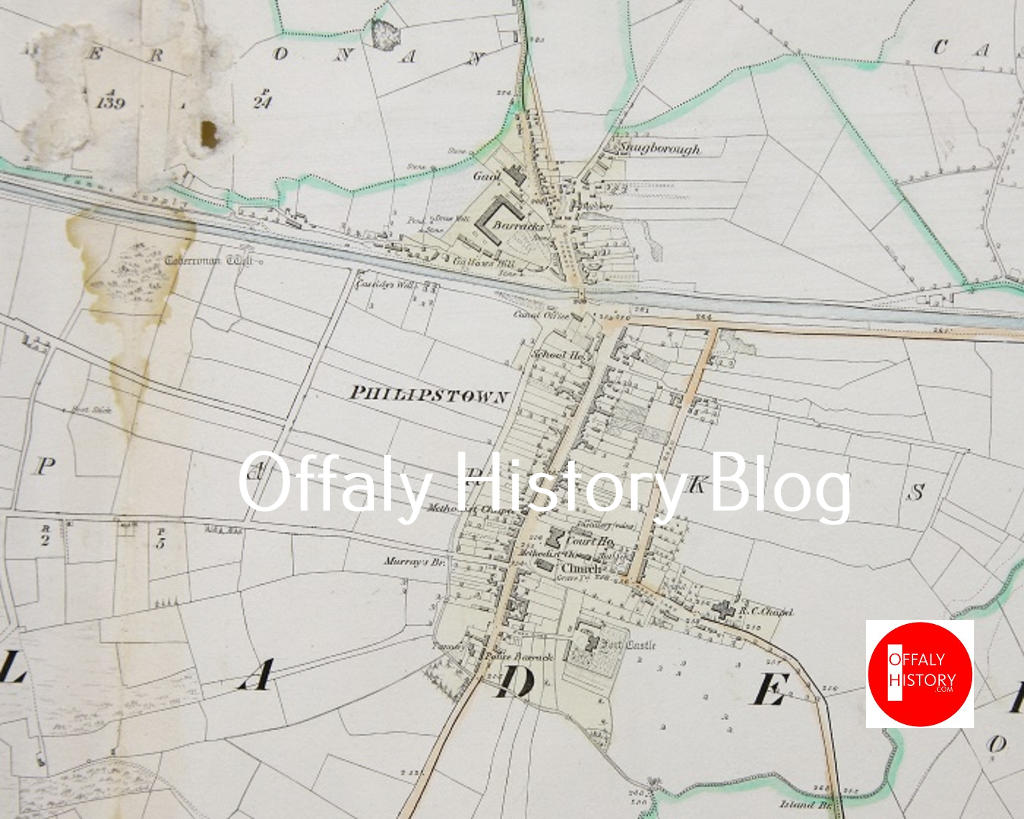
Binns stayed during his time in the south end of Philipstown at a hotel kept by a Mrs. Ellis. On reflection Binns recalled his time in Daingean:
‘My bed-room was part of the Barristers’ dining-room in the palmy days of Philipstown: the sitting-room which we occupied looked out upon the street, and the windows were frequently crowded with miserable women, carrying children upon their backs, and soliciting charity with pitiful lamentations. To relieve all was impossible — and to relieve only a few increased the number of those who begged. Under such distressing circumstances, my consolation was, that I was engaged in preparing a full and honest statement of their wretched condition, with a view to the introduction of legislative measures of relief.’[viii]
Binns contrasts the condition of the town of Philipstown in 1835 with its previous importance:
‘It is robbed of its representatives — the assizes are removed to Tullamoore — its trade has disappeared — many of its houses are in ruins — its shops are falling into decay — and its population, as these signs sufficiently indicate are poor and wretched.’[ix]
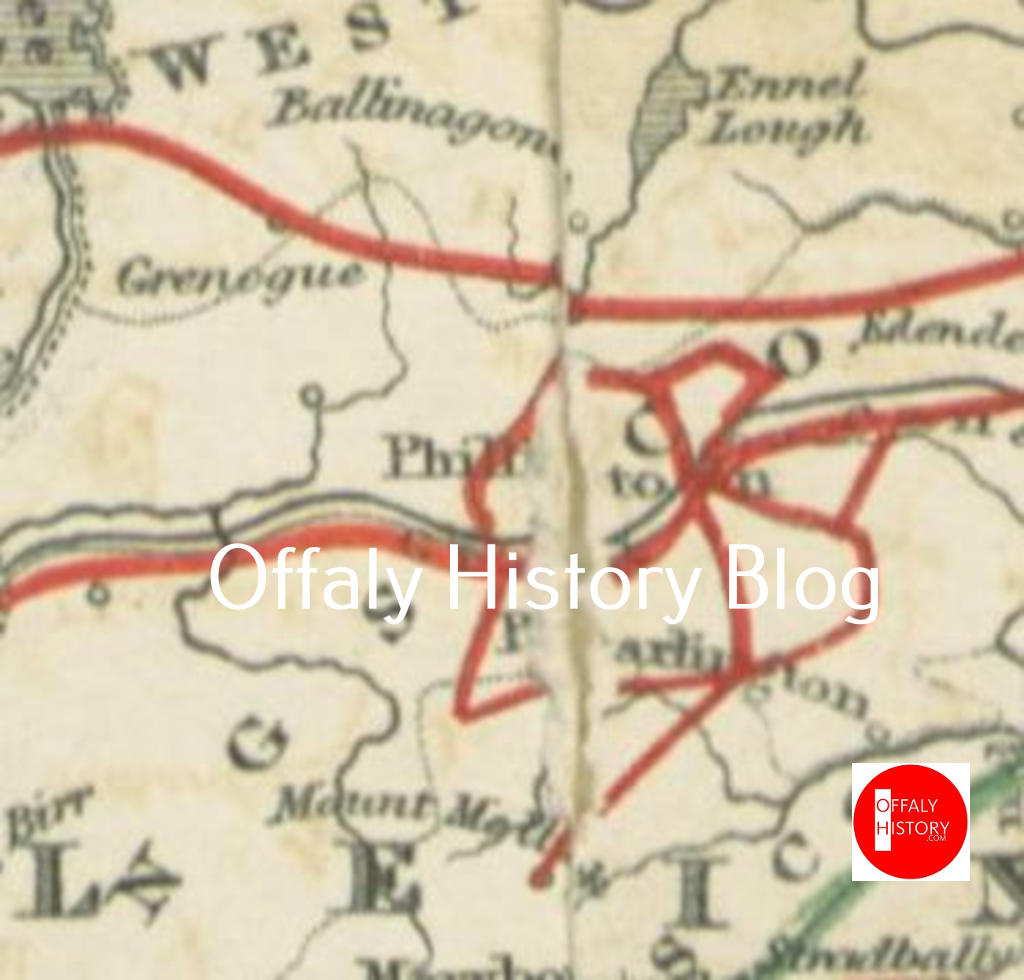
Binns saw that conacre existed considerably in Philipstown.[x]
‘The beggars in this district are very numerous; they sometimes pass through Philipstown, to the number of three or four hundred a day, are often tipsy, and circulate stories of malicious tendency. They shut up their houses, gamble at cockfights, and occasionally amass, by one means or another, considerable wealth. Mr. Odlum, for instance, knew a beggar who gave his daughter £100. Numbers of the labourers would have no objection to go to a workhouse, but, generally speaking, they would prefer rambling about the country — they get more money by this means than they would in a workhouse, and are of course more at liberty to indulge the propensities which a want of education, idleness, and bad habits, have engendered.’[xi]

Binns left Philipstown by canal on the 25 November. He concluded his survey of the area in serious and distressed tone:
‘They would work, as I have stated before, for fourpence or sixpence a day, or even less, if they could get it. Their food is of the poorest description (the coarse potatoes called lumpers) and obtained in quantities barely sufficient to keep the machine of life in languid motion. To use their own words, uttered with great pathos and feeling, — “We are only just kept breathing,” — “Our eyes are only just kept open.” I have witnessed scenes that would awaken commiseration in the coldest and the hardest heart, and some of these I have endeavoured to describe, faithfully, without the slightest shadow of exaggeration. I have seen young and helpless children, almost naked and without food, exposed to the cruel influences of the weather, in huts which should have afforded them protection; and I have seen old people, afflicted severely by asthmas and rheumatic attacks, lying in hovels without either window or chimney, with nothing for their bed but the bare damp floor, or a thin layer of straw. Can it, I again ask, can it surprise us, when people, habituated to such appalling wretchedness, and instigated by mingled feelings of revenge and despair, commit crimes, at the bare relation of which human nature shudders?[xii]
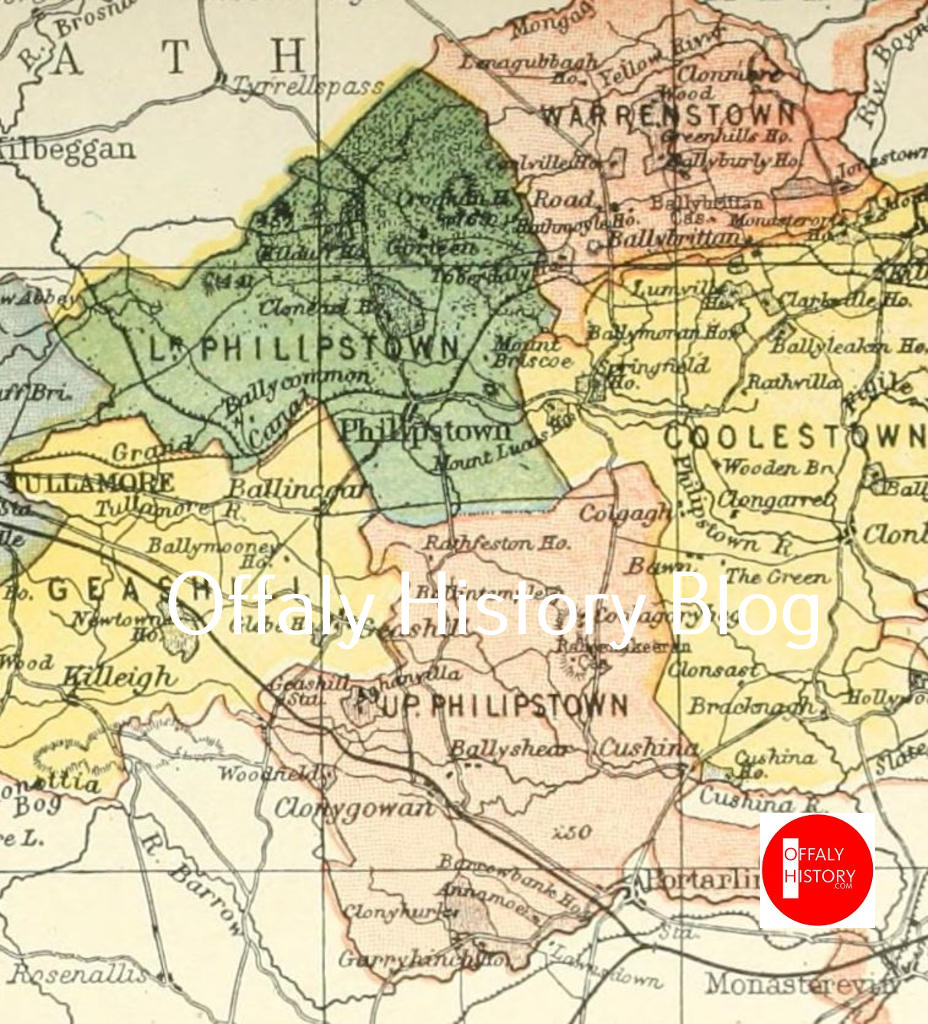
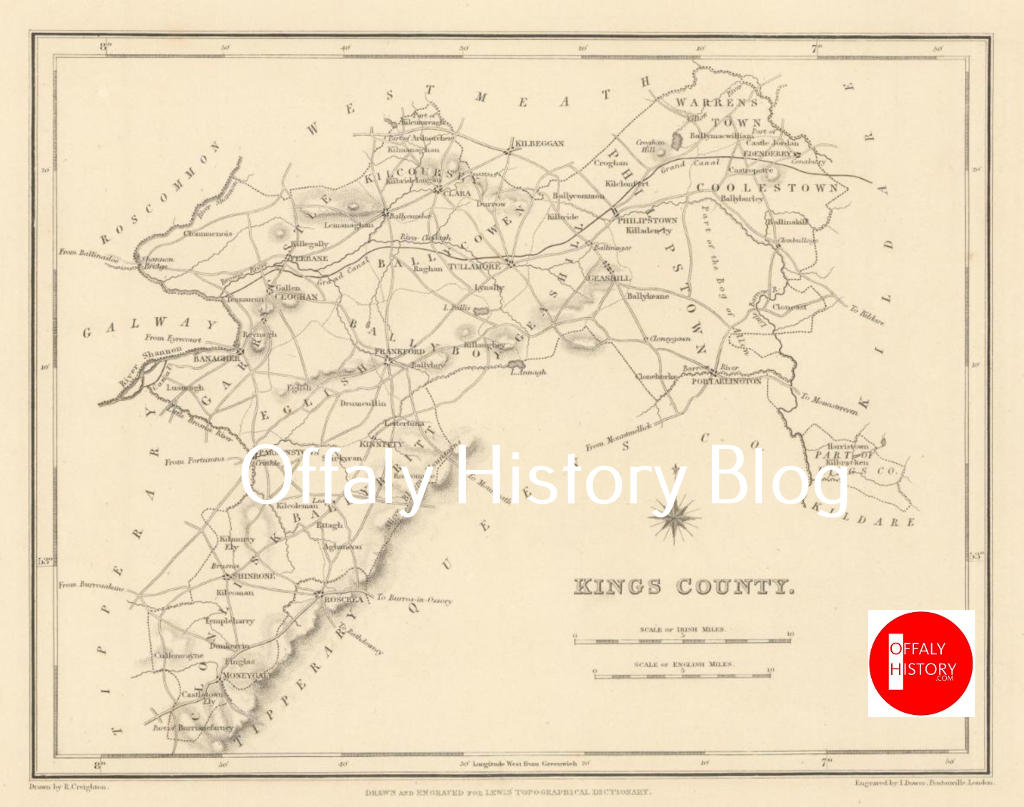
Geography of Philipstown Upper and Lower baronies
There are seven civil parishes in Upper Philipstown:
Ballybracken (part of)
Ballykean (part of)
Cloneyhurk
Donaney (part of)
Fonstown (part of)
Geashill (part of)
Harristown
and
There are 5 civil parishes in Lower Philipstown:
Ballyburly (part of)
Ballycommon
Croghan
Kilclonfert
Killaderry
Headings used within commissioner’s report
Earning of Labourers.
Rate of Wages.
Amount which an Individual can earn.
Effects of insufficient Wages.
Effects of regular Employment.
Causes of low Wages, and Remedy.
Effect of increased Wages on Population.
Recovery of Wages.
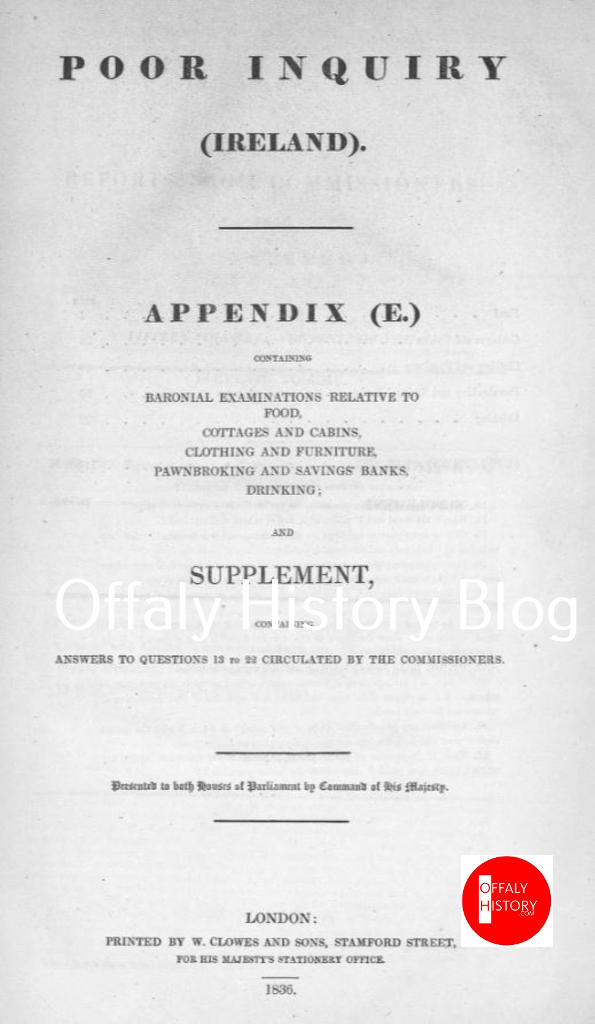
Transcripts of the Poor Law Reports
Cottages and Cabins
State of Cottages – Rent of Cottages. – Location of Cottages. – Recovery of Cottage Rent. – Fuel.
The usual size of the cottages in this barony is about 20 feet long by 12 wide. They are usually made of mud and straw mixed together, and are divided into two equally-sized portions or apartments. They are thatched with sods and straw, and, in many, are badly protected from the weather. The floors are made of earth, and in this barony are kept tolerably dry, the cheapness and abundance of turf enabling the poor to keep good fires in their cabins. These cabins, in general, are without chimneys; a few, however, on the upper lands, have rude chimneys made of mud and sticks clung together. The windows in these cabins are little bits of glass about three or four inches square. Besides these cabins on the upper lands, there are, scattered in various directions about the bog, the most miserable hovels, without either window or chimney; and, in some instances, they are mere excavations of the turf bank.
The cost of erecting a cottier’s cabin in the upper lands was stated to be about £3; but the hovels in the bogs do not cost one-third of that sum. “The rent of a cottier’s cabin, without land, is £1 a-year, so that the cost of erection is paid in three years.” — (Mr. Fawcett.) — The landlord, however, is bound to keep the cabin in repair.
The cottiers’ cabins are generally placed on the outskirts of the farm, and on the worst land. The farmers give as the reason that they wish to be free from the different annoyances arising from the cottier’s family. The labourers in towns were not considered to be so well off as those living in the country, and consequently not so well conducted. The labourers m the town of Philipstown were looked on as the most wretched in the entire district.
The system of seizing a labourer’s goods for rent is seldom resorted to here. The rent is mostly paid in labour.
In the barony the bog of Allen supplies turf in abundance; and the labourers declare that, but for the comforts this article affords, they could not live under the difficulties to which they are here exposed. £1. 10s. is ample to procure turf for the use of an ordinary farmer throughout the year, and half that sum abundantly answers for a labourer.[xiii]
Clothing of the Peasantry and Furniture
The clothing of the labouring classes is very indifferent, and £2 was considered the utmost that any labourer’s family expend on clothes in a year; in some cases the labourers manufacture frieze, that is, they buy the wool, and their wives spin it and get it woven; the fanners’ families all do so.
The furniture of a labourer’s cabin was stated to be very trifling; in general they have bedsteads, but, with regard to bed clothes, they are very badly off. Sergeant Malone says, “their day-clothes are in many cases their night-clothes; I made an inspection of the houses of the labourer of this parish some time ago, and the proportion of blankets was one to every six or seven persons.[xiv]
Pawnbroking and Savings’ Banks
In this barony there is no pawn office, neither is there a loan society, but in a neighbouring barony there is a loan society established, which had the reputation of having conferred great benefit on the district. The Rev. Mr. Hamilton was of opinion that “the establishment of one in Philipstown would be most advantageous.”[xv]
Drinking
Drinking was stated to be on the decrease, and the number of whiskey shops becoming less, “owing to the want of cash.” — (Mr. Odlum.) — Mr. O’Connor also was of opinion that in times of plenty the sale of spirits was greater than in periods of distress, and that “a larger quantity of spirits is sold in the districts in which the inhabitants are well off than where distress generally prevails.” It was stated by S. Bolling that “labourers do not drink because they cannot afford it.” The want of firing cannot here urge them to drinking, because of the abundance of fuel in the barony.[xvi]
Rent of Con Acre
“Con acre” prevails in every part of the barony, and is eagerly sought after — so much so that several of the labourers complained they were not able to get it. The reason given by them for this anxiety to obtain con acre was, that in winter they are destitute of employment, and if they have not provided con acre, they are left entirely without food. Barney Mangan, labourer, states “that he has con acre five miles distant from his dwelling, and that he is glad to get it even there.” A labourer generally takes from a rood to half an acre, and never with a view to make any profit by the sale, but to ensure to himself a supply of food. Con acre land is prepared in two ways in this barony: in some cases the farmer ploughs, manures, and seeds it, and then the rent amounts to £12 an acre; in other cases the farmer only ploughs and manures the land, and the labourer seeds it and works it: in the latter case the rent averages about £8 an acre. The average produce to the acre is about 60 barrels of 24 stones to the barrel.
Simon Bolling says, “In this barony the rent of con acre is paid in money, and that money is got by going to England or somewhere in search of work: sometimes it is paid by the sale of a pig.” — Brock, a labourer, also states “that the con acre rent must be paid in money, because the farmers cannot afford to take work; if they took work as payment for con acre, they might fix whatever rent they pleased on it.”
It does not appear that any number of days’ work was given by the taker of con acre besides the rent.
Mr. Odlum states that “it seldom happens that the produce is not worth the rent of the con acre land; but, should such a case occur, that probably some abatement would he made to the labourer;” and Mr. Fawcett adds “that even if the crop be not worth the rent at the time, yet the labourer does not know but that potatoes may become dear in the course of the year; and, besides, he is afraid not to take the crop, lest he may not get con acre again.”
Mr. Odlum was of opinion, that “it would not be of any advantage if the tenant had the power of surrendering the crop to his landlord on due notice being given. Con acre rent has never been affected in the least in this barony by intimidation or violence. Should the labourer be unable to pay the rent of his con acre immediately, he is allowed to dig the potatoes and put them into pits in the field, but not to carry them away. In this barony also con acre of oats is general; it is not, however, taken by labourers but by small farmers, and Mr. Odlum says “the profit is on the wrong side.” The following was given as an average account of the expense and produce of an acre of con acre oats: — The rent is from £4. 10s. to £6. 10s., — average £5. The tenant seeds and ploughs the land. The seeding two barrels of oats costs 16s., and the ploughing 4s.; thus the expense is £6. The average produce then is about 15 barrels; these, at 8s. a barrel, exactly pay the £6: but this year very little oats exceeded 7s. a barrel, so that the man who takes con acre oats has but the straw for his labour and his risk. He considers himself well paid if he has the straw clear.”
The condition of the labourers of this barony is distressing and anomalous, and such as should not exist in a well-regulated community: every hour that such a state of things continues, social order is hazarded. Here are abundant resources of employment, and yet the labourers are idle and unemployed; so that the great mass of the labouring population are little removed from starvation. Out of this condition they cannot raise themselves; some means ought, therefore, to be used to rescue them. Any prospect of increased employment given by the farmers is out of the question. The large farmers are converting their farms into feeding land: the small farmers describe themselves as unable to pay for labour, though confessing their land to be in want of it; so that instead of agricultural employment increasing for the labourers in this barony, it is rapidly declining; and if an immediate and effectual remedy be not now applied, a heap of misery is likely to be generated in the barony, which may now be prevented at less expense, than it can be afterwards removed. The labourers themselves point to the remedy of their condition, and are importunate to obtain it. Several thousand acres of the bog of Allen are spread in every direction, and, according to the testimony of several respectable persons residing in the district and acquainted with what has been done on the bog, most of this bog is easily reclaimable; and the labourers, seeing many who have been located on it thriving and comfortable, naturally wonder why so much land should be left unproductive, while they are so greatly in want of food. They were all, therefore, very anxious to know if government intended providing them with parts of the bog on reasonable terms, and thus giving them a means to maintain themselves. If small portions were allotted to them, they say, they would themselves reclaim them, devoting to the purpose the time which is at present unemployed, and which certainly exceeds the time during which they have employment.
It certainly is a melancholy reflection, that such a source of relief, and even of profit, should be neglected, indeed almost abandoned, by its owners, which, if brought into operation would relieve the wants of so many distressed families.[xvii]
This is part one of a three-part blog on the 1835 Poor Law Inquiry into the baronies of Philipstown Upper and Lower in northeast County Offaly/King’s County. From here part two will continue with further transcripts of the Poor Law Inquiry, to be available soon.
[i] Census of population, 1831.
[ii] Ciarán McCabe, ‘Poverty in pre-Famine Offaly (King’s County)’, Offaly History (https://offalyhistoryblog.com/2019/09/21/jonathan-binns-and-the-poor-inquiry-in-philipstown-daingean-kings-county-november-1835-by-ciaran-mccabe/) (23 Sept. 2025).
[iii] Edith Mary Johnston-Liik, History of the Irish parliament 1692–1800 (6 vols, Belfast, 2002), iii.
[iv] An act for holding assizes for King’s County in Ireland twice yearly at Tullamore instead of Philipstown, 4 July 1832 (2 & 3 Will., c. lx).
[v] Jonathan Binns, The miseries and beauties of Ireland (2 vols, London, 1837), ii, p. 38.
[vi] An act for the more effectual relief of the destitute poor in Ireland, 31 July 1838 (1 & 2 Vict. c. lvi).
[vii] McCabe, ‘Poverty in pre-Famine Offaly (King’s County)’.
[viii] Jonathan Binns, The miseries and beauties of Ireland (2 vols, London, 1837), ii, p. 40.
[ix] Ibid., i, p. 39.
[x] Conacre was the letting by a tenant of small portions of land prepared for crops or grazing.
[xi] Binns, ii, p. 52.
[xii] Ibid., pp 60–1
[xiii] Royal commission for inquiring into the condition of the poorer classes in Ireland, first report, appendix E, (HC, 1836), pp 47–8.
[xiv] Ibid., p. 72.
[xv] Ibid., p. 94.
[xvi] Ibid., p. 104.
[xvii] Royal commission for inquiring into the condition of the poorer classes in Ireland, first report, appendix F (HC, 1836), pp 12–3.
 offalyhistoryblog