
Town Commissions in Ireland were possible from 1847 after the introduction of the Towns Improvement (Ireland) Act that would allow the larger towns to introduce a series of measures starting with the appointment of commissioners to carry out works in a town like drainage, paving, and other improvements to the infrastructure. Unfortunately, this legislation was neglected in Ireland during the years of the Great Famine and it was not until the early 1850s when events slowly improved in terms of lesser number of deaths that several towns began to explore embracing this legislation for their districts. Parsonstown (Birr) Town Commissioners held their first meeting on August 4 1852 with Laurence Parsons elected as the first chairman and slowly began to implement the 1847 Act and its subsequent consolidation statute in 1854. Over the next 46 years Parsonstown/Birr Town Commissioners attempted to run the town from the rates received from the ratepayers and loans from the Local Government Board as they engaged in constant disputes with the King’s County Grand Jury and the County Surveyor for decades over which authority was responsible for the scavenging and cleaning of the streets and the expenses incurred.
We are glad to welcome the second of our Young Historians blogs this week and this year. If you have an article or an idea for an article do contact us at info@offalyhistory.com. Offaly History blogs now number 774 and reach 80,000 to 100,000 views each year. So do join the panel of authors of this treasure trove of easily accessed articles since 2016. Doing (or have done) a Leaving Cert History Project on local history -keep Offaly History in mind for your piece of research. We can help with editing and illustrations.
The passing of the Local Government (Ireland) Act in 1898 would see an urban district council replace a Town Commission, which would present the new council with far greater powers than the previous Towns Improvements (Ireland) Acts and would allow a council to serve for three years instead of one year and elect 21 councillors instead of 15 commissioners. The Birr commissioners were officially notified of the change in June 1898 in a sealed letter delivered to the Town Clerk, Henry Barlow, and the election for the new municipal authority was to take place in January 1899. This election was highly notable for future societies as under the new legislation, 165 women were eligible to vote for the first time in Birr in a significant moment for women’s suffrage in Ireland.
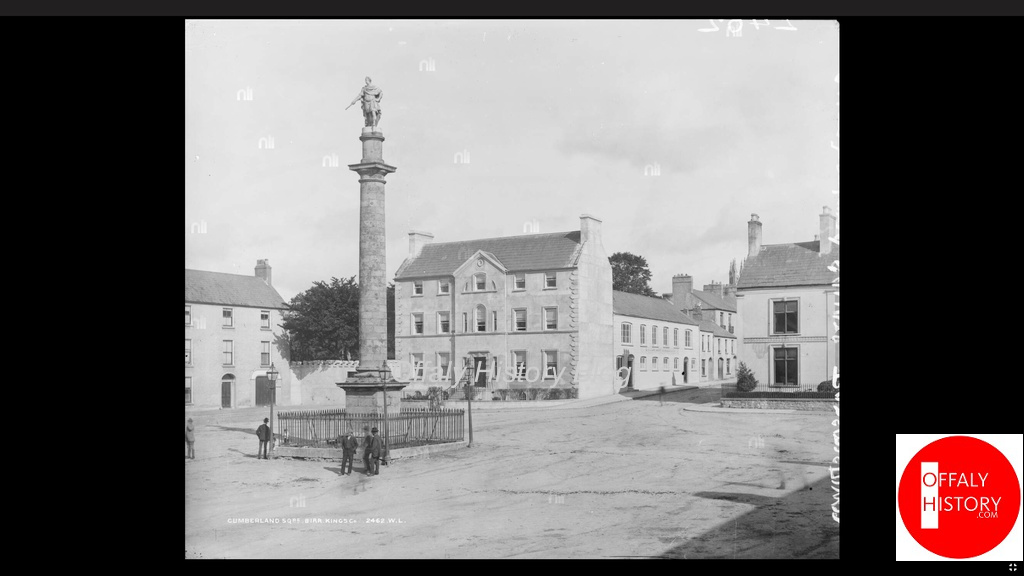
In an unprecedented move, the names of these women were published in the Birr-based King’s County Chronicle as the electorate in Birr rapidly expanded with more ratepayers entitled to vote than in previous years, and 744 electors were now eligible to vote for the new council.
Henry Barlow as the outgoing Town Clerk of the commissioners was the Returning Officer for this historic election in Birr by virtue of a new rule which was issued by the Local Government Board as the last meeting of the commissioners in January 1899 addressed whatever business they were entitled to complete before signing off. Several high-profile commissioners including the chairman, W.K. Fayle and Mark Quigley who informed Henry Barlow of their imminent retirements and would not be included amongst the list of candidates seeking election to the urban council. In all, 31 candidates contested the election and their details were published in the King’s County Chronicle of the profession of the candidates, their proposers and seconders, and if they were existing commissioners or had previously served as one.[1] Considerable pressures were now on Barlow with more people eligible to vote and for 21 councillors to be elected instead of the usual 5 commissioners every year and this first election required two polling stations, the extra expenses involved and the assistance of many others to ensure the votes were cast legally and the count completed accurately and quickly. To this end, those people with the surname between A to H were asked to vote in the Town Hall, with G. Morrison as the presiding officer and J. Ferns as poll clerk and from I to Z were to be accommodated in the Courthouse with Mr Power as presiding officer and J L Dooly as poll clerk.[2]
The turnout figures would be of considerable interest, especially to see if women would abstain as a form of protest for them repeatedly being denied the franchise to vote in general elections but 619 people voted out of 744 eligible with a large number of women using this opportunity to register their votes as the overall turnout was just over 93 %.[3] William O’Meara topped the poll with 431 votes to 430 votes for Stephen Mathews and the large overall turnout across Ireland for these new urban councils was bad news for Conservatives and Unionists.[4]

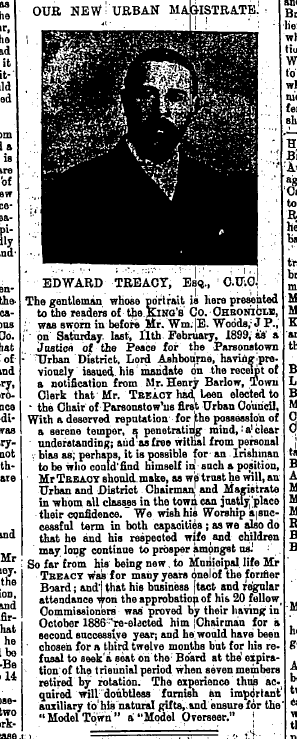
After all the votes were counted across all the districts, Nationalist and Home Rule candidates had captured 523 seats as against 110 for Unionists and Conservatives in what was a clear vote for Home Rule. Indeed at the first meeting of the Birr Urban District Council, councillor William Lowry went on the record that he was fully behind Home Rule for Ireland before the first business of the elected councillors present was to elect the chairman of the new authority. Edward Treacy, after the proposal of Patrick Ryan that was seconded by Patrick Walsh, was unanimously elected the first chairman of new body. In his acceptance speech Treacy vowed to embrace the legislations that needed to take priority in Birr, namely the Artisans Dwelling Act, Compulsory Education Act, Public Libraries Act, and to use the conditions of the 1878 Public Health Act to clean up the fairs and the markets.[5]A hastily arranged meeting was also held to elect the Birr representative for the County Council as somehow J. Powell (editor of the Midland Tribune) defeated the poll topper William O’Meara after a vote by ballot, given the vast experience that O’Meara had gathered in contrast to his opponent who was only starting out in his political journey.[6] How this process was decided upon requires scrutiny as it appears not to have been a designated council meeting as the chair was the local parish priest.
The councillors wasted no time in getting down to business at their second meeting that established the committees with responsibilities for gas and lighting of the town, sanitation of the town, the street committee to oversee paving and drainage works, a finance committee to decide if presented bills were to be paid in full, and a sub-committee to assess the viability of the re-opening of the then derelict Parsonstown to Portumna Bridge railway line. Every committee was requested to have a report ready for the next meetings as the council had to decide what works needed to be completed first and what funding was available from the rates and would they need to apply for a loan to the Local Government Board? Edward Treacy’s appointment as a Justice of the Peace for the Birr District continued the option contained in the original Towns Improvement (Ireland) Acts that the elected chairman of the town commissioners be proposed to the Lord Lieutenant for this role for their respective districts.

Appendix: The women eligible to vote for the first time in Birr.[7]
- Ellen Alt, Cappaneale.
- Mary Anglesea, Pound St.
- Mary A. Armstrong, Green St.
- Marion Barker, John’s Place.
- Anne Barry, Back Lane
- Mary Bergin, Compton Row.
- Mary A Beckett, Wilner Road.
- Kate Brady, Cumberland St.
- Anne Broen, Compton Row.
- Mary Brien, Compton Row.
- Mary Anne Broder, Pound St.
- Julia Browne, Pound St.
- Anne Buckley, Chapel Lane.
- Maria Buckley, Back Lane.
- Annie Campion, John’s Place.
- Mary Carroll, Drumbane.
- Anne Carry, Moorpark St.
- Kate Cassion, Duke St.
- Bridget Cavanagh, Pound St.
- Eliza Cleary, Workhouse.
- Mary A Cleary, Castle St.
- Julia Coghlan, Pound St.
- Annie Cole, Cumberland St.
- Mary Anne Cole, Back Lane.
- Elizabeth Compton, Moorpark St.
- Anne Connolly, High St.
- Ellen Conway, Eden St.
- Mary J Cooke, Cumberland St.
- Mary Cooney, Melsop St.
- Anne Corrigan, Pound St.
- Margaret Cuddihy, Chapel Lane.
- Dora Cuddy, Burke’s Hill.
- Mary Cully, Castle St.
- Margaret Curley, Pound St/
- Elizabeth M F Daly, Church Lane.
- Mary Daly, Eden St.
- Kate Dea, Connaught St.
- Elizabeth Delaney, Main St.
- Eliza Dewane, High St.
- Agnes Dillon, High St.
- Carline Dockery, Cappaneale.
- Bridget Donnelly, Fayle’s Lane.
- Mary Donnelly, Seffin.
- Anne Donohoe, Church Lane.
- Catherine Dooley, Hospital Lane.
- Sarah Dooley, Liverpool.
- Eliza Doorley, Church Lane.
- Anne Doyle, Bridge St.
- Lilly Duffy, Connaught St.
- Julia Eagleton, Newbridge St.
- Annie Edwards, Duke St.
- Margaret Edwards, Main St.
- Julia Egan, Townsend St.
- Kate Egan, Townsend St.
- Mary Egan, Sandymount Lane.
- Anne Eyre, Riversdale.
- Mary Fagan, Pound St.
- Julia Farrell, Cumberland St.
- Anne Filey, New Road.
- Adelaide A Fitzgerald, Cumberland St.
- Anna M Fitzgerald, Wilmer Road.
- Elizabeth Fitzgerald, Main St.
- Anne Fitzpatrick, Spinners Lane.
- Eliza Fox, Compton Row.
- Mary Fox, High St.
- Mary Frehan, Mountsally.
- Dorothy Galvin, Townsend St.
- Eliza Gallagher, Shamble Lane.
- Ellen Gleeson, Connaught St.
- Mary Gleeson, Wood’s Row.
- Ellen A Goldon, Oxmantown Mall.
- Anne Gough, Seffin.
- Bridget Grady, Ballindarra.
- Mary Griffin, Eden St.
- Julia Guinan, Bridge St.
- Honora Gunn, Duke St.
- Jeminia Hackett, Elmgrove.
- Kate Hackett, Duke St.
- Catherine Hanrahan, Burke’s Hill.
- Annie Harbourne, Rosse Row.
- Mary Anne Harrington, Castle St.
- Ellen Harte, Bridge St.
- Mary Healy, Glebe St.
- Elizabeth Hennessy, Cumberland St.
- Ellen Henry, Ballindarra.
- Bridget Higgins, Moorpark St.
- Elizabeth Hill, John’s Place.
- Mary Agnes Hobbins, Compton Row.
- Eliza Hoctor, Chapel Lane.
- Mary Hogan, Church Lane.
- Viney Hogan, Newbridge St.
- Martha Hogan, Melsop St.
- Julia Horan, Castle St.
- Mary Jane Horan, Main St.
- Kate Kelly, Fayle’s Lane.
- Dorah Kelly, Clonoghill Upper.
- Margaret Kelly, Main St.
- Mary Anne Kelly, Melsop St.
- Ellen Kennedy, Connaught St.
- Esther Kennedy, Moorpark St.
- Mary Kennedy, Green St.
- Winifred Kennedy, Townsend St.
- Anne Kenny, Bridge St.
- Margaret Kilmartin, Workhouse.
- Margaret Kirwan, Newbridge St.
- Annie Lander, Green St.
- Maria Leahy, Pound St.
- Anne Lockington, Newbridge St.
- Blanche Lodwick, Chester.
- Mary McDermott, Newbridge St.
- Bridget McDonnell, Melsop St.
- Honor McDonogh, Bridge St.
- Mary J McDougall, John’s Place.
- Eliza McLoughlin, Eden St.
- Ellen McNamara, Sandymount Lane.
- Isabella Madden, Townsend St.
- Mary Magee, Main St.
- Anne Maher, Main St.
- Margaret Maher, Newbridge St.
- Margaret Martin, Compton’s Row.
- Sarah Mitchell, Compton Row.
- Johanna Molloy, Chapel Lane.
- Elizabeth Mooney, Duke St.
- Jane Moore, Cumberland St.
- Anne Moran, Bridge St.
- Hannah Morrison, Duke Square.
- Susan Murison, Compton Row.
- Ellen Murphy, Duke Square.
- Mary Murphy, Spinner’s Lane.
- Maria Nolan, High St.
- Mary O’Brien, Castle St.
- Sarah O’Brien, Green St.
- Winifred M O’Brien, Workhouse.
- Ellen Perry, Pound St.
- Elizabeth F Pilkington, Oxmantown Mall.
- Mary Quirke, Pound St.
- Mary Read, High St.
- Ellen Reuehan, Back Lane/
- Mary Robinson, Moorpark St.
- Catherine Rourke, Melsop St.
- Lily E Rush, Cumberland St.
- Mary Ryan, Moorpark St.
- Margaret Samunou, Spinners Lane.
- Anne Scally, High St.
- Bridget Scanlon, Wilmer Road.
- Mary Anne Schweizer, St. Brendan’s St.
- Anne Scully, High St.
- Rose Shea, Pound St.
- Mary A Spain, Main St.
- Margaret Stone, Compton Row.
- Bridget Sullivan, Spinner’s Lane.
- Mary Sullivan, Pound St.
- Mary A Sylvester, Duke Square.
- Mary Tierney, Duke St.
- Mary Trant, Moorpark St.
- Sarah Treacy, Cumberland St.
- Bridget Walsh, Scurra.
- Alice Waters, Eden St.
- Elizabeth Watterson, Castle St.
- Anne White, Connaught St.
- Mary Winter, Cumberland St.
- Ellen Woods, Oxmantown Mall.
- Eliza Wyth, Pound St.
- Bridget Byrne, Fayle’s Lane.
- Ellen Kennedy, Cumberland St.
[1] King’s County Chronicle, Jan.12 1899.
[2] King’s County Chronicle, Jan.19 1899.
[3] Ibid.
[4] Ibid.
[5] King’s County Chronicle, Jan.26 1899.
[6] Ibid.
[7] King’s County Chronicle, Jan.5 1899.
 offalyhistoryblog