

The recent demolition of all the former Irish Mist liqueur warehouses in Tullamore and the upcoming demolition of the great oats store of D.E. Williams have prompted this lookback at the site that may have been intended for the first canal harbour or docking point in Tullamore close to Pound Street, later called William Street and now Columcille Street and Bury Quay – where the Old Warehouse (‘Shane Lowry’s’) is now located. The newly cleared site is intended for a 1,644 sq. metre Aldi retail store and associated parking. The bonded warehouse or now Old Warehouse and the oats store south of it were built close to the canal as part of a strategic acquisition by the distiller, maltster and merchant Daniel E. Williams and at a time when the Grand Canal provided a commercial transport artery for smooth access to Dublin and Limerick. This article is no. 3 in the series on the impact of the Grand Canal on Offal
If you would like to contribute contact us info@offalyhistory.com
A few factors came into play in not proceeding with the town centre site for a depot for the new canal on its completion to Tullamore in 1798. First, was that the canal terminus for almost five years from 1798 to 1802–4 was in the vicinity of the later metal bridge at what would be called Bury Quay and later Convent Road. The extension of that street name to the stretch in front of Lowry’s bar and restaurant may have been a notion of Desmond Williams of Irish Mist Liqueur after the 1940s. Second, the need for canal stores to be built and also a hotel would require a good site and an ambitious plan. The town’s owner, Charles William Bury, Lord Tullamore (1864–1835) was a director of the Grand Canal Company and facilitated the acquisition of the lands at what became Harbour Street, Store Street, Canal Place and Bury Quay/Convent Road. It was here that the harbour, stores, hotel and harbour master’s house were built. It was a development opportunity for Bury and led to the building of four new streets and in 1820 a new corn market or market square.

The great trade depots on the Grand Canal in County Offaly are associated with the harbours at Edenderry, Tullamore and Shannon Harbour. That for Tullamore was the first and the most significant and is now intended for redevelopment after serving as a repair yard for boats and lock gates for over sixty years. All three harbours date from the first decade of the nineteenth century and significantly impacted on the local landscape in the three towns, first for goods and passenger traffic from 1798 to the 1850s and for a further 100 years until c. December 1959 for goods traffic only. The use of the canal for leisure for pleasure boats began as early as the late 1790s when Lord Tullamore bought one of the company barges for pleasure use, but leisure craft became better with the Shackelton voyage in 1894 and that of L.T.C. Rolt in 1946.
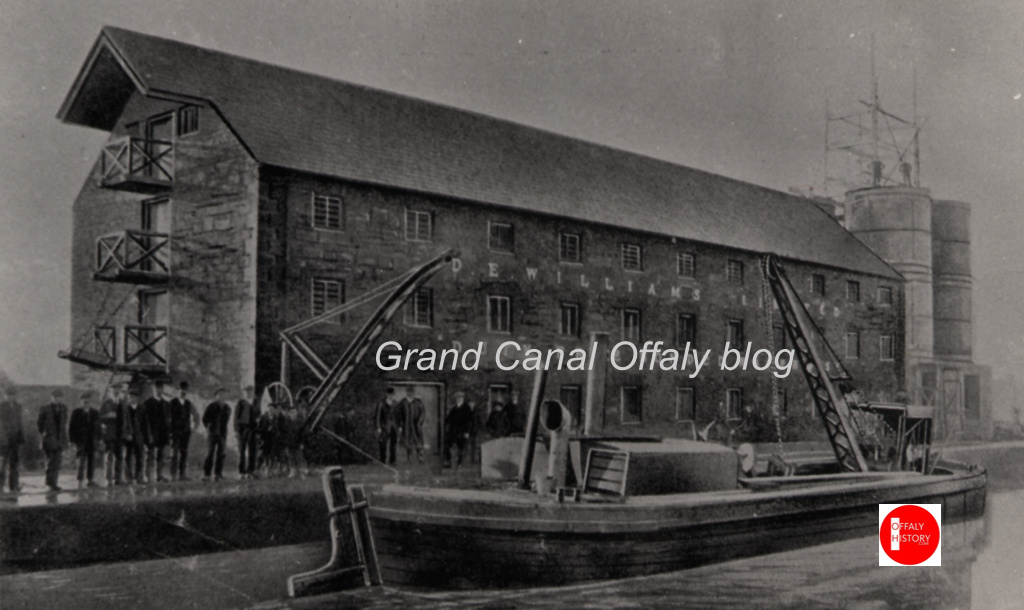
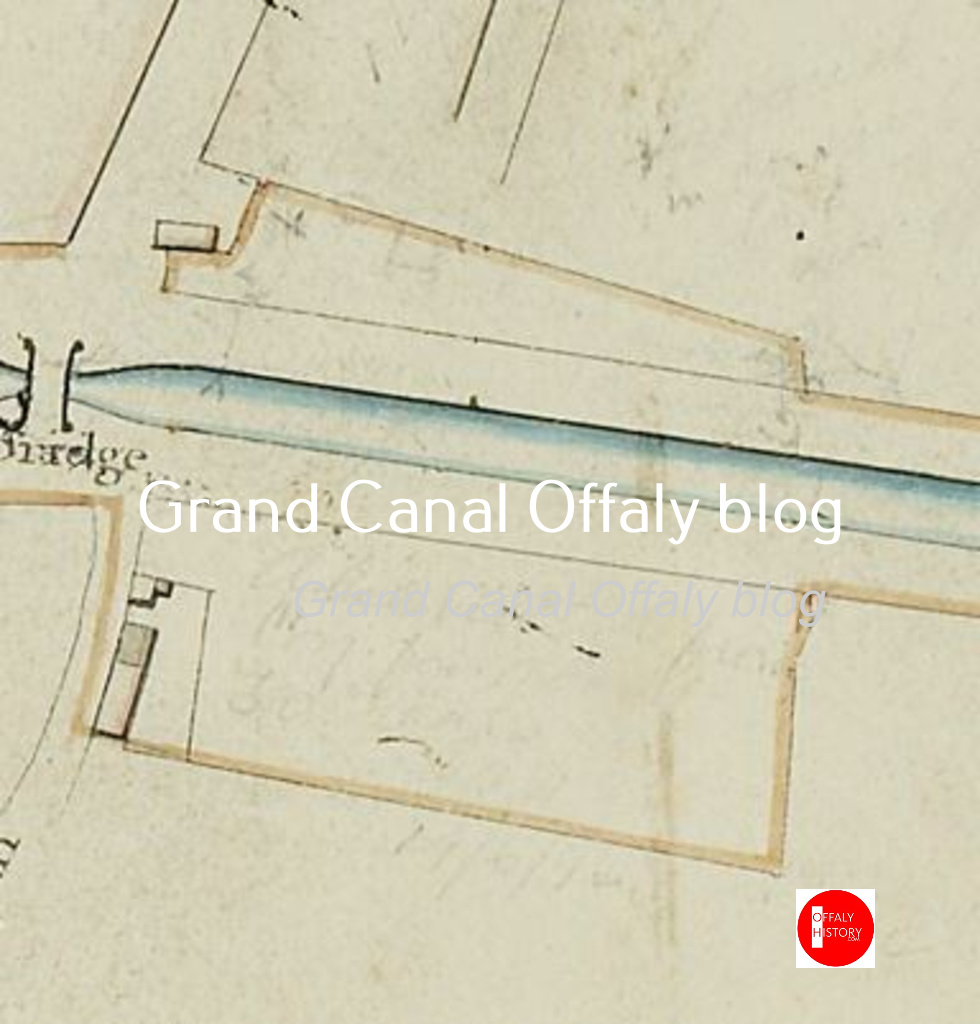
Evidence for the intended use of the first site in Tullamore for a docking station is based on the property maps of the canal company. This land, on both sides of the canal (at what is now the Old Warehouse, Offaly History Centre and Clontarf Road) lay unused for over 100 years until leased by way of a 99-year lease from the Grand Canal Company to Daniel E. Williams in 1898 and 1912. Williams saw the opportunity for a direct link for his whiskey and grain stores to the canal barges at Bury Quay and on to Dublin or Limerick. Williams had acquired the large house and garden at Patrick Street from the Quirke family in 1893. Four years later he built the bonded warehouse facing the canal and to the rear of his new whiskey and mineral works business. The whole was served by a light railway and from 1901 he had his own electrical power – twenty years before Tullamore town was able to avail of same.

The bonded warehouse was used to hold whiskey purchased by publicans and merchants who did not pay the Revenue duty until the whiskey was release from bond. The Tullamore distillery to the south of Patrick Street and Water Lane was in full swing from the 1870s to the early 1920s but closed from the mid-1920s until 1938. The war years of 1939-45 were good for whiskey sales but the market began to decline thereafter and that led on to the development of Irish Mist to facilitate exports of the whiskey-based liqueur and a growing demand in the United States from the 1960s. New production plant and warehousing were needed and hence the new buildings erected in 1970–81 behind the bonded warehouse. These were in use for Irish Mist until the brand was sold in 1985. Ten years later the stores including the oats store were converted into a large retail store by Tom McNamara with the first escalator in the midlands.
The new ‘Texas’ Store in the former grain warehouse was a huge draw for Tullamore and it and the new Bridge Centre (both opened in 1995) put Tullamore at the pinnacle of the midlands retail map where it remained until Golden Island, Athlone was opened followed by Kildare Village and other out-of-town retail hubs in the midlands and east Leinster.

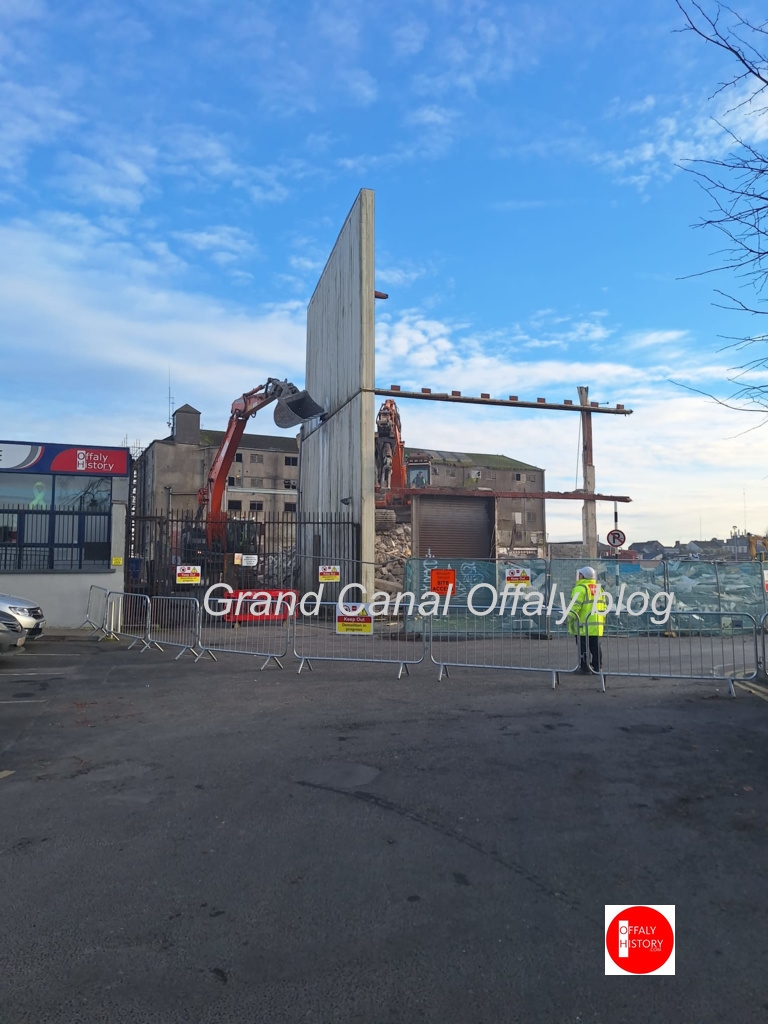
The originator of it all, Daniel E. Williams, transferred part of his asset base to the newly incorporated D.E. Williams Limited in 1903. His three sons were the beneficiaries when he died in 1921. Seven years later the Williams board decided, not without some hesitation, to build an oats store at the rear of the Head Office at a cost of £7,597.[1] The architect retained was T.F. MacNamara (or his eldest son Charles G.). T.F. was well known in Tullamore as he had completed the Catholic church in 1906 and many other jobs over the following twenty years. The builder was Charles Doyle of Mullingar. As John Williams told a valuation appeal hearing in 1931 the new oats store was something of a gamble. The new store cost about £10,000 and was designed to cater for the trade with horse trainers, mainly at the Curragh. The new building was completed in 1929 – in the same year as the Wall Street Crash. In Ireland this was follow in the 1930s by the economic war with England and in 1939-45 the Second World War and all restrictions that came with it. By 1942 there was practically no oats trade, men were made redundant and the business with horse trainers ceased in 1949.[2]

Following on the completion of the new store in 1929–30 the Williams rateable Valuation at Patrick Street jumped from £55 to £220. D.E. Williams had purchased another house in Patrick Street, for a head office, in 1893 from Constantine Quirke. He leased part of the long garden at the rear to Henry Burgess, the Tullamore and Athlone draper, in the same year.[3] This piece of land, now the site of the oats store, reverted to him by 1901. A considerable amount of building took place on the back garden of the head office in the last decade of the nineteenth century as is evidenced by valuation records and newspaper reports.
The changing valuation of the head office property purchased from C. Quirke
_____________________________________________________________________
£ £
1892 18 1930 220
1893 25 10s. 1931 140 (on appeal)
1896 44 1959 300
200 (on appeal)
1898 55 1962 220
_____________________________________________________________________
The increase of 1896 followed on the erection of licensed offices in the previous year.[4] The building of the oats store in 1928–9 caused the dramatic increase of 1930.[5] This valuation did not include the new bonded warehouse and the other buildings near the canal bank built on the canal company 9-year lease.
When the appeal on the high rates was heard in 1931 in the circuit court Tullamore John Williams told the judge that the two original buildings were valued in 1897 at £55. Soon after bottling stores, corn stores, a mineral water factory a garage and hayshed were added, and in 1901 an electical powerhouse was erected and £4, 000 worth of machinery installed. The new oats store of 1928-9 was designed, John Williams declared, to capture for Irish farmers the extensive oats trade ‘hitherto enjoyed by an English firm’– probably Rank who had bought into the Goodbody flour milling business in Clara. The new building added 7,000 sq. ft to a commercial footage of 22,000 on the site, the oats warehouse had cost £10,000 and held 11,000 barrels of oats. The judge agreeably reduced the overall valuation from £220 to £140 comprised of £75 for the new store and £65 for the pre-1929 buildings. John Williams said the new venture was something of a gamble and he seems to have been proved right.
The oats business was gone by the late 1940s and thereafter the building was used to help service the Williams Wine & Spirits business. Probably wines like Hirondelle were bottled on the ground floor in the early 1970s (£2.99 per bottle), with packing and printing on the boxes upstairs.

In September 1995 the Irish Mist buildings including the oats store were converted to shopping use, had magnificent pine floors and an escalator. The entire was sold c. 2007 to a consortium of investors assembled by Davies and planning granted in 2009 for a new shopping centre to face Kilbride Park. and with carparking under the quarry that had been dug out for stone by the canal company 200 years earlier.
By now the recession was taking hold in the aftermath of the banking crisis of 2008-10 and the shopping centre did not proceed. The buildings adjoining the great oats warehouse, including the extensive site assembled by Williams for its new Five Star supermarket (opened by Quinnsworth in 1982) all went to ruin over a period of fifteen years. The bonded warehouse on the canal front found a new use from 2000 as the Tullamore Dew Heritage Centre and from 2012 as a Tullamore DEW visitors’ bar and restaurant for William Grant. It closed in October 2020 and was sold in 2022 to Alan Clancy and Shane Lowry. The adjoining wine & spirits warehouse of the 1950s (facing the canal) is the office and library of Offaly History since 1993.

The proposed arts centre intended for Kilbride Park in 2014, opened in High Street in 2022. In the meantime a new metal bridge was built on this part of the canal in 2013. The bridge may yet come into its own with the new retail store.
In closing we should recall the tragic death of Michael Walsh of Kilbride Street, Tullamore in mid-December 1928 when he fell from scaffolding on the third storey of the oats store and was fatally injured. He had been filling cement moulds at the top of the building when the scaffolding gave way and he fell to the second storey and died soon after. Aged 31, he was the sole support of his wife Annie and their six children. His widow was awarded £600 for herself and her children in 1929.[6] Michael may have been a brother of John Walsh who was also from Kilbride Street and who was executed with ten others by the Germans at Guise, France in 1915.[7]
[1] D.E. Williams Ltd, Minute Book, 11.7.1928. T. F. McNamara, the Architect, Charles Doyle of Mullingar, the Contractor. M.B. Vol. ii (Feb. 1925-June 1928), 22.2.28, Vol. iii (June 1928-Oct. 1931), 23.5.28
[2] Minute Book, 11.8.49 and 28.9.49
[3] Valuation Office: Tullamore town, 1883-1902.
[4] As above
[5] As above, 1916-53.
[6] Offaly Independent, 22 Dec. 1928, 6 July 1929.
[7] See an earlier blog: ‘Remembering John Walsh of Tullamore, executed behind enemy lines at Guise in Northern France on 25 February 1915: a man of Iron.’
 offalyhistoryblog