
The railway line from Portarlington to Tullamore was opened on 2 October 1854. It was a quiet affair, but the commencement of the line was to mean significant growth in the years that followed. This was particularly so from 1857 when the extension to Athlone and Galway was completed.
The act to enable the line to be commenced was passed in 1847, but no action was taken until 1851. The connection to Tullamore was part of the line of the Great Southern and Western Railway (GSWR) while that to the west via Mullingar was backed by the Midland and Great Western Railway (MGWR).
Preliminary planning for the line to Tullamore was completed in April 1853. The acceptance of the tender of William Dargan was agreed on at a price of £29,000. About £8,000 was the estimate for land acquisition and Lord Digby with 30,000 acres in freehold in Geashill received about £2,300 for his transferred lands. Three stations were proposed at Cloneygowan, Ard (Geashill) and Tullamore. Only the latter two were built with that at Geashill particularly fine. The contract for Ard was given to a Cork builder, Richard Evans, to the design of architect Joshua Hargreave junior.
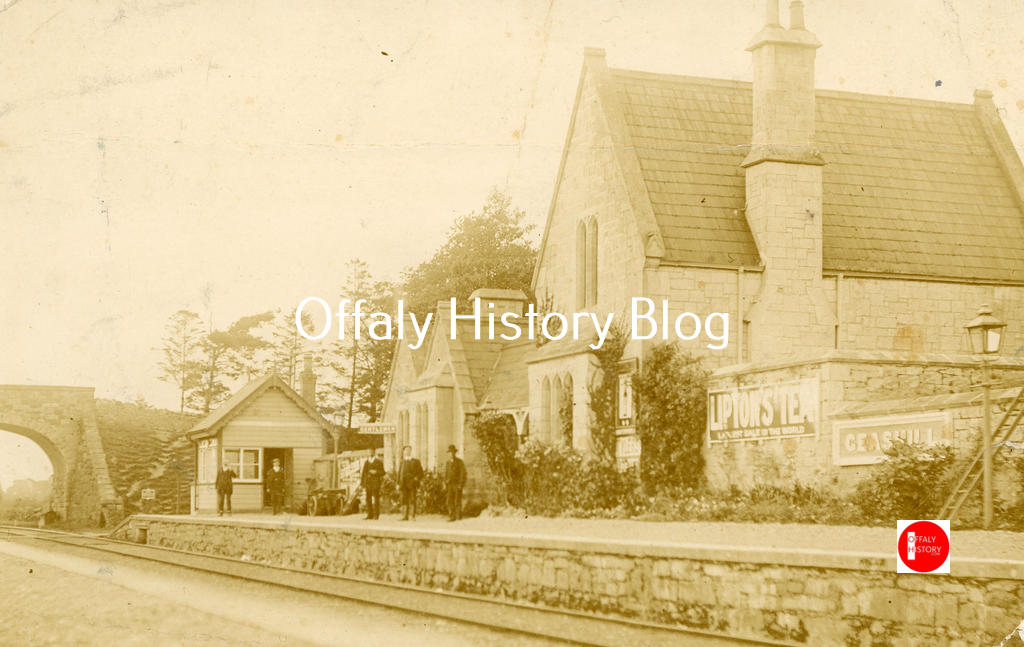
The Tullamore station was more modest at a sum of £1,050 including the platform. The station was that at what is now the bridge at Clonminch. The railway station now in use was not completed until 1865. In June 1854 the railway company accepted the tender of the Magnetic Telegraph Company to run a communications line at three guineas per mile. A problem with the railway bridge at Ard delayed the opening the new line by a week and so the Portarlington to Tullamore line opened on 2 October 1854.
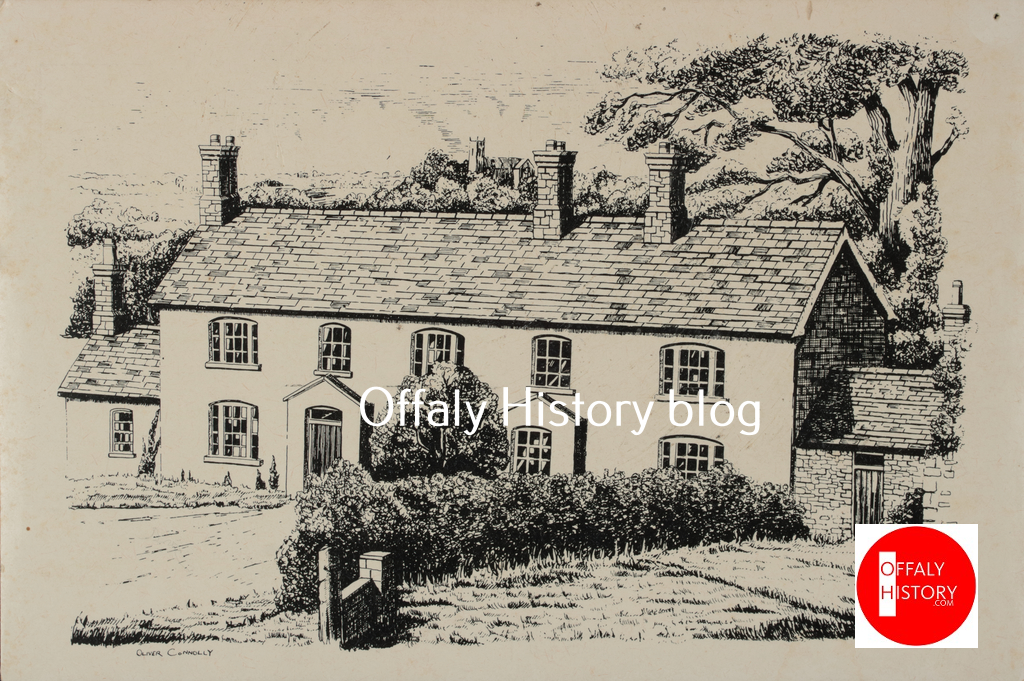
In five years the line was extended to Athlone and six years late and the behest of Alfred Bury, guardian to the children of the third earl of Charleville, the new present-day station was opened.


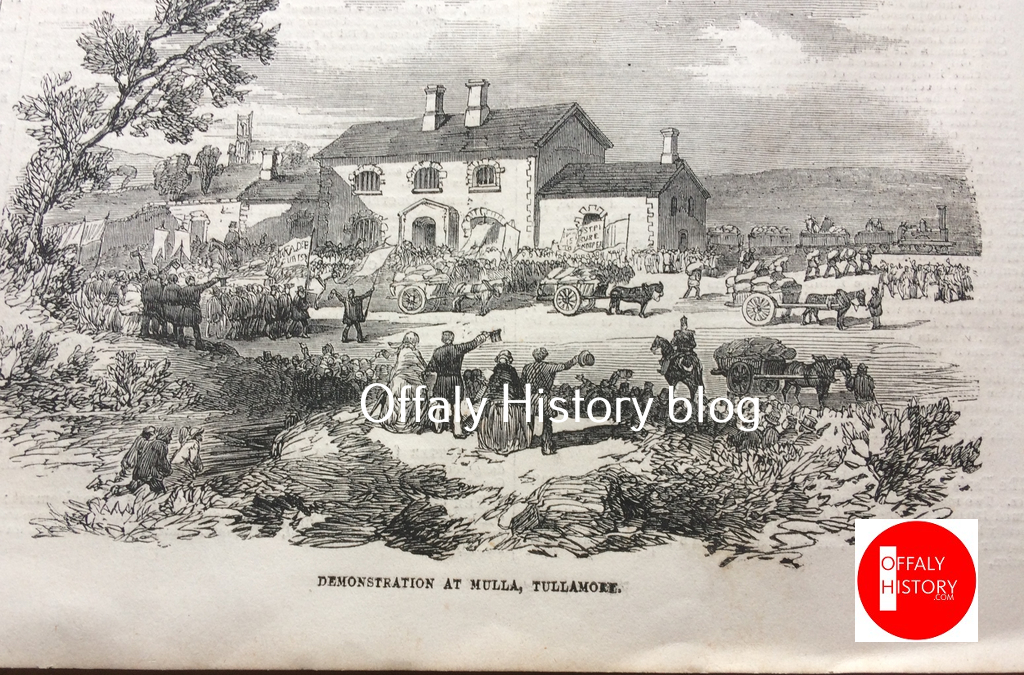
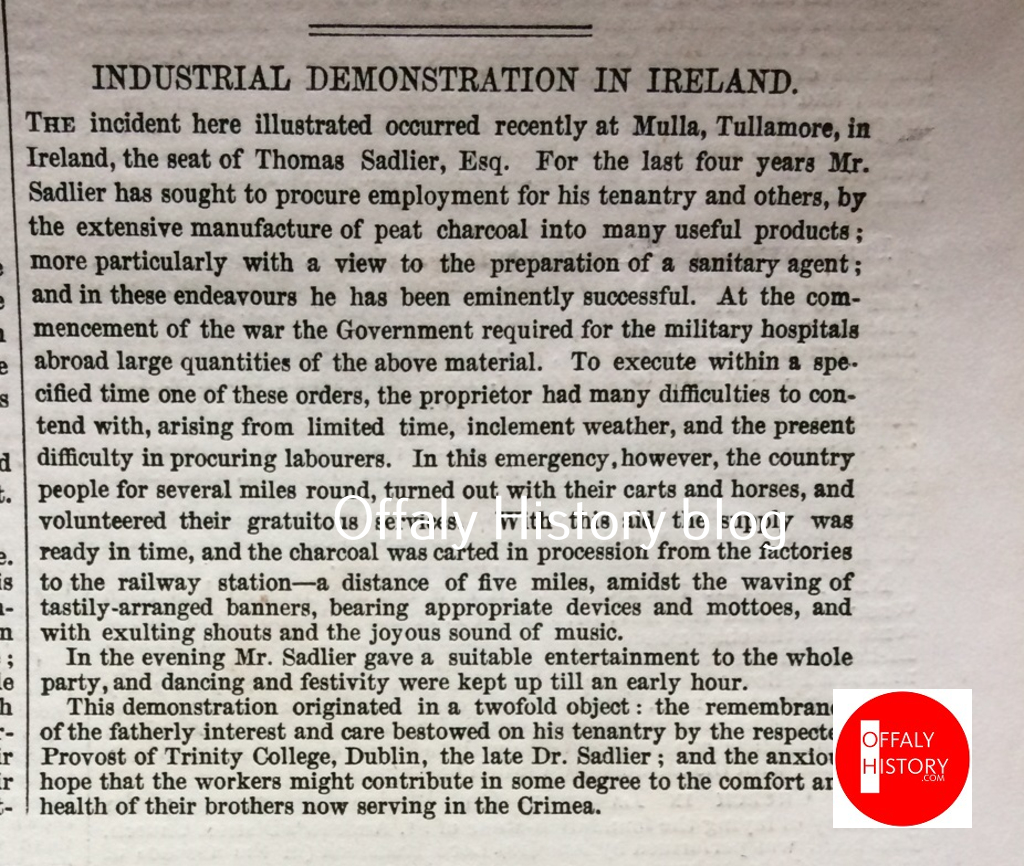
It would soon become a great boon to the Tullamore fairs with livestock transported on the line. A drawing of the first railway station survived because it was published in the Illustrated London News in 1855 in the context of the export of peat charcoal from Killurin, Killeigh for sanitary uses in the course of the Crimean War. It was Thomas Sadlier, a son of the lately deceased provost of Trinity, Franc Sadlier (c. 1774–1851).[1] The Sadliers had an estate in Killurin held from Lord Digby. The Jesuits at Tullabeg, Rahan also used the new line to promote their boarding school.
The railway line was and is of immense importance to Tullamore and indeed to the whole of central Offaly. The benefits for Clara came in 1859 while easier access for Tullamore people came in 1865 when the new station was completed. Sadly, the first station was greatly modernised in the mid-1970s and lost the old world charm it had for 120 years. That at Geashill was closed in the 1960s and there have been calls to have it re-opened.[2]
[1] The son of a barrister, Franc Sadlier graduated in 1795 and was elected to Fellowship in 1805.1 Thereafter his advancement was rapid: he was Bursar for nine years and Librarian for sixteen, and after a brief tenure of the Chair of Hebrew he was Professor of Mathematics for ten years from 1825, and Regius Professor of Greek for five years from 1833. He was a convinced and consistent Whig and sat on two commissions for the Whig Government. In 1837 he reaped his reward and was appointed Provost. For fourteen years he continued, though rather more cautiously, the reforming programme of Provost Lloyd, to whom he had given constant support on the Board. The most significant constitutional change he presided over was the abolition of the celibacy rule for Fellows. From a TCD website.
[2] For more about the Portarlington to Tullamore line see an article by Peter Burke in Offaly Heritage 2 (2004).pp130–6.
 offalyhistoryblog