
Recently, I walked Clara’s Main Street and was again reminded of its relative short length and the relatively small size of its adjoining, almost hidden, Market Square. A square and street where much trade, barter and banter, laughter, disagreements, or agreements on family member marriages, and heated discussions on political reform, occurred on a regular basis for hundreds of years.
Many local hostelries were frequented, where typically a farmer and his wife and family would come to settle bills, visit the local medic for advice, or attend religious services. Today the square is modernly paved, almost hidden and its well-maintained former Market House now tucked away from the passing motorised traffic. Sadly, as in the case of many Irish provincial towns several old buildings have fallen into a state of disrepair and exude an aura of reduced circumstances.
Back in 1826, Clara’s Main Street and Market Square was a hive of activity and was where many notable families conducted their commercial business and resided upstairs. As I strolled the street and looked above the ground floor level of today’s shop fronts, I wondered who were these former resident families and what ever became of some of them?
Clearly, this is just a chosen snapshot of some Clara families, and I would be keenly interested to hear from family members of their stories from those days’ past.
Clara 1831
As mentioned the Market Square was where much happened in provincial Ireland. In County Westmeath, the tragic Castlepollard massacre had recently occurred at its market square on 23 May of that year. It was the time of the tithe wars where agitation against the imposition and payment of tithes to the then state established Church of Ireland was to the fore, and a riot broke out in the towns square. The Royal Irish Constabulary stationed in the town opened fire on the crowd killing 13 people. Nineteen police officers were sent to Mullingar jail and were later released without conviction in July 1831.1
Much political discussion centred around the passing of the Catholic Emancipation Act of 1829 as well as the desired and demanded parliamentary reform. In Ireland, the protestant ascendancy had the assurance of the simultaneous passage of the Parliamentary Elections (Ireland) Act 1829. Its substitution of the Irish forty shilling with the British 10-pound freehold qualification disenfranchised over eighty percent of Ireland’s electorate. This included a majority of the tenant farmers who had helped force the issue of emancipation in 1828 by electing to parliament the leader of the Catholic Association, and founder of the National Bank of Ireland (1835) Daniel O’Connell.2
Many Clara notables paid a significant contribution for the twenty-five-shilling tickets to attend The Great Reform Dinner, at Morrisons Hotel on Dublin’s Dawson Steet on 31 May 1831. They were there to support their reform member of parliament, the honourable John Lawless M.P.

Fig 1. Patrick J White (1855- 1902). First Chairman and founder member of Clara GAA Club. Courtesy OHAS.
What makes for interesting reading in the Freemans Journal newspaper of 31 May 1831, is the recorded list of people from Clara and its vicinity who went to much trouble and expense to support and attend that evening’s function.
Footnote: For the purposes of this essay, I have defined Main Street as it is called today. In 1826 it extended all the way along what is called Church Street. Once St Bridgit’s Catholic Church was completed in 1881, Main Street was truncated as we know it today.
Those who attended were:
Edward Cox J.P. Patrick Tyrell
Michael Coughlan James McGlynn
Garrett Robbins Patrick Mooney
Arthur Molloy John Lalley
William Horan Richard J Walsh, surgeon
Luke Barton Samuel Robinson
Patrick Egan Michael Craven
James O’Hara Lawrence Oates
Patrick Casey Patrick Dowling
Patrick White Hugh Woods
Matthew Casey Richard Woods
Bernard Spollen Matthew Farrell snr
John Kennedy Matthew P Farrell
James Somers George Fuller
Hugh Somers Thomas Fuller
Bernard Woods John Lowry
Thomas Rigney Patrick Egan jnr
Timothy Rigney Thomas Grogan
William Rigney Denis Daly
Luke Dempsey Daniel White
William Egan Daniel Fox
James Barton Luke Rigney
James Molloy Adam Walsh
Rev Patrick Barry P.P. Thomas Brady
Bernard Kilmurray John Carroll
Thomas Daly Michael Rudkin
James Barber Francis Bradley
George Barber James Dolan
Other attendees were returning representatives of the city of Dublin, including Daniel O’Connell M.P. of Merrion Square and Arthur Guinness of St James Gate.3
Families
Researching the tithe applotments registers of 1826 and 1827 one can map some of the above family surnames to Main Street and the Market Square and beyond.
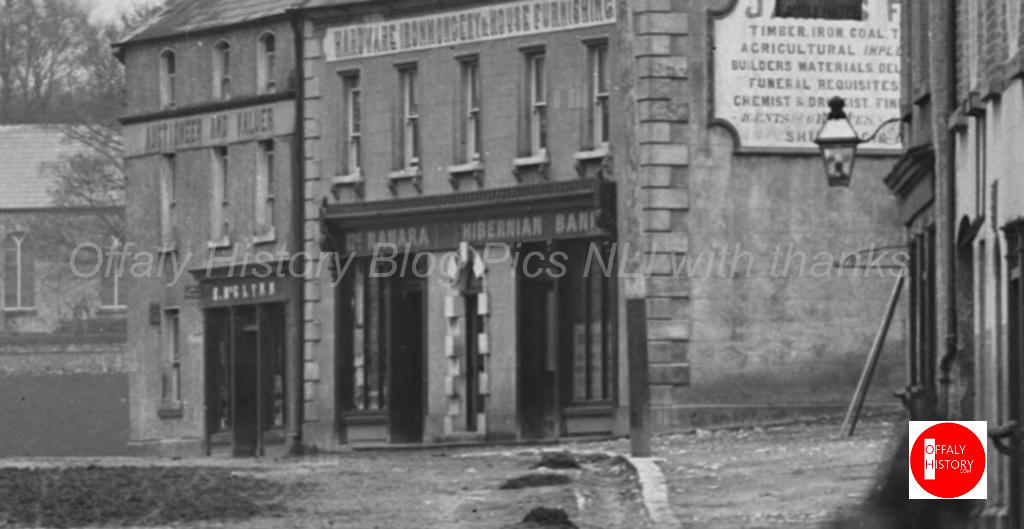
Fig 2. View of Clara’s Market Square from around 1905, with Edward McGlynn (b 1857 d 15 May 1940) and his wife Frances (née Handy d 5 Nov 1931) publican, grocer, auctioneer and valuer, McNamara’s hardware, the Hibernian Bank (today’s Petits Pharmacy) and a gable end advertising board for James Flynn, builders’ merchant, chemist and druggist. Photo courtesy the NLI.
Many of these Clara families were well known to one another, were neighbours and often intermarried.
In 1826, living in the parish of Kilbride, at Dyer’s Plot were:
Starting at the southeastern corner was the boarding house of widow Donnelly, by 1911 her relative from County Roscommon, hotel manager T V Donnelly operated the D E Williams branch house and hotel from there. Moving up the street were members of the Barton family, then before today’s existing houses there was a dwelling house occupied by Patrick Caffrey and sub-let to widow Cormick, then Thomas Woods, James Robbins (d June 1837) and later occupied by Partrick Robbins in 1843. Robbins premises was let to him by Margaret Farrell, whose father Matthew Farrell was at The Reform Dinner. By 1901 Michael and his wife Anne Farrell (d 1904) and thereafter their eldest daughter Norah Farrell were running the shop, and the Farrell name is above the door to this day. William Rigney was next door, and later in 1911 was held by P J Newburn and his wife Jane, postmistress.
Footnote: Dyers Plot, was I believe, made up of a row of first-class houses matching the houses of the western side and made up the eastern side of Main Street.
Today’s Boyles Sports was held by William Egan (b 1773 d 1834) and later by Patrick Egan and his sister and widow Margaret (née Egan) McGlynn. William Egan, Patrick Egan, and William Rigney also attended The Great Reform Dinner.
Who was living on Main Street West?
Starting on the southwestern end of Main Street was grocer William Shiel, later occupied by James O’Hara (who married Mary White 23 Oct 1828, witnessed by Willem Farrell and Daniel White) up to 1847, todays Macari’s. These premises were later occupied by grocer Margaret Digan. Next was the fine building housing merchant and long-term residents into the future, Patrick White’s family (father of Patrick J White, founding member of Clara GAA). Then a second-class residence occupied by Molloy and Kelly. In 1847 this single-story premises housed the post mistress Jane Dillon and her husband James. In 1901 it housed the family of Samuel Clyne a butcher, and his wife Margaret, followed next door by another long-standing Clara family, that of Luke Barton and his descendants. His daughter Sarah Barton ran a shop and bakery there in 1847, she later married John Potter on 4 January 1855. Finally, one Abraham English at the top of Main Street, later the premises of Bernard Spollen in 1847 and in 1901 merchant Joseph Byrne was the occupant, see Fig 3.

Fig 3. Looking south down Clara’s Main Street around 1905, one can see the Clara Mill and the Royal Irish Constabulary (R.I.C.) barracks in the background. In the corner to the left foreground was the house of R.I.C. constable from Queens county, John Phelan. The large gable end house to the left, is the former William Egan and latterly his son Patrick Egan and sister and widow Margaret (née Egan) McGlynn, later became the premises of Michael White who was a superintendent of The Singer Sewing Machine Co Ltd. And also ran a Family Hotel, seen above. The row of houses continued down the left to the public house of James Flynn J. P., and latterly a D E Williams branch house and hotel. To the right general grocer Joseph Byrne, then next was the grocer and baker premises of the Bartons (recently Carey’s public bar) and thereafter for many years, merchant P J White and his son Michael Henry White seen above. Photo courtesy of the NLI.
Who was living on Market Square?
The McGlynns were living on the old Main Street as recorded in the tithe applotments of 1826. Later in 1901 and 1911 some of their descendants were living in the fine two- and three-story houses on the northern side of Market Square.
Farrier William Weir, his wife Margaret and his brother Michael were close to their customers living on the square in 1901. James Irwin from County Cavan of the RIC preceded his fellow RIC member John Phelan in house number one in the corner of the square. In residence in 1901 was farmer John Kelly who inherited his house from his relation Rev Kelly of Dublin who had held the house in 1844. Thomas Flynn, shopkeeper was in, and/or next to the old Market House in 1901. John Kelly’s son Frank was employed as a beamer at the jute factory in Clashawaun and by 1911 was in residence and had taken permanent residence of the house and farm from his father.
Across the road was widow Rose Scanlon, whose daughter and nephew Patrick Mannion ran a butcher’s shop. Next to them was Michael and Ellen Larrisey recently arrived back from America and ran a general merchant store. Back in 1844, Patrick Carey publican and grocer as well as Patrick Kennedy general dealer also resided on the Market Square.
Who of The Reform Dinner attendees lived on Main Street?
What has been found is that several neighbours attended and included: James O’Hara, Patrick White, Luke Barton, Bernard Spollen, William and Patrick Egan, William Rigney and one of the Woods.’ Attendees Daniel White, Bernard Kilmurray and John Wier were all living on River Street in 1826. Edward Cox Esq. attended as well and was a main landlord, who resided at nearby Clara House, later a Goodbody family home. George and Thomas Fuller, whose family built St Bridgit’s Church of Ireland (1770) on Fair Green, were also in attendance.
Occurrences:
Many of the residents on Main Street went on to make a name for themselves and the achievements of some of them make for interesting reading.
Barton
The family of Luke Barton had two Clara born sons who became priests. The Rev Luke Barton jnr (1826-1907) became parish priest at Castletown Geoghegan and built their magnificent St Michaels Church (1885). He is buried in front of the church. His brother the Rev Henry Barton (1822-1887) was parish priest of Oriston and Kilberry, Kells in County Meath.
Later residing at Bank House Moate, their sister Eliza Barton (1822-1887), married Clara man Patrick Egan (1805-1880) both buried at Clara monastery cemetery. Patrick Egan was crown solicitor for County Westmeath for close on 40 years, a fellow alumnus of The Kings Inn and good friend of ‘The Liberator’ Daniel O’Connell. Patrick, his wife, and son Luke Egan ran their well-known general merchant, whiskey bonders and bakery enterprise, trading as P Egan and Sons for close on one hundred years on Main Street, Moate, see Fig 6. Today it is Eamon Coughlan’s public bar and lounge, owned by businessman Terry Coughlan. Their sons Patrick and Henry Egan started one of the largest family owned mercantile businesses the Midlands of Ireland has ever seen and traded for over 116 years under the name P & H Egan Limited, headquartered in Tullamore (1852-1968).
White
Patrick White was a merchant on Main Street and his son Patrick J White (1855-22 Feb 1902) along with fellow Clara man and Land Leaguer Henry Egan (of P & H Egan Limited, Tullamore), James Lynam of Rahan and James Conway of Birr (formed Egan Conway Solicitors, later todays Conway and Kearney Solicitors, Tullamore), were imprisoned at Naas Gaol on 18 October 1881 for organising a monster meeting in Clara in support of the president of the Land League, Charles Stuart Parnell.
They were imprisoned by Chief Secretary of Ireland William ‘Buckshot’ Forster under the Coercion Act and released after five weeks. For several years, P J White was a member of the Board of Guardians for Tullamore and Rural District Council. He married Delia Agnes Ryan of Athenry on 17 January 1878. In 1902, their son Michael Henry White (b 15 July 1880) took over the business.
Egan
William Egan (b +-1730, married Ellen Robbins) was a notable Clara landholder and in 1826 held lands opposite Clara’s St Bridgit’s Church of Ireland, on its western side bordered by Chapel Lane and Church Road. Equally Egan held lands along what became known as Egan’s Lane. His daughter Margaret (1766-1862) married James McGlynn. Margarets sister-in-law Judith Egan (nee Malady from Moate) lived on the old Main street, died 16 November 1848. Judith and her husband William Egan jnr had three sons and a daughter that we know of. Their son Patrick Egan based in Moate, became crown solicitor for County Westmeath and their grandsons Patrick and Henry were proprietors of the famed midlands business trading as P & H Egan Limited and held 28 branch houses and three hotels (Hayes Hotel and Colton’s Hotel in Tullamore and since 1902 Dooly’s Hotel in Birr) across the midlands of Ireland.
McGlynn
Occupying both houses that have todays Centra supermarket and Petits Pharmacy were the McGlynn family. James McGlynn married Margaret Egan, and their son William married Ellen White. William and Ellen McGlynn had sons Patrick J (b 1865) a draper who lived and had his shop on Bridge Street. In July 1906 Patrick married his drapers shop assistant, county Meath woman Mary Greville. His brother Michael, a farmer lived with them on Bridge Street with their sisters Mary Kelly and Bridgit McGlynn. Their brother Edward a publican, auctioneer and valuer lived on the square, see Fig 2.
James and Margaret McGlynn had six daughters who married local men named Kelly, Mulready, Buckley, Hugh Woods, Fox, and Horan. Hugh who married fourth daughter Margaret (née McGlynn), their sons Hugh and Michael Woods born in Clara, became famed paper and stationery manufacturers on Dublin’s High Street in the late 1800’s.
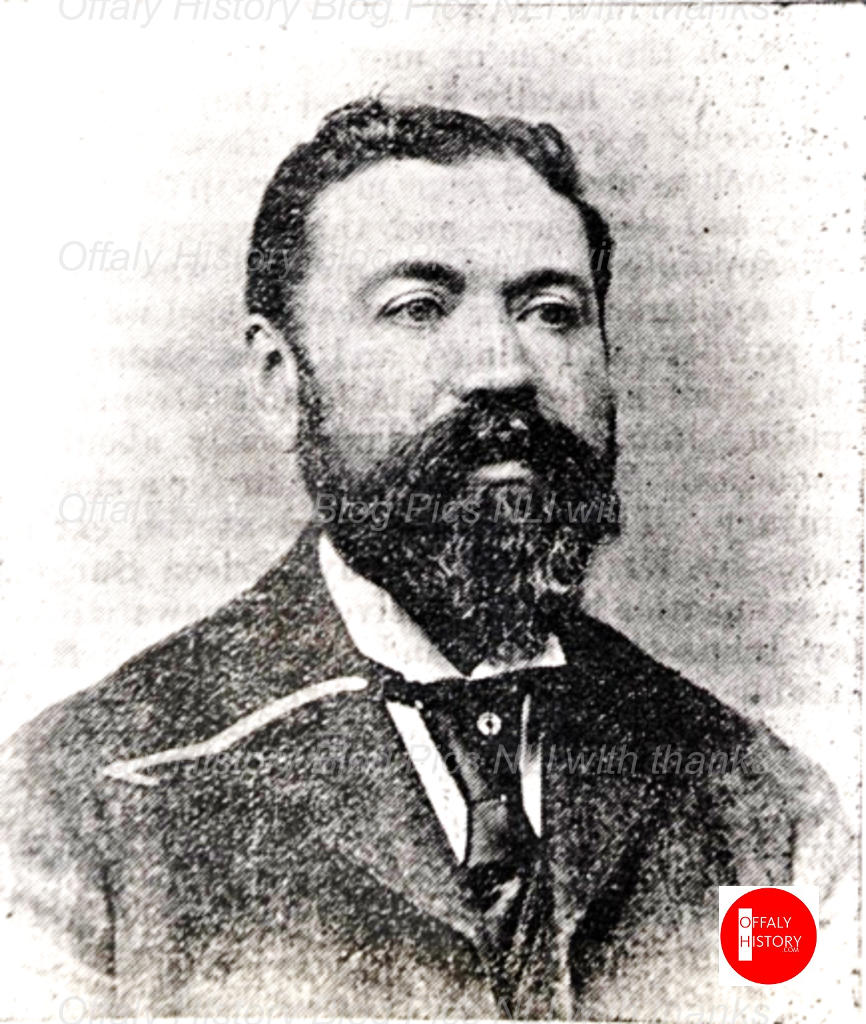
Fig 4. Patrick Egan (1841-1897)
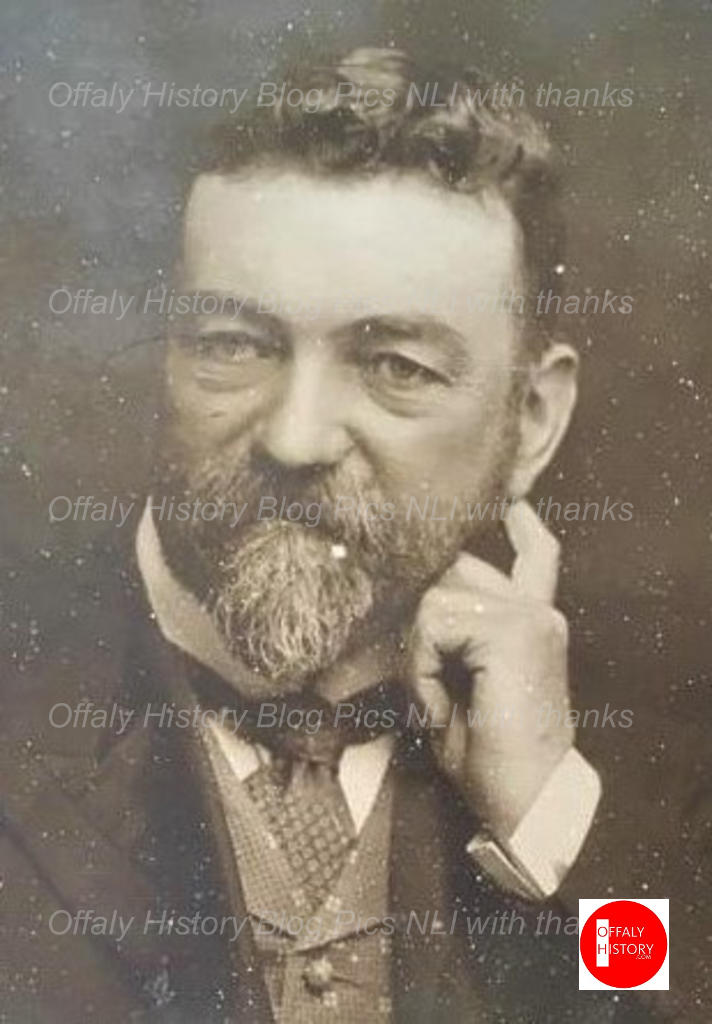
Fig 5. Henry Egan (1847-1919)
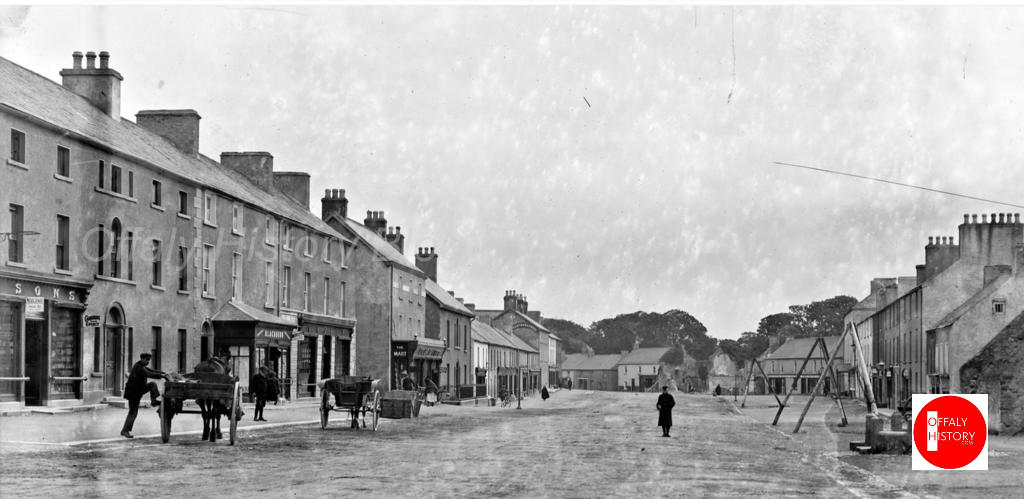
Fig 6. Seen here on the left and opposite todays Moate Library and former Court House, P Egan and Sons (c 1834-1929), General dealers, Bacon curers, Whiskey and Spirits bonders, Bakers and Provision merchants, operated for close on one hundred years on Main Street, Moate (todays Eamon Coughlan’s premises, owned by businessman Terry Coughlan). Photo courtesy the NLI.
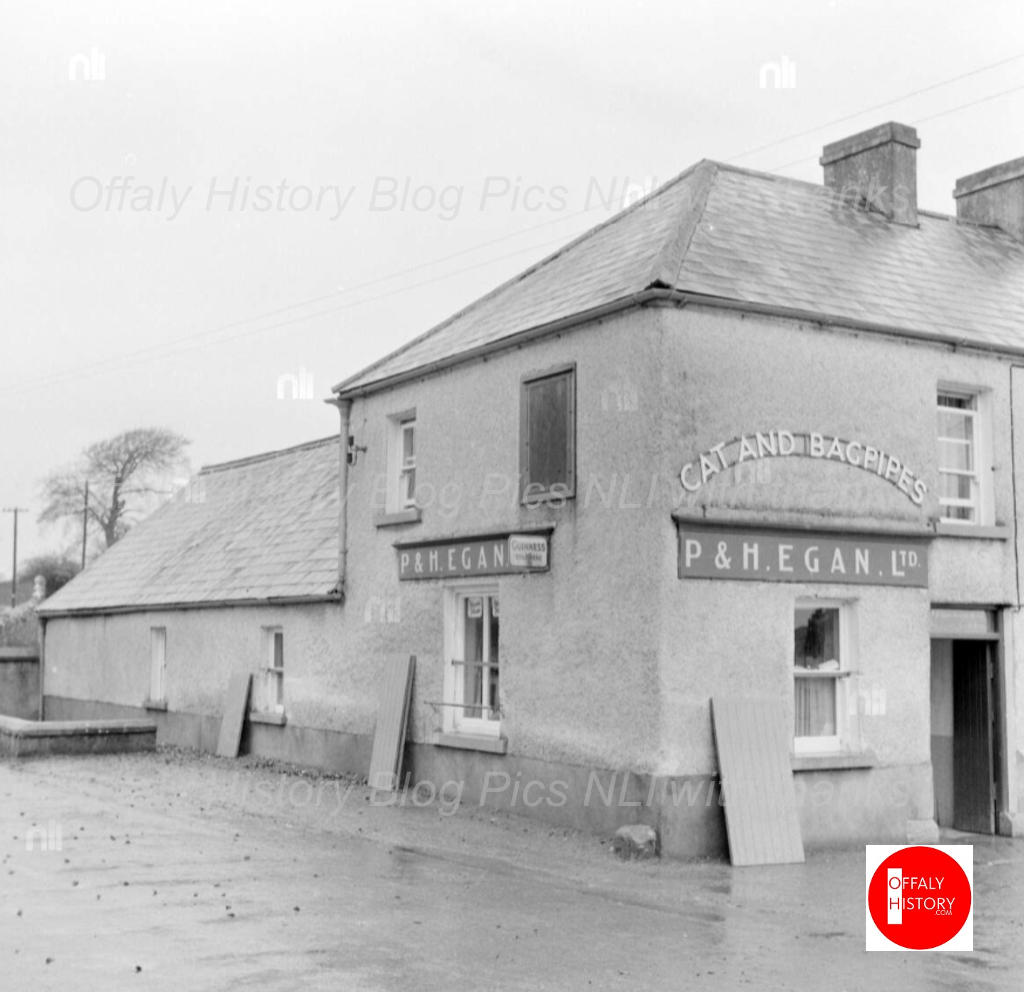
Fig 7. Clara men Patrick and Henry Egan trading as P & H Egan Limited of Tullamore, owned the Cat and Bagpipes public house and branch house in Tubber. Photo courtesy the NLI.
Notes:
1 Available at: https://en.wikipedia.org/wiki/Castlepollard (Accessed 2 Oct 2024)
2 Available at: https://en.wikipedia.org/wiki/Roman_Catholic_Relief_Act_1829. (Accessed 2 October 2024)
3 ‘The Freemans Journal’. (1831), 31 May. (Accessed 3 October 2024)
Our thanks to Maurice Egan for this fine piece on Clara’s history and families Ed. If you would like to contribute an article on Offaly History contact us info@offalyhistory.
 offalyhistoryblog