
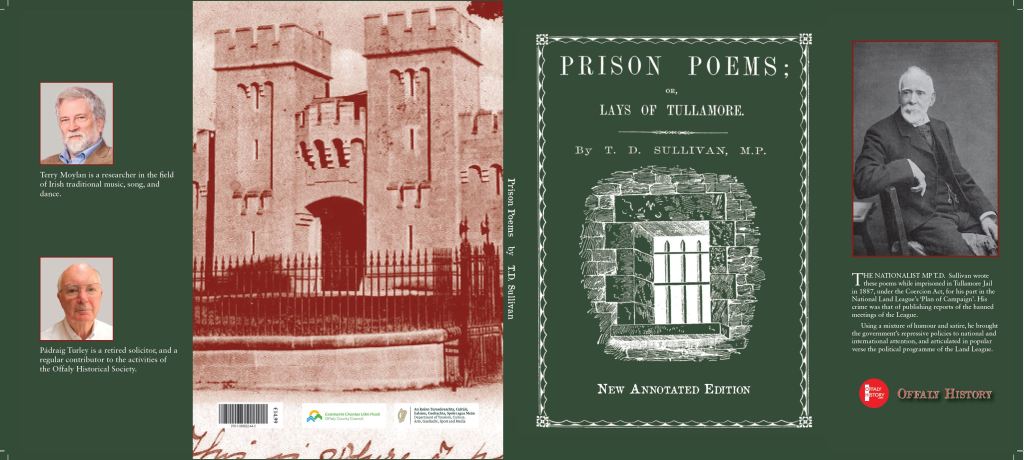
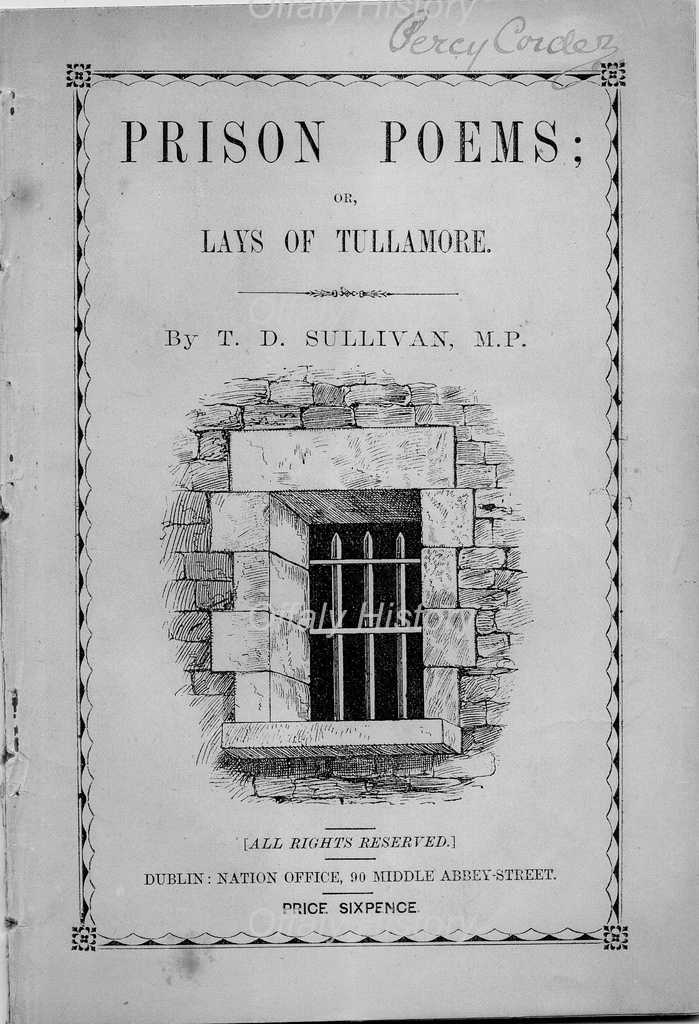
28 March Saturday at 11.00 a.m. at the former Tullamore Prison/Kilcruttin Business Park, Cormac Street, Tullamore, for the Launch of a new edition of Prison Poems or Lays of Tullamore by T.D. Sullivan, edited by Terry Moylan and Padráig Turley. Sullivan like William O’Brien and John Mandeville were political prisoners who refused to wear the prison clothes.
See Cormac Street from a new perspective
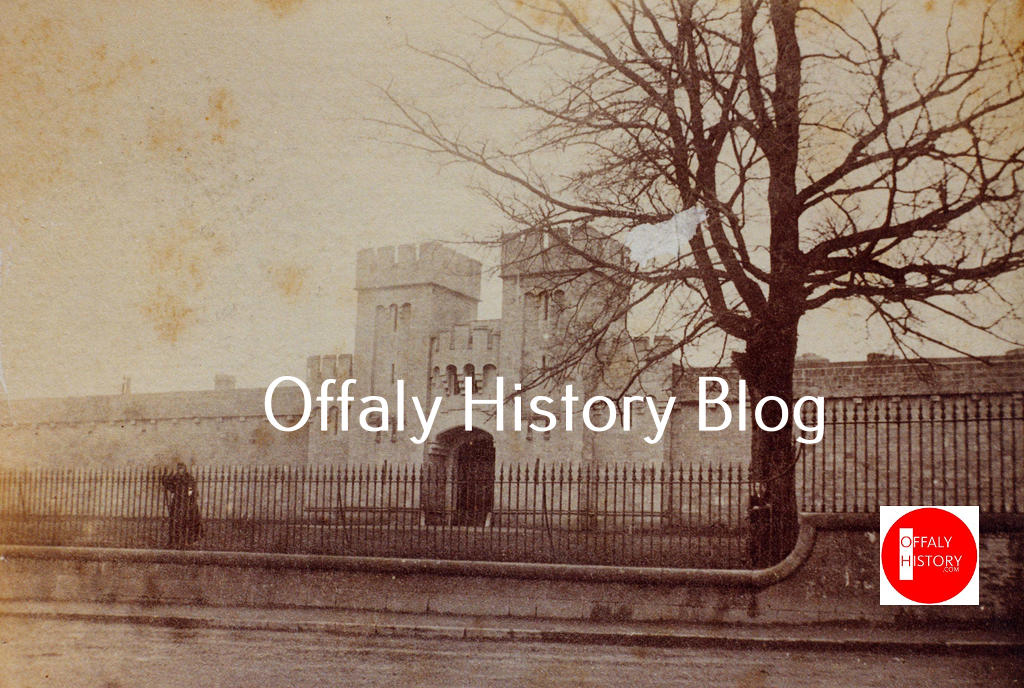
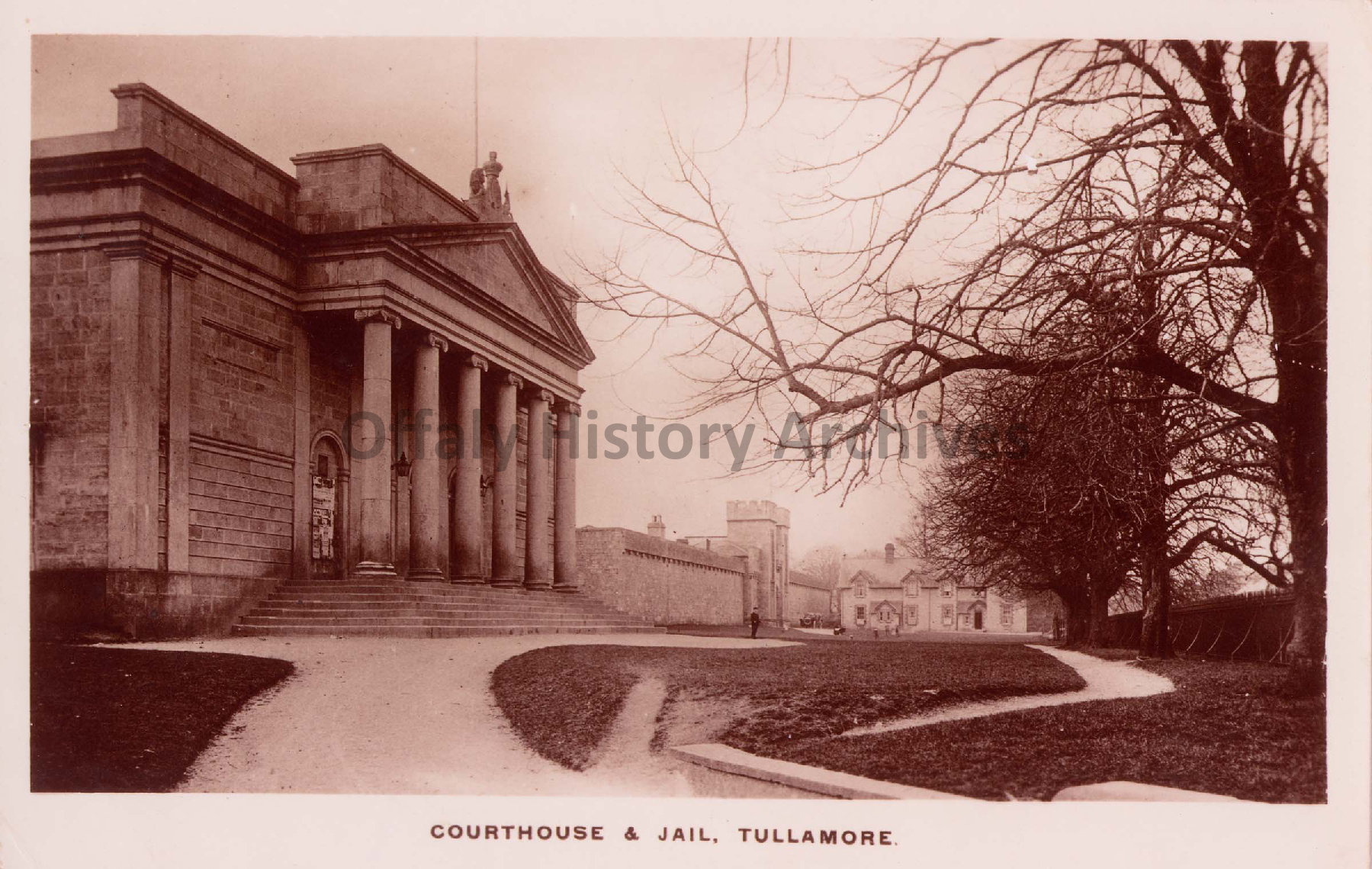
Today we are reminded of the jail every time we stop at the lights at the junction with Cormac Street, Kilcruttin and Charleville Road and look to the magnificent limestone façade, memorial tablet, jail warders’ cottages and the very fine gates with their Roman fasces to remind us of the symbols of authority back to early times. Then who has not heard of the underground passage (now mostly closed off) that allowed the prisoners to be brought into one of the two semi-circular courts in the old pre-1922 courthouse.
None of this happened accidently and the building of the jail from 1826 and the courthouse in 1833-5 were part of the elaborate strategy of Lord Tullamoore to ensure that Tullamore got its county town status long sought and deferred for fifty years. The houses on all sides of the jail and those on the approach near the courthouse were all part of a plan to ensure that these new public buildings were located in an attractive planned setting. In the early 1840s Lord Tullamoore’s daughter even got up a drawing of a crescent of houses in what is now the town park, but somebody realised that nobody wanted to build on soft ground and near a cemetery. Besides, demand for such houses had wilted with the declining economy of the Famine years.
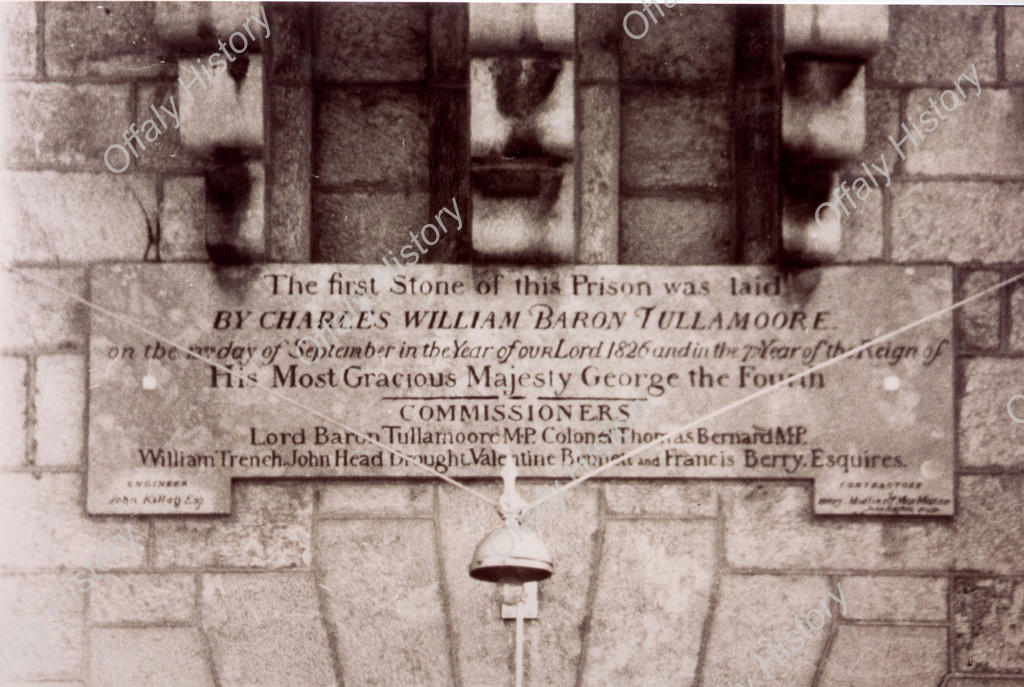
Although only the façade of the jail now survives it is one of the most impressive architectural features in Tullamore and makes for a striking and impressive structure as one takes a first view of it coming from the railway station. The building of the jail is recorded on a memorial tablet over the entrance and notes the role of the famous canal engineer and Tullamore-connected John Killaly.
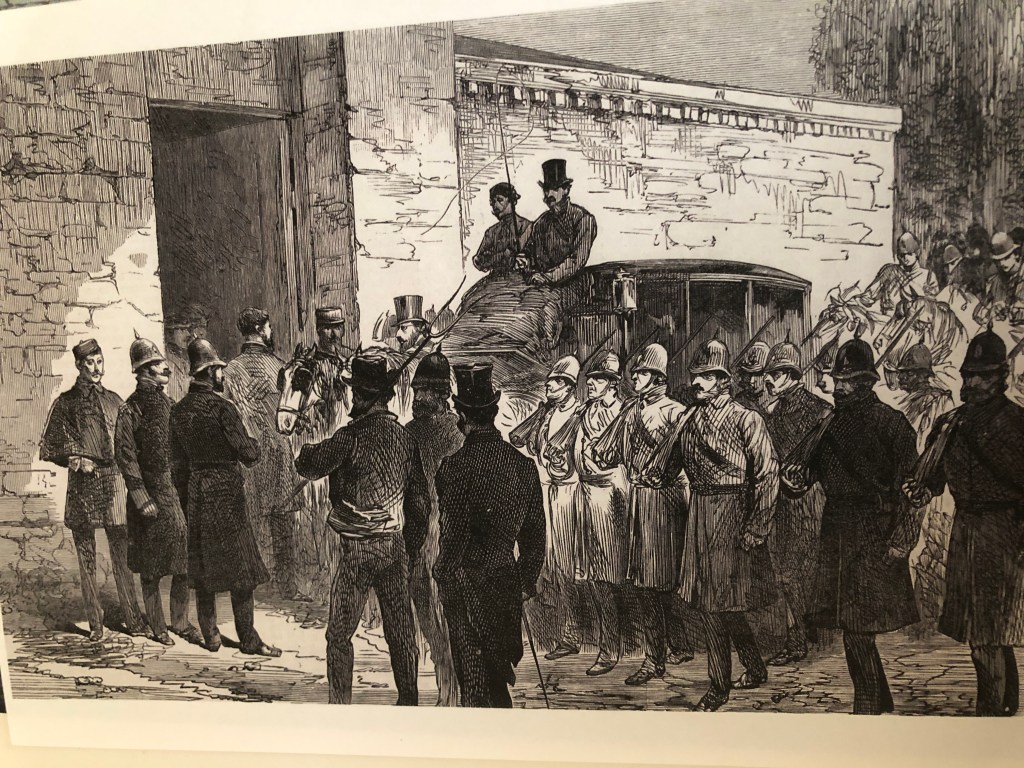
Undoubtedly, the history of Tullamore jail would make a study in itself for besides the mundane occurrences which are themselves worthy of historical analysis there were a few extraordinary events such as the imprisonment of some of those involved in the Plan of Campaign, a second run of the Land War of the early 1880s, including William O’Brien and John Mandeville in 1887-88, the women’s suffrage prisoners in 1913, the Tullamore Incident prisoners of 1916 and, of course, the executions, the last being in 1903 and of a woman, Mary Daly.
A study of the jail might also involve a study of the pattern and frequency of crime in the nineteenth century and how the law was administered. These questions were raised from time to time as with the death of the Alice Dillon of Geashill, aged 79, imprisoned in Christmas Week 1861 for allegedly begging for alms; again with the botched executions of a brother and sister in 1870; and the treatment of the Plan of Campaign prisoners in 1887-8 put Tullamore in the national press for several years in the 1880s.
The foundation stone of the jail laid 200 years ago in September 1826
The laying of the foundation stone for the jail in September 1826 saw the biggest ever public spectacle in Tullamore up to that time with about 30,000 people gathering for a procession and fireworks to celebrate the occasion.
Lord Tullamore played a major part in having the jail and courthouse built in Tullamore. In regard to the number attending the ceremony it should be remembered that prior to the Famine the population of the county of Offaly was about 150,000 or almost twice the present figure. The next biggest spectacle in the town was the Daniel O’Connell ‘Monster Meeting’ of 1843. After that the All-Ireland wins from 1971.
Breaking stones was part of the punishment for prisoners
Tullamore jail was opened in April 1830, the prisoners having been conveyed by canal barge from Philipstown. The male prisoners were to be employed in breaking stones and at the tread mill, the board being of the opinion that ‘without full and constant employment for every prisoner, no essential good can result in jail discipline as to its two great objects, viz. punishment and reformation’. Rudimentary education was also to be provided with a schoolmaster and the turnkeys (warders) acting as instructors. A potato diet for the prisoners was recommended on the grounds of economy.
The female prisoners were employed in spinning, knitting, making skirts, repairing clots and washing for the entire jail, ‘two hours each day are the time appropriated for school, so that no time is allowed for idleness, that constant source of vice’.[1] The average numbers of prisoners was 60 in 1831, 75 in 1832 and almost 200 in 1834. This seems to have been unusually high because the figure was down to 122 in 1839. The jail with its 112 cells could accommodate the latter number fairly comfortably. During the famine years the number of prisoners rose dramatically. In 1849 Tullamore jail had 321 inmates, many of whom had committed petty offences in order to get into jail to be fed.[2]
The agenda for the launch of Prison Poems – 28 March
The new edition of Prison Poems or Lays of Tullamore by T.D. Sullivan, edited by Terry Moylan and Padráig Turley, will be launched on Saturday 28 March at 11 a.m. at Cormac Street entrance to the old prison.
Coffee will be available from 10 a.m. at Tullamore market Spollanstown to the rear of the old prison, now Kilcruttin Centre.
The plan is to meet in the farmers’ market, Spollanstown for coffee from 10 a.m. and process at 10 45 to the front hall of the jail for the launch. Tony Flanagan has kindly sponsored the coffee in the market and OH will distribute a voucher ticket to those attending the book launch.

Parking is available at the farmers’ market, Spollanstown and at the Cormac Street frontage to the old jail (best approached from Cormac St to take a left turn into the jail/Kilcruttin Centre). Pedestrian access only will be available from the market to the front of the jail from 10 to 12 noon
The book can be ordered online from Offaly History or purchased on the day or later at Offaly History Centre and Midland Books.
The book will be launched by Michael Hanna who gave the lecture in December 2025.
The launch should take about thirty minutes.
The speakers are:
Chair of Offaly History Shaun Wrafter welcomes the speakers
Delcan Harvey, Cathaoirleach of Tullamore Municipal, welcomes the publication of the part of Tullamore Municipal Council.
Padraig Turley, a co-editor, on the author T.D. Sullivan
Terry Moylan, co-editor, on the Poems
Michael Hanna to launch – on the jail, medical men and the new book. Michael Hanna is the author of Irish General Practice: the long story. He spoke on medical doctors at Tullamore prison in the 1880s in the course of his lecture to Offaly History in December 2025.
Michael Byrne, General Secretary Offaly History, to close and thanks to all.
Timothy Daniel Sullivan MP and Lord Mayor of Dublin published Prison Poems; or Lays of Tullamore in 1888, printed by The Nation at 90 Middle Abbey Street, Dublin. What are these about? What made Sullivan write them?
Tullamore Prison would turn out to be the fulcrum in the enforcement of Balfour’s Coercion legislation. The Prison Poems were written during a most tempestuous, unsettled, tumultuous decade in Irish history, the 1880s. The Land War was at its height under the leadership of Charles S. Parnell. The campaign for Home Rule had turned to dust. William Ewart Gladstone the British Prime Minister had brought forward a Home Rule Bill in 1886, which by today`s criteria might appear modest, but for its time was seen as revolutionary. This set off alarm bells which would do irreparable damage to the ruling Liberal Party.
[1] See jail report in King’s County: a schedule of presentments, special sessions previous to summer assizes 1830 (Birr, 1830), p. 45-53.
[2] See the jail report presented at the assizes each year in the presentments for summer 1834, p. 47; Lent 1839, p. 8; Lent 1849, pp 10-11, 56.

 offalyhistoryblog