
The foundation stone for the Tullamore jail was laid on 13 September 1826 just 200 years ago. Two hundred years of history as we pass those gates of what is now Kilcruttin Business Park. We may wonder at what went on there over 200 years. In many ways the former jail encapsulates the history of Tullamore since the 1820s. When the jail was built Tullamore was not yet the county town. There was no railway until 1859 at this location. No road up from Kilcruttin until 1938, Lloyd Town Park was agricultural land with an old out-of-town cemetery nearby. Only the ‘Charleville Parade’ houses north of the courthouse were built. The courthouse was not completed until 1835. The jail was designed to accommodate 120 prisoners and had double that number during the Famine years of the late 1840s. It was well run on reform lines but Victorian prisons were tough places.
(more…)Category: Places
-
Memories of life by the Grand Canal: the Cummins family at Ballycowan Lock as recorded in 1983. Blog no. 816 in the Offaly History Blog Series. 11 Sept. 2026
The Grand Canal, like all great waterways, has its own traditions. One of the most enduring of these customs is the tradition of loyal service given by those men and women who work on, or at the canal. In many cases, this tradition of service remains within a family, and is passed down from generation to generation. The Cummins family of Ballycowan Lock are such a family.
In the early years of the twentieth century when trade and commerce flourished, and the Grand Canal was still a thriving transport waterway with barges steaming up and down from Dublin to Shannon, Michael Cummins worked as a greaser in the Canal Basin T Shannon. In 1915 he was the victim of a tragic drowning accident in the place where he had spent his whole working life. He left behind a widow, Catherine, and a teenage boy, Joseph and to keep the wolf from the door, they had to find a new means of living. Thus began the long association between the Cummins family and Ballycowan Lock.
(more…)
-
Phil O’Reilly, Harbour Street, Tullamore – An Appreciation: He fought the good fight, both on the playing field and in civic life. A special article in the Offaly History Blog Series, no. 814, 1 Sept. 2026.
This appreciation piece is based on an interview by Aidan Barry and Shaun Wrafter (Offaly History members) with Phil O’Reilly Snr. at his home in Harbour St. Tullamore on 10th June 2024.
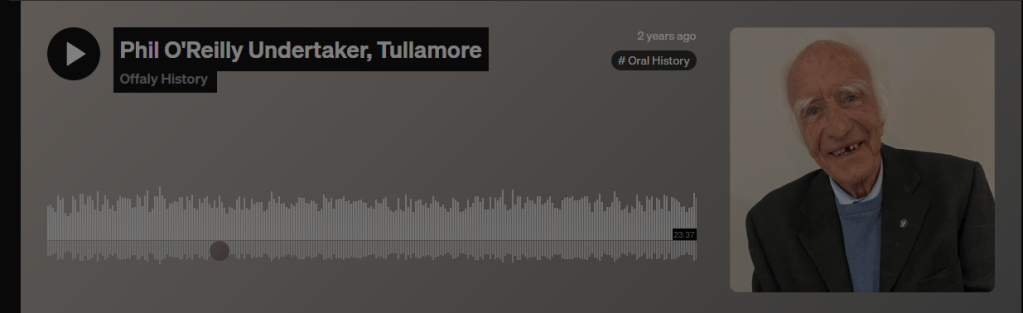
You can listen to the full interview here at Offaly History on SoundCloud. Go to Phil O’Reilly on SoundCloud or to Voices on the http://www.offalyhistory.com website. A lifetime spent in the quiet, noble service of a community leaves an indelible mark on the town that bred it. In the summer of 2024, when Shaun Wrafter, Offaly History sat down with Phil O’Reilly Snr in his beloved Harbour Street, the retired undertaker and former Offaly footballing legend looked back across his ninety years of life in Tullamore. With the news of his passing, Tullamore, County Offaly, and the wider GAA community mourn not just a giant of local history, but a man whose humble dedication, deep faith, and sporting courage touched generations.
From his earliest days kicking a ball along Harbour Street, Tullamore to the roaring, record-breaking crowds of Croke Park, and onward through over five decades of comforting grieving families as one of the town’s funeral directors, Phil O’Reilly Snr lived a life defined by decency, duty, and devotion.
Phil Reilly was born in 1993 and grew up in TullamoreBorn in 1933, Phil was a son of Tullamore and a true product of Harbour Street. His father, Phil, hailed from Tullamore, while his mother, Nora, came from Ballyhaunis, County Mayo. The couple had married in New York, where Phil’s eldest sister, Patsy, was born in 1932 before the family returned to Ireland and settled into the property on Harbour Street.
(more…)
-
An Exciting Start: Fergal MacCabe recalls his first day at the School of Architecture U.C.D. in late October 1957. Blog no. 813 in the Offaly History Blog Series, 27.08.2026
At eight o’clock in the morning, my mother burst into my bedroom waving a telegram.
‘You have got a County Scholarship! You have to go to Dublin straight away!’
It was late October 1957. I had applied for a scholarship from Offaly County Council to study architecture in UCD but when the new term opened at the beginning of the month and I had no word I presumed that my Leaving Cert results simply weren’t good enough and had given up hope. Being an unemployed widow there was no way my mother could have found the money for fees and digs. A scholarship – of which there were only six- was my only hope.
At the last moment a student brighter than I had pulled out and I was next on the list. However, the offer had to be taken up that very day or else would be withdrawn. My mother thrust the telegram and three pounds into my hands and I raced to the station and caught the train to Dublin.
At Kingsbridge I got a taxi to the offices of the National University of Ireland in Merrion Square. My telegram from the Council was carefully scrutinised and to my great relief I was told that I was accepted but would have to be interviewed by the Professor of the School of Architecture who would have the final say. A call was made and I was told to race across to Earlsfort Terrace where Professor Desmond FitzGerald would interview me at one o’clock.
It was plainly obvious from the moment I entered his office that the Professor was unenthusiastic about my joining the course. I had already missed two weeks of projects and lectures and would never catch up, he said. Might it not be better if I used my scholarship to do an Arts degree. Anyway, why did I want to study architecture?
(more…)
-
‘One of the most remarkable days Tullamore has seen for some time’: A Fashionable Marriage in Tullamore 135 years ago – Michael F. Gorry senior and Edith McGlynn. Blog no. 812, 21 Aug. 2026 by Michael Byrne.
Then, as now, fashionable weddings get a lot of press attention. Michael F. Gorry was the great grandfather of Francis (Francie) Gorry whose family had the famous newsagency shop in Harbour Street, Tullamore for over 100 years. Michael F. Gorry was the first person to be buried in the new Catholic cemetery in Clonminch in 1893. The report of a wedding on 31 July 1891 was published in the Midland Tribune on 8 August and no doubt created a stir in Tullamore. The style of the report was that of the kind carried in the Birr Protestant and unionist King’s County Chronicle, a then hated rival of the Midland Tribune, and might have been related to Gorry’s being the agent for the Birr Chronicle in Tullamore. One James Joyce also used this style to describe fashionable bourgeois occasions is his Ulysses (published in 1922).
(more…)
-
Tullamore marks the 40th anniversary of the rebuilding of the Church of Assumption, Tullamore in August 1986. No. 811 in the Offaly History Blog Series, 15.8.2026. By Michael Byrne
One of the saddest events in Tullamore history was the destruction of the 1906 Church of the Assumption by fire in the early hours of 31 October 1983. By morning all that remained was a burnt-out shell and the spire which survived. It is ironic that in the opening of Heritage Week 2026 Tullamore is also marking the 40th anniversary of the opening of the new and third church on the same site at Harbour and Chapel Street, Tullamore. Another example of the Phoenix at work in Tullamore over the past 250 years.
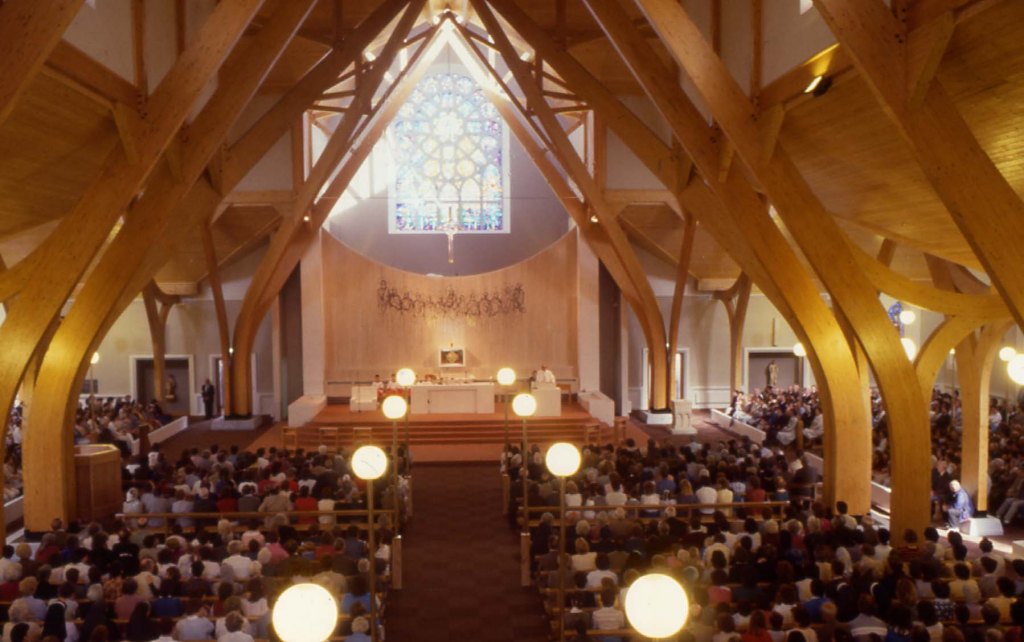
The new Catholic church, Tullamore completed for 15 August 1986. 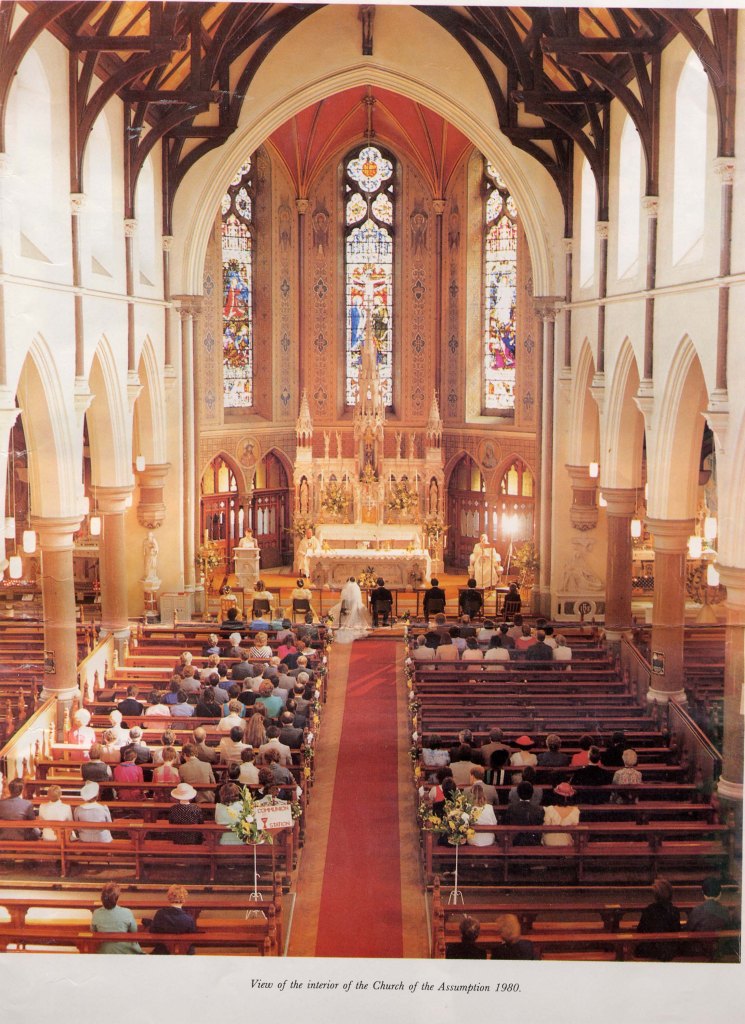
The interior of the 1906-83 church The background to the fire was well documented in several publications and resulted from a break-in and carelessness in not reporting a small fire that had been started by the lighting of a candle near a confessional curtain after the church had been closed and locked at 8.30 p.m. By 2.00 a.m. the building was gutted and gone with it were all the improvements since the late 1960s including the great refurbished organ and the well varnished pitch pine. It was a great tragedy for the parish.
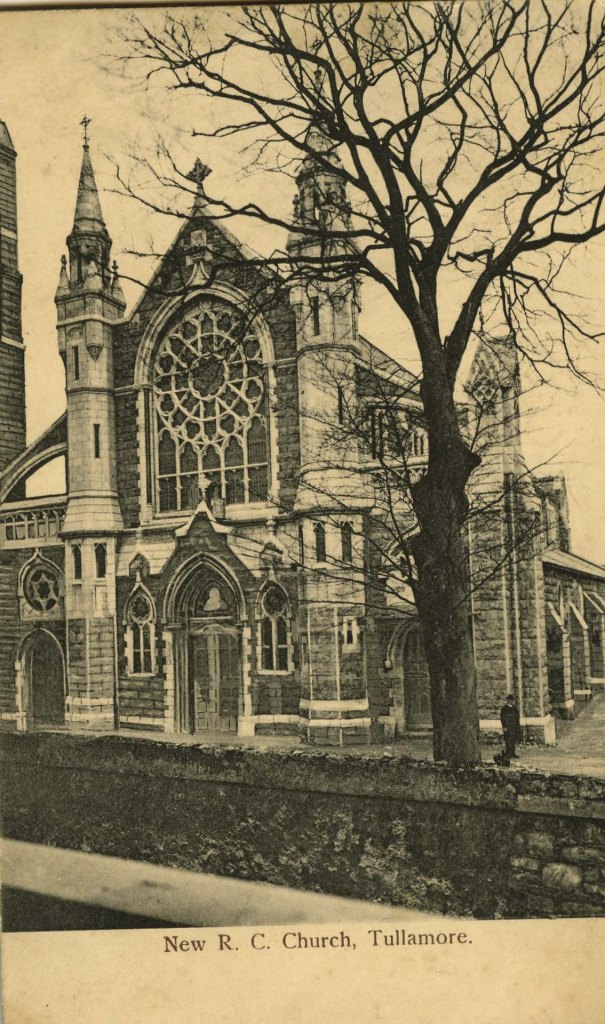
The detail from the west front of the Hague McNamara church of 1906. This picture probably early 1906. 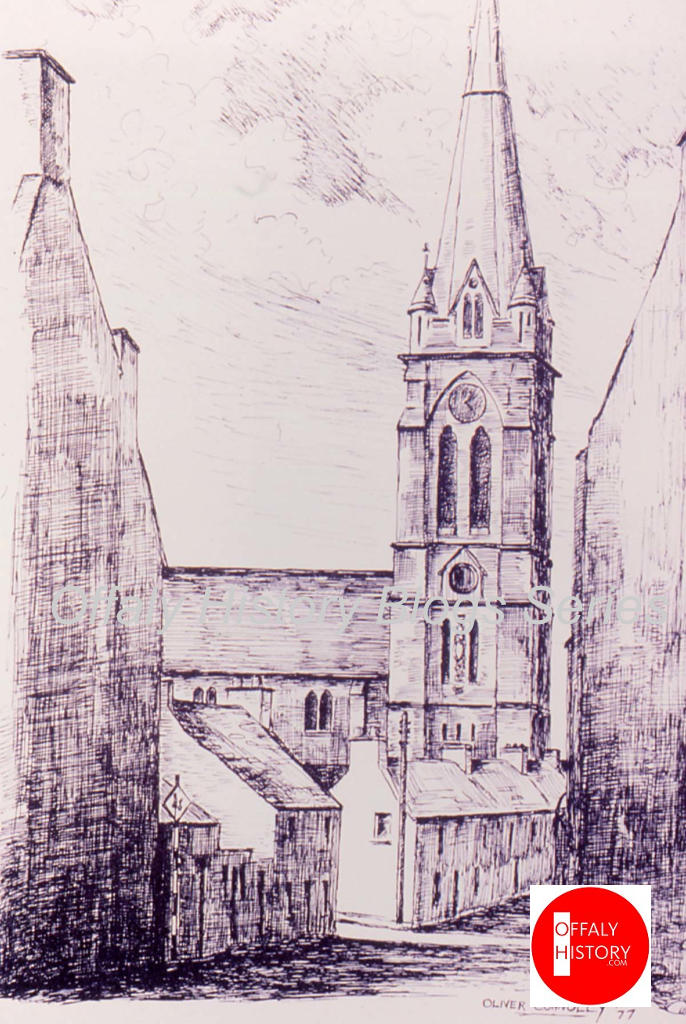
Chapel St and the church in 1977. Courtesy of Oliver Connolly. The building was deemed too unsafe to permit investigation of the causes of the fire, and as a result important and never-to-be replaced architectural features were taken down. Whether the stone could have been salvaged was contested by at least one architectural historian. The question of building a second church in Tullamore, which had been on the agenda in some shape since the mid-1960s, was now solved by a decision to build a new and larger church on the existing site in keeping, in so far as this was possible, with the old church. Edward N. Smith and Partners, architects, were selected by the then parish priest, Fr Fallon, to design the new church (there was no competition).
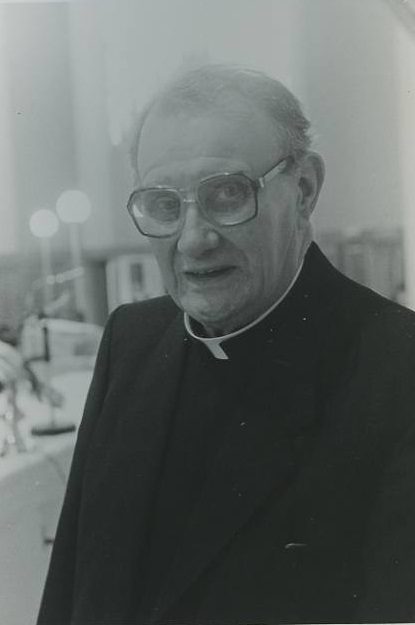
Fr Fallon took charge of the operation to built the new church.The historic first mass in the new church was celebrated on Saturday 9 August at 10.00 am. It was a deeply emotional occasion for the parishioners and clergy. Parishioners bade farewell on the previous Sunday to the temporary mass centres of almost three years standing in the case of Vocational School, St Mary’s Hall and the Tullamore Harriers, and seven years in respect of the G.A.A. centre. Fr Fallon’s first words on the Saturday morning ‘My dear people of Tullamore, Welcome Home’ The architect’s brief was to re-build the church in such a way as to ‘retain or regain as much as possible of the character of the old church but in a modern idiom’. This was next to impossible to achieve. He reused much of the old stonework especially on the Chapel Street side and went for a contemporary interior. What was lost of the Gothic exterior and interior was replaced in the self-finished timber ceilings and laminated structural frames of the interior. Full restoration of the exterior was not possible on expense grounds in the 1980s.
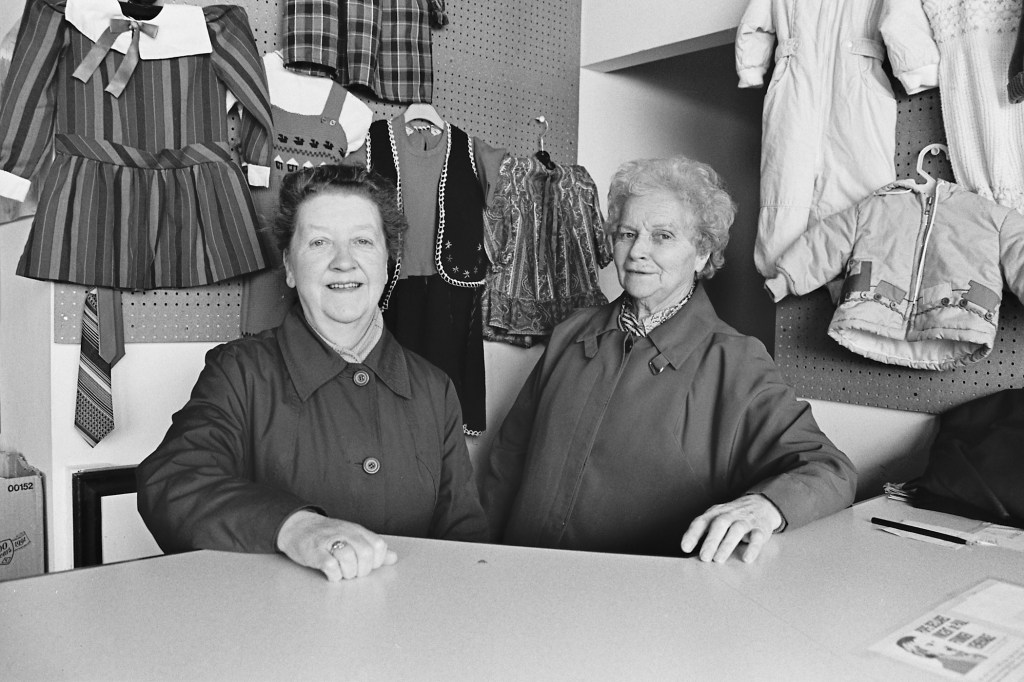
Miss Fallon of Robbins Limited and a friend – all great church people of the 1900s to the 1980s
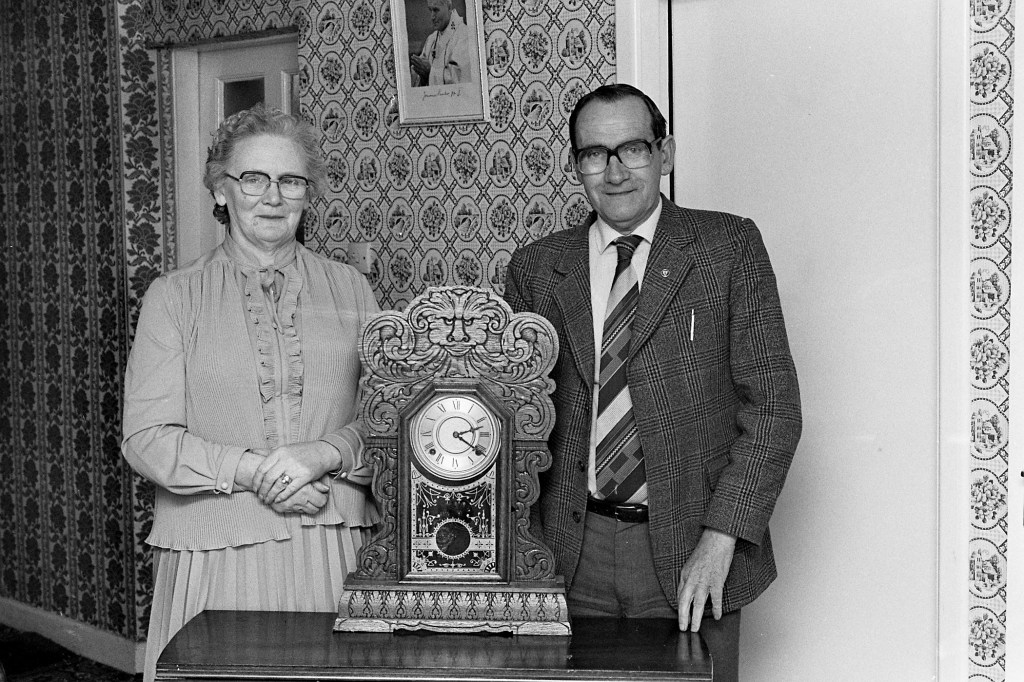
John Dunne (Sacristan) and Mrs Dunne at retirement. He opened the church at 7 30 Mon to Friday and at 6 a.m. on Good Fridays. For many the most attractive feature of the new church was the warm and modern interior with its timber spans. John Flanagan & Sons Limited, the Tullamore-based building firm, was appointed builders and work began in October 1984 and was completed for the opening of the present and third church on the Harbour Street site in August 1986. For almost three years masses were said at the Tullamore GAA Centre, Tullamore Vocational School gym, Scoil Mhuire, Tullamore Harriers Pavilion and St Mary’s Hall. Weddings were generally in Durrow and a few were held in St Catherine’s Church of Ireland church.
William Ralph
Fundraising for the new building had started almost immediately after the fire and a sum of £700,000 was raised through donations, raffles and special events. The chairman of the Finance Committee was William Ralph, who was a corporate director of the Williams Group. The experience of Williams trained directors and managers would benefit not only Tullamore Parish but also Tullamore Credit Union and could be seen in the shrewd management of money. A sum of £2.85m was eventually paid by the state in settlement of the malicious damages claim and part of this amount had, in the meantime, been advanced by the insurer, Church & General. That sum combined with the donations earned for the parish over £600,000 in investment income. Ralph believed in working from cash flow and in trying to maintain capital and use interest to fund projects. It worked because some of the more expensive stonework features were not restored and as result the parish was left with about £1m which was placed in a Trust Fund for the ongoing maintenance of the new church. In the mid-1990s the High Court confirmed that the money could only be used for this specific purpose which accorded with the intention of the donors and could not be called on to fund broader charitable proposals. The Trust Fund has continued to benefit Tullamore parish in that way and is managed by local trustees with the benefit of professional advice.
Donation of an organ by the Lutheran church in Copenhagen
In 1994 a sum of £90,000 was paid from the Trust for the installation of the organ donated by the Lutheran cathedral church in Copenhagen. The organ was built by one of the world’s leading organ building firms, Th. Frobenius of Lyngby (Copenhagen), in 1965 for the great cathedral church of Denmark’s capital city. The organ obviously needed a new case to fit the gallery dimensions of Tullamore’s fine new church. This was designed and built by the Frobenius firm with the work carried out by a team of three Frobenius craftsmen. The net result was that Tullamore now has the largest mechanical action church organ in Ireland, and the sole example in the country of the Frobenius firm’s renowned skill and craftsmanship. The organ was inaugurated in a gala concert on 10 May, 1995. Tullamore’s requirements for an organ at that time and their request to Prof. Gerard Gillen, NUI Maynooth, to assist them in securing an instrument, brought about a remarkable series of coincidences which resulted in the organ’s installation in Tullamore in the latter months of 1994. A Tullamore International Summer Organ Series (TISOS) of concerts was inaugurated in 1999 and has continued since. This series would not be possible without the help of Professor Gillen.
Fr Fallon and his team of curates
While in a sense things worked out well Tullamore lost its Hague-McNamara designed church of 1906 and the strain of the decision-making over three years affected the health of Fr Fallon and he died just three years later, aged 70, in 1989.
During his time in Tullamore Fr Fallon had among his curates some very popular men. He had the benefit of John Charles O’Reilly until his transfer in 1981 and also of Edward Daly who was a curate in Tullamore from 1970 to 1979. Fr Daly was later transferred to Kilcormac as parish priest. Seamus Giles (later PP in Castletown, d. 2013) was a curate in the Tullamore parish from 1965 to 1974 and was popular with young people because of his easy way of connecting with the trends of the late 1960s and 1970s. Another man who had a lot of experience of Tullamore was Joe Gleeson who had been a curate for a short time in 1958 and again from 1966 to 1976. A native of Kilcormac parish he was transferred at about the same time as Fr Fallon was appointed to Tullamore. Fr Colm Savage was in the parish from 1972 to 1983 and worked closely with the Tullamore Vocational School.
Probably best known in the late 1970s and early 1980s was Michael Lynn. He had been in Peru for ten years and had a close affinity with the ordinary person, and the Travellers at the several halting sites. This was helped by his cycling about the town in a leisurely way, something that gave him more immediate contact with parishioners than is possible in a motor car. He was curate in the parish of Tullamore from 1975 to 1986. His commitment to the social dimension of the Church mission found another outlet as a member of the Education Committee of the Tullamore Credit Union. In this he was unusual as unlike in other places in Ireland this important local organisation had no other clerical activist since the days of Fr Fintan Cassidy as a founding director (1963-64). Fr Lynn celebrated twenty-five years as a priest in 1985 and told those present that in the large class from which he was ordained in June 1960 62 were still in the priesthood. ‘The man on the bike’ the Tullamore Tribune called him when he departed Tullamore to serve as PP in Duleek in 1988.
Fr Sean McGearty spent ten years in Tullamore from 1979 to 1989. He was on loan from Adelaide, Australia and during his time in Tullamore made a singular contribution to the development of family history in Ireland through his appreciation of the importance of the Catholic parish registers and the need to index and conserve them. He was the inspiration for the setting up of the Offaly Historical and Archaeological Society family history project which in the 1980s was the host for the country-wide development of the Irish Family History Society and the Irish Family History Foundation. He made a valuable photographic record of the course of building of the new church over the period 1984 to 1986. His colleague, Fr Tom Mullen, came to Tullamore in the same year as Fr McGearty and from late 1983 to 1985 led the fundraising drive for the new church. He was appointed as parish priest of Kilcormac in 1985. Fr Philip O’Connor served in the parish from 1984 to 1988 as did Fr David Hanratty from 1984 to 1985. In the year before Fr Fallon’s death, Fr Dermot Farrell, was appointed to the parish and remained for two years. His forte was in administration and he went on to serve as vice-president and president of Maynooth College and later as parish priest of Trim. He is now Archbishop of Dublin.
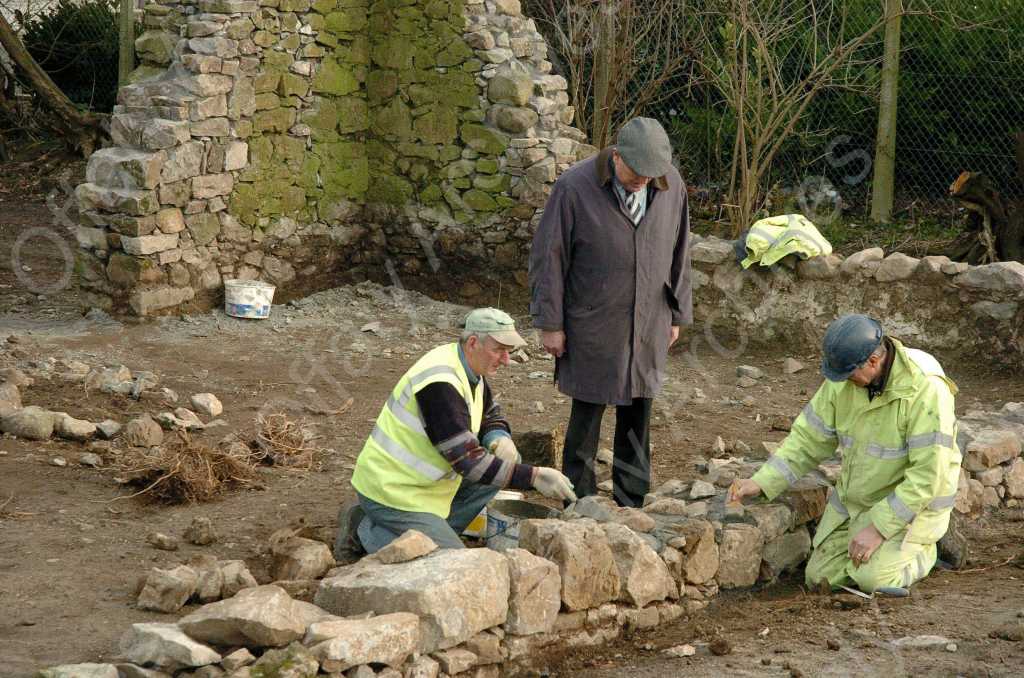
John Flanagan, the builder, looking at work on the old Ballyduff Catholic church of 1775.
-
T. L. Cooke of Birr and the Great Industrial Exhibition in Dublin of 1853. By John Dolan. Blog no. 809, in the Offaly History Series,7.8.2026
The 1850s was the decade of the Great Exhibitions. The London Crystal Palace Exhibition in 1851 was followed by Dublin and New York in 1853 and Paris in 1855. In Ireland there were regional/city exhibitions including in Cork (1852). It must be remembered that Ireland was still struggling to emerge from the disaster of the Great Famine.
The Great Industrial Exhibition of 1853 was the most ambitious exhibition ever held in Ireland up to that time. Staged in Dublin from 12 May to 31 October 1853, it was inspired by the famous Great Exhibition in London and was intended to showcase industry, technology, art, and manufacturing while encouraging economic development in Ireland. One of the developments of partcular interest was to copy the emergnce of Monster Houses (department stores) that began to appear in cities throughout Western Europe and the USA from the 1840s.
The exhibition aimed to move Ireland away from solely agricultural production towards industrialisation, promoting a shift toward Victorian consumer culture.
[Congratulations to Birr Historical Society on the reprint of Cooke’s first book on Birr published in 1826 and launched on 5 August 2026. Ed.]
(more…)
-
Urban Regeneration in Tullamore. By Fergal MacCabe. Blog no. 808 in the Offaly History Series. 31.7.2026
PROJECT 2040
Many may find it hard to believe, but Ireland has a pretty good planning structure and system.
Some years ago we embarked on an exercise of estimating where as a nation- indeed as an island – we should be going. How many people would we need to cater for, where would they live, how would they get around and what about climate change?
The outcome was Project 2040 which set out a broad overall framework and most importantly had a dedicated budget to deliver it. Its national vision is now filtering down through regional planning, to county planning, then to more detailed statutory plans for the cities and finally for the more important towns.
As a ‘Key Town’, Tullamore has a particular role to play and, in anticipation of an additional population projection of 1 million persons in the State by 2040, is presently making its own contribution by upping its housing projections to provide for an additional c. 2,000 houses and identifying an ambitious new employment and enterprise zone with direct access to the national road network.
(more…)
-
The Groome Family of Knockdrin and Garr in the Heart of Uíbh Fhailí. ByPadráig Groome. Blog no. 807, 24 July 2026.
The Groome Family of Knockdrin and Garr in the Heart of Uíbh Fhailí
Introduction
Nestled on the frontier of the ancient kingdom of Uíbh Fhailí, beneath the shadow of Croghan Hill, lies the historic townland of Knockdrin—a place long known as the “Hill of Conflict.” For centuries, this landscape formed part of the heartland of Gaelic Offaly, where kings ruled, battles were fought, and generations of ordinary families worked the land and built their lives.
Like many Irish families, the history of the Groomes was preserved through seanchas, the ancient Irish tradition of storytelling. Long before history was written in books, it was carried in memory. Stories of ancestors, local events, victories, hardships and family life were passed from one generation to the next around the warmth of the turf fire by the seanchaí (traditional storyteller), ensuring that the history of a family and its community would never be forgotten.
(more…)
 offalyhistoryblog