A new study of Offaly’s two Great Houses at Birr and Charleville, Tullamore just published
Two of the great houses of Ireland, are here in County Offaly at Birr and Tullamore. Both regularly feature in articles and magazine stories. Birr Castle much more so as it has been the family home of the Parsons family, earls of Rosse, since the 1620s. The present earl and his wife from the death of the sixth earl in 1979, have worked for almost fifty years to promote the castle and gardens for the benefit for tourism and build on the enthusiasm of the sixth earl to create a science museum commemorating the work of the third and fourth earls and that of Charles Parsons, the engineer who helped win the First World War. Both earls worked tirelessly for the gardens at Birr Castle.
On Thursday 23rd April 2026 the new, changed, developed, market house in Portarlington’s square was formally opened, following over a year’s work on the structure to commence a new chapter in its long history. The new occupier is the Portarlington Community Development Association, and the building has become available, for gatherings, conferences, presentations. There is no doubt this is a construction for specific purposes.
And the building has two names: market house, though there is no longer a market; and tholsel, a name given to municipal buildings in Ireland where tolls and dues were collected. Tholsels had an authority in a town, and usually hosted corporation bodies. Notable examples of tholsels in Ireland may be found at Carlingford, Clonmel, Kilkenny and Youghal. In other locations tholsels have been changed into other uses, or gone to demolition, such as that in Mountrath.
My very first memory is of waving goodbye to a man who was on his way to the scaffold.
I was just three and was frightened by the noise and smoke of the steam train and the hubbub created by a large crowd but was totally unaware of the reason for it all.
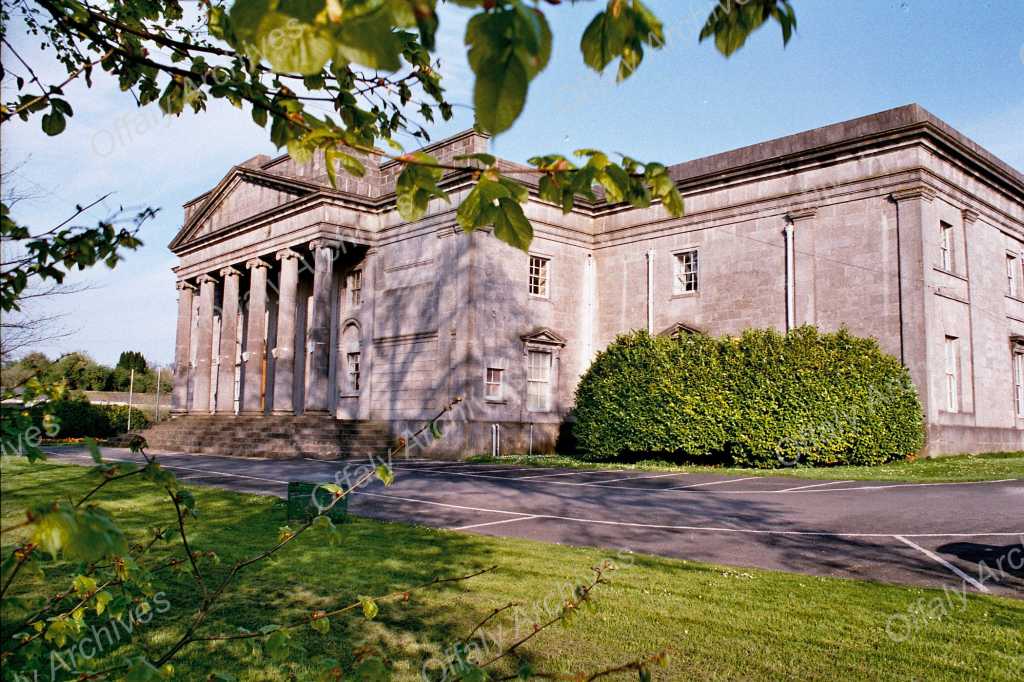
The Tullamore courthouse
Barney Kirwan
I was with my mother and her friend Tessie Leonard who had brought me along with them –together with half Tullamore – to wave goodbye to Rahan man Barney Kirwan who was being brought to trial in Dublin accused of having chopped up his brother, following a dispute over property and then burying the pieces in a nearby bog. Barney was now being transferred from Tullamore railway station to Mountjoy Gaol to await a high-profile trial whose guilty verdict he would challenge.
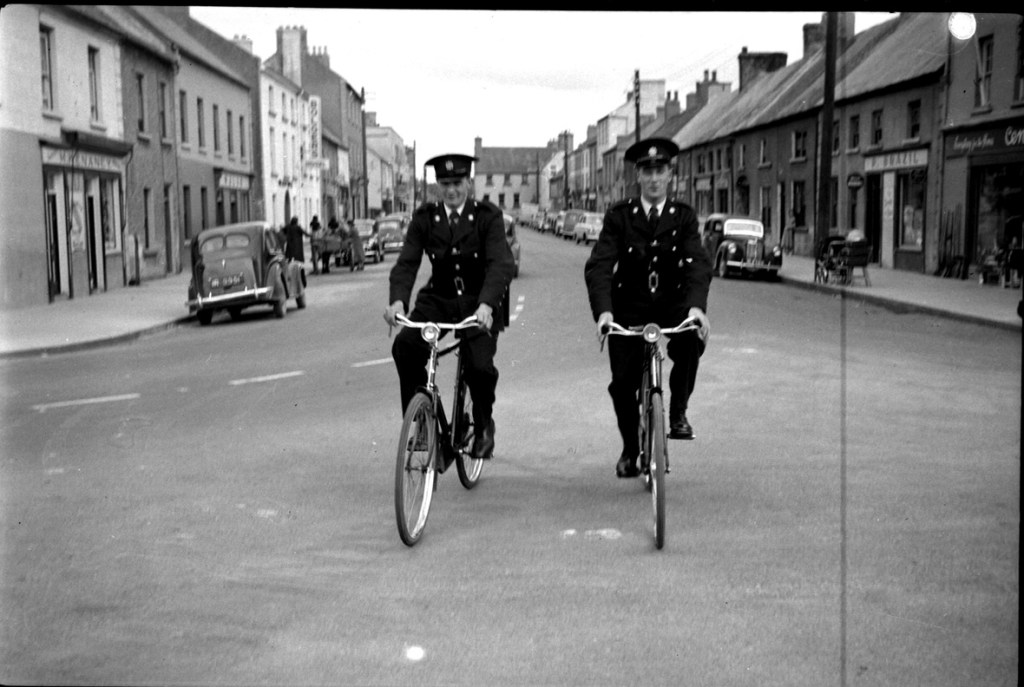
On the bikes in Kirwan’s time at Patrick St, Tullamore.
Following an unsuccessful appeal to the High Court he was hanged on 2 June 1943. Brendan Behan who was in Mountjoy on Republican charges at the same time would make the event famous with his play ‘The Quare Fellow’ in which Kirwan is the unseen but central character.
The last hanging in Ireland was in 1954 and the brutal practice was terminated in 1990.
A Threat to Tullamore
I was born three days after the outbreak of the Second World War and was therefore quite oblivious of its progress and significance. This was to dramatically change on the 23rd January 1944 when a massive American B‑17 Flying Fortress which had taken off from Goose Bay, Newfoundland, bound for RAF Prestwick in Scotland, developed engine trouble over Northern Ireland
Its crew of ten parachuted to safety over Enniskillen. Before leaving the aircraft, they had set the now unmanned bomber on a course back toward the coast, hoping it would continue flying until it ran out of fuel and would crash harmlessly into the sea.
However, the prevailing winds shifted the aircraft off its intended path, carrying it further inland rather than out toward the coast. The unmanned bomber (luckily without a lethal load) remained aloft, flying on without its crew, but began gradually to lose height as it flew over the Irish Midlands. Its flight path brought it over Edgworthstown, west of Mullingar, over Kilbeggan and heading straight for Tullamore.
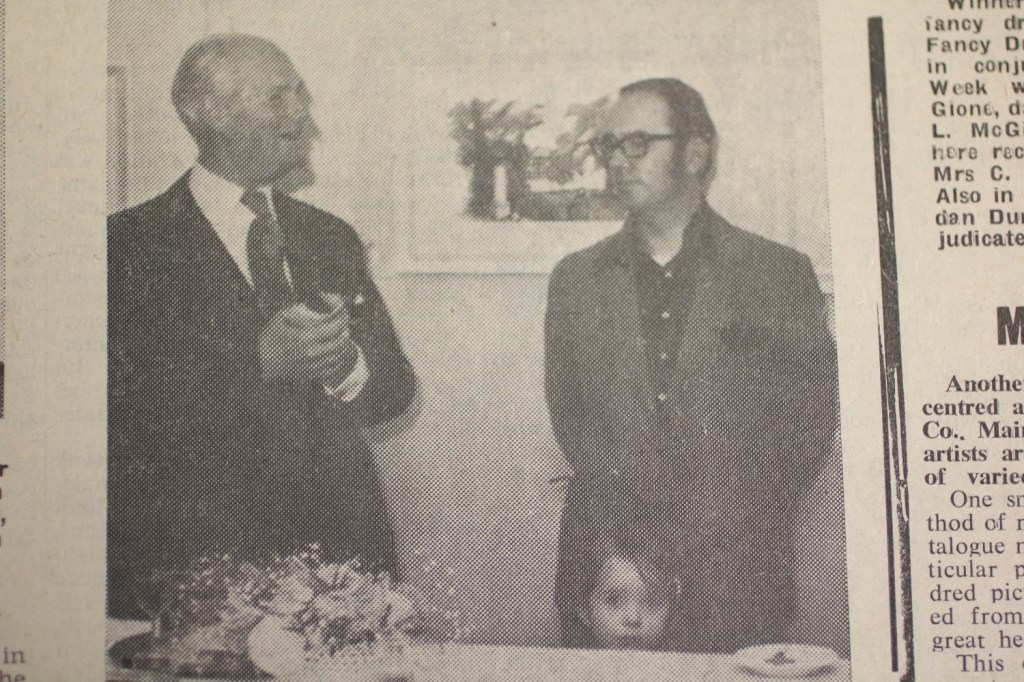
Fergal MacCabe (right) at one of his art exhibitions in 1972 and attentive to the comments of the sixth earl of Rosse.
This created an emergency which was transmitted by alarm calls over Radio Eireann. The prospect of its crashing near, or even on, Tullamore caused great excitement. I remember standing in our yard and seeing it drifting slowly and silently over the town at a low level. It disappeared over Ballard bog. We waved it on its journey and hoped Portlaoise would not be its final destination. Eventually it crashed harmlessly in fields half a mile from the village of Johnstown in Co. Kilkenny.
In 1947 I asked my brother Tommy how the war was getting on. So far as I knew there had always been a war. I was quite surprised when he told me it had concluded two years previously.
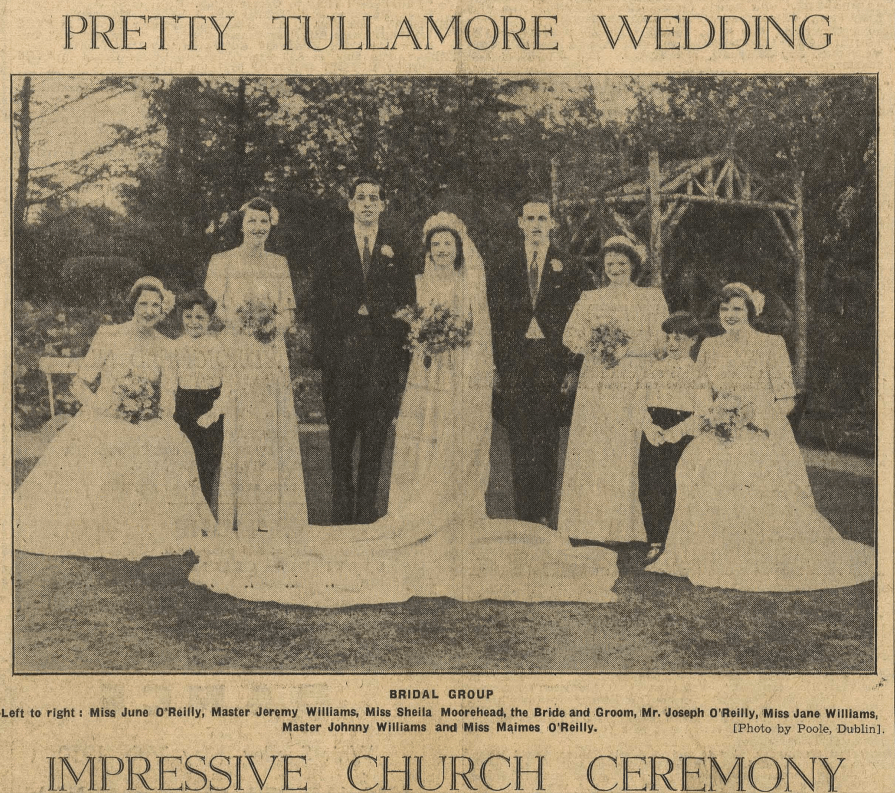
A Big White Wedding – Williams and O’Reilly
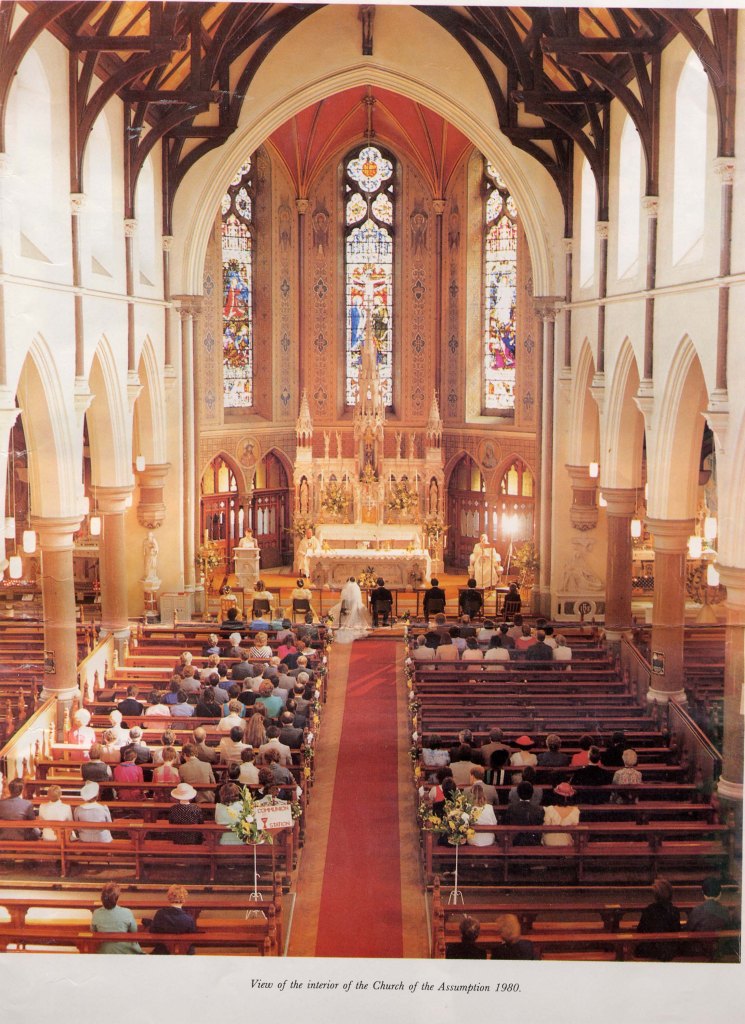
The old Tullamore RC church of 1906-83
Tullamore Dew and Powers
But the event which made the greatest impact on me was the wedding in 1950 of our next door neighbour Teresa Williams to Frank O’Reilly (1922–2013) of Powers Distillery.
The excitement, glamour, fashion, music, food and general gaiety which it generated stimulated my young imagination and had a beneficial effect on the town of Tullamore which in those dreary days desperately needed a diverting public spectacle.
Though wealthy, the Williams family lived very modestly, their only public luxury being a beautiful dark blue Chrysler limousine.
The engagement of their eldest daughter to the handsome Frank O’Reilly who had returned from service in the British army during the Second World War to take over his family business of Powers Distillery, was not just a love match (they went on to produce ten children) but the linking of two great Irish distilling families. No expense would be spared therefore to mark the great occasion and a three-day gala was planned. For Tullamore it would be a huge event and everyone was excited by the glamour of it all.
The Williams O’Reilly wedding with a young Jeremy Williams on the left (see an earlier blog).
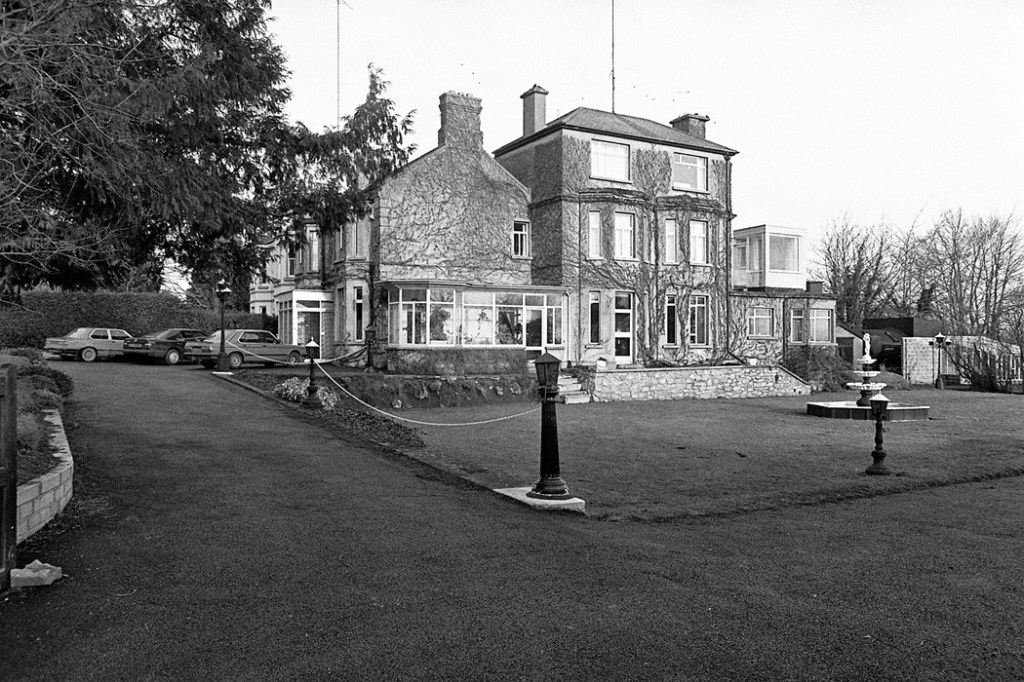
I lived with my mother and brother in my grandparents house ‘Innisfree’ (now Loughmore Lodge) which was semi-detached with the Williams residence ‘Auburn’ owned by Captain Jack. The property had been much extended and additional land acquired to provide a magnificent south facing lawn and tennis court.
Scene of the wedding breakfast. Auburn then the home of John and Mrs Williams (nee Moorhead).
In the run up to the great day tents began to be erected in the grounds to accommodate three days of festivities. On the first evening there was a spectacular fireworks display-the first I had ever seen.
The following day all of Tullamore went to the Church of the Assumption and crowded outside to greet the bride and her six bridesmaids and to witness the first white wedding in Tullamore since 1939.
The imposing west door of the church (now sadly blocked up) made a magnificent backdrop for the emerging bride and groom and I remember confetti being thrown and the bridal bouquet tossed in the air to be grabbed by a scrum of enthusiastic young women.
The bridal party then proceeded to Clonminch where a reception and dinner were provided by caterers brought from Dublin for the occasion. All us neighbouring children gathered on the flat roof of our shed which overlooked the kitchen where the feast was prepared and from time to time we were fed titbits. I savoured the unfamiliar tastes of lobster, pate and rhum baba.
The dancing under the fairy lights continued all night and in my bedroom I could hear it until I went to sleep. It was magical.
On the third day a party was thrown for the staff and employees of the two distilleries whose owners were now united in marriage and the gaiety continued well into that night too.
Then the tents were folded, the caterers cleaned up and departed and Tullamore got back to normal. But the wedding had brought a welcome interlude of glamour at the beginning of a decade that would be marked by further economic decay and emigration.
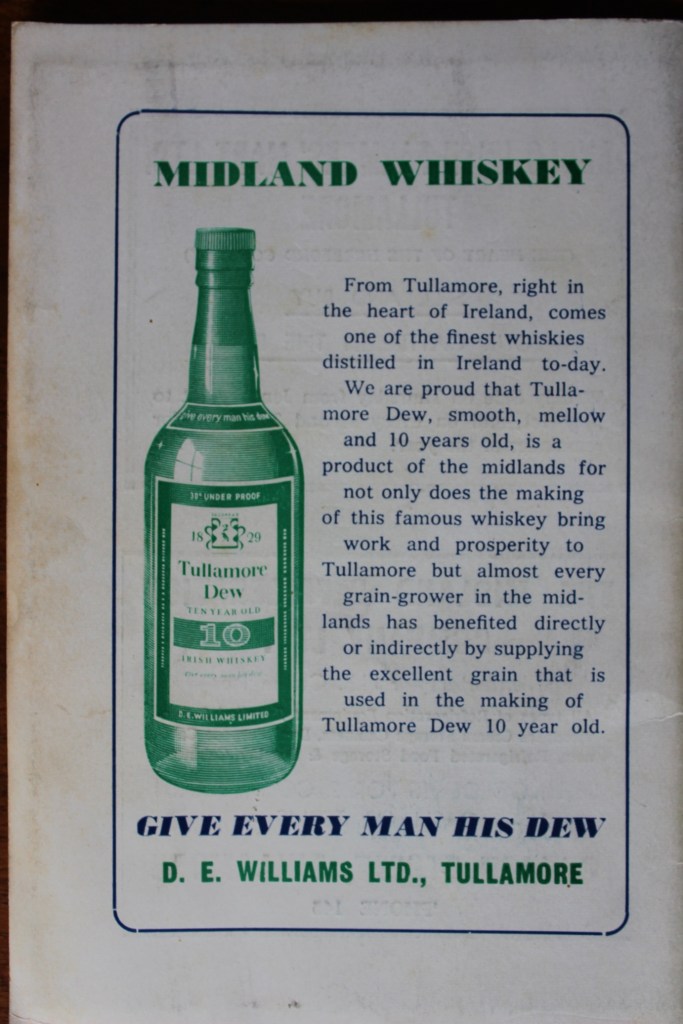
The Tullamore Dew whiskey of the late 1950s – ten years old and a child for every year in the Williams O’Reilly household.The brand was sold in 1965 and yes the sum was £10,000. For an excellent Life of Frank O’Reilly see the online Dictionary of Irish Biography, written by Tullamore man Terry Clavin [Ed].
Thanks to Fergal MacC for these memories and more to come we hope.
In the lead up to the feast day of Saint Colm Cille on 9 June we are glad to have this article thanks to Rachel Moss, Professor in the History of Art and Architecture, Trinity College, Dublin and author of The Book of Durrow, London, Thames and Hudson (2018), Blog Editor.
The long and eventful life of the Book of Durrow. By Rachel Moss. Blog no. 799, http://www.offalyhistoryblog. The Book of Durrow, a 1,300-year-old manuscript of the four gospels associated with the ancient monastic site at Durrow Co. Offaly, is special for many reasons. It is the earliest surviving complete gospel book in northwest Europe; it contains exquisite full-pages of ornament that demonstrate knowledge of current art styles in Ireland, Britain, Roman Europe and Coptic Egypt; it is one of the earliest examples of perfectly executed ‘Insular’ script that was to become the hallmark of Irish art for the following centuries and it is thought to be the work of a single scribe. Most significant of all, is the fact that it has survived, in near perfect condition, for such a long time
A Prima Donna in King’s County/ Offaly, Dame Nellie Melba 1861-1931. By Aidan Doyle.
Melbourne, February 26 1931-
The usually busy streets of Melbourne were hushed today when Britain’s “Queen of Song” Dame Nellie Melba, was taken in a simple farm cart on her last journey to her beloved village of Lilydale, 20 miles from Melbourne not far from her own beautiful home, to be buried by the side of her father. Australia’s last respects were paid by thousands of people who reverently lined the route of the funeral cortege from the Presbyterian Church to the cemetery, and the world’s tributes were represented by a mountain of wreaths from mourners in every corner of the globe. Throughout the early part of the morning crowds filed past the coffin in the Presbyterian Church in which the famous singer lay in state, and in which as a girl she used to sing in the choir. When the memorial service began every pew was packed. The Federal and State Governments and the worlds of music and art were fully represented. Dr. Borland, State Moderator, conducted the service which was fully choral. “Our sorrow and sympathy” he said in a striking tribute to Melba” are shared by millions in every land who feel grateful that God raised up in our nation for the benefit of the whole world the gifted singer they mourn. 1
23 May 2026 Saturday, Tour of Shannonbridge depart at 10 a.m. from Offaly History Centre (let us know if you can share or need a lift). To meet at Shannonbridge at the Old Fort across the Bridge at 11 a.m. Our guide is Declan Ryan. Starting with coffee, followed by tours of the forts, the river and the town. To conclude about 1.30 p.m. with lunch at Killeen’s (you need to book this yourself). This is an excellent venue so why not make it a day out and bring the family and friends. Declan will be an excellent guide Note Sturdy Footwear required for uneven ground and long wet grass. And on Friday evening in Banagher….
TALK ON ARMSTRONG FAMILY HISTORY 22 May 5 p.mby Eduardo M. Garcia Fernandez Saenz from Buenos Aires
Local history enthusiasts are in for a real treat next week when Eduardo M. Garcia Fernandez Saenz from Buenos Aires will give an important talk on his Armstrong ancestors, in particular Thomas St. George Armstrong who was born in Garrycastle, Banagher, in 1797. At the early age of twenty Thomas went to Argentina and between then and his death in 1875 he became a very successful businessman, married into aristocratic society and also became an adviser to the rulers of Argentina. The talk will be held in Crank House, Lower Main Street, Banagher at 5 p.m. on Friday 22nd May. The event is organised by Offaly History and all are welcome. Enquiries to James Scully at 085 710 7569.
This article is the sixth in a series on the stonecutters of Tullamore, particularly those associated with the limestone quarries of Ballyduff on the outskirts of the town.
When I began researching the quarries and the men who worked there, I thought I might find enough material for one or two articles. Instead, a much wider story has come to light—one shaped not only by local industry, but also by migration and opportunity.
One of the most striking features of that story is the number of stonecutters who, having learned their trade in Tullamore, chose to emigrate. This was not unusual in nineteenth-century Ireland, but what is interesting in this case is that many of these men were not driven by poverty. They had skills and could make a living at home. Even so, many chose to leave, drawn by the hope of a better future for themselves and their families.
Unlike most Irish emigrants of the time, most of the Tullamore stonecutters went to Australia, where they helped to build a growing society. Among them were members of the Jageurs family, whose story gives a good insight into this wider pattern.
I grew up on a small farm beside Lemanaghan Bog, and to this day I can still feel the rhythm of those summers spent wandering up and down the lane that led from our 150 year old farm house to the bog. It wasn’t just a lane, it was an enchanted corridor. The hedges were alive with native flora and fauna, and as children we were convinced there was something mystical about that stretch of road. Maybe it was the way the light filtered through the trees and hedges or the rustle of wings from creatures we could never quite see. Whatever it was, it shaped our imaginations long before we understood the world beyond it.
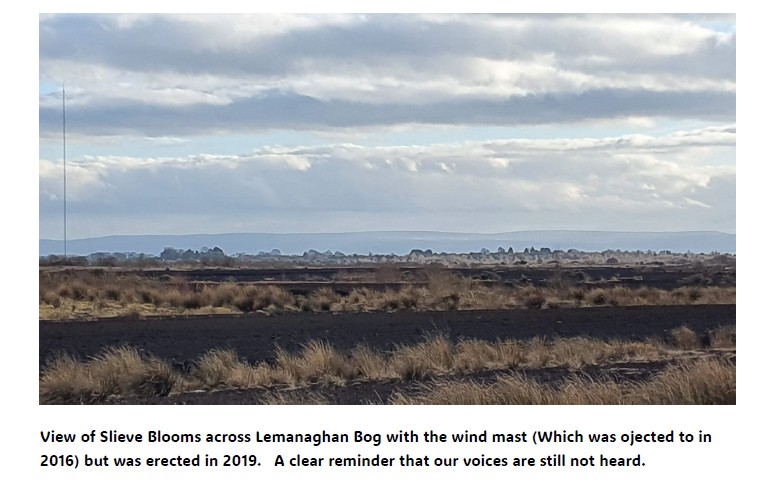
From the top of the lane, the view swept across the bog all the way to the Kinnitty Mountains which is what we called them then, though of course they are the Slieve Blooms. Their colour changed with the weather: soft blues on warm days, deep purples in the evenings, and that unmistakable dark, heavy shade that meant rain was on the way. Some days they felt close enough to touch, other days they drifted away like a dream. That shifting landscape was the backdrop of our childhood.
I was lucky, truly lucky, to grow up with my grandparents. Not everyone gets that gift. They filled our days with stories, traditions, and the kind of work that didn’t feel like work until you were old enough to realise it was. As a small children on the bog, we were more of a hindrance than a help, too busy chasing frogs, spotting bog lizards, or watching butterflies and dragonflies dance over the bog waters. If you had to go in evening, you would get ate alive by midges and it would cause great distress but of course knowing that they are a vital food source in a healthy ecosystem, was good reason enough to put up. It was magical, and we didn’t know it then, but those were the moments that would stay with us for life.
Of course, when you got older, the magic didn’t excuse you from the reality of saving turf. As the saying went, “If you want to keep your arse warm for the winter, you need to help save the turf.” At the time, I thought it was hardship. Other families didn’t have to go to the bog, and I envied them. But looking back now, I see it differently. Those balmy summer days, the laughter, the bottles of water buried in a bog hole to keep cool, the quiet companionship, they were some of the happiest times of my life.
A Landscape Layered with Time
What makes Lemanaghan truly extraordinary is not just its beauty or its wildlife, but the sheer depth of history held within its soil. This landscape is a tapestry woven from thousands of years of human presence — Mesolithic hunter‑gatherers, Neolithic farmers, early Christian monks, medieval pilgrims, and the families who still live here today. All of these eras sit side by side, layered gently through the bog, preserved in a way that few places in Ireland can match.
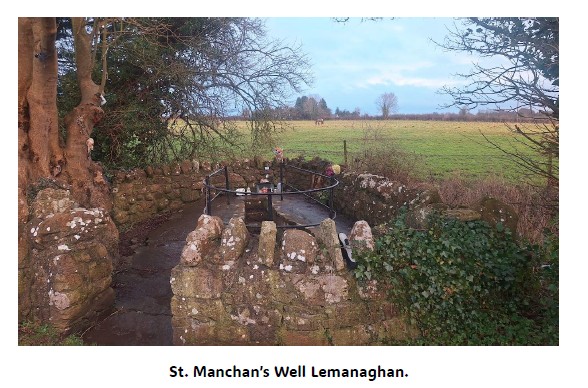
Across the bog, the old toghers still lie beneath the surface — wooden trackways built by our ancestors to cross the wetlands long before roads existed. Some date back to prehistory, others to the early Christian period. In recent years they’ve been called pilgrim paths or mass paths, but whatever name they carry, they are proof of continuous life, movement, and devotion across this landscape. These paths connect us to places of deep significance like Clonmacnoise and the Hill of Tara and are the only remaining paths from our past that we have. They need to be protected. Generations walked these routes with purpose: to travel, to worship, to trade, to survive. When you stand on the bog today, you are standing on the same ground they crossed.
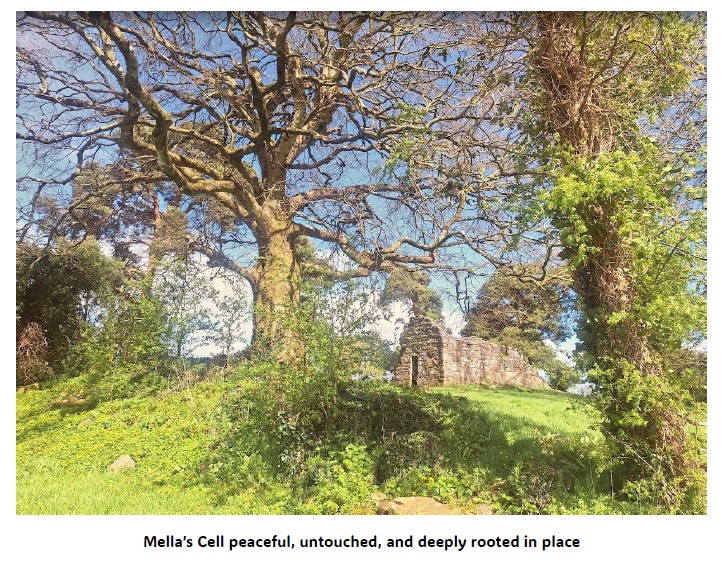
One discovery in particular brought this ancient world sharply into focus. In 1998, part of a bog body was uncovered in the townland of Tumbeagh. It was a remarkable archaeological find — a direct connection to a person who lived and died here centuries or even millennia ago. Maybe a native to the are or a pilgrim who lost their way. But the circumstances of the discovery were a stark reminder of the cost of industrial peat extraction. The body was found during the milling of peat, and some of the remains had already been sent to a power station and burned as fuel before anyone realised what they were. It was heartbreaking, and it showed clearly that these peatlands are not wastelands or empty spaces waiting to be exploited. They are sacred ground, holding the stories and the bones of our ancestors, much like the recent discovery back in January 2025 at Mella’s Cell when storm Éowyn swept through the land and with it, it brought down trees in Mellas Cell. Yet another discovery was made. Human remains from over a thousand years ago were uncovered. This was the first time it was realised that this was in fact a sacred burial grounds. These ancient trees had managed to fall but avoided falling on the remaining structure of Mella’s Cell as luck would truly have it.
The Changing Bog
When Bord na Móna took over the bogs, the land began to shift in ways we didn’t fully understand at the time. Drains were cut long before harvesting began. My granddad was deeply uneasy about it. He knew — instinctively, from a lifetime on the land, that this kind of change wasn’t good for the landscape. But compulsory purchase orders came, and people had no choice. You accepted it and got on with it, because that’s what rural people did.
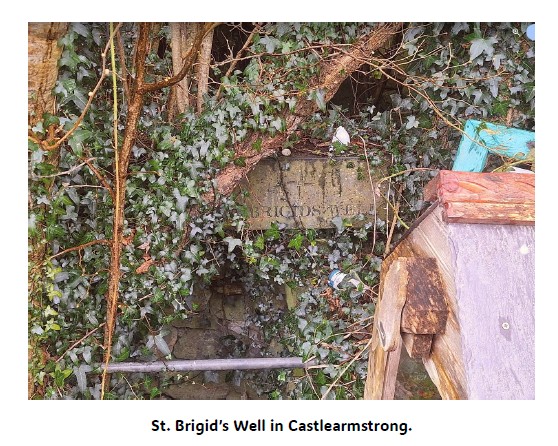
Over the years, natural springs and wells that had flowed for generations dried up. Water tables dropped. Getting water to cattle became a more difficult task. The land we knew began to alter under our feet. And yet, for many families, Bord na Móna meant jobs, stability, a way to support children. It was a trade-off that people felt they had to endure it seems.
But there were other consequences too. Fires on the bog were not unusual, especially during long hot spells. Many of them were never acknowledged by Bord na Móna, even when the community knew exactly how they had started. The most recent major fire in the late 2010s is still fresh in people’s minds. We were not long moved into our new house when it happened. Homes were filled with smoke, belongings destroyed, and yet when people reached out for help, nothing was done. That memory lingers — not just the damage, but the feeling of being dismissed.
A Community Under Threat Again
And now, here we are again.
The community around Lemanaghan Bog is facing another upheaval, this time in the form of a proposed wind farm: fifteen turbines, each 220 metres tall, right through the heart of the bog. People are angry, upset, and deeply worried. The consultation process felt deceitful from the start. A semi‑state body has enormous power, and they know it. They can pressure, divide, and buy silence. What was once a company rooted in community has become something unrecognisable, one determined in causing division and willing to fracture the very places and people it once relied on. These places have helped people heal in the greatest time of need and I can vouch for that personally. In times of grief, all one needs sometimes is solace and time to reflect and remember in peace. Lemanaghan Bog gives us all of that reminding us each of our life times are short and that we are connected through generations that went before us and their presence is still there it just appears in a different form. In that there is comfort.
For many of us, especially during COVID, the bog was our sanctuary. It was the one place we could walk freely, breathe deeply, and feel grounded. It is still the most peaceful place you could wander. But if the machinery comes — the diggers, the cranes, the convoys of lorries — that peace will be shattered. The wildlife that has survived generations of change will be displaced. The delicate ecology of the bog will be torn apart. And all the “surveys” carried out over a few rushed days here and there will never capture the depth of local knowledge that has been passed down through families like in our communities.
Our fear is simple: that once again, the people who live here — who love this place, who understand it — will be ignored. And if the project becomes inconvenient, BnM will simply sell it on, as they have done in other areas, leaving the community to deal with the consequences. There are some things that money simply can not buy and connection is one.
Growing up beside Lemanaghan Bog taught me the value of land, heritage, and memory. It taught me that these landscapes hold stories, and that communities are shaped by the places they belong to. What worries me now is that those stories — our stories rich in heritage— are at risk of being drowned out by decisions made far away by people who will never walk that enchanted lane or watch the Slieve Blooms change colour with the weather.
All we want is to protect the place that shaped us. You don’t need to be deeply religious or even believe in anything in particular, but when you have a deep connection with the land that you live upon, you just know that an area is not suitable for what is being forced upon it. I believe that our ancestors will rise to help us whether it is to show people that they need to lay off and choose more suitable places to build their energy plants. This is not suitable or natural place for industrial wind farms. We need to protect our peatlands.
Down in the Jetty. In your early childhood? Yeah.What form of lighting was used down there?
Hurricane lamps. All the time. All the time
There was always a few hurricane lamps here and you’d light up and walk down with this hurricane lamp hanging out of you and, you know,
And that was in the office and in the store.
Oh, yeah. No other light only paraffin oil, hurricane lamps. During the time that the boats were traveling night and day, they always had a red light up in the stern of the boat.
That’s up on the front of the boat?
Yes. Just as one board could see another.
And what? These lamps.What fueled the lamps?
Just an ordinary pony and trap lamp, you see, with a candle in it. And that’s all just red surround. Well, that was before the all night traffic stopped. There was a big strike, and there were several boats tied up here.
The Goodbody family is widely associated with the prosperous Quaker industrial dynasty that emerged in Clara and Tullamore during the nineteenth century. However, this article focuses on a lesser-known and far less successful branch of the family: the descendants of Thomas Goodbody (1783–1848), brother of the prominent miller Robert Goodbody (1781–1860). While Robert’s line flourished, Thomas’s life and that of his children was marked by repeated financial failure, instability, and eventual decline, culminating in the disappearance of the Goodbody name from Birr by the early twentieth century.